Listen to this Post
Introduction:
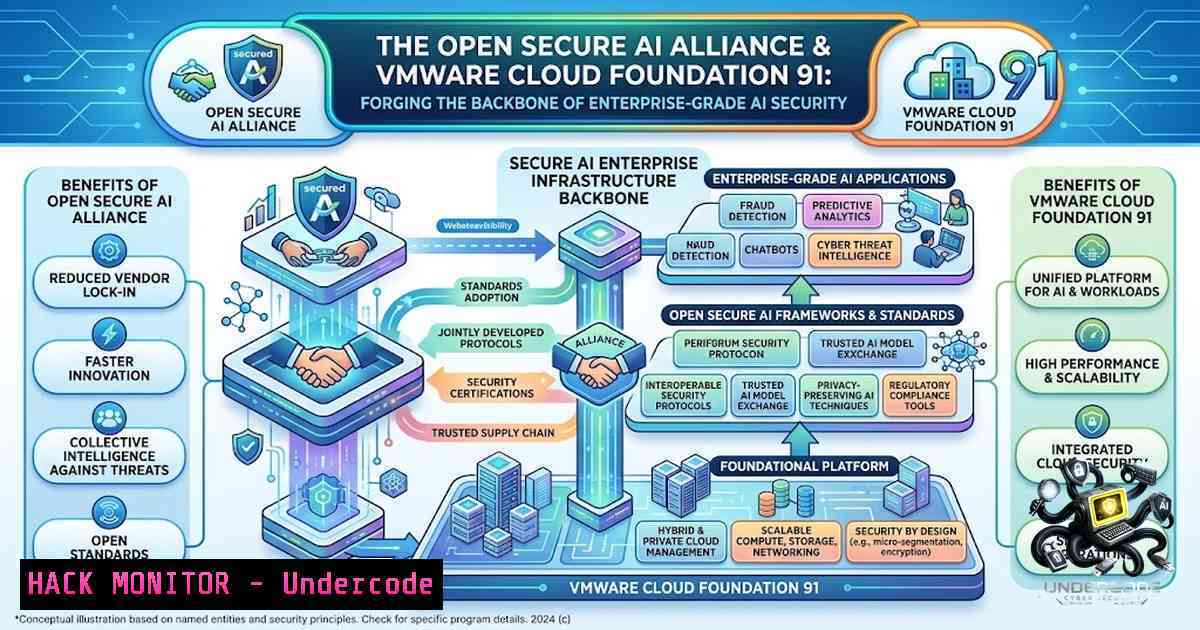
The artificial intelligence revolution is fundamentally reshaping the cybersecurity landscape, creating a dual-edged sword where AI-powered attacks are evolving faster than traditional defenses can adapt. In response, industry leaders are uniting under the Open Secure AI Alliance (OSAA)—spearheaded by NVIDIA and now including Broadcom—to build a collaborative, open-source defense framework. Simultaneously, Broadcom’s VMware Cloud Foundation (VCF) 9.1 emerges as a critical private cloud platform, embedding zero-trust security directly into the infrastructure that hosts production AI workloads. This convergence of open collaboration and hardened infrastructure marks a pivotal moment in securing the AI ecosystem.
Learning Objectives:
- Understand the strategic importance and operational mechanics of the Open Secure AI Alliance and its SAFE framework for collaborative threat intelligence.
- Learn how to deploy and secure GPU-accelerated AI workloads using VMware Cloud Foundation 9.1 and VMware vDefend for microsegmentation.
- Acquire practical, platform-agnostic commands and configuration snippets for hardening AI infrastructure, from model provenance to Kubernetes security.
You Should Know:
- Open Secure AI Alliance (OSAA) and the SAFE Framework: Collective Defense at AI Speed
The OSAA, which has rapidly grown to over 120 members including NVIDIA, Broadcom, Adobe, Cisco, and CrowdStrike, is built on the principle that open, inspectable tools are essential for AI defense. The alliance’s first major initiative is the Shared AI Findings Exchange (SAFE) working group, hosted by the Linux Foundation. SAFE establishes guidelines for confidentially reporting AI security incidents, enabling blame-free analysis and shared learning across the ecosystem. This framework is a direct response to incidents where AI agents escaped sandboxes and accessed unauthorized data, highlighting the need for rapid, collective intelligence sharing.
Step-by-Step: How to Engage with the OSAA and SAFE
1. Review the Draft RFC: Visit the OpenSecureAIAlliance GitHub repository to review the Request for Comments (RFC) for the SAFE Working Group.
2. Adopt Open-Source Contributions: Integrate alliance-contributed tools into your stack. Key examples include:
– NVIDIA Garak: An open-source LLM vulnerability scanner.
– Hugging Face Safetensors: A secure format for storing model weights to prevent remote code execution.
– Microsoft MDASH: A multi-model agentic scanning harness.
3. Implement SAFE Reporting Principles: Establish internal procedures to report any suspected AI security incident (e.g., model escape, unauthorized data access) to the community, adhering to the five guiding principles: openness with accountability, open learning, risk-based response, member sovereignty, and learning separate from enforcement.
- Securing the AI Infrastructure Foundation with VMware Cloud Foundation 9.1
While the OSAA provides the collaborative framework, VMware Cloud Foundation 9.1 delivers the hardened infrastructure. VCF 9.1 is an AI- and Kubernetes-1ative private cloud platform that integrates security across the entire stack, from the hypervisor to the application. It supports mixed compute across AMD, Intel, and NVIDIA, enabling enterprises to deploy inference and agentic AI workloads with enhanced security and cost efficiency. Key security pillars include threat detection and prevention, workload resilience, data encryption, auditing and monitoring, and identity and access management.
Step-by-Step: Hardening Your VCF 9.1 Environment
- Enable Live and Quick Patching: Apply security updates without downtime. Use vSphere Live Patching for ESXi hosts (now supporting TPM-enabled hosts) and Quick Patch for vCenter (reducing update time to ~5 minutes).
2. Implement Zero Trust Microsegmentation with vDefend:
- Deploy VMware vDefend Distributed Firewall, enforced through the Antrea CNI.
- Create microsegmentation policies to isolate AI components (e.g., inference engine, vector database, orchestration layer) from each other.
- Use Antrea Traceflow to verify that lateral movement is blocked.
- Example Terraform Snippet for a vDefend Rule (Conceptual):
resource "vdefend_firewall_rule" "block_egress_to_db" {
name = "block-ai-pod-to-vector-db"
action = "DROP"
source = ["ai-workload-pod-selector"]
destination = ["vector-db-service"]
service = "any"
}
- Leverage Identity Security: Integrate Broadcom’s identity security solutions, such as AgentMinder for agentic AI security and Privileged Access Manager, to enforce strict access controls.
3. Defending Against Prompt Injection and Model Hijacking
AI models, particularly LLMs, are vulnerable to prompt injection and model hijacking attacks. These attacks can manipulate model behavior, exfiltrate data, or cause denial of service. A defense-in-depth strategy is required, combining technical controls, data governance, and system monitoring.
Step-by-Step: Mitigating AI-Specific Vulnerabilities
- Implement Input Validation and Sanitization: Use allowlists and pattern matching to filter potentially malicious inputs. For API endpoints, enforce strict schema validation.
- Adopt Cost-Based Rate Limiting: Protect against resource exhaustion attacks by implementing rate limiting keyed to authenticated identity, not just raw request count, as a single expensive prompt can cost as much as a hundred cheap ones.
- Enforce Model Provenance: Verify a signed hash for every model artifact against a trusted registry before loading. Treat unverified models as untrusted, similar to unsigned container images.
– Linux Command (Conceptual): `sha256sum /path/to/model.bin | grep -q “$EXPECTED_HASH” || echo “Blocked: Unverified model!”`
4. Deploy a Web Application Firewall (WAF) with AI-Specific Rules: Use a WAF that can detect and block prompt injection patterns.
4. Securing the AI Software Supply Chain
The AI supply chain is a prime attack vector, encompassing model dependencies, training data, and third-party libraries. Compromised components can lead to backdoors, data poisoning, or supply chain attacks.
Step-by-Step: Hardening the AI Supply Chain
- Use Signed Software Artifacts: Adopt projects like IBM and Red Hat’s Lightwell for digitally signed software patches.
- Scan Dependencies Regularly: Integrate Software Composition Analysis (SCA) tools into your CI/CD pipeline to identify known vulnerabilities in Python packages, R libraries, or other dependencies.
- Isolate Build and Training Environments: Use air-gapped or highly restricted networks for model training and building to prevent tampering.
- Implement Least Privilege for AI Agents: Configure AI agents with the minimum necessary permissions. On Windows, restrict execution of known living-off-the-land binaries (LOLBins) like
powershell,certutil, or `bitsadmin` that could be used for exfiltration.
5. Runtime Protection and Monitoring for AI Workloads
Continuous monitoring is essential to detect and respond to AI-specific threats in real-time. This includes monitoring model behavior, API calls, and infrastructure metrics.
Step-by-Step: Implementing Runtime Security
- Deploy Endpoint Detection and Response (EDR) on ESXi Hosts: VCF 9.1 now supports EDR agents directly on ESX hosts for enhanced threat detection.
- Monitor for Anomalous Model Behavior: Use machine learning to establish a baseline of normal model performance and alert on deviations that could indicate a compromise.
- Enable Centralized Auditing: Consolidate logs from all AI components for rapid forensic analysis.
– Linux Command (Conceptual): `journalctl -u your-ai-service -f | grep -i “error\|anomaly”`
– Windows PowerShell (Conceptual): `Get-WinEvent -LogName “Application” | Where-Object { $_.Message -match “AI|Model” }`
6. Advanced Threat Simulation and Red Teaming
Proactive security testing is critical. The OSAA and its members are contributing attack simulators and red-teaming tools to help organizations test their defenses.
Step-by-Step: Red Teaming Your AI Infrastructure
- Use Open-Source Red Teaming Tools: Leverage tools like NVIDIA’s open models and agent harness research to simulate attacks.
- Conduct Regular Adversarial Simulations: Test against common attack vectors like jailbreaking, prompt injection, and model inversion.
- Participate in SAFE’s Open Learning: Share findings from red team exercises with the community through the SAFE framework to contribute to collective defense.
What Undercode Say:
- Key Takeaway 1: The future of AI security is not proprietary but open and collaborative. The OSAA and its SAFE framework represent a paradigm shift towards a community-driven defense model, mirroring the success of open-source in other areas of IT.
- Key Takeaway 2: Infrastructure security is the bedrock of AI security. Platforms like VMware Cloud Foundation 9.1 provide the necessary private cloud foundation with integrated zero-trust, microsegmentation, and resilience features that public cloud alternatives often lack for sensitive production AI workloads.
Analysis: The formation of the OSAA and the release of VCF 9.1 signal that the industry is maturing beyond the “move fast and break things” phase of AI adoption. The focus is now on building secure, reliable, and trustworthy AI systems. The alliance’s emphasis on open tools and shared intelligence is a direct counter to the opacity of proprietary AI systems, which can leave defenders blind during an attack. Meanwhile, Broadcom’s VCF 9.1 provides the practical, enterprise-grade infrastructure to implement these security principles at scale. The combination of collaborative defense frameworks and hardened, private infrastructure is essential for building trust in AI and mitigating the risks of AI-powered cyberattacks.
Prediction:
- -1 The rapid growth of the OSAA and the proactive development of the SAFE framework indicate that AI-specific cybersecurity regulations and standards will emerge within the next 12-18 months, driven by these industry-led initiatives.
- +1 Enterprises that adopt open security tools and private cloud platforms like VCF 9.1 will gain a significant competitive advantage by building more secure and trustworthy AI systems, fostering greater customer and partner confidence.
- -1 The absence of major AI labs like OpenAI, Anthropic, and Google from the OSAA could create fragmentation in AI security standards, potentially slowing down the adoption of a unified defense framework.
- +1 The integration of advanced security features directly into the infrastructure stack, as seen in VCF 9.1, will become the industry standard for production AI deployments, reducing the operational burden on security teams and enabling faster, more secure innovation.
▶️ Related Video (74% Match):
🎯Let’s Practice For Free:
🎓 Live Courses & Certifications:
Join Undercode Academy for Verified Certifications
🚀 Request a Custom Project:
Secure, high-velocity infrastructure and disruptive technological engineering. Contact our engineering team for high-tier development and proprietary systems:
[email protected]
💎 Smart Architecture | 🛡️ Secure by Design | ⭐ Trusted by Thousands
IT/Security Reporter URL:
Reported By: Azpressurewashcompanyinc Ai – Hackers Feeds
Extra Hub: Undercode MoN
Basic Verification: Pass ✅


