Listen to this Post
Introduction
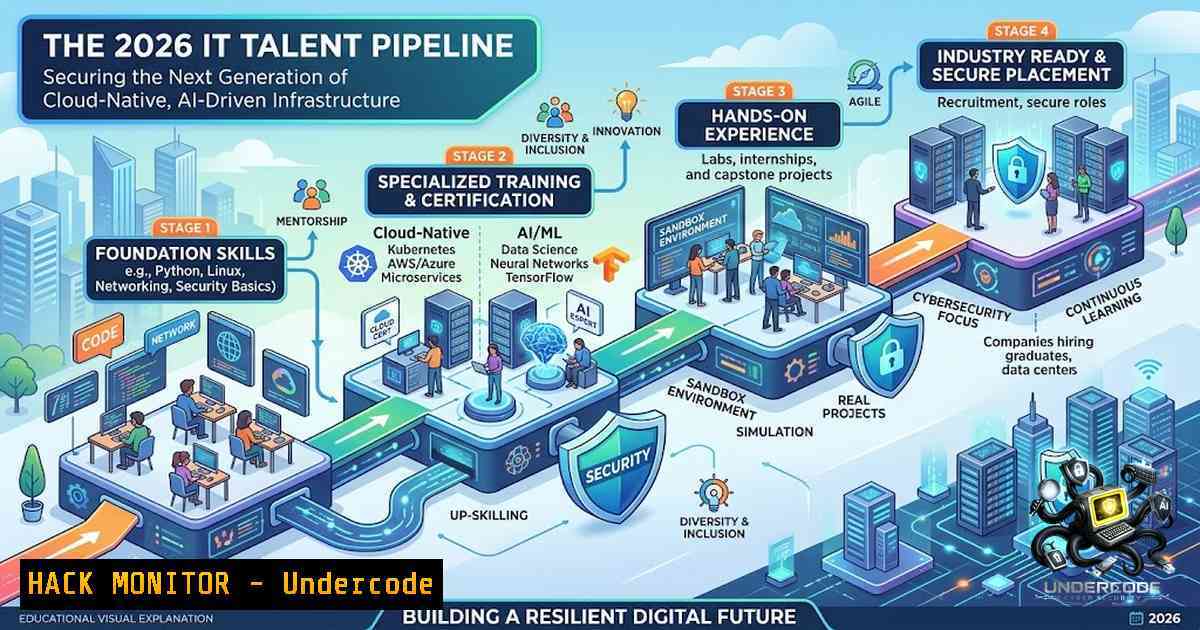
The modern enterprise technology stack has evolved into a complex tapestry of cloud-1ative architectures, containerized microservices, and AI-augmented operations. As organizations rapidly adopt Generative AI, multi-cloud strategies, and zero-trust security frameworks, the demand for professionals who can architect, deploy, and secure these environments has reached critical mass. This technical deep-dive examines the core competencies demanded by today’s IT landscape, focusing on the intersection of DevSecOps, cloud infrastructure hardening, and AI/ML operations.
Learning Objectives
- Master enterprise-grade CI/CD pipeline security configurations across AWS, Azure, and GCP environments
- Implement robust container orchestration security using Kubernetes RBAC, network policies, and Pod Security Standards
- Deploy automated vulnerability scanning and remediation workflows for cloud-1ative applications
- Understand data pipeline security for modern data engineering stacks including Snowflake and Databricks
- Configure advanced logging, monitoring, and threat detection across hybrid and multi-cloud infrastructure
You Should Know
- Cloud Infrastructure Hardening Across AWS, Azure, and GCP
The foundation of modern IT security lies in properly configured cloud infrastructure. Organizations are rapidly moving beyond basic IAM roles to implement sophisticated zero-trust architectures. For AWS environments, this means leveraging AWS Organizations with SCPs, implementing AWS Config rules for continuous compliance, and utilizing AWS Security Hub for centralized threat detection. Azure professionals must master Azure Policy, Azure Defender, and Microsoft Sentinel for SIEM capabilities. Google Cloud Platform requires expertise in BeyondCorp Enterprise, VPC Service Controls, and Cloud Armor for DDoS protection and WAF capabilities.
Step-by-step guide for implementing a secure AWS multi-account strategy:
1. Initialize AWS Organizations with SCPs
aws organizations create-organization
aws organizations create-policy --1ame "DenyPublicS3" --type SERVICE_CONTROL_POLICY \
--content '{
"Version": "2012-10-17",
"Statement": [
{
"Effect": "Deny",
"Action": "s3:PutBucketPublicAccessBlock",
"Resource": "",
"Condition": {
"Bool": {
"aws:SecureTransport": "false"
}
}
}
]
}'
2. Configure AWS Config Aggregator for cross-account compliance
 PowerShell for AWS Config Aggregator creation
aws configservice put-configuration-aggregator --configuration-aggregator-1ame "OrgAggregator" `
--account-aggregation-sources "[{\"AccountIds\": [\"123456789012\"], \"AllAwsRegions\": true}]"
3. Deploy Azure Policy for compliance enforcement
{
"properties": {
"displayName": "Audit storage accounts without soft delete",
"policyType": "Custom",
"mode": "Indexed",
"parameters": {},
"policyRule": {
"if": {
"allOf": [
{
"field": "type",
"equals": "Microsoft.Storage/storageAccounts"
},
{
"field": "Microsoft.Storage/storageAccounts/blobServices/default.softDelete.enabled",
"notEquals": "true"
}
]
},
"then": {
"effect": "audit"
}
}
}
}
4. Implement GCP VPC Service Controls with perimeter settings
gcloud access-context-manager perimeters create my-perimeter \
--title="My Perimeter" \
--description="Restricted access perimeter" \
--resources=projects/1234567890 \
--restricted-services=storage.googleapis.com,bigquery.googleapis.com
5. Enable Azure Defender for multi-cloud protection
az security pricing create -1 VirtualMachines --tier standard
az security pricing create -1 SqlServers --tier standard
az security pricing create -1 StorageAccounts --tier standard
6. Configure AWS GuardDuty with threat intelligence feeds
aws guardduty create-detector --enable
aws guardduty create-members --detector-id <detector-id> --account-details AccountId=123456789012
2. Container Security and Kubernetes Hardening
Kubernetes has become the de facto orchestration platform, but misconfigurations remain the leading cause of container breaches. Implementing Pod Security Standards (PSS), network policies, and robust RBAC configurations is essential. Security professionals must understand the interaction between container runtime security, image vulnerability scanning, and admission controllers.
Step-by-step guide for securing a production Kubernetes cluster:
1. Deploy Kubernetes Network Policies for micro-segmentation
apiVersion: networking.k8s.io/v1
kind: NetworkPolicy
metadata:
name: api-database-policy
namespace: production
spec:
podSelector:
matchLabels:
app: api-service
policyTypes:
- Egress
egress:
- to:
- podSelector:
matchLabels:
app: postgres-database
ports:
- protocol: TCP
port: 5432
2. Configure OPA Gatekeeper for policy enforcement
apiVersion: constraints.gatekeeper.sh/v1beta1
kind: K8sRequiredLabels
metadata:
name: require-security-labels
spec:
match:
kinds:
- apiGroups: [""]
kinds: ["Pod"]
parameters:
labels:
- key: security-group
- key: data-classification
3. Deploy Falco for runtime security monitoring
helm repo add falcosecurity https://falco.org/charts
helm repo update
helm install falco falcosecurity/falco \
--set falco.rules_file[bash]=/etc/falco/falco_rules.yaml \
--set falco.rules_file[bash]=/etc/falco/falco_custom_rules.yaml
4. Implement Trivy in CI/CD pipeline for container scanning
 .gitlab-ci.yml
trivy-scanning:
image: aquasec/trivy
script:
- trivy image --severity HIGH,CRITICAL --1o-progress --ignore-unfixed $CI_REGISTRY_IMAGE:$CI_COMMIT_SHA
only:
- main
5. Configure Kubernetes RBAC for least privilege access
apiVersion: rbac.authorization.k8s.io/v1
kind: Role
metadata:
namespace: production
name: pod-reader
rules:
- apiGroups: [""]
resources: ["pods"]
verbs: ["get", "watch", "list"]

apiVersion: rbac.authorization.k8s.io/v1
kind: RoleBinding
metadata:
namespace: production
name: read-pods
subjects:
- kind: User
name: developer
apiGroup: rbac.authorization.k8s.io
roleRef:
kind: Role
name: pod-reader
apiGroup: rbac.authorization.k8s.io
6. Deploy Istio Service Mesh for mTLS and fine-grained authorization
apiVersion: security.istio.io/v1beta1
kind: AuthorizationPolicy
metadata:
name: require-jwt
namespace: production
spec:
action: ALLOW
rules:
- from:
- source:
requestPrincipals: [""]
to:
- operation:
methods: ["GET"]
3. DevSecOps Pipeline Integration and Automated Security Testing
The shift-left approach to security requires embedding vulnerability scanning, SAST, DAST, and secret detection directly within CI/CD workflows. Modern DevSecOps professionals must master tools like SonarQube, Snyk, Checkov, and Terraform Sentinel to ensure infrastructure-as-code remains secure.
Step-by-step guide for implementing comprehensive DevSecOps pipeline security:
1. Configure GitHub Actions with security scanning
name: DevSecOps Pipeline
on:
push:
branches: [ main, develop ]
pull_request:
branches: [ main ]

jobs:
security-scanning:
runs-on: ubuntu-latest
steps:
- uses: actions/checkout@v3

- name: Run SAST with Semgrep
run: |
pip install semgrep
semgrep scan --config=p/r2c-security-audit --sarif-output=semgrep.sarif

- name: Run SCA with Snyk
run: |
npm install -g snyk
snyk auth ${{ secrets.SNYK_TOKEN }}
snyk test --json > snyk_results.json

- name: Scan Infrastructure-as-Code with Checkov
run: |
pip install checkov
checkov -d . --framework terraform -o json > checkov_results.json

- name: Run Container Scanning with Trivy
run: |
wget https://github.com/aquasecurity/trivy/releases/download/v0.52.0/trivy_0.52.0_Linux-64bit.deb
sudo dpkg -i trivy_0.52.0_Linux-64bit.deb
trivy fs --security-checks vuln,config --severity HIGH,CRITICAL --format sarif --output trivy.sarif .
2. Implement secret scanning with GitLeaks
gitleaks detect --source . --report-path gitleaks-report.json --verbose
3. Configure SonarQube quality gates for security thresholds
curl -u $SONAR_TOKEN: \
-X POST "http://sonarqube.company.com/api/qualitygates/create" \
-d "name=SecurityGate"
4. Deploy AWS CodePipeline with integrated security checks
aws codepipeline create-pipeline --cli-input-json file://pipeline.json
 Include stages for Build, Test, SecurityScan, and Deploy
5. Configure Azure DevOps Pipeline with security tasks
- task: Bash@3
inputs:
targetType: 'inline'
script: |
npm install -g snyk
snyk auth $(SNYK_TOKEN)
snyk test --severity-threshold=high
displayName: 'Snyk Security Test'

- task: CmdLine@2
displayName: 'Terraform Security Scanning'
inputs:
script: |
docker run --rm -v $(pwd):/src bridgecrew/checkov --directory /src --framework terraform
6. Implement OWASP ZAP DAST in pipeline
docker pull owasp/zap2docker-stable
docker run -v $(pwd):/zap/wrk -t owasp/zap2docker-stable zap-baseline.py \
-t https://staging-app.com -r scan_report.html -J scan_results.json
4. Data Engineering Security and Modern Data Platform Hardening
The explosive growth of data platforms including Snowflake, Databricks, and BigQuery has created new attack surfaces. Security professionals must understand column-level security, dynamic data masking, secure data sharing, and encryption key management for modern data warehouses.
Step-by-step guide for securing a Snowflake data platform:
1. Implement Snowflake RBAC with secure data sharing
-- Create role hierarchy
CREATE ROLE SECURITY_ADMIN;
CREATE ROLE DATA_ENGINEER;
CREATE ROLE DATA_SCIENTIST;
CREATE ROLE ANALYST;

-- Grant warehouse access
GRANT USAGE ON WAREHOUSE DATA_WAREHOUSE TO ROLE DATA_ENGINEER;
GRANT USAGE ON WAREHOUSE DATA_WAREHOUSE TO ROLE DATA_SCIENTIST;
GRANT USAGE ON WAREHOUSE DATA_WAREHOUSE TO ROLE ANALYST;

-- Implement dynamic data masking
CREATE OR REPLACE MASKING POLICY EMAIL_MASK AS (VAL VARCHAR) RETURNS VARCHAR ->
CASE
WHEN CURRENT_ROLE() IN ('SECURITY_ADMIN', 'DATA_ENGINEER') THEN VAL
ELSE '@.'
END;

ALTER TABLE CUSTOMERS MODIFY COLUMN EMAIL SET MASKING POLICY EMAIL_MASK;
2. Configure Databricks Unity Catalog for governance
CREATE CATALOG secure_catalog;
CREATE SCHEMA secure_catalog.sales;
GRANT SELECT ON SCHEMA secure_catalog.sales TO ROLE data_analyst;

-- Implement row-level security
CREATE ROW FILTER security_filter ON employees
RETURN CASE
WHEN current_user() = 'admin' THEN TRUE
ELSE region = current_region()
END;
3. Implement BigQuery data classification and IAM
bq mk --dataset --description "Secure dataset" project:secure_dataset
bq add-iam-policy-binding project:secure_dataset \
--member="user:[email protected]" \
--role="roles/bigquery.dataViewer"
bq update --encryption_key=projects/project/locations/global/keyRings/keyring/cryptoKeys/key \
--dataset project:secure_dataset
5. AI/ML Pipeline Security and Generative AI Governance
As organizations rush to adopt Generative AI, the security of ML pipelines and model governance has become paramount. This includes securing model registries, implementing adversarial detection, protecting training data, and establishing guardrails for LLM applications.
Step-by-step guide for securing an ML pipeline with AWS SageMaker:
1. Configure SageMaker VPC with private subnets
aws sageMaker create-1otebook-instance \
--1otebook-instance-1ame secure-1otebook \
--instance-type ml.t3.medium \
--role-arn arn:aws:iam::account-id:role/service-role/AmazonSageMakerServiceCatalogProductsUseRole \
--subnet-id subnet-12345678 \
--security-group-ids sg-12345678
2. Implement model registry security with approval workflows
{
"ModelPackageGroupName": "secure-models",
"ModelPackageGroupDescription": "Approved models only",
"ModelApprovalStatus": "Approved",
"ModelMetrics": {
"Bias": {
"Report": {
"ContentType": "application/json",
"S3Uri": "s3://bucket/bias-report.json"
}
}
}
}
3. Deploy prompt injection protection for LLM applications
import re
from typing import List

def sanitize_prompt(input_text: str, blocklist: List[bash]) -> str:
"""Remove potential injection patterns from prompts"""
patterns = [
r"ignore previous instructions",
r"system\s:\s.+",
r"you are now\s:",
r"act as\s:",
]
for pattern in patterns:
input_text = re.sub(pattern, "", input_text, flags=re.IGNORECASE)
for blocked in blocklist:
input_text = input_text.replace(blocked, "[bash]")
return input_text
4. Configure Azure AI content filters and safety
az cognitiveservices account update --1ame ai-account \
--resource-group rg-ai \
--set properties.publicNetworkAccess=Disabled

az cognitiveservices account network-rule add \
--1ame ai-account \
--resource-group rg-ai \
--subnet /subscriptions/.../subnets/private-subnet
6. Windows and Linux Server Hardening for Enterprise Environments
Despite the cloud shift, on-premises and hybrid server security remains critical. Windows Server hardening includes PowerShell execution policies, Windows Defender Advanced Threat Protection, and Group Policy Object (GPO) configuration. Linux hardening focuses on kernel-level security, SELinux/AppArmor configuration, and auditd monitoring.
Step-by-step guide for Windows Server 2022 hardening:
1. Configure PowerShell execution policy and logging
 Set execution policy to restricted
Set-ExecutionPolicy -ExecutionPolicy Restricted

 Enable PowerShell script block logging
Set-ItemProperty -Path "HKLM:\SOFTWARE\Policies\Microsoft\Windows\PowerShell\ScriptBlockLogging" `
-1ame "EnableScriptBlockLogging" -Value 1

Enable PowerShell transcription
Set-ItemProperty -Path "HKLM:\SOFTWARE\Policies\Microsoft\Windows\PowerShell\Transcription" `
-1ame "EnableTranscripting" -Value 1
2. Implement Windows Defender Application Control (WDAC)
 Create WDAC policy
New-CIPolicy -FilePath C:\WDAC\Policy.xml -Level Publisher -UserPEs

 Convert policy to binary format
ConvertFrom-CIPolicy -XmlFilePath C:\WDAC\Policy.xml `
-BinaryFilePath C:\WDAC\Policy.p7b

Deploy policy
Copy-Item C:\WDAC\Policy.p7b C:\Windows\System32\CodeIntegrity\SiPolicy.p7b
3. Configure audit policies via GPO
 Enable advanced audit policies
auditpol /set /subcategory:"Logon" /success:enable /failure:enable
auditpol /set /subcategory:"Object Access" /success:enable /failure:enable
auditpol /set /subcategory:"Privilege Use" /success:enable /failure:enable
4. Linux kernel hardening with sysctl
 /etc/sysctl.d/99-hardening.conf
net.ipv4.tcp_syncookies = 1
net.ipv4.conf.all.rp_filter = 1
net.ipv4.conf.all.accept_source_route = 0
net.ipv4.tcp_timestamps = 0
kernel.kptr_restrict = 2
kernel.dmesg_restrict = 1
5. Implement SELinux targeted policy
 Set enforcing mode
setenforce 1

Configure SELinux for custom applications
semanage fcontext -a -t httpd_sys_rw_content_t "/var/www/html/logs(/.)?"
restorecon -Rv /var/www/html/logs

Audit SELinux denials
audit2allow -a -M mypolicy
semodule -i mypolicy.pp
6. Configure fail2ban for SSH protection
 /etc/fail2ban/jail.local
[bash]
enabled = true
port = ssh
filter = sshd
logpath = /var/log/auth.log
maxretry = 3
bantime = 3600
7. Network Security and Zero-Trust Architecture Implementation
Modern network security requires moving beyond perimeter-based defenses to implement zero-trust architectures. This includes micro-segmentation, SASE (Secure Access Service Edge) implementation, and advanced firewall rule management.
Step-by-step guide for implementing zero-trust network access:
1. Implement BeyondCorp-style access with Cloudflare Access
 Configure Cloudflare Access policies via Terraform
resource "cloudflare_access_application" "secure_app" {
zone_id = var.zone_id
name = "Secure Application"
domain = "app.company.com"
type = "self_hosted"
session_duration = "24h"
}

resource "cloudflare_access_policy" "policy" {
application_id = cloudflare_access_application.secure_app.id
zone_id = var.zone_id
name = "Allow corporate users"
precedence = 1
decision = "allow"

include {
email = ["[email protected]"]
email_domain = ["company.com"]
geo = ["US", "GB"]
}
}
2. Configure network segmentation with AWS Security Groups
 Create security groups for micro-segmentation
aws ec2 create-security-group --group-1ame web-tier --description "Web tier SG"
aws ec2 create-security-group --group-1ame app-tier --description "App tier SG"
aws ec2 create-security-group --group-1ame db-tier --description "DB tier SG"

Configure inter-service communication rules
aws ec2 authorize-security-group-ingress --group-id sg-12345 \
--protocol tcp --port 8080 --source-group sg-67890
What Undercode Say:
- The convergence of AI and security demands rapid upskilling – Professionals with combined expertise in cloud security, data engineering, and AI/ML will command premium compensation. Organizations are struggling to find talent that understands both the operational aspects of cloud-1ative infrastructure and the security implications of AI workloads. This creates a significant opportunity for technical professionals who can bridge these domains.
-
Automation is no longer optional; it’s existential – The complexity of modern infrastructure requires automated security controls embedded within CI/CD pipelines. Manual security reviews are insufficient when deployments occur multiple times per day. Professionals must master tools like Checkov, Terragrunt, and Kube-bench to maintain compliance at scale.
-
The talent gap is widening faster than previously anticipated – With retirement of legacy IT professionals and the explosive growth of cloud-1ative positions, organizations are increasingly turning to recruiters specializing in niche technical roles. The demand for professionals with hands-on experience in Kubernetes, Terraform, and Python far exceeds supply, creating unique opportunities for professionals who invest in continuous learning.
-
Compliance and security are becoming indistinguishable – Regulatory requirements like SOC2, HIPAA, and GDPR now require demonstrable security controls and automated compliance checks. Professionals who understand how to implement continuous compliance monitoring through infrastructure-as-code will be essential for enterprise security teams.
-
Generative AI introduces new attack surfaces that require specialized expertise – The emergence of prompt engineering, model poisoning, and data poisoning attacks demands security professionals who understand both the technical architecture and the unique vulnerabilities of AI/ML systems. Organizations need professionals who can implement guardrails, content filters, and adversarial detection mechanisms.
-
Cross-cloud expertise is becoming mandatory – Organizations are increasingly adopting multi-cloud strategies to avoid vendor lock-in, requiring professionals who understand the security nuances of AWS, Azure, and GCP. This includes identity management, IAM, network security, and encryption across multiple platforms.
Prediction:
+1 The demand for integrated DevSecOps professionals with multi-cloud expertise will increase by 45% YoY through 2027, creating significant opportunities for technical professionals who invest in certifications and hands-on experience.
+N Organizations that fail to implement automated security scanning in their CI/CD pipelines will experience a 60% increase in security incidents due to misconfigurations and known vulnerabilities.
+1 The integration of AI-specific security roles (MLSecOps) will emerge as a distinct career path, with salaries exceeding traditional cloud security roles by 30-40%.
+N The complexity of managing security across hybrid environments will lead to a 25% increase in security tool consolidation spending, as organizations seek to reduce alert fatigue and improve response times.
+1 Adoption of zero-trust architectures will accelerate, with 70% of enterprises implementing SASE or similar frameworks by 2027, creating demand for network security specialists with cloud-1ative expertise.
+N The gap between available technical talent and open positions will continue to widen, with organizations increasingly relying on specialized technical recruiters and staffing agencies to fill critical roles, especially in cybersecurity, cloud architecture, and AI operations.
▶️ Related Video (82% Match):
🎯Let’s Practice For Free:
🎓 Live Courses & Certifications:
Join Undercode Academy for Verified Certifications
🚀 Request a Custom Project:
Secure, high-velocity infrastructure and disruptive technological engineering. Contact our engineering team for high-tier development and proprietary systems:
[email protected]
💎 Smart Architecture | 🛡️ Secure by Design | ⭐ Trusted by Thousands
IT/Security Reporter URL:
Reported By: Venu M – Hackers Feeds
Extra Hub: Undercode MoN
Basic Verification: Pass ✅


