Listen to this Post
Introduction:
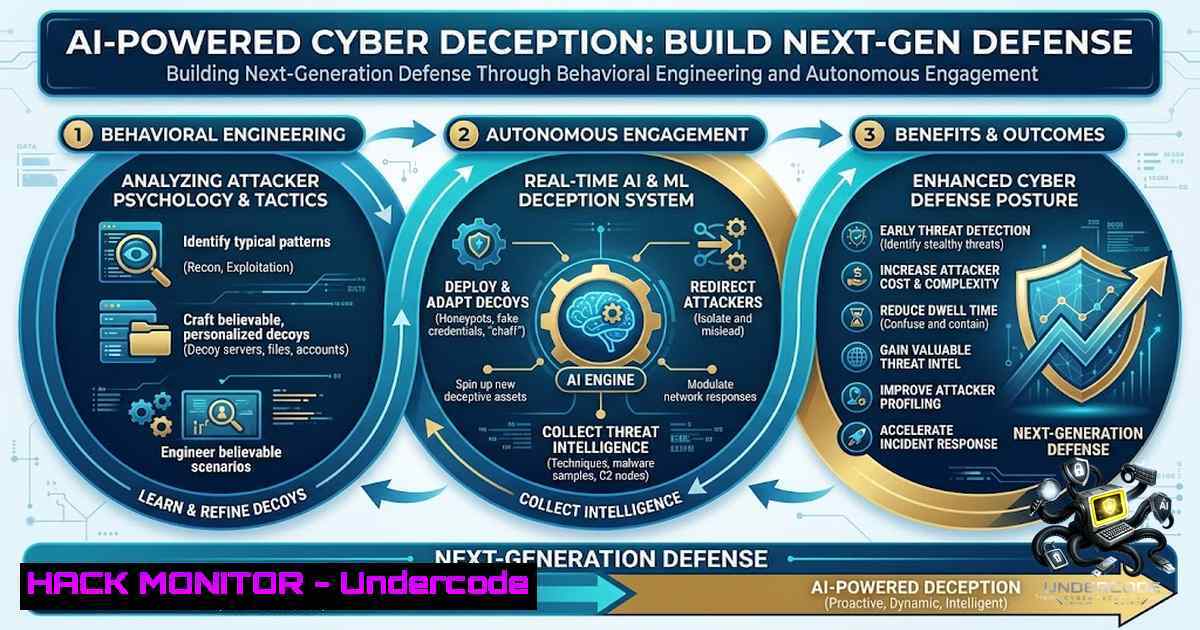
Traditional cyber defenses operate on a reactive premise—detect the breach, contain the damage, and remediate afterward. But AI is rewriting the rules of attack at machine speed, rendering signature-based detection and perimeter defenses increasingly obsolete. Cyber deception offers a paradigm shift: instead of waiting to be breached, organizations can proactively engage adversaries, shape their decisions, and extract intelligence before damage occurs. By integrating behavioral science, AI-driven automation, and narrative-based deception, next-generation defense transforms the network into an active hunting ground where attackers become the ones being studied.
Learning Objectives:
- Understand why AI-driven attacks demand a fundamental shift from reactive detection to proactive engagement through cyber deception
- Learn how to operationalize behaviorally engineered digital personas and narrative-driven deception content
- Master frameworks for measuring deception effectiveness and scaling AI-powered deception operations
- Gain practical knowledge of open-source deception tools, Linux/Windows commands, and cloud hardening techniques
You Should Know:
1. Why AI Demands a New Defensive Paradigm
AI is not merely accelerating existing attack techniques—it is creating entirely new categories of threat. Large language models can now craft polymorphic phishing campaigns, generate contextually adaptive social engineering scripts, and automate reconnaissance at scale. Traditional defenses that rely on static signatures or rule-based detection cannot keep pace with attacks that evolve in real time.
Cyber deception flips this dynamic. Instead of trying to block every attack vector, deception creates an environment where attackers cannot distinguish between real assets and decoys. This forces adversaries to expend time and resources navigating a fabricated reality, while defenders collect high-fidelity threat intelligence. The psychological impact is significant: research shows that awareness of deception causes some attackers to abandon their targets entirely, while others become more cautious and forfeit easily exploitable vulnerabilities.
The core insight is that deception shifts the defender’s role from passive victim to active strategist. By designing lures that appeal to specific attacker motivations—whether financial gain, data exfiltration, or operational disruption—defenders can influence adversary decision-making at every stage of the kill chain.
2. Operationalizing Cyber Deception: Behaviorally Engineered Digital Personas
The most sophisticated deception operations do not rely on static honeypots. They employ behaviorally engineered digital personas—synthetic identities designed to mimic authentic user behavior with sufficient fidelity to attract and engage adversaries.
LLMs enable the creation of these personas at scale. A deception persona might maintain consistent social media activity, respond to queries in a specific tone, and generate realistic artifacts that appear credible to an attacker conducting reconnaissance. The SANDMAN architecture, for example, leverages language agents to emulate convincing human simulacra that extend observation periods and capture detailed attacker behavior.
Step-by-Step Guide to Deploying LLM-Powered Deception Personas:
- Define Persona Attributes: Establish demographic details, professional role, communication style, and behavioral patterns. Consider what type of persona would attract your likely adversaries.
-
Select a Deception Framework: Deploy open-source tools like Beelzebub, which provides an LLM-powered deception runtime across SSH, HTTP, TCP, TELNET, and MCP protocols. Alternatively, honeyprompt offers an LLM-first deception framework for web developers.
-
Configure Persona Behavior: Use structured prompt engineering to define response patterns. The persona should appear authentic without revealing its deceptive nature.
-
Deploy Decoy Services: Spin up decoy services that mimic legitimate infrastructure. For SSH-based deception:
 Clone and run Beelzebub deception framework
git clone https://github.com/beelzebub-labs/beelzebub
cd beelzebub
 Configure LLM backend and deception personas in config.yaml
./beelzebub --config config.yaml
- Monitor and Analyze Interactions: Log all attacker interactions, including inputs, LLM responses, and session summaries. Use this data to refine persona behavior and identify attacker TTPs.
-
Iterate and Scale: Continuously update personas based on threat intelligence. As attackers adapt, deception must evolve in lockstep.
3. Measuring Deception Effectiveness: Frameworks and Metrics
One of the greatest challenges in cyber deception has been the absence of standardized measurement frameworks. Without metrics, it is impossible to quantify ROI, justify investment, or optimize deployment strategies.
Recent research has begun to address this gap. Game-theoretic evaluation frameworks now quantify deception benefit relative to non-deceptive baselines, linking strategic outcomes to information disclosure. The Honeyquest instrument provides a human-subject testing methodology for rapid prototyping and assessment of deception techniques. Autonomous AI-driven frameworks now incorporate real-time threat detection and behavior-based attribution.
Key Metrics to Track:
- Dwell Time: How long attackers spend engaging with decoys before realizing they are deceived
- Intel Yield: Quality and quantity of attacker TTPs, tools, and infrastructure revealed
- Attribution Accuracy: Ability to link deceptive engagement to specific threat actors
- Deterrence Effect: Reduction in attack volume against real assets when deception is active
- Engagement Rate: Percentage of attackers who interact with decoys versus bypassing them
- Technical Implementation: Linux and Windows Commands for Deception Operations
Operationalizing cyber deception requires proficiency across multiple platforms. Below are verified commands and configurations for deception deployment, monitoring, and analysis.
Linux Commands for Deception Deployment:
 Deploy a high-interaction honeypot using Cowrie (SSH/Telnet)
git clone https://github.com/cowrie/cowrie
cd cowrie
cp cowrie.cfg.dist cowrie.cfg
 Edit cowrie.cfg to configure logging, deception content, and LLM integration
./bin/cowrie start

Monitor honeypot activity in real-time
tail -f cowrie/log/cowrie.log

Deploy network-level deception using iptables to redirect suspicious traffic
iptables -t nat -A PREROUTING -p tcp --dport 22 -j REDIRECT --to-port 2222

Analyze captured attacker sessions
cat cowrie/log/attacker_ips.txt | sort | uniq -c | sort -1r

Use tcpdump to capture deception network traffic for analysis
tcpdump -i eth0 -w deception_capture.pcap port 22 or port 80
Windows Commands and PowerShell Scripts:
 Configure Windows Firewall to redirect suspicious traffic to decoy ports
New-1etFirewallRule -DisplayName "Redirect SSH to Deception" -Direction Inbound -Protocol TCP -LocalPort 22 -Action Allow
 Set up port forwarding using netsh (requires admin)
netsh interface portproxy add v4tov4 listenport=22 listenaddress=0.0.0.0 connectport=2222 connectaddress=127.0.0.1

Deploy decoy services using Windows Subsystem for Linux (WSL)
wsl --install -d Ubuntu
wsl bash -c "git clone https://github.com/beelzebub-labs/beelzebub && cd beelzebub && ./beelzebub"

Monitor deception logs with PowerShell
Get-Content C:\deception\logs\beelzebub.log -Wait

Extract attacker IPs from deception logs
Select-String -Path C:\deception\logs.log -Pattern "attacker_ip" | ForEach-Object { $_ -replace '.attacker_ip":"([^"]+).', '$1' } | Sort-Object | Get-Unique
Cloud Hardening and Deception-as-a-Service:
For cloud-1ative environments, frameworks like DDCA (Dynamic Deception Cloudification Architecture) leverage programmable data planes to construct high-fidelity deception environments with dynamic topology. This enables physically static deception resources to exhibit dynamic behaviors, confounding attackers at the network layer.
 AWS: Deploy deception VPC with isolated decoy subnets
aws ec2 create-vpc --cidr-block 10.0.0.0/16 --tag-specifications 'ResourceType=vpc,Tags=[{Key=Name,Value=Deception-VPC}]'

Deploy a decoy EC2 instance running Beelzebub
aws ec2 run-instances --image-id ami-0abcdef1234567890 --instance-type t3.medium --subnet-id subnet-12345678 --user-data "!/bin/bash
git clone https://github.com/beelzebub-labs/beelzebub && cd beelzebub && ./install.sh && ./beelzebub --config config.yaml"
5. Vulnerability Exploitation and Mitigation Through Deception
Deception is not merely about detection—it is a proactive mitigation strategy. By understanding how attackers exploit vulnerabilities, defenders can design decoys that mirror vulnerable systems, attracting adversaries before they reach production assets.
Common Exploitation Vectors and Deception Countermeasures:
- SSH Brute-Force: Deploy Cowrie or Beelzebub on port 22 to capture credential attempts and attacker tools
- Web Application Attacks: Use web application honeypots that simulate vulnerable endpoints (e.g., /wp-admin, /phpmyadmin)
- API Abuse: Deploy HoneyMCP to inject “ghost tools” that act as honeypots for AI agents attempting to exploit Model Context Protocol servers
- Prompt Injection: AgentShield provides a multi-layer deception-based detection framework for identifying when tool-using AI agents have been compromised
Mitigation Commands:
 Block known attacker IPs identified through deception
iptables -A INPUT -s 192.168.1.100 -j DROP

Implement rate limiting on SSH to slow brute-force attempts
iptables -A INPUT -p tcp --dport 22 -m state --state NEW -m recent --set
iptables -A INPUT -p tcp --dport 22 -m state --state NEW -m recent --update --seconds 60 --hitcount 4 -j DROP

Windows: Block attacker IPs via firewall
New-1etFirewallRule -DisplayName "Block Attacker IP" -Direction Inbound -RemoteAddress 192.168.1.100 -Action Block
6. Integrating Behavioral Influence and Narrative-Driven Deception
The most advanced deception operations apply behavioral influence techniques to shape attacker decisions inside and beyond the network. This involves understanding attacker psychology, cognitive biases, and decision-making heuristics.
Research demonstrates that cyber deception creates a measurable psychological impact on attackers. The framing effect—where behavior changes based on how a situation is described—can be weaponized to nudge attackers toward decoys and away from real assets.
Practical Application:
- Narrative Design: Craft deception content that tells a compelling story—a misconfigured database, an unpatched server, or sensitive documents left accessible
- Cognitive Bias Exploitation: Leverage confirmation bias by presenting information that aligns with attacker expectations
- Social Proof: Create the appearance of other attackers engaging with the same decoy to increase credibility
Step-by-Step Guide to Narrative-Driven Deception:
- Profile Your Adversary: Understand what motivates your likely attackers—financial gain, espionage, hacktivism?
- Design the Lure: Create a narrative that appeals to those motivations. For financial attackers, a decoy payment system with visible transaction logs.
- Populate with Artifacts: Generate realistic documents, logs, and communications using LLMs.
- Deploy and Observe: Monitor how attackers interact with the narrative. Do they follow the expected path? Are there deviations?
- Refine and Adapt: Use intelligence gathered to improve the narrative for future engagements.
What Undercode Say:
- Cyber deception represents a fundamental paradigm shift from reactive defense to proactive engagement—organizations that fail to adopt deception strategies will increasingly find themselves outmaneuvered by AI-driven attackers
- The integration of behavioral science with AI-powered deception creates a force multiplier effect; understanding attacker psychology is just as important as technical implementation
- Measurement frameworks are the missing link in deception adoption—without quantifiable metrics, deception will remain underfunded and underutilized despite its proven effectiveness
The trajectory of cyber deception is clear: static honeypots are giving way to adaptive, AI-powered deception ecosystems that engage attackers in sustained, intelligence-gathering interactions. The frameworks and tools are maturing rapidly, with open-source projects like Beelzebub, honeyprompt, and AgentShield making sophisticated deception accessible to organizations of all sizes. The challenge is no longer technological—it is organizational. Security teams must develop the expertise to design, deploy, and measure deception operations, and leadership must recognize deception as a strategic capability rather than a tactical novelty.
Prediction:
- +1 Cyber deception will become a standard component of enterprise security architectures within 3-5 years, driven by AI’s ability to automate deception at scale and the escalating cost of reactive breach response
- +1 The convergence of behavioral science, LLMs, and deception technology will create a new category of “cognitive security” professionals who blend technical expertise with psychological insight
- -1 Organizations that delay deception adoption will face increasingly sophisticated AI-driven attacks that bypass traditional controls, leading to higher breach costs and reputational damage
- +1 Open-source deception frameworks will accelerate innovation and democratize access, enabling smaller organizations to deploy capabilities previously available only to nation-states and large enterprises
- -1 Adversaries will develop counter-deception techniques, including AI systems trained to recognize and evade decoys, creating an ongoing arms race between deception and detection
- +1 Regulatory frameworks and insurance requirements will increasingly mandate deception capabilities as part of “reasonable” cybersecurity measures
- -1 The proliferation of synthetic personas and AI-generated deception content will blur the line between defensive and offensive operations, raising ethical and legal questions about attribution and escalation
▶️ Related Video (84% Match):
🎯Let’s Practice For Free:
🎓 Live Courses & Certifications:
Join Undercode Academy for Verified Certifications
🚀 Request a Custom Project:
Secure, high-velocity infrastructure and disruptive technological engineering. Contact our engineering team for high-tier development and proprietary systems:
[email protected]
💎 Smart Architecture | 🛡️ Secure by Design | ⭐ Trusted by Thousands
IT/Security Reporter URL:
Reported By: Timpappa Reimagining – Hackers Feeds
Extra Hub: Undercode MoN
Basic Verification: Pass ✅


