Listen to this Post
Introduction:
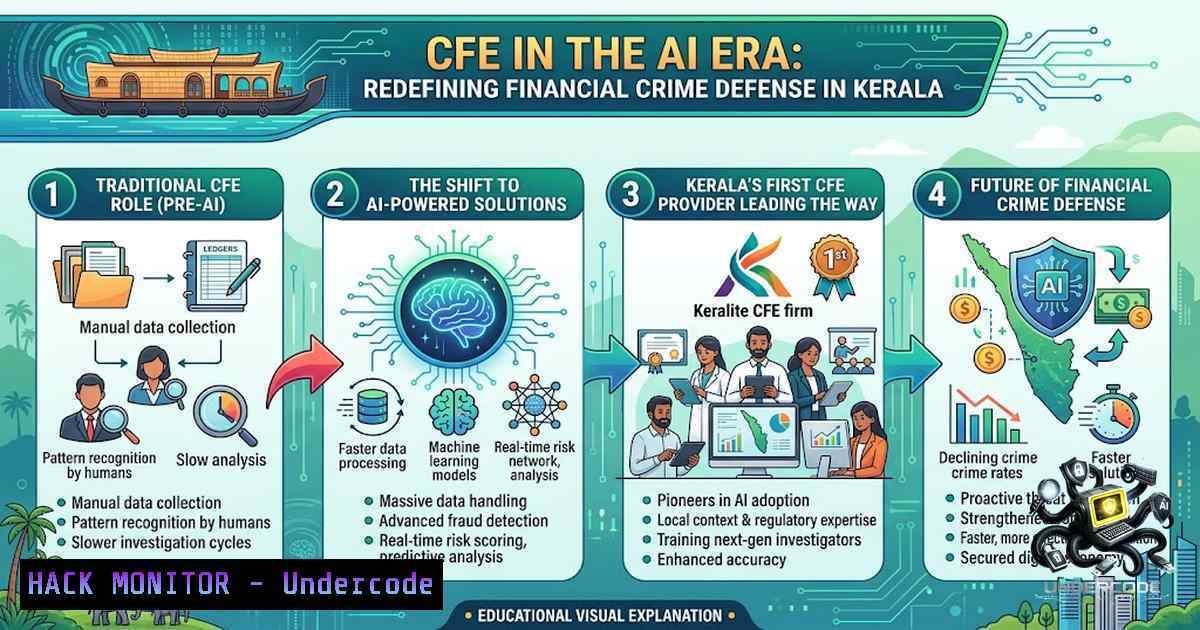
As organizations lose billions annually to fraud, financial crime, and cyber-enabled scams, the demand for professionals who can detect, investigate, and prevent these threats has never been higher. The Certified Fraud Examiner (CFE) credential—administered by the Association of Certified Fraud Examiners (ACFE)—has emerged as the global gold standard for anti-fraud professionals. At Meantoir Global Academy, Kerala’s first and only dedicated CFE exam preparation center, professionals are being equipped with the AI-era skills necessary to combat increasingly sophisticated financial crimes.
Learning Objectives:
- Master fraud investigation, forensic accounting, and digital forensics techniques aligned with the updated 2026 CFE Exam structure.
- Understand how AI, machine learning, and data analytics are transforming fraud detection and prevention.
- Develop practical, job-ready skills for banking, Big 4 firms, MNCs, and government sectors across India, UAE, and global markets.
You Should Know:
- The 2026 CFE Exam Overhaul: What’s Changed and Why It Matters
The ACFE launched a revised CFE Exam in June 2026, reflecting the evolution of the fraud examination industry. Based on a comprehensive 2024 Job Task Analysis, the exam transitioned from four sections to three. The new structure consists of:
- Fraud Schemes and Financial Crimes (120 questions, 2.5 hours) – Identifies various fraud schemes and financial crimes, guiding examiners on prevention and detection.
- Fraud Investigations and Legal Issues (120 questions, 2.5 hours) – Explores how fraud investigations are conducted and the legal considerations involved.
- Fraud Prevention and Deterrence (70 questions, 1.5 hours) – Examines why people commit fraud and how it can be prevented.
The exam is closed-book, administered via online remote proctoring through Prometric’s ProProctor platform or in-person at testing centers worldwide. Candidates have a 60-day window to complete all three sections once eligibility is activated.
Step‑by‑Step Guide to CFE Exam Preparation:
- Join the ACFE – Only ACFE members can earn the CFE credential. Ensure you meet the eligibility requirements (minimum 40 points to take the exam, 50 points to be certified).
- Understand the Exam Blueprint – Review the official CFE Exam Content Outline available on the ACFE website.
- Choose Your Study Resources – The ACFE offers the CFE Exam Prep Course® (self-paced, computer-based with 500+ lessons), the CFE Exam Review Course (instructor-led), and the 1,900-page Fraud Examiners Manual.
- Follow a Phased Study Plan – Meantoir recommends a 45–60 day plan: Foundation (10–15 days covering ethics and criminology), Core Mastery (20–25 days focusing on Indian fraud trends like UPI, KYC, and corporate frauds), and Practice Mode (15–20 days solving 1,000+ practice questions and timed mock tests).
- Register and Schedule – Pay the $480 application fee (covers first attempt at each section; retakes are $110 per failed section) and schedule your exam within the 60-day window.
-
AI and Cybersecurity: The New Frontier in Fraud Examination
The 2026 Anti-Fraud Technology Benchmarking Report, developed by the ACFE in partnership with SAS, reveals that one in four organizations (25%) currently use AI or machine learning in their data analysis initiatives—up from 18% in 2024. An additional 28% expect to adopt these tools within the next two years. Generative AI is being used for phishing and scam detection (49%), risk identification and assessment (46%), and report writing (45%).
However, fraudsters are also leveraging AI. More than half of respondents indicated that the volume of AI-powered fraud schemes has increased over the past two years. Deepfake social engineering, generative AI document fraud, and deepfake digital injection are among the schemes most expected to grow. Alarmingly, only 7% of respondents believe their organization is more than moderately prepared to detect or prevent AI-powered fraud.
Linux and Windows Commands for Digital Forensics and Fraud Investigation:
| Purpose | Linux Command | Windows Command | Description |
|---|---|---|---|
| File Integrity Monitoring | `sudo aide –init` | `fciv.exe -md5 -sha1 |
Creates a baseline database of file hashes to detect unauthorized modifications. |
| Log Analysis | `grep “Failed password” /var/log/auth.log` | `findstr “4625” C:\Windows\System32\winevt\Logs\Security.evtx` | Searches for failed login attempts (event ID 4625 on Windows) in security logs. |
| Network Connection Monitoring | `ss -tulpn` | `netstat -an` | Lists all active network connections and listening ports to identify suspicious activity. |
| Process Inspection | `ps aux –sort=-%mem` | `tasklist /v` | Displays all running processes, sorted by memory usage, to spot rogue processes. |
| Disk Imaging (Forensic Copy) | `dd if=/dev/sda of=/mnt/evidence.img bs=4M status=progress` | `FTK Imager` (GUI tool) | Creates a bit-for-bit copy of a storage device for forensic analysis. |
| Metadata Extraction | `exiftool -a -u |
`exiftool -a -u |
Extracts all metadata from a file (e.g., document, image) to uncover hidden information. |
| Registry Analysis (Windows) | N/A | `reg query HKLM\Software\Microsoft\Windows\CurrentVersion\Run` | Queries the Windows Registry for startup programs, a common persistence mechanism for malware. |
Step‑by‑Step Guide to Investigating a Suspected Financial Fraud Using Digital Forensics:
- Preserve the Evidence – Use `dd` (Linux) or FTK Imager (Windows) to create a forensic image of the affected system’s hard drive. Never work on the original evidence.
- Analyze System Logs – On Linux, examine `/var/log/auth.log` and `/var/log/syslog` for unauthorized access. On Windows, use `wevtutil qe Security /f:text` to export security logs and search for event IDs like 4624 (successful logon) and 4625 (failed logon).
- Check for Anomalous Processes – Use `ps aux` (Linux) or `tasklist` (Windows) to identify unfamiliar or suspicious processes. Cross-reference with known malware signatures.
- Examine Network Connections – Use `ss -tulpn` (Linux) or `netstat -an` (Windows) to identify any outbound connections to unknown IP addresses, which could indicate data exfiltration.
- Review File Integrity – Compare current file hashes against a known-good baseline using `aide` (Linux) or `fciv` (Windows) to detect unauthorized changes to critical system or financial files.
- Document Everything – Maintain a detailed chain of custody and log all actions taken during the investigation to ensure admissibility in legal proceedings.
-
Cloud Hardening and API Security for Financial Systems
With the migration of financial services to the cloud, securing APIs and cloud infrastructure is paramount. The 2026 Anti-Fraud Technology Benchmarking Report highlights that organizations are integrating AI and data analytics, but governance and security lags behind. For example, 75% of respondents said bias or lack of fairness is an important factor when adopting AI, but only 18% reported that their organizations test AI models for bias.
Cloud Hardening Checklist for Financial Environments:
- Enable Multi-Factor Authentication (MFA) for all user accounts, especially those with administrative privileges.
- Implement Principle of Least Privilege (PoLP) – restrict user permissions to only what is necessary for their role.
- Encrypt Data at Rest and in Transit – use AWS KMS, Azure Key Vault, or Google Cloud KMS for key management.
- Enable Comprehensive Logging and Monitoring – use AWS CloudTrail, Azure Monitor, or Google Cloud Logging to track all API calls and administrative actions.
- Regularly Patch and Update all systems and applications to mitigate known vulnerabilities.
- Conduct Regular Security Assessments – perform vulnerability scans and penetration tests on your cloud infrastructure.
API Security Best Practices:
- Use Strong Authentication and Authorization – implement OAuth 2.0 or OpenID Connect (OIDC) for API access.
- Validate and Sanitize All Inputs – protect against injection attacks (SQL, NoSQL, OS command) by using parameterized queries and input validation.
- Implement Rate Limiting and Throttling – prevent brute-force attacks and denial-of-service (DoS) attempts.
- Use API Gateways – such as Kong, AWS API Gateway, or Azure API Management to enforce security policies, monitor traffic, and log requests.
- Encrypt Sensitive Data in Payloads – use TLS for all API communications and consider encrypting sensitive fields at the application level.
- Regularly Audit API Logs – monitor for unusual patterns, such as repeated failed authentication attempts or unexpected data access.
4. Vulnerability Exploitation and Mitigation in Financial Systems
Understanding how vulnerabilities are exploited is crucial for effective mitigation. Common attack vectors in the financial sector include:
- Phishing and Social Engineering – attackers use deceptive emails or messages to trick employees into revealing credentials or installing malware. Mitigation: regular security awareness training, email filtering, and MFA.
- Insider Threats – employees or contractors with legitimate access misuse their privileges. Mitigation: implement PoLP, monitor user activity, and conduct background checks.
- Ransomware – malware that encrypts data and demands payment for decryption. Mitigation: regular data backups, endpoint detection and response (EDR), and network segmentation.
- API Exploitation – attackers target insecure APIs to gain unauthorized access to sensitive data. Mitigation: implement the API security best practices outlined above.
- AI-Powered Fraud – fraudsters use generative AI to create deepfakes, forge documents, or automate social engineering attacks. Mitigation: deploy AI-based detection tools, verify identities through multiple channels, and stay informed about emerging threats.
Step‑by‑Step Guide to Conducting a Vulnerability Assessment:
- Define the Scope – identify the systems, networks, and applications to be assessed.
- Gather Information – use tools like `nmap` (network scanning) and `enum4linux` (enumeration) to discover open ports, services, and potential entry points.
- Scan for Vulnerabilities – use vulnerability scanners like OpenVAS, Nessus, or Qualys to identify known vulnerabilities (CVEs) in the target environment.
- Analyze and Prioritize – assess the risk level of each vulnerability based on its exploitability and potential impact. Use the Common Vulnerability Scoring System (CVSS) for prioritization.
- Exploit (Optional) – in a controlled environment, use tools like Metasploit to verify if a vulnerability is exploitable. This step should only be performed with proper authorization.
- Remediate – apply patches, update configurations, or implement compensating controls to mitigate identified vulnerabilities.
- Re-scan and Verify – after remediation, re-scan the environment to confirm that vulnerabilities have been successfully addressed.
- Document and Report – create a detailed report outlining the findings, remediation steps, and recommendations for ongoing security improvements.
What Undercode Say:
- The CFE credential is no longer just about traditional fraud examination; it is increasingly intertwined with cybersecurity, AI, and data analytics. Professionals who can bridge these domains will be in high demand.
- Meantoir Global Academy’s position as Kerala’s first CFE provider offers a unique opportunity for Indian professionals to gain a globally recognized certification with a local, practical focus on Indian financial fraud trends like UPI, KYC, and corporate governance.
- The 2026 CFE Exam update and the findings of the Anti-Fraud Technology Benchmarking Report underscore a critical reality: the fraud landscape is evolving rapidly, and organizations are struggling to keep pace. Only 7% feel prepared for AI-powered fraud. This gap represents a massive opportunity for certified professionals.
- The integration of AI in both fraud detection and fraud perpetration creates a technological arms race. CFEs must not only understand traditional investigative techniques but also how to leverage and defend against AI.
- Cloud adoption and API proliferation in financial services introduce new attack surfaces. Security hardening, continuous monitoring, and a proactive vulnerability management program are non-1egotiable.
- The demand for CFEs is surging across Banking, Big 4, MNCs, and Government sectors, with excellent career opportunities in India, UAE, and worldwide. CFEs earn 32% more than their non-certified colleagues.
- The future of fraud examination belongs to those who can combine financial acumen with technical expertise in cybersecurity, digital forensics, and AI. The CFE credential, especially when pursued through a program that emphasizes practical, real-world application like Meantoir’s, is a powerful differentiator.
Prediction:
- -1: The increasing sophistication of AI-powered fraud, including deepfakes and generative AI document forgery, will outpace the defensive capabilities of most organizations over the next two years, leading to a surge in high-profile financial fraud cases.
- +1: The demand for CFE-certified professionals with expertise in AI, data analytics, and cybersecurity will skyrocket, creating a significant salary premium and career advancement opportunities for those who upskill.
- +1: The 2026 CFE Exam update, with its focus on practical, current knowledge, will produce a new generation of fraud examiners better equipped to handle the challenges of the AI era.
- -1: Many organizations will continue to struggle with AI governance, particularly in testing for bias and ensuring explainability, leaving them vulnerable to both regulatory scrutiny and AI-enabled fraud.
- +1: Institutions like Meantoir Global Academy, with their industry-aligned, practical training programs, will play a crucial role in bridging the skills gap and producing job-ready professionals for the global anti-fraud market.
▶️ Related Video (78% Match):
🎯Let’s Practice For Free:
🎓 Live Courses & Certifications:
Join Undercode Academy for Verified Certifications
🚀 Request a Custom Project:
Secure, high-velocity infrastructure and disruptive technological engineering. Contact our engineering team for high-tier development and proprietary systems:
[email protected]
💎 Smart Architecture | 🛡️ Secure by Design | ⭐ Trusted by Thousands
IT/Security Reporter URL:
Reported By: Certifiedfraudexaminer Cfe – Hackers Feeds
Extra Hub: Undercode MoN
Basic Verification: Pass ✅


