Listen to this Post
Introduction:
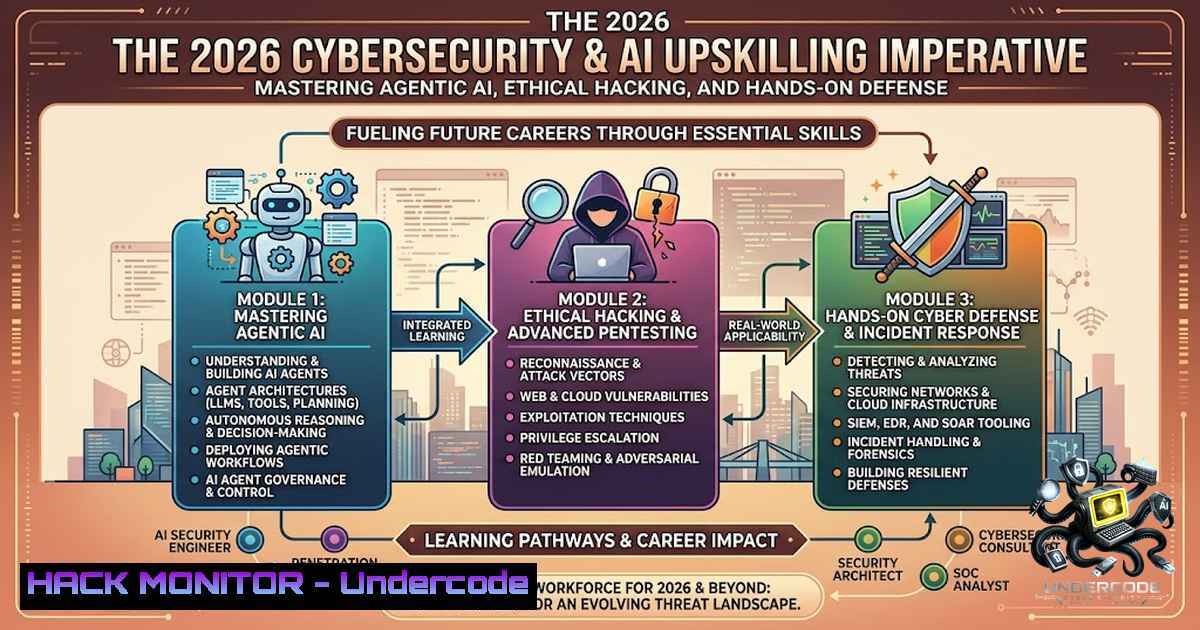
As we navigate through 2026, the cybersecurity landscape is evolving at an unprecedented pace, driven by the dual forces of artificial intelligence and increasingly sophisticated attack vectors. Organizations worldwide are grappling with AI-powered threats, ransomware, and advanced persistent attacks, creating an urgent demand for professionals who can bridge the gap between data science and security. This convergence has made hands-on, industry-aligned training in areas like Data Science, AI, and Cybersecurity not just an advantage, but a necessity for those looking to thrive in the modern tech ecosystem.
Learning Objectives:
- Master the fundamentals of AI-powered threat detection and ethical hacking to defend against modern cyberattacks.
- Develop practical skills in Generative AI and Agentic AI development, including building and deploying autonomous AI agents.
- Gain hands-on experience with real-world labs, tools, and frameworks used by industry leaders for security automation and incident response.
You Should Know:
1. Understanding the AI-Cybersecurity Symbiosis
The relationship between AI and cybersecurity is a double-edged sword. On one hand, cybercriminals are leveraging AI to enhance phishing attacks, automate malware, and create sophisticated scams. On the other, security professionals are using AI-powered tools for threat detection, behavioral analysis, and automated response. To stay ahead, you must understand both sides of this equation.
Step‑by‑step guide: Setting Up an AI-Powered Threat Detection Lab
- Environment Setup: Begin by setting up a virtual lab environment. Use VirtualBox or VMware to create a Kali Linux virtual machine (VM) and a Windows 10/11 client VM.
- Install Essential Tools: On your Kali Linux VM, install key tools like Nmap for network scanning, Metasploit for exploitation, and theHarvester for OSINT gathering.
sudo apt update && sudo apt install nmap metasploit-framework theharvester -y
- Deploy a Target Environment: Set up a vulnerable target like Metasploitable or DVWA (Damn Vulnerable Web Application) within your lab to practice ethical hacking techniques.
- Integrate AI for Log Analysis: Use a Python script with a machine learning library to analyze security logs. A practical example is using a Random Forest classifier to identify phishing emails, as demonstrated in the `ai_for_the_win` lab:
Example snippet for phishing detection
from sklearn.ensemble import RandomForestClassifier
... (load and vectorize email data)
model = RandomForestClassifier()
model.fit(X_train, y_train)
predictions = model.predict(X_test)
- Monitor and Respond: Configure a Security Information and Event Management (SIEM) tool like Wazuh to aggregate logs from your VMs and set up alerts for suspicious activities.
2. Mastering Agentic AI for Enterprise Automation
Agentic AI represents the next frontier, moving beyond simple generative models to autonomous systems that can plan, reason, and execute complex tasks. These agents are built using frameworks like AutoGen, CrewAI, and LangGraph, and are capable of orchestrating multi-step workflows.
Step‑by‑step guide: Building a Simple Agentic AI Workflow
- Choose a Framework: Select an agentic framework. For beginners, CrewAI or the OpenAI Agents SDK are good starting points due to their extensive documentation.
- Set Up Your Environment: Install the necessary libraries. For CrewAI:
pip install crewai
- Define Your Agent’s Role: Create a Python script to define an agent with a specific role, goal, and backstory. For example, a “Security Analyst Agent” that automates vulnerability scanning.
from crewai import Agent, Task, Crew
security_agent = Agent(
role='Security Analyst',
goal='Identify and prioritize vulnerabilities in the system.',
backstory='You are an expert in cybersecurity with a focus on automated threat intelligence.',
verbose=True
)
- Create a Task: Define a task for the agent, such as scanning a network for open ports.
scan_task = Task(
description='Scan the target IP range for open ports using Nmap.',
agent=security_agent,
expected_output='A list of open ports and services.'
)
- Execute the Crew: Assemble the agent and task into a crew and kick off the process.
crew = Crew(agents=[bash], tasks=[bash])
result = crew.kickoff()
print(result)
3. Practical Cybersecurity and Ethical Hacking Techniques
A strong foundation in core cybersecurity principles is essential. Modern courses emphasize hands-on labs covering a wide range of topics, from advanced persistent threats (APTs) to API security and cloud hardening.
Step‑by‑step guide: Performing an API Security Assessment
- Understand the OWASP Top 10: Familiarize yourself with the OWASP Top 10 for API Security, which includes risks like Broken Object Level Authorization (BOLA) and Broken Authentication.
- Use an API Testing Tool: Tools like Postman or Burp Suite can be used to intercept and modify API requests. Set up Burp Suite as a proxy between your browser and the target API.
- Test for BOLA: Attempt to access resources by changing object identifiers in the API request (e.g., changing `/user/123` to
/user/124). If you can access another user’s data without proper authorization, the API is vulnerable. - Check Authentication: Verify that the API enforces strong authentication mechanisms like OAuth 2.0 or OpenID Connect. Test for weaknesses by attempting to use expired or invalid tokens.
- Secure the API: Implement input validation, use rate limiting, and ensure all communications are over HTTPS. Consider using an API Gateway for an additional layer of security.
4. The Rise of Generative AI in Development
Generative AI is transforming how applications are built. Courses now focus on practical skills like prompt engineering, Retrieval-Augmented Generation (RAG), and LLM fine-tuning. Understanding how to build and secure these AI-powered applications is critical.
Step‑by‑step guide: Building a RAG-Powered Chatbot
- Set Up Your Environment: Install necessary Python libraries like
langchain,openai, andchromadb.pip install langchain openai chromadb
- Load and Index Documents: Load your documents (e.g., PDFs, text files) and split them into chunks. Use an embedding model to create vector representations and store them in a vector database like ChromaDB.
- Implement the RAG Pipeline: When a user asks a question, retrieve the most relevant document chunks from the vector database. Pass these chunks along with the user’s question to an LLM (e.g., GPT-4) to generate a context-aware response.
- Add Security Considerations: Ensure your RAG application is secure by sanitizing inputs to prevent prompt injection attacks and controlling the scope of documents the model can access to prevent data leakage.
5. Cloud Hardening and Security Operations
With organizations rapidly moving to the cloud, mastering cloud security models (IaaS, PaaS, SaaS) and hardening techniques is non-1egotiable. This involves understanding cloud-specific threats, implementing robust architectures, and setting up continuous monitoring.
Step‑by‑step guide: Hardening a Cloud Environment (AWS Example)
- Implement the Principle of Least Privilege: Use Identity and Access Management (IAM) to grant users and services only the permissions they need to perform their tasks.
- Enable Logging and Monitoring: Activate services like AWS CloudTrail for API activity logging and Amazon GuardDuty for intelligent threat detection.
- Secure Data: Encrypt data at rest using AWS Key Management Service (KMS) and data in transit using TLS.
- Configure Security Groups and Network ACLs: Restrict inbound and outbound traffic to only what is necessary. For example, a web server should only allow traffic on ports 80 (HTTP) and 443 (HTTPS).
- Regularly Audit and Patch: Use AWS Inspector to assess your environment for vulnerabilities and ensure all systems are up-to-date with the latest security patches.
What Undercode Say:
- The Hands-On Imperative: Success in 2026’s tech landscape demands more than theoretical knowledge; it requires practical, lab-based experience that simulates real-world scenarios.
- Agentic AI is the Future: Moving beyond simple prompt engineering to building autonomous, multi-agent systems will be a key differentiator for AI professionals.
- Cybersecurity is Everyone’s Responsibility: With AI-enhanced threats on the rise, security skills are no longer just for specialists but are critical for all IT and data professionals.
Prediction:
- +1 The integration of AI and cybersecurity will lead to the creation of new, highly specialized roles like “AI Security Architect” and “Agentic AI Engineer,” driving significant job growth in the coming years.
- +1 Hands-on, industry-aligned training programs will become the gold standard for education, as employers increasingly prioritize practical skills over traditional degrees.
- -1 The proliferation of AI-powered cyberattacks will outpace the development of defensive measures, leading to a “crisis of trust” in digital systems and a surge in demand for ethical hackers.
- +1 Agentic AI frameworks will mature rapidly, enabling fully autonomous security operations centers (SOCs) that can detect, investigate, and respond to threats with minimal human intervention.
- -1 The skills gap in AI and cybersecurity will widen, creating a significant shortage of qualified professionals and leaving many organizations vulnerable to sophisticated attacks.
▶️ Related Video (78% Match):
🎯Let’s Practice For Free:
🎓 Live Courses & Certifications:
Join Undercode Academy for Verified Certifications
🚀 Request a Custom Project:
Secure, high-velocity infrastructure and disruptive technological engineering. Contact our engineering team for high-tier development and proprietary systems:
[email protected]
💎 Smart Architecture | 🛡️ Secure by Design | ⭐ Trusted by Thousands
IT/Security Reporter URL:
Reported By: https://lnkd.in/p/eGjSeDJh – Hackers Feeds
Extra Hub: Undercode MoN
Basic Verification: Pass ✅


