Listen to this Post
Introduction
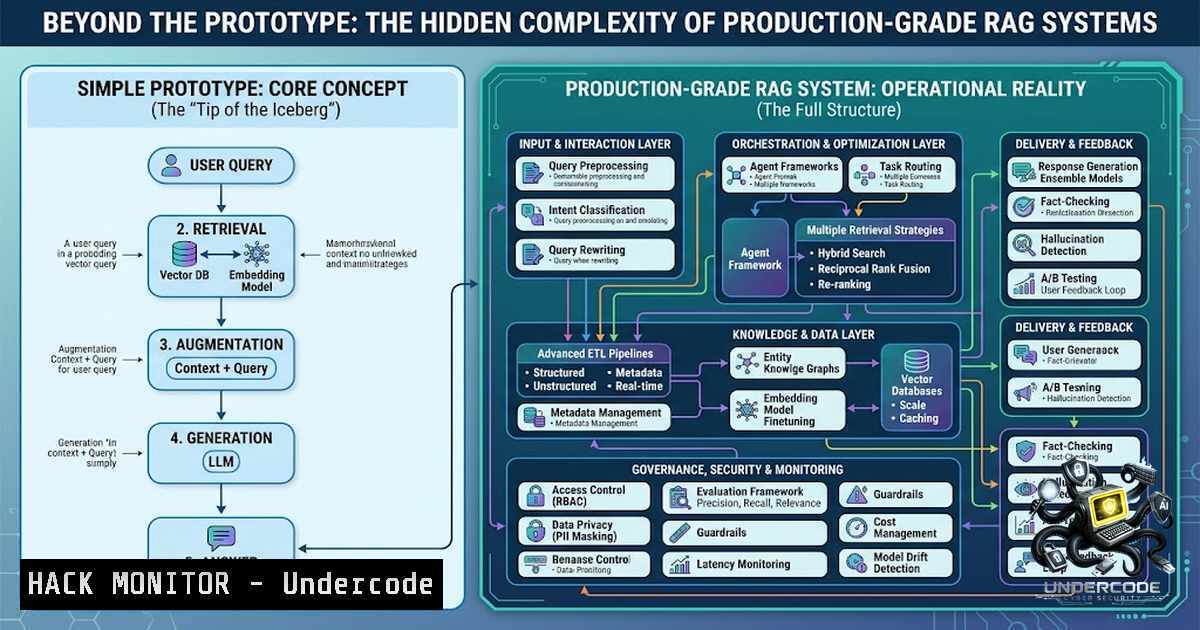
Retrieval-Augmented Generation (RAG) has emerged as a powerful paradigm for enhancing Large Language Models (LLMs) with external knowledge, enabling more accurate and contextually relevant responses. While the conceptual architecture appears straightforward—PDF ingestion, chunking, embedding generation, vector storage, similarity search, and LLM synthesis—the journey from a functional prototype to a production-ready system reveals layers of engineering complexity that transform this simple pipeline into a sophisticated distributed architecture. This article explores the multifaceted challenges encountered when scaling RAG systems from a handful of users to millions, addressing security vulnerabilities, retrieval optimization, system reliability, and performance engineering.
Learning Objectives
- Understand the security implications of user inputs in RAG systems, including prompt injection and jailbreak attacks
- Master advanced retrieval techniques including hybrid search, query rewriting, and reranking strategies
- Learn to design scalable RAG architectures with caching, rate limiting, and distributed database optimization
- Implement comprehensive observability and monitoring for production RAG deployments
- Apply practical mitigation strategies for retrieval failures, LLM hallucinations, and system timeouts
You Should Know
1. Hardening the Input Pipeline: Security and Validation
The assumption that user inputs are benign represents one of the most dangerous oversights in RAG system design. When I first encountered the “User Input Is Evil” concept, it fundamentally reshaped my approach to building AI systems. A production RAG system must defend against prompt injection attacks where malicious users craft inputs that attempt to override system instructions, jailbreak attempts that bypass safety filters, and document-based attacks where uploaded files contain hidden instructions to manipulate retrieval or generation.
Input validation requires a layered defense strategy. Start with input sanitization to remove escape sequences and control characters that could alter query parsing. Implement content filtering to detect and block potentially harmful patterns. However, traditional validation approaches prove insufficient because attacks can be encoded, obfuscated, or distributed across multiple turns of conversation.
Step‑by‑step validation implementation:
1. Query pre‑processing pipeline
Create a validation service that intercepts all user inputs before they reach the retrieval system.
import re
from typing import Tuple, Optional

class InputValidator:
def <strong>init</strong>(self):
 Patterns for common injection vectors
self.dangerous_patterns = [
r"ignore\s+(previous|above|the\s+above)",
r"system\s+1rompt",
r"you\s+are\s+now\s+",
r"disregard\s+(all\s+)?previous",
r"new\s+instruction",
r"role\s:"
]
self.max_length = 2048

def validate(self, query: str) -> Tuple[bool, Optional[bash]]:
 Length check
if len(query) > self.max_length:
return False, "Query exceeds maximum length"

Pattern matching for injection attempts
for pattern in self.dangerous_patterns:
if re.search(pattern, query.lower()):
return False, f"Suspicious pattern detected: {pattern}"

Content filtering - block obvious jailbreak attempts
normalized = query.lower()
jailbreak_indicators = ["jailbreak", "bypass", "ignore all", "new persona"]
if any(indicator in normalized for indicator in jailbreak_indicators):
return False, "Request contains prohibited content"

return True, None
2. Implement content moderation
Use pre‑trained models like OpenAI’s moderation endpoint or open‑source alternatives to flag unsafe content.
 Example using OpenAI moderation API
curl https://api.openai.com/v1/moderations \
-H "Authorization: Bearer $OPENAI_API_KEY" \
-H "Content-Type: application/json" \
-d '{"input": "Your query here"}'
3. Guardrails framework integration
Deploy guardrail systems that act as policy enforcement points, ensuring outputs comply with safety and security requirements before returning responses to users.
4. Rate limiting and request throttling
In the `nginx.conf` file:
limit_req_zone $binary_remote_addr zone=rag_requests:10m rate=30r/m;
location /rag/ {
limit_req zone=rag_requests burst=10 nodelay;
proxy_pass http://rag_backend;
}
2. Query Understanding and Retrieval Optimization
A critical insight that emerged from working with RAG systems is that similarity search alone rarely retrieves the most relevant context. The assumption “embed everything, search everything, and the best match wins” fails when queries are ambiguous, information spans multiple chunks, or semantic similarity doesn’t equate to actual relevance. This realization led to the development of comprehensive retrieval strategies that transform naive similarity search into a sophisticated understanding of user intent.
The challenge of ambiguous queries requires query rewriting and expansion. When a user asks “How do I fix this error?” without context, the system must infer what “this” references or provide clarifying questions. For technical documentation queries, we can leverage historical context and conversation state to disambiguate references. Similarly, when correct information appears across multiple chunks—a common scenario in technical documentation where a concept is introduced, elaborated, and finally summarized—the retrieval system must identify and combine these dispersed pieces.
Step‑by‑step advanced retrieval implementation:
1. Query rewriting with LLM assistance
Transform ambiguous or incomplete queries into more searchable forms.
def rewrite_query(original_query: str, conversation_history: list = None) -> str:
prompt = f"""Rewrite the following user query to make it more specific and searchable.
If the query is ambiguous or lacks context, add clarifying details from the conversation.
Original query: {original_query}
{f"Conversation history: {conversation_history}" if conversation_history else ""}
Rewritten query:"""
return llm.generate(prompt)
2. Hybrid search combining vector and keyword methods
Use Elasticsearch or OpenSearch for BM25 keyword search alongside vector similarity, then combine results.
from elasticsearch import Elasticsearch
from sentence_transformers import SentenceTransformer
import numpy as np

def hybrid_search(query: str, es_client: Elasticsearch, index: str, embedder: SentenceTransformer, k: int = 10):
 Generate embedding
query_embedding = embedder.encode(query)

Vector search
vector_query = {
"script_score": {
"query": {"match_all": {}},
"script": {
"source": "cosineSimilarity(params.query_vector, 'embedding') + 1.0",
"params": {"query_vector": query_embedding.tolist()}
}
}
}

Keyword search (BM25)
keyword_query = {
"multi_match": {
"query": query,
"fields": ["title^3", "content", "metadata"],
"type": "best_fields",
"fuzziness": "AUTO"
}
}

Execute both searches and combine results
vector_results = es_client.search(index=index, body={"size": k, "query": vector_query})
keyword_results = es_client.search(index=index, body={"size": k, "query": keyword_query})

Reciprocal Rank Fusion
return combine_results(vector_results, keyword_results, k)
3. Reranking with cross‑encoders
Use a cross‑encoder model to re‑evaluate retrieved candidates for better relevance ordering.
 Install sentence-transformers with cross-encoder
pip install sentence-transformers
from sentence_transformers import CrossEncoder

reranker = CrossEncoder('cross-encoder/ms-marco-MiniLM-L-6-v2')
def rerank_results(query: str, documents: list) -> list:
pairs = [[query, doc['content']] for doc in documents]
scores = reranker.predict(pairs)
 Sort documents by reranking score
sorted_docs = sorted(zip(documents, scores), key=lambda x: x[bash], reverse=True)
return [doc for doc, _ in sorted_docs]
4. Metadata filtering and context management
Implement dynamic metadata extraction that filters documents based on time, source, author, or domain.
3. Building Resilient Systems: Failure Handling and Observability
The complexity of production RAG systems becomes starkly apparent when we examine failure modes. In a prototype environment, when a document parser fails or an LLM hallucinates, the developer simply reruns the pipeline. In production, these failures cascade across thousands of concurrent requests, each with different error profiles. Retriever failures occur when vector databases become inconsistent or embeddings lose quality due to model updates. LLM hallucinations manifest as plausible but incorrect responses, often indistinguishable from correct outputs without rigorous evaluation. Service timeouts and database slowdowns introduce latency spikes that degrade user experience.
Building resilience requires implementing comprehensive retry mechanisms with exponential backoff, fallback strategies that degrade gracefully rather than fail completely, and extensive monitoring to detect anomalies before they impact users. Observability goes beyond simple logging to include performance tracing, error clustering, and real‑time alerting based on response quality metrics.
Step‑by‑step implementing resilience and observability:
1. Retry and backoff strategy
Implement retry logic for transient failures like network timeouts.
import time
from typing import Callable, Any

def retry_with_backoff(func: Callable, max_retries: int = 3, initial_delay: int = 1) -> Any:
retries = 0
delay = initial_delay
while retries < max_retries:
try:
return func()
except Exception as e:
retries += 1
if retries >= max_retries:
raise e
time.sleep(delay  (2 retries))  Exponential backoff
2. Fallback mechanisms
Configure fallback retrievers when the primary vector database is unavailable.
def retrieve_with_fallback(query: str, primary_db, fallback_db):
try:
return primary_db.search(query)
except ConnectionError:
 Log the failure
logger.error("Primary database unavailable, using fallback")
return fallback_db.search(query)
3. Monitoring and logging
Deploy Prometheus and Grafana for system metrics, and structured logging for debugging.
 prometheus.yml
scrape_configs:
- job_name: 'rag_service'
static_configs:
- targets: ['localhost:8000']
import logging
import json

logger = logging.getLogger("rag_system")
def log_event(event_type: str, details: dict):
log_entry = {
"timestamp": time.time(),
"type": event_type,
"details": details
}
logger.info(json.dumps(log_entry))
4. Evaluation and quality monitoring
Implement RAGAS (RAG Assessment) metrics for automated evaluation.
pip install ragas
from ragas.metrics import answer_relevancy, context_precision, context_recall

def evaluate_response(query: str, context: list, answer: str) -> dict:
return {
"answer_relevancy": answer_relevancy(answer, context),
"context_precision": context_precision(context, query),
"context_recall": context_recall(context, query)
}
- Scaling to Millions: Performance Engineering and Distributed Architecture
The transition from 10 users to 1 million represents the most profound architectural shift in RAG system development. Performance bottlenecks that remain invisible under low load become critical blockers at scale. Latency emerges as the primary concern—a response that takes 2 seconds for 10 users becomes an overwhelming 2,000,000 seconds of cumulative processing time for a million users. Caching strategies must be carefully designed to maximize cache hit ratios while invalidating stale data. Database performance requires sharding, replication, and optimized indexing. Queueing systems manage request bursts while rate limiting protects backend services from overload.
At cloud scale, cost optimization becomes inseparable from performance engineering. Each embedding generation API call, each vector database query, and each LLM invocation carries a financial cost. Efficient batching, opportunistic caching, and intelligent routing to cost‑optimized models for simple queries become essential practices that balance performance against operational expenditure.
Step‑by‑step scaling implementation:
1. Caching strategy
Implement Redis or Memcached for query‑result caching and embedding caching.
import redis
import hashlib

cache = redis.Redis(host='localhost', port=6379, decode_responses=True)

def get_cached_response(query: str) -> str | None:
 Normalize and hash the query to use as cache key
normalized = query.lower().strip()
cache_key = hashlib.md5(normalized.encode()).hexdigest()

Try to get from cache
cached_response = cache.get(cache_key)
return cached_response
Docker command for running Redis:
docker run --1ame redis -p 6379:6379 -d redis:alpine
2. Database performance tuning
Optimize vector database with indexing, sharding, and connection pooling.
 PostgreSQL with pgvector
import psycopg2
from psycopg2 import pool

Create connection pool
pg_pool = psycopg2.pool.SimpleConnectionPool(1, 20, user="rag_user", password="secure_pw",
host="localhost", port=5432, database="rag_db")

def get_connection():
return pg_pool.getconn()
3. Queue‑based request processing
Use RabbitMQ or Kafka to decouple request handling from processing.
import pika

def publish_request(request):
connection = pika.BlockingConnection(pika.ConnectionParameters('localhost'))
channel = connection.channel()
channel.queue_declare(queue='rag_requests')
channel.basic_publish(exchange='', routing_key='rag_requests', body=json.dumps(request))
connection.close()
4. Load testing and performance benchmarking
Use Locust or JMeter to simulate user load and identify bottlenecks.
 Install Locust
pip install locust

Run load test
locust -f locustfile.py --host http://localhost:8000 --users 1000 --spawn-rate 100
Locustfile.py example:
from locust import HttpUser, task, between

class RAGUser(HttpUser):
wait_time = between(1, 5)

@task
def ask_question(self):
self.client.post("/rag/query", json={"query": "What is RAG?"})
What Undercode Say
- RAG is not a pipeline; it’s a distributed system. The simplistic PDF→Chunks→LLM flow that works for prototypes collapses under production constraints. True RAG engineering requires treating each component—ingestion, storage, retrieval, generation, and monitoring—as independently scalable microservices.
-
Security must be embedded at every layer. The assumption that user inputs are benign is dangerous; production RAG systems need defense‑in‑depth with validation, guardrails, content moderation, and rate limiting to prevent prompt injection and abuse.
Analysis: The evolution from simple RAG prototypes to enterprise‑grade systems reveals fundamental truths about AI engineering. The initial enthusiasm for RAG’s elegant concept masks the harsh realities of real‑world deployment: malicious users, ambiguous queries, system failures, and relentless scaling pressures. Organizations that succeed in building production RAG systems don’t just implement better retrieval algorithms; they build entire engineering cultures around resilience, observability, and continuous evaluation.
The complexity often exceeds expectations because RAG operates at the intersection of multiple disciplines—information retrieval, natural language processing, distributed systems, and security engineering. Each component presents unique challenges: retrieval must balance precision and recall; LLM generation must balance creativity and factuality; system architecture must balance performance and cost. The companies that master this complexity, like Google with NotebookLM and various enterprise AI platforms, effectively create new product categories that transform how knowledge workers interact with information.
Prediction
- +1 The RAG ecosystem will see consolidation around standardized evaluation frameworks, enabling organizations to benchmark and compare RAG systems objectively, driving rapid innovation in retrieval and generation quality.
-
-1 Security vulnerabilities in RAG systems will become a significant attack vector, with prompt injection and data poisoning attacks increasingly targeting enterprise AI deployments, necessitating new security paradigms.
-
+1 Specialized RAG‑optimized databases and infrastructure will emerge, reducing the engineering burden and enabling smaller teams to build production‑grade systems without deep distributed systems expertise.
-
-1 The compute and storage costs of production RAG systems at scale may limit adoption to well‑funded enterprises, creating a capability gap between large organizations and smaller players who cannot afford sophisticated RAG infrastructure.
▶️ Related Video (88% Match):
https://www.youtube.com/watch?v=1F9IohtPuPY
🎯Let’s Practice For Free:
🎓 Live Courses & Certifications:
Join Undercode Academy for Verified Certifications
🚀 Request a Custom Project:
Secure, high-velocity infrastructure and disruptive technological engineering. Contact our engineering team for high-tier development and proprietary systems:
[email protected]
💎 Smart Architecture | 🛡️ Secure by Design | ⭐ Trusted by Thousands
IT/Security Reporter URL:
Reported By: https://lnkd.in/p/en4ZMkiu – Hackers Feeds
Extra Hub: Undercode MoN
Basic Verification: Pass ✅


