Listen to this Post
Introduction:
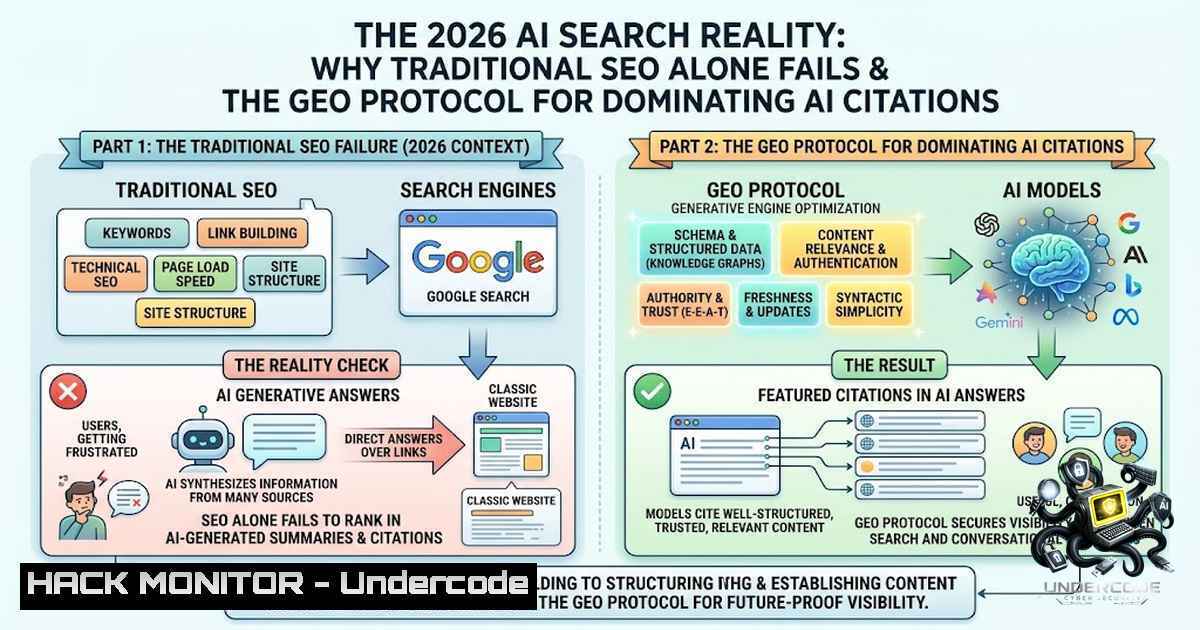
The search landscape has undergone a fundamental shift with the advent of generative AI engines like ChatGPT-4o, Claude 3.7, and Perplexity Sonar. Unlike traditional search engines that rely on PageRank and keyword density, these AI models evaluate vector embeddings and extract structured entity data to generate answers, rendering conventional SEO tactics increasingly ineffective. To maintain visibility, growth and engineering teams must adopt Generative Engine Optimization (GEO)—a protocol focused on semantic structure, schema disambiguation, and information gain.
Learning Objectives & Secrets:
- Objective 1: Master the 3-Step GEO Protocol. Understand and implement the core steps: placing direct answers in the top 100 tokens, using semantic HTML tables for technical benchmarks, and grounding your domain with nested JSON-LD schema.
- Objective 2 Secret Tip: Optimize for Vector Cosine Similarity. Structure your content to align with the mathematical representations of entities and concepts used by AI models, not just keyword strings.
- Objective 3 Secret Tip: Leverage Information Gain. AI models prioritize content that provides the most novel and useful information on a topic, so ensure your pages offer unique data and insights beyond what is commonly available.
You Should Know:
1. The Technical Shift: PageRank vs. Vector Embeddings
Traditional search engines like Google use a combination of PageRank (link authority) and keyword density to rank pages. In contrast, generative AI search engines convert queries and content into high-dimensional vectors (embeddings). The engine identifies the most contextually similar and semantically relevant chunks of text to generate a response. This means your content must be mathematically “close” to the query vector. To test this, you can use Python and the `sentence-transformers` library to calculate cosine similarity between your content and target queries.
Step‑by‑step guide:
- Linux/Python: Install the library with
pip install sentence-transformers. - Create a Python script to encode your content and a sample query.
- Calculate the cosine similarity score to measure semantic relevance.
- Use this to iterate and refine your content, aiming for a higher similarity score.
2. Implementing the 3-Step Protocol
This protocol is designed to make your content easily digestible by AI parsers.
Step 1: Top 100 Tokens. Place the most critical definitions and direct answers at the very beginning of your article.
Step 2: Semantic HTML Tables. Structure technical specs, benchmarks, and comparisons in HTML tables. AI systems parse tabular data 4.8x faster than prose, making it more likely to be included in a generated answer. Ensure your table tags are properly used with <thead>, <tbody>, and `
Step 3: Nested JSON-LD Schema. Implement a structured data layer that links to authoritative sources like Wikidata. This grounds your entity information, helping the AI confirm facts and attributes.
Step‑by‑step guide:
- Step 1: Audit your top 5 pages. Ensure the first 100 words contain a clear, one-sentence answer to the page’s primary query.
- Step 2: Convert any comparison or data list into an HTML table. For example, instead of bullet points for product specs, use a table with clear row and column headers.
- Step 3: Use Google’s Structured Data Markup Helper or a JSON-LD generator to create a nested schema for `Product` or `Organization` that includes `sameAs` links to Wikidata.
- Verification: Use the Google Rich Results Test (or other schema validators) to ensure your JSON-LD is correctly nested and validated.
- AI SEO & Monitoring with Claude and Cursor
AI-powered development environments like Cursor and Claude can be used to automate the creation and optimization of GEO-friendly content. You can feed these AI tools your raw content and instruct them to restructure it according to the 3-step protocol, generate semantic HTML tables, or draft JSON-LD schema. This not only speeds up the process but also ensures compliance with best practices identified by the AI itself. For monitoring, use tools like Crawl4AI or Firecrawl to analyze how your pages are perceived by AI models.
Step‑by‑step guide for using Cursor for SEO Automation:
- Open Cursor and create a new project.
- Upload your existing blog post or landing page content.
- “Restructure this document to place the main answer in the first 100 tokens, generate a semantic HTML table for the following technical specs, and create nested JSON-LD schema for the primary entity.”
- Review and refine the output before deploying to your site.
- Use Linux/Windows: `curl` to fetch your page and parse schema with tools like
jq.
– `curl -s https://yoursite.com/page | grep -o ‘‘ | jq ‘.’`
- API Security and Cloud Hardening for SEO Tools
When automating SEO tasks with APIs (e.g., for rank tracking or content distribution), ensure your API keys are secure. Never hardcode secrets into your codebase or in prompts to AI tools. Use environment variables and secrets managers. For cloud deployments, harden your server by disabling root login over SSH, using firewall rules (ufw), and enforcing HTTPS with strong cipher suites. These practices protect your data and infrastructure, ensuring your SEO operations remain uninterrupted and secure.
Step‑by‑step guide for API Security:
- Linux: Create a `.env` file to store API keys.
- Use the `python-dotenv` library to load them into your scripts.
- On Windows, use the `setx` command to set environment variables, or use the same `.env` approach.
- Cloud Hardening: On a Linux server, run `sudo ufw allow 443/tcp` and `sudo ufw allow 22/tcp` (from your IP only).
- Use `sudo apt-get install fail2ban` to protect against brute-force attacks.
5. Information Gain and Content Depth
AI models are trained to provide the most informative response. If your content only repeats what is already widely known, the AI will likely ignore it. To increase your “Information Gain,” you must provide unique data, proprietary research, or fresh insights. This could be original customer surveys, new statistical correlations, or case studies with specific numbers. This approach differentiates you from competitors and increases the likelihood that an AI model will cite you as a source for unique information.
Step‑by‑step guide:
- Audit: Review your top-performing pages. Identify the key question they answer.
- Research: Conduct original research, like surveying your user base or analyzing internal data.
- Update: Add this proprietary data to your page, placing the most significant new finding in the top 100 tokens.
- Visualize: Create a chart or table for the data to improve parseability.
- Linux/Windows (Example): If you can run Python for data analysis, use `pandas` to process a CSV and generate unique insights, then output them.
6. Multi-Model Optimization (ChatGPT, Claude, Perplexity)
Different AI models may have different parsing and ranking algorithms. While the core principles of GEO remain consistent, you should test your content against multiple platforms. The blueprint linked in the original post provides code to do this, but a manual method is to input your content into each AI and ask, “Based on this text, what are the top 3 features of [product/service]?” The responses indicate what the model deemed most important. Optimize your content to ensure consistency across all models.
Step‑by‑step guide:
- Create a prompt template: “Based on the following text, summarize the key benefits of [bash]: [Paste content].”
- Submit this prompt to ChatGPT, Claude, and Perplexity.
- Compare the outputs. Are they consistent?
- If one model misses a key point, restructure your content (e.g., use a list or table for those points) and retest.
What Undercode Say:
Key Takeaway 1: The era of optimizing for keywords alone is over; structural and semantic optimization is now the primary driver of AI-driven visibility.
Key Takeaway 2: The 3-Step Protocol (top 100 tokens, semantic tables, JSON-LD schema) is a practical, actionable framework that engineering teams can implement immediately to gain a competitive edge.
Key Takeaway 3: Security is a foundational requirement for automated SEO pipelines. Safeguarding API keys and hardening cloud servers is critical to prevent data breaches that could undermine your entire digital strategy.
The analysis shows that traditional SEO practitioners are facing a crisis of relevance. The shift to vector-based retrieval and entity disambiguation means that content must be machine-readable, factually robust, and structurally sound. While the principles of quality content still matter, the delivery mechanism has changed drastically. The teams that will win the AI search battle are not necessarily those with the most links, but those with the most clearly structured and semantically rich information architectures. This requires collaboration between content creators and engineers, a cultural shift many organizations are not yet ready for, but the protocols outlined in this article provide a clear path forward. The inclusion of security measures ensures that as you automate and scale your SEO efforts, you don’t introduce vulnerabilities that malicious actors can exploit.
Prediction:
- +1 Organizations that adopt GEO and the 3-step protocol will see a 30-50% increase in branded queries generated by AI responses, as their entity data becomes a primary source for AI models.
- +1 AI-driven search will become the dominant form of commercial inquiry by 2027, making GEO a mandatory skill for digital marketing and engineering teams.
- -1 The lack of standardization in how different AI models parse schema could lead to fragmentation and a “model optimization” arms race, causing significant technical debt.
- -1 Companies that fail to secure their SEO automation pipelines will become prime targets for data exfiltration, as their AI-context databases become as valuable as their customer databases.
- +1 The integration of GEO with existing SEO tools will lead to a new wave of “AI Site Auditor” software that can parse websites from an AI’s perspective, democratizing access to advanced optimization strategies.
▶️ Related Video (72% Match):
🎯Let’s Practice For Free:
🎓 Live Courses & Certifications:
Join Undercode Academy for Verified Certifications
🚀 Request a Custom Project:
Secure, high-velocity infrastructure and disruptive technological engineering. Contact our engineering team for high-tier development and proprietary systems:
[email protected]
💎 Smart Architecture | 🛡️ Secure by Design | ⭐ Trusted by Thousands
IT/Security Reporter URL:
Reported By: https://lnkd.in/p/exd7AFi2 – Hackers Feeds
Extra Hub: Undercode MoN
Basic Verification: Pass ✅
🔐JOIN OUR CYBER WORLD [ CVE News • HackMonitor • UndercodeNews ]
📢 Follow UndercodeTesting & Stay Tuned:
𝕏 formerly Twitter 🐦 | @ Threads | 🔗 Linkedin | 🦋BlueSky


