
Listen to this Post
Introduction:
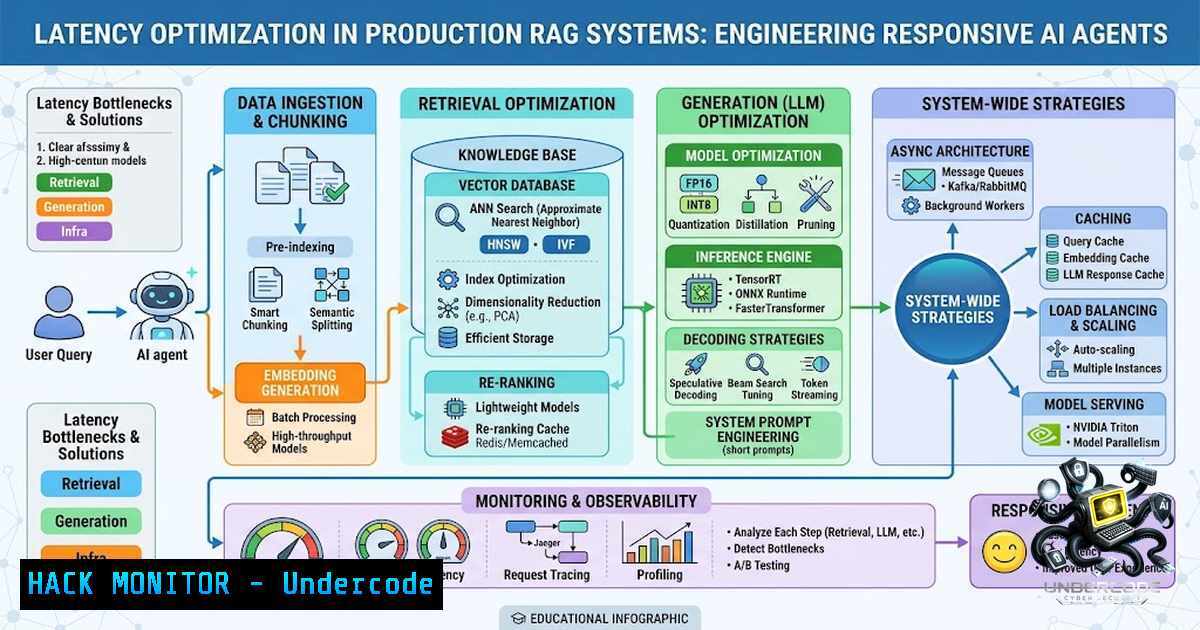
Retrieval-Augmented Generation (RAG) has emerged as the dominant architecture for grounding Large Language Models (LLMs) in proprietary data, yet the transition from prototype to production often exposes a critical bottleneck: latency. While accuracy and factual grounding are paramount, user experience is directly tied to responsiveness; a slow, grounded answer can erode trust faster than a hallucinated one. Modern AI engineering must therefore treat latency not as a model limitation, but as a system architecture challenge, implementing strategies like response streaming, intelligent caching, and dynamic context pruning to deliver production-grade performance.
Learning Objectives & Secrets:
- Objective 1: Implement Server-Sent Events (SSE) for Responsive UX. Learn to stream LLM responses token-by-token to drastically reduce Time-to-First-Token (TTFT) and create the perception of speed.
- Objective 2: Leverage Semantic Caching for Repeated Queries. Secret: Move beyond exact-match caching to semantic caching using vector similarity, allowing the system to return cached results for conceptually similar questions without re-invoking the LLM.
- Objective 3: Design Dynamic Context Truncation. Secret: Instead of cramming all retrieved documents into the prompt, implement a relevance scoring mechanism to pass only the top-K chunks to the model, reducing token processing time and cost while maintaining answer quality.
You Should Know:
1. Implementing Response Streaming with Server-Sent Events (SSE)
Streaming is the most immediate way to improve perceived performance. Instead of waiting for the entire response payload to be generated by the Gemini API, SSE allows the server to push data to the client as soon as it is available.
Step‑by‑step guide explaining what this does and how to use it:
– Step 1: Set up a route in your backend (e.g., FastAPI or Flask) that accepts a user query and initiates a streaming request to the Gemini API. Ensure the route returns a `StreamingResponse` with the correct Content-Type: text/event-stream.
– Step 2: In your frontend (JavaScript), use the `EventSource` API or the `fetch` API with `response.body.getReader()` to listen for incoming data chunks.
– Step 3: As each chunk arrives, append it directly to the UI. This provides visual feedback to the user that the system is “thinking” and working on their request, effectively reducing the perceived latency to zero.
Example Code (Backend – Python FastAPI):
from fastapi import FastAPI
from fastapi.responses import StreamingResponse
import google.generativeai as genai
import asyncio

app = FastAPI()

async def stream_gemini_response(prompt: str):
model = genai.GenerativeModel('gemini-1.5-pro')
response = model.generate_content(prompt, stream=True)
for chunk in response:
yield f"data: {chunk.text}\n\n"
await asyncio.sleep(0)  Yield control to event loop

@app.get("/stream")
async def stream(prompt: str):
return StreamingResponse(stream_gemini_response(prompt), media_type="text/event-stream")
Linux/Windows Command (Testing):
To test the endpoint without a browser, use curl:
curl -1 http://localhost:8000/stream?prompt=Tell%20me%20about%20RAG
The `-1` flag disables buffering, allowing you to see the streamed data in real-time.
2. Leveraging Redis for Semantic Caching
Caching is a powerful tool, but traditional key-value stores fail when users ask the same question in different ways. Semantic caching solves this by using embeddings.
Step‑by‑step guide explaining what this does and how to use it:
– Step 1: Before sending a query to the Gemini API, generate an embedding for the user’s question using a lightweight model (e.g., text-embedding-004).
– Step 2: Use a vector database like Redis Stack or Pinecone to query for similar vectors. Set a similarity threshold (e.g., Cosine Similarity > 0.95).
– Step 3: If a match is found, return the cached response instantly. If not, proceed to the LLM and store the new query embedding and response for future use.
Example Redis Command:
 Assuming Redis Stack is running with the RediSearch module
redis-cli FT.CREATE idx:questions SCHEMA embedding VECTOR HNSW 6 DIM 768 TYPE FLOAT32 DISTANCE_METRIC COSINE
 Query for similar vectors
redis-cli FT.SEARCH idx:questions "=>[KNN 1 @embedding $query_vec]" PARAMS 2 query_vec <binary_vector> DIALECT 2
3. Conditional API Requests and Context Pruning
A significant portion of latency stems from unnecessary external calls. If your portfolio agent integrates with GitHub, you don’t need to fetch project details unless specifically asked. This is a core tenet of “Just-in-Time” computation.
Step‑by‑step guide:
- Step 1: Implement an Intent Classification layer that runs before the RAG pipeline. This small, fast model determines the user’s intent (e.g.,
projects,experience,general_info). - Step 2: If the intent is
general_info, skip the GitHub API call entirely and rely solely on the static knowledge base. Use the LLM with a low “thinking” budget. - Step 3: For `projects` or detailed queries, activate the external GitHub connector, but implement a “trimmer” function that limits the returned context to the 3-5 most relevant files or pull requests. In Python, this can be done using a simple `list.sort()` based on a relevance score from the retrieval step.
Python Context Trimming Example:
def trim_context(retrieved_docs: list, max_chunks: int = 4):
 retrieved_docs is a list of (document, score) tuples
sorted_docs = sorted(retrieved_docs, key=lambda x: x[bash], reverse=True)
return [doc for doc, score in sorted_docs[:max_chunks]]
4. Adaptive Reasoning (Thinking) Settings
Gemini and other modern LLMs allow configuration of “reasoning effort.” For high-confidence, grounded questions, you can lower the reasoning tokens to reduce generation time. Conversely, for open-ended or complex analytical questions, allocate more compute.
Step‑by‑step guide explaining what this does and how to use it:
– Step 1: Include a `complexity_score` in your system prompt extraction or intent classification output.
– Step 2: Pass this score to the LLM generation config. For straightforward FAQ, set `temperature=0` and a lower top_k.
– Step 3: For “detailed experience” queries, increase the `temperature` slightly or enable a higher `candidate_count` to explore more reasoning paths (though this increases latency).
Gemini API Configuration Example:
genai.configure(api_key="YOUR_API_KEY")
model = genai.GenerativeModel('gemini-1.5-pro')
generation_config = {
"temperature": 0.7 if complex_question else 0.2,
"top_p": 0.95,
"top_k": 40,
"max_output_tokens": 2048
}
response = model.generate_content(prompt, generation_config=generation_config)
5. Mastering Token Budgets and Output Length
Token generation is the primary driver of latency. By controlling the max_output_tokens, you can forcibly speed up the generation process. A verbose response of 1000 tokens will always take longer than a concise 200-token summary.
Step‑by‑step guide:
- Step 1: Analyze the typical user question. If it’s a yes/no or fact-based question, force a `max_output_tokens` of 100-150.
- Step 2: Add an instruction in the system prompt: “Be concise. Keep responses under 3 sentences unless explicitly asked for detail.”
- Step 3: For “career” questions, dynamically increase the limit. This is a simple check on the user’s query text.
Linux Command to measure generation speed:
time curl -X POST https://your-gemini-endpoint/generate -H "Content-Type: application/json" -d '{"prompt": "Hello"}'
6. Production System Monitoring
Treating a RAG agent as a production system requires observability. Tools like Prometheus and Grafana can track latency percentiles, token usage, and cache hit rates.
Step‑by‑step guide:
- Step 1: Instrument your Python code with Prometheus client. Create metrics for
query_duration_seconds,cache_hit_total, andcontext_chunk_count. - Step 2: Expose these metrics on a `/metrics` endpoint.
- Step 3: Set up alerts if the P95 latency exceeds 4 seconds or if the cache hit ratio drops below 30%.
Python Code Snippet:
from prometheus_client import Counter, Histogram, start_http_server

REQUEST_TIME = Histogram('request_processing_seconds', 'Time spent processing request')
CACHE_HITS = Counter('cache_hits_total', 'Total number of cache hits')

@REQUEST_TIME.time()
def process_request(query):
 Your logic
if cache_hit:
CACHE_HITS.inc()
What Undercode Say:
- Key Takeaway 1: AI engineering is fundamentally a systems integration problem. The performance of a RAG agent depends less on the base model and more on the surrounding infrastructure, including retrieval strategies, caching mechanisms, and network calls.
- Key Takeaway 2: Latency optimization must be user-centric. Streaming, dynamic context trimming, and conditional execution are not just performance tweaks; they are critical UX decisions that build trust and engagement.
Analysis: Samar Singh’s approach illustrates a shift from treating AI systems as monolithic “black boxes” to engineering them as distributed systems. By breaking down the problem into token budgets, caching, and intent-based routing, the agent achieves a 3.5-second response time while maintaining reliability and the safe handling of sensitive data like resumes. This proves that robust engineering can enhance the “intelligence” of the system by making it more predictable and responsive, effectively turning latency from a flaw into a feature of a well-designed architecture.
Prediction:
- +1 The adoption of semantic caching and streaming will become standard in enterprise RAG systems, setting a new baseline for user expectations. We will see a proliferation of “Think/Thunk” architectures that separate fact retrieval from complex reasoning to optimize cost and speed.
- -1 Over-optimization and aggressive context pruning risk “hallucination by omission,” where the system discards crucial context to save time, leading to plausible but incomplete answers. This will require sophisticated “confidence-aware” retrieval systems that can flag when context is insufficient.
- +1 We will see the rise of “Performance-as-a-Feature” marketing in AI platforms, where providers compete on TTFT and throughput, driving innovation in specialized hardware and inference engines.
- -1 As systems become more complex with multiple caching layers and conditional logic, debugging and maintaining them will become a nightmare, increasing operational overhead and leading to brittle AI implementations that break in unexpected ways when underlying models change.
▶️ Related Video (88% Match):
🎯Let’s Practice For Free:
🎓 Live Courses & Certifications:
Join Undercode Academy for Verified Certifications
🚀 Request a Custom Project:
Secure, high-velocity infrastructure and disruptive technological engineering. Contact our engineering team for high-tier development and proprietary systems:
[email protected]
💎 Smart Architecture | 🛡️ Secure by Design | ⭐ Trusted by Thousands
IT/Security Reporter URL:
Reported By: https://lnkd.in/p/eWW8d3qd – Hackers Feeds
Extra Hub: Undercode MoN
Basic Verification: Pass ✅


