Listen to this Post
Introduction:
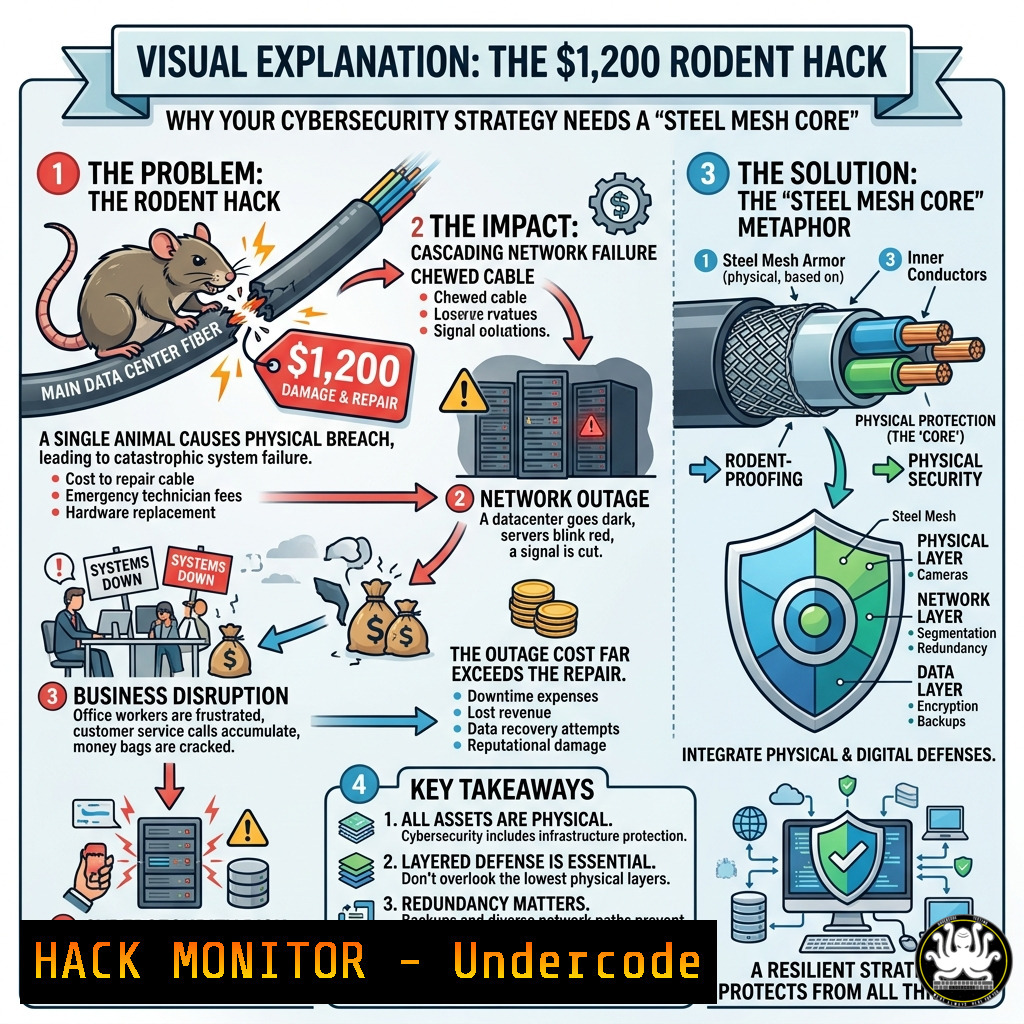
The physical and digital realms of enterprise security have long been managed as separate domains, but the modern threat landscape demands a unified approach. Rodent activity, often dismissed as a facilities issue, is directly responsible for thousands of confirmed power outages and network disruptions, with documented cases of a single squirrel cutting off over 1,000 broadband users for an entire day. As IoT sensors and AI-driven monitoring systems become the frontline of pest defense, protecting the physical integrity of critical infrastructure is no longer just about concrete and steel—it is a foundational cybersecurity requirement.
Learning Objectives:
- Understand the security and compliance risks of rodent-related physical infrastructure damage.
- Learn to implement layered physical access controls aligned with NIST Cybersecurity Framework 2.0.
- Identify vulnerabilities in IoT-based pest monitoring systems and apply OWASP best practices.
You Should Know:
- Exclusion as a Physical Access Control (NIST PR.AA-06)
A rodent’s ability to squeeze through a gap as small as a quarter is the physical equivalent of a zero-day vulnerability. Modern cybersecurity frameworks, such as NIST CSF 2.0, mandate strict controls over physical access to assets, treating physical breaches as critically as logical ones. The Flexi Armour Door, with its extruded rubber and knitted steel mesh core, acts as a “firewall” for your loading dock, physically preventing unauthorized “actors” (rodents) from gaining entry to server rooms or network hubs.
Step‑by‑step guide for conducting a physical access audit:
- Identify Entry Vectors: Using a site blueprint, mark all external and internal wall penetrations, including cable conduits, weep holes, and expansion joints. Use a flashlight to check under dock levelers.
- Apply the “Quarter Test”: If a gap is large enough to fit a U.S. quarter (approx. 24mm), it is a viable rodent entry point. This includes gaps under insulated roller doors.
3. Implement Physical Patches:
- For Doors: Install rodent-proof door seals or bottom sweeps. Rentokil’s Flexi Armour Doors utilize a unique knitted mesh core to prevent gnawing through.
- For Gaps: Use a stainless steel mesh combined with a hard-setting epoxy resin (like Flexi Armour Expansion) to seal expansion joints, which can flex without breaking the barrier.
- For Cables: Seal all cable and pipe entries with mechanical transit solutions that block fire, gas, and pests.
- Continuous Monitoring (Linux Command): To ensure compliance, log your audit results. On a Linux-based asset management system, you can use a simple command to create a timestamped entry for your security log:
sudo echo "Physical audit: Rodent exclusion verified. Gaps sealed at $(date)" >> /var/log/security/access_control.log
-
Securing the “Smart Trap”: IoT and AI Vulnerabilities
The integration of IoT sensors and machine learning into pest control is revolutionizing the industry. Rentokil’s PestConnect system uses 24/7 precision sensors and AI algorithms to detect rodent activity, reducing the need for traditional bait by up to 60%. However, every connected device is a potential backdoor. Research has shown that while LoRa-based pest detection systems are effective, they lack built-in security, exposing data to eavesdropping, sinkhole, and wormhole attacks.
Step‑by‑step guide to hardening IoT pest sensors:
- Implement Encryption: IoT sensors, such as an ESP32 with a PIR sensor, are resource-constrained. Implement lightweight but robust encryption like Triple DES (3DES) on the data stream. Recent studies show 3DES can be executed on such nodes in real-time with an average encryption delay of only 1.4 milliseconds, ensuring data integrity and confidentiality.
- Secure the Network Service: Refer to the OWASP IoT Top 10. Ensure that your pest monitoring system does not run “Insecure Network Services” or have “Insecure Ecosystem Interfaces” (APIs) that lack proper authentication.
- Segmentation (Windows Command): Isolate your IoT pest network from your corporate domain to prevent lateral movement. On a Windows Server acting as a Domain Controller, use PowerShell to enforce a firewall rule that blocks traffic between the IoT VLAN and the corporate LAN.
New-NetFirewallRule -DisplayName "Block IoT to Corporate" -Direction Inbound -LocalAddress 192.168.1.0/24 -RemoteAddress 10.0.0.0/8 -Action Block
- Update Protocols: Ensure that any cloud-based dashboard or mobile interface (like PestNetOnline) uses strong, modern TLS encryption for all data in transit.
3. Data Center Hardening: The CyberSquirrel Effect
The threat is not theoretical. The satirical “CyberSquirrel1” project documented over 1,252 successful “attacks” by squirrels on critical infrastructure, vastly outnumbering confirmed cyberwarfare incidents in the same period. For an IT facility, a rodent chewing through a fiber optic cable is not a maintenance issue; it is a denial-of-service (DoS) attack with a direct financial cost. Innovators in the space are pushing beyond traditional exclusion, exploring biological or neurological approaches to inhibit the motor nerve signals responsible for a rodent’s constant gnawing.
Step‑by‑step guide for server room protection:
- Seal the Perimeter: Check all cable trenches and access panels. Use mechanical seals (e.g., Roxtec) around every cable bundle entering the server room. These provide proven protection against fire, water, and pests.
- Deploy Deterrents: In floor voids and ceiling cavities, install ultrasonic rodent repellent systems that generate high-frequency sound waves (above 20kHz), which are inaudible to humans but irritating to rodents.
- Establish ERDM Principles: Follow the Exclusion, Restriction, Destruction, Monitoring (ERDM) framework. Restrict food and shelter by keeping the server room immaculate and sealing all garbage bins.
- Layered Monitoring: Integrate your physical security surveillance with your SIEM (Security Information and Event Management). Motion sensors that detect unauthorized movement (by rodents or humans) should trigger an access log entry.
4. Compliance Frameworks and Management Training
Facility managers must navigate overlapping regulatory standards. The Food Safety Modernization Act (FSMA) mandates preventive controls for pest infestations, requiring regular sanitation and detailed reporting of pest control measures. Furthermore, the NIST Cybersecurity Framework’s “Protect” function (PR.AA-06) explicitly requires that access to physical assets is managed and protected with layered controls. Management training, such as the Commercial Pest Control Training Workshop offered by Mississippi State University, provides essential recertification and covers everything from rodent control to the future of structural pest management, ensuring that human operators are as hardened as the infrastructure.
Step‑by‑step guide to building a compliance dashboard:
- Centralize Logs: Collect logs from your access control systems, IoT pest sensors, and manual inspection reports.
- Automate Alerts: Use Node-RED (a common tool in IoT systems) to process data from your LoRaWAN gateway and generate an alert if a sensor is triggered after hours.
- Generate Audit Reports: Create a weekly script (Linux) that extracts successful authentication events (PR.AA-01) and physical access attempts (PR.AA-06) from your logs, formatting them for FSMA or NIST compliance review.
What Undercode Say:
- Security is a Layered Stack: The humble rubber door seal is just as critical as the complex encryption algorithm. A failure in physical exclusion (Layer 1) bypasses every subsequent digital control.
- The “Tooth-Growth” Attack Vector: Rodents chew to manage tooth growth, not for food. This biological imperative means traditional baiting is reactive; future defense must involve “behavioral cybernetics,” tricking the rodent to stop chewing before it cuts the cable.
Prediction:
The convergence of operational technology (OT) and physical pest control will accelerate rapidly over the next 24 months.
– + AI-driven image recognition will reduce false positives from motion sensors by 90%, allowing for truly autonomous, proactive response teams.
– + The cost of LoRaWAN sensors will drop below $5/unit, making “security mesh” a standard data layer in all commercial buildings, not just data centers.
– – However, the OWASP IoT Top 10 (specifically “Insecure Ecosystem Interfaces” and “Lack of Physical Hardening”) will become a primary attack vector. Expect a headline within 18 months about a ransomware gang using compromised rodent trap APIs to pivot into a retail chain’s POS system.
▶️ Related Video (82% Match):
🎯Let’s Practice For Free:
IT/Security Reporter URL:
Reported By: Rodents Constantly – Hackers Feeds
Extra Hub: Undercode MoN
Basic Verification: Pass ✅
🎓 Live Courses & Certifications:
Join Undercode Academy for Verified Certifications
🚀 Request a Custom Project:
Secure, high-velocity infrastructure and disruptive technological engineering. Contact our engineering team for high-tier development and proprietary systems:
[email protected]


