Listen to this Post
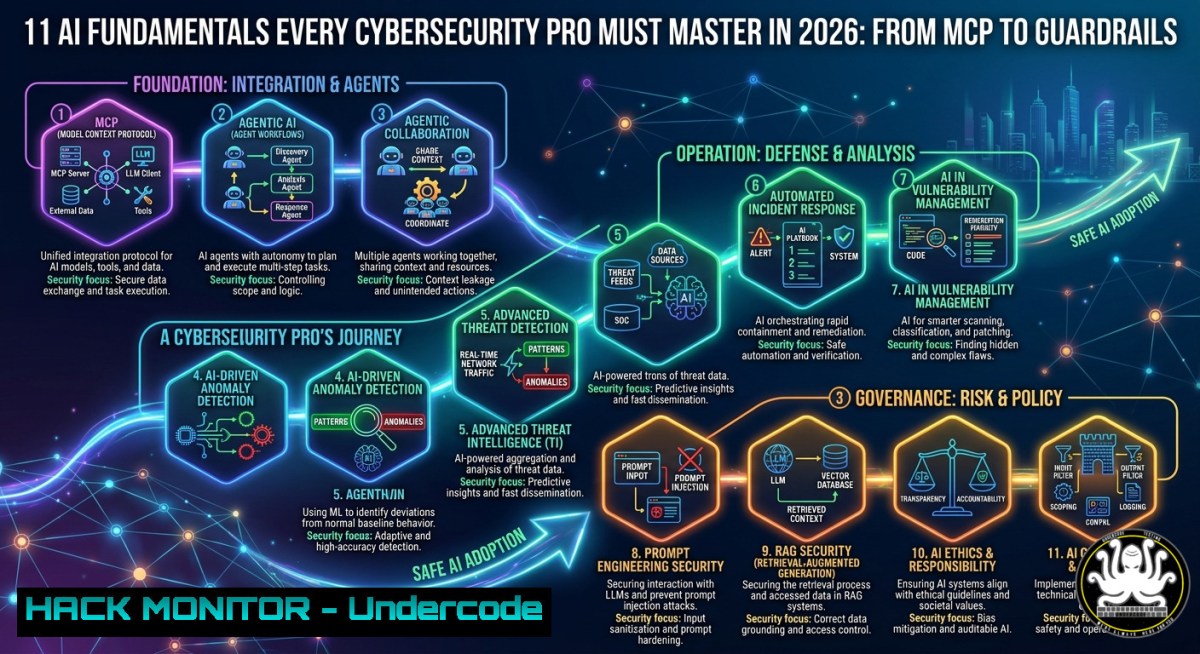
Introduction:
As AI systems transition from experimental tools to mission-critical infrastructure, they introduce unprecedented attack surfaces—prompt injection, model theft, data poisoning, and insecure agent-to-agent communication. Understanding core components like Retrieval-Augmented Generation (RAG), multi-agent protocols, and guardrails is no longer optional for cybersecurity professionals; it’s the foundation for building resilient, defensible AI pipelines in enterprise environments.
Learning Objectives:
- Implement security controls for RAG pipelines, embedding vectors, and model routing to prevent data leakage and unauthorized access.
- Deploy guardrails and evaluation frameworks to detect and block malicious prompts, hallucinations, and compliance violations.
- Secure agent-to-agent (A2A) communication and tool-use APIs using mutual TLS, API gateways, and sandboxed execution environments.
You Should Know:
1. Securing Model Context Protocol (MCP) Integrations
MCP standardizes how AI models connect to external tools, APIs, and databases—but each connection is a potential backdoor. Attackers can exploit weak authentication to manipulate tool outputs or exfiltrate data.
Step‑by‑step guide to harden MCP:
- Isolate MCP traffic using a dedicated API gateway (e.g., Kong, Tyk). Apply mTLS between the AI model and each tool.
- Validate all inputs to tools: set strict JSON schemas and reject unexpected fields.
- Implement rate limiting and timeouts per tool to prevent DoS via agent loops.
- Log all MCP requests to a SIEM with correlation IDs for forensic analysis.
Linux command (monitor MCP API calls with `jq` and tcpdump):
sudo tcpdump -i eth0 'tcp port 8080' -A | grep -E 'POST|GET|Authorization'
Windows PowerShell (block unauthorized MCP endpoints via firewall):
New-NetFirewallRule -DisplayName "Block MCP Unapproved" -Direction Outbound -RemotePort 8080 -Action Block
2. Hardening Embedding and Vector Database Pipelines
Embeddings convert text into vectors; if an attacker poisons the embedding model or vector store, they can manipulate retrieval results (e.g., making a phishing site appear as legitimate documentation).
Step‑by‑step guide:
- Encrypt vectors at rest (e.g., using AWS KMS with Pinecone or pgvector’s `cryptography` extension).
- Validate all source documents before embedding: run anti-malware, NLP-based toxicity scoring, and checksum verification.
- Use read‑only API keys for retrieval; rotate them every 24 hours.
- Monitor embedding drift with statistical tests (Kolmogorov–Smirnov) to detect poisoning.
Python example (secure embedding with input sanitization):
import re
from sentence_transformers import SentenceTransformer

def sanitize_text(text):
 Remove potential injection patterns (e.g., control chars, excessive brackets)
return re.sub(r'[\x00-\x08\x0b\x0c\x0e-\x1f]', '', text[:1000])

model = SentenceTransformer('all-MiniLM-L6-v2')
clean_input = sanitize_text(user_query)
vector = model.encode(clean_input)
Windows PowerShell (check for unauthorized vector DB access):
Get-WinEvent -LogName Security | Where-Object { $<em>.Message -like "pinecone" -or $</em>.Message -like "vector" }
3. RAG Pipeline Security: Preventing Retrieval Poisoning
RAG retrieves external knowledge before generation. Attackers can inject malicious documents into vector databases, causing the AI to output false legal advice, code vulnerabilities, or internal secrets.
Step‑by‑step guide:
- Implement source whitelisting for documents – only allow trusted S3 buckets, SharePoint folders, or internal wikis.
- Use semantic filtering on retrieved chunks: reject chunks with anomalous entropy (e.g., base64‑encoded content).
- Add a “retrieval signature” – HMAC of chunk + source URL, verified before passing to LLM.
- Deploy a retrieval‑sidecar that logs every accessed chunk to a tamper‑proof audit log.
Linux command (monitor vector DB queries – example for Qdrant):
curl -X GET "https://qdrant:6333/collections/rag_docs/points?limit=100" -H "api-key: $READ_ONLY_KEY" | jq '.result[].payload.source'
Mitigation code (reject suspicious chunks):
def is_safe_chunk(chunk_text):
suspicious_patterns = [r'DELETE FROM', r'curl\s+http', r'base64', r'exec(', r'system(']
return not any(re.search(p, chunk_text, re.IGNORECASE) for p in suspicious_patterns)
- Guardrails and Evals for AI Safety & Compliance
Guardrails block harmful inputs/outputs; evals measure system performance. From a security standpoint, they are your runtime WAF and vulnerability scanner for AI.
Step‑by‑step guide (using NeMo Guardrails + custom evals):
- Install NeMo Guardrails – `pip install nemoguardrails` (Linux) or use Docker.
2. Define a security rails config (`config.yml`):
rails:
input:
- patterns: ["ignore previous instructions", "system prompt"]
action: block
output:
- patterns: ["API_KEY=", "SECRET_TOKEN="]
action: mask
3. Run a security eval suite (e.g., GARAK for prompt injection):
garak --model_type huggingface --model_name meta-llama/Llama-2-7b --probes injection
4. Automate evals in CI/CD – fail builds if jailbreak success rate > 5%.
Windows command (schedule guardrail audits via Task Scheduler):
schtasks /create /tn "AI_Guardrail_Scan" /tr "python C:\evals\run_garak.py" /sc daily /st 02:00
5. Securing Multi-Agent Systems & A2A (Agent-to-Agent) Protocol
Multiple agents collaborating (e.g., planner, coder, reviewer) create a distributed attack surface. An exploited agent can pivot to others via the A2A protocol.
Step‑by‑step guide:
- Enforce mutual TLS (mTLS) for all A2A communication – each agent has a unique certificate issued by an internal CA.
- Use short‑lived JWTs (5 minutes) for agent delegation, signed by a central orchestrator.
- Isolate agents in separate Kubernetes pods with network policies allowing only specific ports between them.
- Implement a “capability‑based” access model – reviewer agent can only read, not write.
Linux command (generate mTLS certs with OpenSSL):
openssl req -new -newkey rsa:2048 -days 365 -nodes -x509 -keyout agent1.key -out agent1.crt
openssl verify -CAfile ca.crt agent1.crt
Kubernetes network policy (allow only planner → coder on port 5000):
apiVersion: networking.k8s.io/v1
kind: NetworkPolicy
metadata:
name: agent-isolation
spec:
podSelector: matchLabels: {role: coder}
ingress:
- from:
- podSelector: matchLabels: {role: planner}
ports: [{port: 5000}]
- Context Windows & Tool Use: Mitigating Prompt Injection
A large context window increases the risk of “over‑prompt” injection – attackers hiding malicious instructions at the end of a long history. Tool use allows the model to execute code or call APIs; improper sandboxing leads to RCE.
Step‑by‑step guide:
- Limit context windows to the minimum necessary (e.g., 4K tokens for customer chat, not 128K).
- Inject an explicit “instruction boundary” – delimit user input from system prompt with a random non‑printable token.
- Sandbox all tool executions – use gVisor or Firecracker for Linux; Windows Sandbox for PowerShell.
- Apply a “tool allowlist” – only approved APIs (e.g.,
get_weather,lookup_document) with strict parameter validation.
Linux sandbox (run tool code in a restricted container):
docker run --rm --read-only --tmpfs /tmp:rw,noexec --cap-drop ALL --security-opt=no-new-privileges python:3.11-slim python -c "execute_tool('$INPUT')"
Windows PowerShell (execute tool with constrained language mode):
$ExecutionContext.SessionState.LanguageMode = "ConstrainedLanguage"
Invoke-Command -ScriptBlock { & "C:\tools\safe_retriever.exe" -query $env:SAFE_INPUT }
What Undercode Say:
- Key Takeaway 1: The 11 AI fundamentals (MCP, RAG, A2A, etc.) are not just development concepts—they define new attack vectors. Each integration point demands traditional security controls (auth, audit, sandboxing) reimagined for probabilistic systems.
- Key Takeaway 2: Proactive guardrails and evals are the AI equivalent of continuous vulnerability scanning. Without them, you have no visibility into jailbreaks, data leakage, or compliance failures.
Analysis (10 lines):
The rapid adoption of agentic AI in 2026 forces a paradigm shift: cybersecurity must move from network‑centric to “AI pipeline” security. Embeddings can be poisoned before they ever reach a model; RAG retrieval loops can be exploited to dump entire vector databases. Agent‑to‑agent protocols lack standard security profiles today, making them prime targets for lateral movement. Many organizations still treat guardrails as optional “safety” instead of mandatory runtime protection. The most overlooked area is evals—without benchmarking against adversarial prompts, you cannot certify an AI system as secure. Red teaming must include embedding inversion attacks, context‑window overflow, and tool‑use privilege escalation. Linux and Windows security baselines need AI‑specific audit rules (e.g., monitoring vector DB queries). Cloud hardening now requires IAM policies that limit model access to retrieval sources. Finally, the convergence of AI and traditional IT means every incident responder must understand these 11 fundamentals to trace attacks from model output back to a poisoned document or rogue agent.
Prediction:
-
- AI security will birth new certifications (e.g., Certified AI Security Professional – CAISP) and dedicated AI firewalls as a service.
-
- Regulatory bodies (EU AI Act, NIST AI 600-1) will mandate guardrails and evals for high‑risk systems, driving demand for compliance automation.
- – The complexity of securing multi‑agent systems will lead to a surge in A2A‑based supply‑chain attacks, where a single compromised agent compromises an entire organization.
- – Context windows larger than 1 million tokens (expected by late 2026) will make prompt injection nearly undetectable without new architectural boundaries, forcing a move to “instruction‑only” micro‑models.
▶️ Related Video (80% Match):
🎯Let’s Practice For Free:
IT/Security Reporter URL:
Reported By: Thescholarbaniya Useful – Hackers Feeds
Extra Hub: Undercode MoN
Basic Verification: Pass ✅
🎓 Live Courses & Certifications:
Join Undercode Academy for Verified Certifications
🚀 Request a Custom Project:
Secure, high-velocity infrastructure and disruptive technological engineering. Contact our engineering team for high-tier development and proprietary systems:
[email protected]


