Listen to this Post
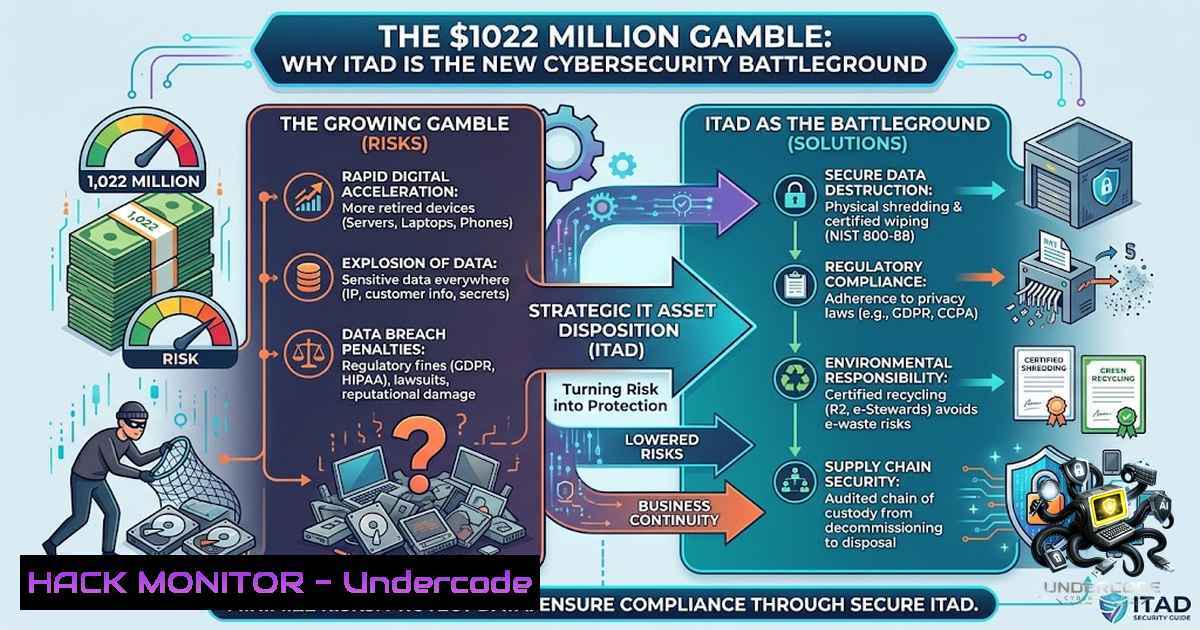
Introduction:
In the high-stakes world of cybersecurity, the retirement of IT assets has become a critical vulnerability. With the average data breach now costing $10.22 million, a single unwiped hard drive from a decommissioned server can trigger mandatory public disclosures under HIPAA or SEC cybersecurity rules. As the Global Cloud Computing Data Center IT Asset Disposition (ITAD) market surges toward billions by 2030, the intersection of data security, environmental compliance, and advanced technology like AI is redefining how enterprises must approach the end-of-life of their infrastructure.
Learning Objectives:
- Understand the critical role of ITAD in preventing data breaches and ensuring compliance with regulations like GDPR, HIPAA, and NIST standards.
- Master the technical methods for secure data erasure, including Linux commands, Windows utilities, and physical destruction techniques.
- Learn how to implement a structured, defensible ITAD program that integrates AI-driven tracking and adheres to the latest industry standards.
- The Imperative of Secure Data Sanitization: NIST 800-88 and Beyond
The foundation of any ITAD strategy is the irrefutable destruction of data. Simply deleting files or reformatting drives is insufficient, as data remnants can be easily recovered. The gold standard for this process is the National Institute of Standards and Technology (NIST) Special Publication 800-88, “Guidelines for Media Sanitization.” This framework defines three distinct levels of sanitization:
- Clear: This involves using logical techniques to overwrite data on all addressable storage locations, making it unrecoverable through standard system commands. This is suitable for media being reused within an organization.
- Purge: A more rigorous process designed to make data recovery infeasible using state-of-the-art laboratory techniques. This often involves cryptographic erasure, where the encryption keys for the entire drive are destroyed.
- Destroy: The ultimate form of sanitization, which renders the media physically unusable through shredding, disintegration, or incineration. This is mandatory for classified data or physically failing media.
The recently published NIST SP 800-88r2 (September 2025) emphasizes a program-focused approach, aligning sanitization with broader cybersecurity standards like SP 800-53 and ISO/IEC 27040. It also defers specific technical details to newer standards like IEEE 2883-2022, which provides updated specifications for modern media such as NVMe and flash drives.
Step‑by‑Step: Implementing NIST 800-88 Clear on Linux
To perform a “Clear” sanitization on a Linux system, you can use the `dd` command to overwrite a drive with zeros or random data. WARNING: This is irreversible and will destroy all data on the target device. Identify the correct device (e.g., /dev/sdb) with extreme caution.
- Identify the Drive: Use `lsblk` or `fdisk -l` to list all block devices and confirm the target drive (e.g.,
/dev/sdX). - Unmount the Drive: Ensure the drive is not in use by unmounting it: `sudo umount /dev/sdX1` (repeat for all partitions).
- Overwrite with Zeros: Execute the `dd` command to write zeros. This is a single-pass overwrite.
sudo dd if=/dev/zero of=/dev/sdX bs=1M status=progress
- Overwrite with Random Data: For a more secure “Purge,” you can use random data from
/dev/urandom. Note that this is significantly slower.sudo dd if=/dev/urandom of=/dev/sdX bs=1M status=progress
- Verify with `wipe` or
scrub: For more advanced multi-pass overwrites, tools like `wipe` (which performs 34 write passes) or `scrub` can be used.sudo scrub /dev/sdX
-
Data Erasure for Windows Environments: Leveraging the Cipher Command
In Windows environments, the built-in `Cipher.exe` tool provides a powerful method for securely overwriting deleted data. When you delete a file in Windows, the data is not immediately removed; the space it occupied is merely marked as available. The `cipher /w` command overwrites all deallocated space on a volume, ensuring that previously deleted files cannot be recovered.
Step‑by‑Step: Using Cipher.exe to Sanitize Free Space
- Open Command Prompt as Administrator: Click Start, type
cmd, right-click on Command Prompt, and select “Run as administrator.” - Execute the Cipher Command: Type the following command and press Enter:
cipher /w:C:\
This command overwrites all free space on the C: drive. You can specify any directory on the target volume, e.g., `cipher /w:D:\SomeFolder` to clean the D: drive.
- Wait for Completion: The process can take a long time depending on the size of the drive and the amount of free space.
- Understand the Process: The `cipher /w` command performs a three-pass overwrite: first with zeros (0x00), then with ones (0xFF), and finally with random numbers.
-
Securing the Supply Chain: Chain of Custody and Asset Tracking
Data destruction is only one part of the ITAD puzzle. A secure chain of custody is equally critical to ensure that assets are tracked and managed at every stage of the disposition process. This is where technology, particularly AI, is revolutionizing the industry.
AI-powered machine vision is being deployed to automate the identification of hard drives, SSDs, and server components. These systems can automatically capture serial numbers, track assets, and create visual evidence for audit-ready compliance. This automation not only improves efficiency but also reduces the risk of human error, which is a major source of chain-of-custody gaps. As Jim Levine of Iron Mountain noted, automated systems are increasingly handling repetitive inspection and triage tasks that were previously manual.
Step‑by‑Step: Building a Defensible Chain of Custody
A robust chain of custody involves meticulous documentation and verification at every step.
- Create a Comprehensive Inventory: Before any decommissioning begins, create a detailed inventory of all assets, including servers, storage systems, and networking gear. Record serial numbers, model numbers, and physical locations.
- Implement Serialized Tracking: Use barcode or RFID tags to track each asset. AI-driven systems can automate this capture.
- Document Every Transfer: For every asset, document each transfer of custody, including the date, time, personnel involved, and purpose of the transfer.
- Maintain a Secure Storage: Assets awaiting processing must be stored in a secure, access-controlled area.
- Require Certificates of Destruction: Upon completion of data destruction, obtain a certificate of destruction from your ITAD provider that includes the method used (e.g., NIST 800-88 Clear/Purge/Destroy) and the specific asset serial numbers.
-
Navigating the Compliance Landscape: GDPR, HIPAA, and Beyond
Data centers are subject to a complex web of regulations, including GDPR (Europe), HIPAA (Healthcare), CCPA (California), and PCI DSS (Payment Cards). These regulations impose strict requirements for protecting sensitive information, and non-compliance can result in significant financial penalties and reputational damage. A certified ITAD provider ensures that data destruction processes are aligned with these regulations. For example, under HIPAA, covered entities must have signed business associate agreements that legally bind their subcontractors to comply with HIPAA.
Step‑by‑Step: Ensuring ITAD Compliance
- Map Your Data: Classify the data that resides on your assets to understand the regulatory requirements that apply (e.g., PHI for HIPAA, PII for GDPR).
- Select a Certified Provider: Choose an ITAD partner with recognized certifications such as:
– NAID AAA: For data destruction vendor certification via unannounced audits.
– R2v3: For responsible electronics recycling and environmental accountability.
– ISO 27001: For information security management.
3. Define Sanitization Methods: Based on your data classification, define the required sanitization method (Clear, Purge, or Destroy) in line with NIST 800-88.
4. Request Auditable Documentation: Ensure your ITAD provider delivers a detailed audit trail, including certificates of destruction, chain-of-custody records, and environmental compliance reports.
- The Future of ITAD: AI, Automation, and Circular Economy
The ITAD industry is undergoing a significant transformation driven by the rapid expansion of data centers, the rise of AI, and a growing emphasis on sustainability. AI is not only improving asset tracking but also enhancing decision-making for resale vs. scrap pathways, helping companies maximize value recovery. The market is seeing increased consolidation as companies seek to achieve scale and diversify their service portfolios.
Furthermore, ITAD is a cornerstone of the circular economy. By enabling the reuse, refurbishment, and responsible recycling of IT assets, ITAD helps reduce e-waste and the environmental impact of technology. Companies are increasingly prioritizing these sustainable practices as part of their corporate social responsibility goals.
Step‑by‑Step: Implementing a Future-Ready ITAD Program
- Integrate ITAD into Asset Lifecycle Management: Don’t treat disposition as an afterthought. Plan for it from the moment an asset is procured.
- Adopt AI-Powered Tools: Leverage AI for automated asset tracking, grading, and decision-making to improve efficiency and reduce errors.
- Prioritize Value Recovery: Work with your ITAD provider to maximize the resale value of decommissioned assets through refurbishment and component harvesting.
- Focus on Sustainability: Choose ITAD partners with strong environmental certifications and zero-landfill policies to meet your sustainability goals.
What Undercode Say:
- Key Takeaway 1: The financial and reputational risks of improper ITAD are immense, making it a critical cybersecurity function, not just a logistical one.
- Key Takeaway 2: A defensible ITAD strategy must be built on a foundation of recognized standards (NIST 800-88) and verified through a secure chain of custody and auditable documentation.
- Analysis: The ITAD market’s growth is a direct response to the escalating threat landscape and stricter regulatory environment. Enterprises can no longer afford to treat asset disposition as a low-priority task. The integration of AI and advanced tracking technologies is a positive development, offering the potential to automate and secure a process that has historically been prone to human error. However, this also introduces new complexities, such as the need to manage and secure the AI systems themselves and ensure the integrity of the data they generate. The shift toward a program-focused approach, as seen in NIST SP 800-88r2, signals that ITAD must be embedded within an organization’s broader cybersecurity and risk management framework. Ultimately, the companies that succeed will be those that view ITAD not as a cost center, but as a strategic pillar of their security and sustainability posture.
Prediction:
- +1: The convergence of AI and ITAD will lead to a new class of cybersecurity solutions that offer real-time, automated chain-of-custody tracking, significantly reducing the risk of data breaches from decommissioned assets.
- -1: The rapid growth of data centers and the increasing complexity of hardware will outpace the current certification and regulatory frameworks, creating a window of vulnerability where sophisticated attackers may exploit gaps in the disposition process.
- +1: The emphasis on circular economy principles will transform ITAD from a disposal service into a value-recovery engine, making it a standard, board-level consideration in corporate IT strategy.
- -1: As ITAD becomes more automated and data-driven, it will become a more attractive target for cyberattacks, with threat actors potentially seeking to compromise asset tracking systems to intercept valuable hardware or data.
- +1: The globalization of ITAD services, particularly in the Asia-Pacific region, will drive innovation and standardization, leading to more robust and consistent security practices worldwide.
▶️ Related Video (86% Match):
🎯Let’s Practice For Free:
🎓 Live Courses & Certifications:
Join Undercode Academy for Verified Certifications
🚀 Request a Custom Project:
Secure, high-velocity infrastructure and disruptive technological engineering. Contact our engineering team for high-tier development and proprietary systems:
[email protected]
💎 Smart Architecture | 🛡️ Secure by Design | ⭐ Trusted by Thousands
IT/Security Reporter URL:
Reported By: Cloudcomputing Itassetdisposition – Hackers Feeds
Extra Hub: Undercode MoN
Basic Verification: Pass ✅


