Listen to this Post
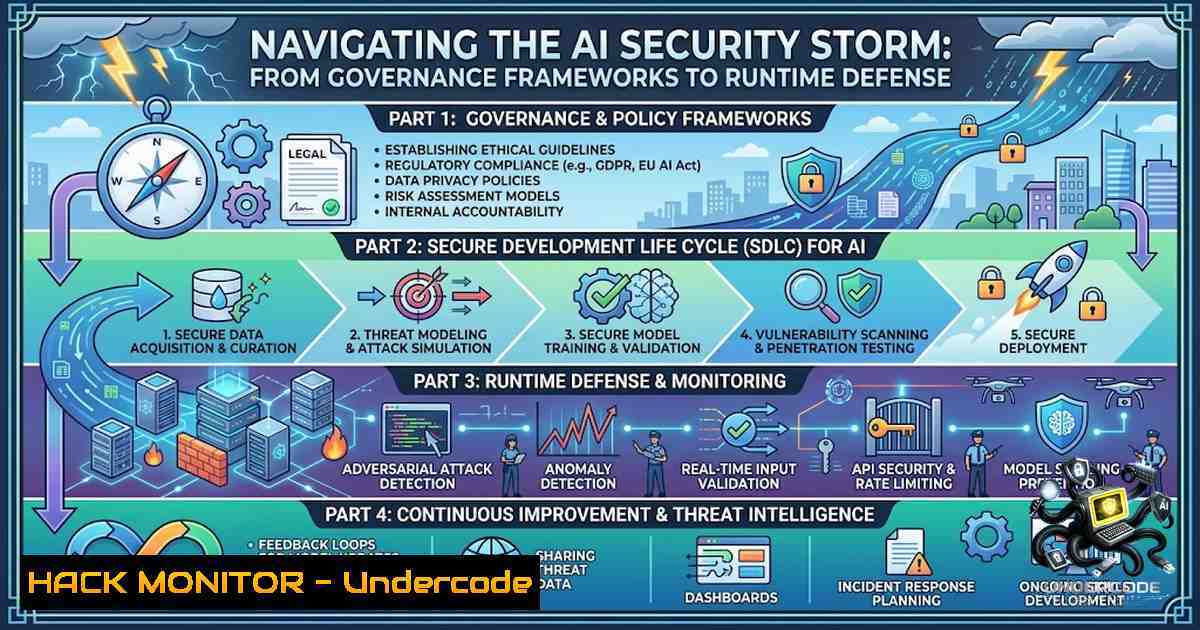
Introduction:
As organizations race to deploy AI agents and large language models (LLMs) at scale, security and governance are struggling to keep pace. With only 1% of leaders believing their AI governance arrangements have reached maturity and 78% expressing low confidence in passing an AI governance audit, the gap between deployment and control represents one of the most significant cybersecurity challenges of 2026. This article distills critical insights from industry experts—including Katie Moussouris, founder and CEO of Luta Security—to provide a practical roadmap for securing AI systems through governance frameworks, operational controls, and proactive defense strategies.
Learning Objectives:
- Understand the core pillars of AI governance and how to operationalize them within your organization
- Identify and deploy essential AI security tools across the development lifecycle
- Implement runtime protections and pre-deployment verification for AI agents
- Apply red-teaming and adversarial testing methodologies to AI systems
- Align AI security practices with regulatory frameworks including the EU AI Act and NIST AI RMF
You Should Know:
- The Three Pillars of AI Governance: Adopt, Defend, Govern
The EC-Council’s recently launched Adopt, Defend, Govern (ADG) Framework provides a practical model for securing and governing AI systems as adoption moves beyond pilot projects into broader operational use. This framework, developed with input from practitioners at Citi, JPMorgan Chase, Microsoft, KPMG, Deloitte, and Salesforce, sets out three pillars, 12 minimum controls, and nine governance surfaces.
What This Does:
The framework addresses risks linked to prompt injection, adversarial manipulation, model exploitation, data poisoning, and compromise in AI supply chains. It references existing standards including the EU AI Act, ISO/IEC 42001, the NIST AI Risk Management Framework, the OWASP Top 10 for LLM and Agentic AI, and MITRE ATLAS.
Step-by-Step Implementation:
- Adopt Pillar: Align AI deployment with business objectives, operational readiness, workforce capability, and implementation accountability.
- Defend Pillar: Protect AI systems from security threats through continuous monitoring, vulnerability scanning, and incident response.
- Govern Pillar: Establish oversight, auditability, accountability, and risk management across enterprise operations.
Practical Commands & Tools:
- Use the free EC-Council AI readiness self-assessment tool to evaluate your governance posture across maturity, implementation discipline, operational resilience, security posture, and accountability structures.
- Leverage the open-source garak scanner for LLM vulnerability scanning:
Install garak (NVIDIA's open-source LLM vulnerability scanner)
pip install garak
Run a basic scan against an LLM endpoint
garak --model_type openai --model_name gpt-4 --probes all
- For runtime guardrails, deploy Lakera Guard (now part of Check Point) to screen prompts and outputs for injection, jailbreaks, and data leakage.
- Agent Behavior Verification: Pre-Deployment Security for Autonomous AI
As AI agents evolve from assisting users to performing operational tasks with greater autonomy, they increasingly access enterprise systems, invoke tools, execute workflows, and make decisions independently. Traditional security approaches such as vulnerability scanning and red teaming focus on runtime activity, but a critical gap exists before deployment.
What This Does:
Agent Behavior Verification (ABV), introduced by Exabeam, is a new security discipline designed to help organizations evaluate whether AI agents are properly configured, authorized, and governed before they are deployed into production environments. The accompanying open-source framework, Praxen, uses an ABV remit—a policy contract defining what an AI agent is authorized to do, what resources it may access, and the operational boundaries it must follow.
Step-by-Step Implementation:
- Define the Agent’s Authorized Role: Document what the agent should do, what resources it can access, and what actions are prohibited.
- Verify Implementation Against Remit: Use Praxen to assess whether the agent’s tools, configurations, memory, integrations, and operating environment align with its defined role.
- Identify Gaps: Praxen generates reports with findings, suggested improvements, and an overall maturity score for the agent’s security posture.
- Remediate Before Deployment: Address identified gaps before the agent enters production.
Practical Implementation:
 Clone and set up Praxen (Apache 2.0 licensed)
git clone https://github.com/exabeam/praxen
cd praxen
 Define an ABV remit policy (YAML format)
 Run verification against your agent implementation
python praxen verify --remit agent_remit.yaml --agent-config agent_config.json
As Exabeam’s Chief AI Officer Steve Wilson notes: “Security teams need more than runtime visibility. They need confidence that agents have the right permissions, the right controls and the right boundaries before they enter production”.
- AI Application Security: Tools for the Development Lifecycle
According to the Veracode 2025 GenAI Code Security Report, 45% of AI-generated code samples failed security tests and introduced an OWASP Top 10 vulnerability. With roughly 90% of development teams now using an AI assistant to write or review code, the need for AI-1ative application security tools has never been more critical.
What This Does:
AI application security tools use machine learning or large language models to find security vulnerabilities in source code, dependencies, and AI-generated completions, and in most cases suggest or apply a validated fix directly in the developer’s editor or pull request.
Step-by-Step Implementation:
- Integrate AI-Powered SAST: Deploy tools like Snyk Code (free tier with 100 SAST tests per month) or Semgrep ($40/contributor/month) to scan AI-generated and human-written code.
- Enable Autofix Capabilities: GitHub Copilot Autofix fixes flagged vulnerabilities about 3x faster overall, and up to 12x faster for SQL injection.
- Deploy Runtime Guardrails: Use platforms like Lakera Guard, Prisma AIRS (Palo Alto Networks), or Cisco AI Defense to protect LLM applications from prompt injection, jailbreaks, and data leakage.
- Implement AI Security Posture Management (AI-SPM): Tools like Wiz AI-SPM inventory AI assets and misconfigurations in production.
- Conduct Automated Red Teaming: Platforms like Mindgard provide automated AI red teaming to identify vulnerabilities before attackers do.
Key Commands:
 Snyk Code scan (free tier)
snyk code test --severity=high

Semgrep scan with custom rules
semgrep --config auto --severity ERROR

Garak LLM vulnerability scan
garak --model_type openai --model_name gpt-4 --probes prompt_injection
4. Runtime Protection: Guardrails, Observability, and Threat Detection
With the EU AI Act enforcement beginning in August 2026, organizations in regulated industries face a near-term compliance deadline with material legal consequences for those unable to demonstrate AI governance. Runtime protection is essential for continuous compliance and security.
What This Does:
Runtime guardrails screen prompts and outputs for injection, jailbreaks, and data leakage; scanners probe models and pipelines for vulnerabilities before release; and posture management inventories AI assets and misconfigurations in production.
Step-by-Step Implementation:
- Deploy Prompt Defense: Implement runtime guardrails using Lakera Guard or similar tools to detect and block prompt injection attempts (OWASP LLM01).
- Enable AI Observability: Use Security Operations Centre (SOC) monitoring for AI-specific risks such as prompt abuse, model manipulation, or anomalous AI behavior.
- Implement Continuous Monitoring: Deploy solutions like Exabeam’s Agent Behavior Analytics (ABA) to identify anomalous or risky agent behavior in production environments.
- Establish Incident Response: Develop playbooks specifically for AI-related security incidents, including model extraction attempts, data poisoning, and unauthorized access.
Practical Commands:
 Monitor AI agent activity (example with custom logging)
tail -f /var/log/ai-agent/activity.log | grep -E "ERROR|WARNING|UNAUTHORIZED"

Set up alerting for anomalous behavior
 Example: Alert on high-frequency API calls from AI agents
awk '{print $1}' /var/log/ai-agent/api_calls.log | sort | uniq -c | sort -1r | head -20
- Red Teaming and Adversarial Testing for AI Systems
Katie Moussouris, founder and CEO of Luta Security, has been at the forefront of vulnerability disclosure and bug bounty programs, and she emphasizes the importance of adversarial testing for AI systems. Comprehensive AI governance involves establishing clear organizational policies, continuous monitoring of AI system performance in production, and adversarial testing (red-teaming) to identify and mitigate evolving attack vectors.
What This Does:
Red teaming for AI involves simulating adversarial attacks against AI systems to identify vulnerabilities before malicious actors can exploit them. This includes testing for prompt injection, model manipulation, data poisoning, and model extraction.
Step-by-Step Implementation:
- Define Red Team Objectives: Identify what assets need protection and what attack scenarios are most relevant.
- Use Automated Red Teaming Tools: Deploy platforms like Mindgard or open-source frameworks to continuously test AI systems.
- Conduct Manual Adversarial Testing: Engage security researchers to probe AI systems for logic flaws, edge cases, and unexpected behaviors.
- Establish a Vulnerability Disclosure Program: As Moussouris advocates, create sustainable bug bounty and vulnerability disclosure programs to leverage the broader security community.
- Iterate and Improve: Use findings from red teaming to strengthen guardrails, update policies, and enhance monitoring.
Practical Commands:
 Install and run Promptfoo for LLM red teaming
npm install -g promptfoo
promptfoo init
promptfoo eval

Run garak with specific probes for red teaming
garak --model_type openai --model_name gpt-4 --probes dan,Jailbreak,encoding
6. Building a Unified AI Governance Model
To govern AI effectively, organizations should start with a unified model that aligns data, AI, and regulatory practices across the organization. This involves creating a minimum viable set of guardrails, then evolving them as the AI footprint grows.
What This Does:
A unified governance model provides a single framework for security, legal, compliance, data, and engineering teams, rather than each silo inventing its own approach. It establishes the guardrails, approval paths, and monitoring that will occur across the organization.
Step-by-Step Implementation:
- Inventory AI Assets: Know which models, prompts, tools, datasets, and vector stores you have, who owns them, and what decisions were taken about risk.
- Establish Clear Policies: Define what AI systems can access, what they can use, who is responsible for them, and what they can do.
- Implement Controls: Deploy preventive and detective controls from the Security domain to protect AI systems against adversarial attacks, prompt injection, data poisoning, and model extraction.
- Monitor and Audit: Continuously monitor AI system behavior and conduct regular audits to ensure compliance with policies and regulations.
- Adapt and Evolve: As your AI footprint grows, evolve your guardrails and governance practices to address new risks and regulatory requirements.
What Undercode Say:
- Key Takeaway 1: The gap between AI deployment and governance is widening, with 78% of executives lacking confidence in passing an AI governance audit. Organizations must move from a “deploy-first” mindset to a “govern-first” approach, implementing frameworks like EC-Council’s ADG to restore operational discipline and accountability.
-
Key Takeaway 2: Pre-deployment verification of AI agents is as critical as runtime monitoring. Tools like Exabeam’s Praxen enable organizations to answer the fundamental question: “Will this agent do its job, and only its job?” before it enters production. This shift from reactive to proactive security represents a paradigm change in AI risk management.
Analysis:
The cybersecurity community is at a pivotal moment where AI adoption is outpacing security and governance capabilities. Katie Moussouris’s work with Luta Security—bridging vulnerability disclosure, bug bounties, and AI security—highlights the need for human expertise to complement AI-driven defenses. The emergence of frameworks like ADG and tools like Praxen, garak, and Lakera Guard demonstrates that the industry is responding, but adoption remains uneven. Organizations that prioritize AI governance now will not only avoid regulatory penalties but will also gain a competitive advantage by building trust with customers and partners. The key is to treat AI security not as an afterthought but as a foundational element of AI strategy, integrating governance, verification, and runtime protection throughout the AI lifecycle.
Prediction:
- +1 The EU AI Act enforcement beginning in August 2026 will accelerate enterprise adoption of AI governance frameworks, creating a multi-billion-dollar market for AI security tools and consulting services.
-
+1 Open-source tools like Praxen and garak will become foundational elements of AI security stacks, democratizing access to advanced AI security capabilities and fostering community-driven innovation.
-
-1 The rapid proliferation of autonomous AI agents will lead to a wave of security incidents involving unauthorized data access and API manipulation, as organizations struggle to implement pre-deployment verification at scale.
-
-1 Without standardized AI security certifications and workforce development, the shortage of skilled AI security professionals will worsen, leaving many organizations vulnerable to AI-specific attacks.
-
+1 The convergence of AI security and API security—exemplified by platforms like Wallarm’s AI Control Platform—will create unified defense mechanisms that protect the entire AI lifecycle, from development to runtime.
▶️ Related Video (86% Match):
https://www.youtube.com/watch?v=-DSTruXbKJo
🎯Let’s Practice For Free:
🎓 Live Courses & Certifications:
Join Undercode Academy for Verified Certifications
🚀 Request a Custom Project:
Secure, high-velocity infrastructure and disruptive technological engineering. Contact our engineering team for high-tier development and proprietary systems:
[email protected]
💎 Smart Architecture | 🛡️ Secure by Design | ⭐ Trusted by Thousands
IT/Security Reporter URL:
Reported By: Brandonlwise Boston – Hackers Feeds
Extra Hub: Undercode MoN
Basic Verification: Pass ✅


