Listen to this Post
Introduction:
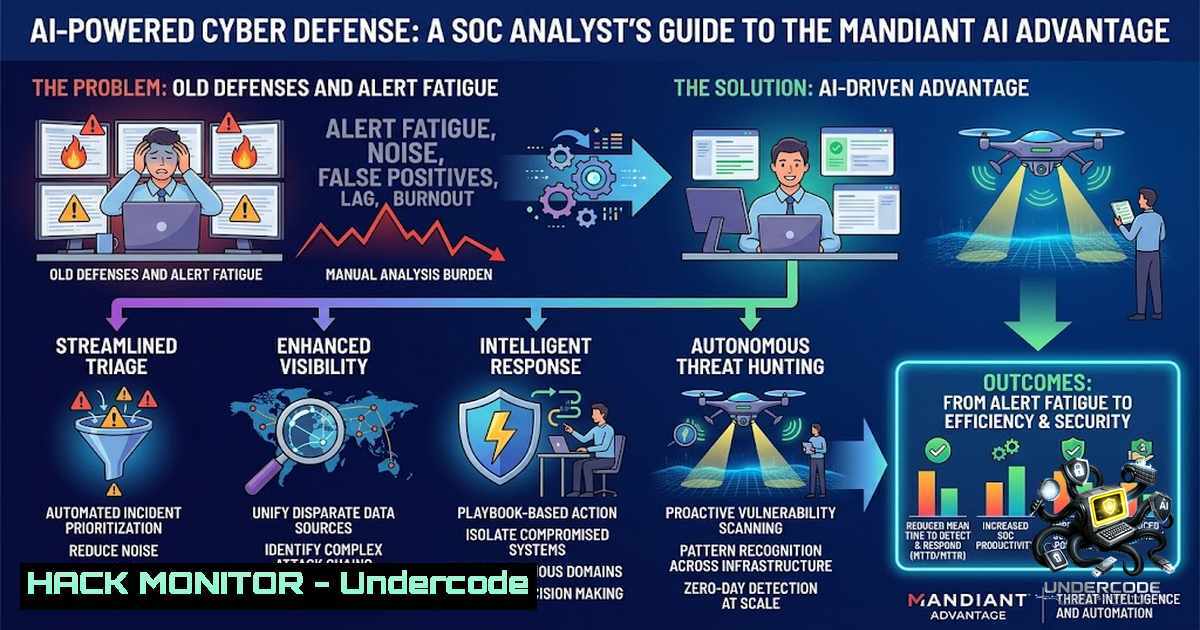
The cybersecurity landscape has reached an inflection point where the volume, velocity, and sophistication of attacks have outpaced human-centric defense models. Security Operations Center (SOC) analysts are drowning in alerts, and adversaries are leveraging AI to automate their attacks at machine speed. Mandiant’s “Artificial Intelligence (AI) Advantage: Elevating Cyber Defense” certification—an 8-hour training track—equips defenders with the practical knowledge to flip the asymmetry, teaching how to integrate Google’s AI suite (Gemini, NotebookLM, and Colab) into security strategies to detect, investigate, and respond to threats with unprecedented speed and accuracy. This isn’t about replacing analysts; it’s about augmenting human expertise to achieve what Mandiant calls the “Defender’s Advantage”.
Learning Objectives:
- Master the integration of generative AI and large language models (LLMs) into SIEM and SOAR workflows for accelerated threat detection and automated incident response.
- Implement AI-driven threat hunting techniques to proactively search for indicators of compromise (IoCs) and lateral movement across cloud, endpoint, and identity systems.
- Develop and deploy machine learning models for anomaly detection, reducing false positives and improving the mean time to detect (MTTD) and respond (MTTR).
You Should Know:
- Operationalizing AI in the SOC: A Step‑by‑Step Guide to AI‑Driven Threat Hunting
AI-powered threat hunting transforms the traditional reactive approach into a proactive, intelligence-led discipline. Modern AI threat hunters can autonomously query SIEM platforms, EDR tools, and cloud environments, performing in hours what would take human analysts up to 40 hours. To operationalize this in your environment, follow this structured approach:
Step 1: Data Aggregation and Normalization.
Ensure your SIEM (e.g., Splunk, Google Chronicle, or Wazuh) ingests and normalizes logs from all critical sources: endpoints, network devices, cloud platforms (AWS, Azure, GCP), and identity providers (Active Directory, Okta). Use a unified data model like Google’s UDM (Unified Data Model) to enable seamless querying.
Step 2: Deploy AI-Powered Threat Hunting Agents.
Integrate an AI agent (such as Dropzone AI Threat Hunter or Prophet AI) that can autonomously run threat hunting campaigns. Configure the agent to execute natural-language queries against your SIEM. For example, you can ask: “Show me all instances of lateral movement using SMBexec in the last 24 hours.” The AI translates this into the appropriate SIEM query language (e.g., KQL, SPL, or Chronicle’s Search Language).
Step 3: Automate Indicator of Compromise (IoC) Enrichment.
Configure the AI agent to automatically pull threat intelligence feeds (STIX/TAXII) and enrich detected IoCs with context from MITRE ATT&CK. This transforms raw alerts into actionable intelligence, showing the TTPs (Tactics, Techniques, and Procedures) associated with the threat.
Step 4: Initiate One-Click Hunts.
Use the AI agent’s “one-click hunt” functionality to launch pre-built or custom hunting queries across your entire security stack. The agent will autonomously correlate data from SIEM, EDR, and cloud logs, presenting a prioritized list of potential threats with a confidence score.
Step 5: Investigate and Respond.
When the AI surfaces a high-confidence threat, initiate an automated or semi-automated investigation. The AI should provide a narrative summary of the attack chain, including patient zero, lateral movement paths, and data exfiltration attempts. Use this to make rapid containment decisions.
Linux Command Example (Log Analysis for Threat Hunting):
 Search for failed SSH attempts followed by successful logins (potential brute-force success)
sudo grep "Failed password" /var/log/auth.log | awk '{print $9}' | sort | uniq -c | sort -1r
 Then, check for successful logins from those IPs
sudo grep "Accepted password" /var/log/auth.log | grep "192.168.1.100"
Windows PowerShell Command (Event Log Analysis):
 Query Windows Security Event Log for suspicious account logons (Event ID 4624) followed by privilege escalation (Event ID 4672)
Get-WinEvent -FilterHashtable @{LogName='Security'; ID=4624} | Where-Object {$_.Properties[bash].Value -like '192.168.1.'} | Format-List
 Check for user account creation (Event ID 4720)
Get-WinEvent -FilterHashtable @{LogName='Security'; ID=4720}
2. Building AI-Powered Anomaly Detection Pipelines
Traditional rule-based detection fails against novel and zero-day attacks. Machine learning models excel at identifying deviations from normal behavior, flagging potential intrusions that signature-based systems miss. This section provides a practical guide to implementing an anomaly detection pipeline using open-source tools.
Step 1: Data Preparation.
Collect a baseline of “normal” network traffic or user behavior data. Use tools like `tcpdump` or Wireshark to capture PCAP files, or export NetFlow data from your network devices. For a more structured approach, use the `zeek` (formerly Bro) network security monitor to generate logs.
Step 2: Feature Engineering.
Extract relevant features from your data. For network anomaly detection, key features include: packet size, protocol type, source/destination IP entropy, number of connections per second, and bytes transferred. For user behavior, features include: login times, access patterns, and data transfer volumes.
Step 3: Model Selection and Training.
Choose an appropriate machine learning model. For unsupervised anomaly detection (where you don’t have labeled attack data), Isolation Forest and Autoencoders are highly effective. For supervised detection, XGBoost (Extreme Gradient Boosting) provides high accuracy for phishing and network anomaly detection.
 Example: Training an Isolation Forest model for network anomaly detection in Python
from sklearn.ensemble import IsolationForest
import pandas as pd

Load your preprocessed network traffic data (features: bytes_sent, packets_sent, duration, etc.)
data = pd.read_csv('network_traffic.csv')
features = data[['bytes_sent', 'packets_sent', 'duration', 'src_port']]

Train the model
model = IsolationForest(contamination=0.01, random_state=42)  Assuming 1% of data is anomalous
model.fit(features)

Predict anomalies (1 = normal, -1 = anomaly)
data['anomaly'] = model.predict(features)
anomalies = data[data['anomaly'] == -1]
print(f"Detected {len(anomalies)} anomalies.")
Step 4: Integration with SIEM.
Deploy the trained model as a microservice that continuously ingests live log data via APIs (e.g., using Flask or FastAPI). Configure your SIEM to forward logs to this service and consume the anomaly scores as enrichment fields. Create alerts in your SIEM for any event with an anomaly score above a defined threshold.
Step 5: Continuous Retraining.
Implement a feedback loop where confirmed incidents and false positives are used to retrain the model periodically, improving its accuracy over time. Use Google Colab for prototyping and retraining models with updated datasets.
3. Automating Incident Response with AI-Enhanced SOAR
The gap between detection and response is where attackers thrive. AI-enhanced SOAR (Security Orchestration, Automation, and Response) platforms can reduce mean response time from 45 minutes to under 30 seconds by automating containment, eradication, and recovery actions.
Step 1: Define Automated Playbooks.
Create playbooks for common incident types (e.g., ransomware, phishing, data exfiltration). For each playbook, define the trigger conditions (e.g., an alert from your AI-powered threat hunter) and the automated actions.
Step 2: Integrate with Security Tools.
Configure your SOAR platform to have API access to your EDR (e.g., CrowdStrike, SentinelOne), firewalls, identity management systems, and ticketing systems. This enables the automated workflows to execute actions across the entire security stack.
Step 3: Implement AI-Driven Triage.
Integrate a generative AI model (like Google’s Gemini or an open-source LLM) into your SOAR platform. When an alert is triggered, the AI ingests all related context (alert details, affected assets, threat intelligence) and generates a natural-language summary of the incident, including a recommended response strategy.
Step 4: Automate Containment Actions.
For confirmed high-severity incidents, configure the SOAR platform to automatically execute containment actions. For example:
– Isolate the infected host from the network.
– Revoke compromised user credentials.
– Block malicious IPs at the firewall.
– Quarantine malicious emails across all mailboxes.
Step 5: Human-in-the-Loop for Critical Decisions.
While automation is powerful, maintain human oversight for critical decisions such as shutting down critical infrastructure or initiating a full-scale incident response. The SOAR platform should escalate these cases to the on-call analyst with all relevant data packaged for quick review.
- Securing the AI Pipeline: Defending the Model Itself
As organizations adopt AI, the AI pipeline itself becomes a target. Adversaries can poison training data, steal models, or manipulate model outputs. Mandiant’s “Defend the AI Pipeline” workshop covers the core security principles required to protect machine learning workflows from data ingestion through model deployment.
Step 1: Secure the Data Supply Chain.
Implement strict access controls and data validation checks at every stage of the data pipeline. Use cryptographic hashing to ensure data integrity and detect tampering.
Step 2: Model Hardening.
Implement adversarial training, where you expose your model to adversarial examples during training to make it more robust against evasion attacks. Regularly perform red-teaming exercises specifically targeting your AI models.
Step 3: Continuous Monitoring.
Monitor model performance and input data distribution for drift. Sudden changes in model accuracy or prediction patterns can indicate a poisoning or evasion attack. Implement alerts for these anomalies.
Step 4: API Security.
Secure all APIs used to interact with your AI models. Implement strong authentication (OAuth 2.0, API keys), rate limiting, and input validation to prevent injection attacks and denial-of-service (DoS) attempts. Regularly audit API logs for suspicious access patterns.
Step 5: Governance and Compliance.
Establish clear governance policies for AI adoption, including guidelines on data privacy, model explainability, and ethical use. Conduct regular AI threat modeling sessions to identify and mitigate emerging risks.
- Intelligence-Led Defense: Bridging the Gap Between Threat Intel and Action
AI is most powerful when it is intelligence-led. Mandiant emphasizes the importance of being “intelligence-led” in cyber defense, meaning that defensive actions are prioritized and informed by a deep understanding of the adversary.
Step 1: Consume and Normalize Threat Intelligence.
Automate the ingestion of threat intelligence feeds (both commercial and open-source) into your SIEM and SOAR platforms using STIX and TAXII protocols. Normalize this data into a common format for correlation.
Step 2: Map Intelligence to MITRE ATT&CK.
Automatically map incoming intelligence to the MITRE ATT&CK framework. This provides immediate context on the adversary’s TTPs, enabling defenders to anticipate the attacker’s next move.
Step 3: AI-Powered Correlation.
Use AI to correlate threat intelligence with your internal telemetry. For example, if a new C2 (Command and Control) domain is identified in threat intel, the AI can automatically query your network logs to see if any internal hosts have communicated with that domain.
Step 4: Prioritize and Respond.
Use AI to prioritize alerts based on the relevance and severity of the associated threat intelligence. A low-severity alert from a system that is known to be targeted by a specific adversary group should be elevated automatically. Trigger automated or manual response actions based on this prioritized list.
Step 5: Feedback Loop.
Ensure that the outcomes of your incident response efforts (e.g., newly discovered IoCs) are fed back into your threat intelligence platform and AI models, creating a continuous improvement cycle. This is the essence of the “Defender’s Advantage”.
What Undercode Say:
- Key Takeaway 1: AI is not a silver bullet but a force multiplier. The most effective defense strategies combine human intuition and strategic thinking with AI’s ability to process vast amounts of data at machine speed. The Mandiant certification rightly emphasizes practical, hands-on skills over theoretical knowledge.
- Key Takeaway 2: The future of the SOC is autonomous but not humanless. The goal is to offload repetitive, time-consuming tasks to AI agents, freeing analysts to focus on complex investigations, strategic threat hunting, and proactive defense. This shift requires a cultural change within security teams, embracing continuous learning and adaptation.
Analysis: Lerato Moshoadiba’s achievement of the Mandiant AI certification highlights a critical trend: the democratization of AI skills in cybersecurity. As AI becomes embedded in every layer of the security stack, from SIEM to SOAR to endpoint protection, the analysts who can effectively wield these tools will be the ones who define the next generation of cyber defense. This certification, built on Google’s AI ecosystem, provides a vendor-aligned yet broadly applicable foundation. However, the real value lies not in the certificate itself but in the practitioner’s ability to translate that knowledge into tangible improvements in detection accuracy, response speed, and overall security posture. The challenge for organizations is to not only train their staff but also to provide the infrastructure and data maturity required to fully leverage AI’s potential.
Prediction:
- +1 By 2028, AI-powered autonomous threat hunting and response agents will become a standard feature in all major SIEM and XDR platforms, reducing the average incident response time from hours to minutes.
- -1 The rapid adoption of AI in defense will be mirrored by an equally rapid evolution of AI-powered attacks, including sophisticated deepfake-based social engineering and autonomous malware that can dynamically adapt to evade AI detection models.
- +1 The Mandiant AI Advantage curriculum will serve as a blueprint for a new generation of cybersecurity certifications, with a focus on practical, AI-augmented defense skills becoming a prerequisite for SOC analyst roles.
- -1 Organizations that fail to invest in AI governance and model security will face new classes of vulnerabilities, including data poisoning and model theft, which could render their AI defenses ineffective.
- +1 The integration of generative AI into SOAR platforms will enable the creation of “digital twin” security environments, allowing defenders to simulate and test response strategies against AI-generated attack scenarios before they occur in production.
▶️ Related Video (68% Match):
🎯Let’s Practice For Free:
🎓 Live Courses & Certifications:
Join Undercode Academy for Verified Certifications
🚀 Request a Custom Project:
Secure, high-velocity infrastructure and disruptive technological engineering. Contact our engineering team for high-tier development and proprietary systems:
[email protected]
💎 Smart Architecture | 🛡️ Secure by Design | ⭐ Trusted by Thousands
IT/Security Reporter URL:
Reported By: Lerato Moshoadiba – Hackers Feeds
Extra Hub: Undercode MoN
Basic Verification: Pass ✅


