Listen to this Post
Introduction
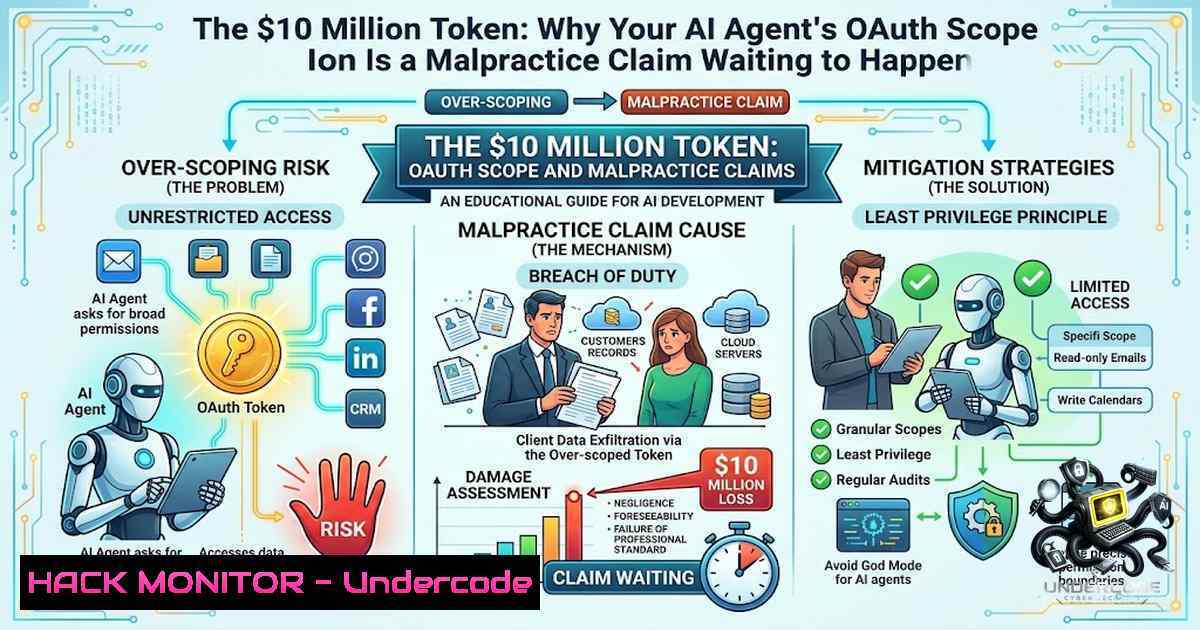
When a law firm authorizes an AI agent to access its document management system—even for a single contract summary—the OAuth token typically grants session-level access to every matter folder the authorizing user can see. Matter A through Matter Z. Every client. Every privileged communication. This isn’t a theoretical vulnerability; the 2024 Snowflake breach exposed 165 organizations through stolen credentials, and attackers are now applying the same tactics to AI agent tokens. For professional services firms, the access boundary isn’t the task—it’s the token, and that distinction is now a regulatory exposure that malpractice insurers are starting to price in.
Learning Objectives
- Understand why OAuth token scopes for AI agents create session-level exposure across entire document repositories
- Implement matter-level permissioning and just-in-time (JIT) access controls to limit AI agent reach
- Deploy audit logging frameworks that capture every document an AI agent reads, not just the outputs it generates
- Apply ABA Model Rule 1.6 confidentiality requirements to AI governance with verifiable technical controls
You Should Know
1. The Token Is the Boundary—Not the Task
Most firms treat an AI agent like a paralegal who only sees what you hand them. It doesn’t work that way. When your team authorizes an AI agent via OAuth, that token carries the full scope of the authorizing user’s permissions. The AI isn’t limited to the single contract you asked it to summarize—it can read every matter, every client, every privileged communication that the user can see.
The Snowflake breach demonstrated this principle in sharp relief: a single compromised credential set gave attackers access across every cloud-connected application sharing that token scope. AI agents operate on the same principle. The 2025 Salesloft Drift breach saw attackers steal OAuth refresh tokens and infiltrate Salesforce, AWS, and Snowflake across 700+ enterprises in ten days. In each case, the breach vector wasn’t a sophisticated exploit—it was an over-scoped token.
What This Means for Your Firm: Your AI agent’s access is defined by the OAuth scopes you grant, not the task you assign. If your agent holds a `read` scope on your document management system, it can read everything the authorizing user can read. If it holds write, the exposure is catastrophic.
Technical Implementation:
Linux/macOS – Inspect OAuth Token Scopes (JWT Decode):
 Decode a JWT token to inspect its scopes and claims
echo "YOUR_JWT_TOKEN" | cut -d. -f2 | base64 -d 2>/dev/null | jq '.scope, .aud, .exp'
Windows PowerShell – Decode JWT and Inspect Scopes:
 Decode JWT payload (split by '.' and decode middle segment)
$token = "YOUR_JWT_TOKEN"
$payload = $token.Split('.')[bash]
 Add padding if needed
$payload = $payload.PadRight($payload.Length + (4 - $payload.Length % 4) % 4, '=')
[System.Text.Encoding]::UTF8.GetString([System.Convert]::FromBase64String($payload)) | ConvertFrom-Json | Select-Object scope, aud, exp
Azure CLI – List OAuth Consent Grants (Global Admin):
 List all OAuth permission grants in your tenant
Get-MgOauth2PermissionGrant -All | Where-Object { $_.Scope -match "read|write|all" }
2. Scope Narrowing: From Coarse to Operation-Level Permissions
Standard OAuth scopes like `read` or `write` are dangerously coarse for AI agent deployments. The industry best practice is operation-level scopes following a `tool:resource:action` naming pattern—for example, `dms:matter123:read` instead of dms:read. This enables per-step scoping where different workflow nodes carry different permissions: a read step should never carry write permissions.
RFC 9396 (Rich Authorization Requests) now enables consent UI that discloses action-level permissions, time-bound grants, and explicit re-consent triggers when an agent requests new capabilities. NIST SP 800-63B recommends short-lived tokens with 15-60 minute TTLs, and revocation must be automated.
Matter-Level Permissioning Implementation:
 Example: Request a token with fine-grained scope using OAuth 2.0
curl -X POST https://your-okta-domain/oauth2/v1/token \
-H "Content-Type: application/x-www-form-urlencoded" \
-d "grant_type=client_credentials" \
-d "scope=dms:matter-456:read dms:matter-456:summarize" \
-d "client_id=YOUR_CLIENT_ID" \
-d "client_secret=YOUR_CLIENT_SECRET"
Windows PowerShell – Request Fine-Grained Token:
$body = @{
grant_type = "client_credentials"
scope = "dms:matter-456:read dms:matter-456:summarize"
client_id = "YOUR_CLIENT_ID"
client_secret = "YOUR_CLIENT_SECRET"
}
Invoke-RestMethod -Method Post -Uri "https://your-okta-domain/oauth2/v1/token" -Body $body
Key Principle: Binding OAuth tokens to cryptographic client certificates (mTLS or DPoP) closes the token theft gap that standard bearer tokens leave open. Every token should be cryptographically bound to the agent’s private key.
- Audit Logging: The Difference Between a Routine Disclosure and a Privilege Motion
When a state bar or opposing counsel asks what your AI touched during discovery, your audit log is the difference between a routine disclosure and a privilege motion. Most AI deployments lack audit trails entirely—one mid-size firm deployed three AI tools before engaging security consultants; none had audit trails, and two had firm-wide DMS read access.
What Must Be Logged:
- Every document the agent reads (not just the output it generates)
- Every tool call the agent makes
- Every token issuance, refresh, and revocation event
- Every policy decision (allowed, blocked, or escalated)
Audit Logging Implementation – Linux with jq:
 Simulate audit log entry for agent document access
echo '{
"timestamp": "'$(date -Iseconds)'",
"agent_id": "ai-assistant-01",
"user_id": "attorney.johnson",
"matter_id": "matter-456",
"action": "document_read",
"document_id": "doc-789",
"token_scope": "dms:matter-456:read",
"policy_evaluation": "ALLOWED"
}' | jq '.' >> /var/log/ai-agent-audit.log
Windows PowerShell – Structured Audit Logging:
$auditEntry = @{
timestamp = (Get-Date -Format "yyyy-MM-ddTHH:mm:ssK")
agent_id = "ai-assistant-01"
user_id = "attorney.johnson"
matter_id = "matter-456"
action = "document_read"
document_id = "doc-789"
token_scope = "dms:matter-456:read"
policy_evaluation = "ALLOWED"
} | ConvertTo-Json
$auditEntry | Out-File -Append -FilePath "C:\Logs\ai-agent-audit.json"
Open-Source Governance Tools: Platforms like NeuroSentinel and Tandem provide production-grade policy engines that intercept every tool call, evaluate against policy, and log every action—allowed and blocked—before anything irreversible happens.
4. Credential Rotation and Session Revocation
One mid-size firm implemented a credential rotation protocol that revokes agent tokens after each session—no disruption to billable workflow. This is the standard that cyber-insurance carriers are now expecting.
Automated Token Revocation – Linux cURL:
 Revoke an OAuth token immediately after session completion
curl -X POST https://your-auth-server/oauth2/revoke \
-H "Content-Type: application/x-www-form-urlencoded" \
-d "token=YOUR_ACCESS_TOKEN" \
-d "token_type_hint=access_token" \
-d "client_id=YOUR_CLIENT_ID" \
-d "client_secret=YOUR_CLIENT_SECRET"
Windows PowerShell – Revoke All Sessions for a User:
 Azure AD - Revoke all refresh tokens for a user
Revoke-AzureADUserAllRefreshToken -ObjectId "[email protected]"
Linux – List and Revoke Active OAuth Grants (Okta CLI):
 List active grants for a specific user
okta list grants --userId=00u1xxxxx

Revoke a specific grant
okta revoke grant --grantId=og1xxxxx
5. ABA Model Rule 1.6 and AI Governance
ABA Model Rule 1.6 requires lawyers to make “reasonable efforts to prevent the inadvertent or unauthorized disclosure of, or unauthorized access to” client information. The question your bar association is now asking—and that your cyber-insurance carrier will ask on renewal—is whether you’ve conducted due diligence on what your AI tools can actually reach, not just what you intended them to reach.
ABA Formal Opinion 512 explicitly warns that inputting client information into AI tools may risk unauthorized disclosure or access. Lawyers must maintain a “reasonable understanding of the capabilities and limitations” of the AI tools they use. Rule 1.6 does not bend to AI use—and the duty of confidentiality covers all information relating to a client’s representation, including financial details, not just case strategy.
Compliance Checklist:
- Document all AI tool deployments, including scope of access
- Implement matter-level permissioning with audit trails
- Conduct vendor due diligence (SOC 2 Type 2, ISO 27001)
- Train staff on AI-specific confidentiality obligations
- Update vendor contracts to include data processing and confidentiality terms
6. Cloud and API Hardening for AI Agents
API Security Best Practices:
- Use scopes for coarse-grained limits and claims for fine-grained, context-aware authorization
- Restrict access tokens by audience and never reuse them across components
- Implement just-in-time authorization—create the permission at request time, scope it to the exact resource and action, and auto-revoke on a short TTL
- Evaluate each request using identity and risk signals through a unified policy engine
Linux – Validate Token Scope Before Each API Call:
 Before executing an agent action, validate the token's scope
TOKEN_SCOPES=$(echo "$ACCESS_TOKEN" | cut -d. -f2 | base64 -d 2>/dev/null | jq -r '.scope')
if [[ ! "$TOKEN_SCOPES" =~ "dms:matter-456:read" ]]; then
echo "ERROR: Token lacks required scope for this operation"
exit 1
fi
 Proceed with API call
curl -X GET "https://api.dms.com/matters/matter-456/documents" \
-H "Authorization: Bearer $ACCESS_TOKEN"
Windows PowerShell – Scope Validation:
$tokenScopes = ($token.Split('.')[bash].PadRight(4,'=') -replace '-','+' -replace '_','/') |
ConvertFrom-Base64 | ConvertFrom-Json | Select-Object -ExpandProperty scope
if ($tokenScopes -1otmatch "dms:matter-456:read") {
Write-Error "Token lacks required scope for this operation"
exit 1
}
Invoke-RestMethod -Uri "https://api.dms.com/matters/matter-456/documents" -Headers @{Authorization = "Bearer $ACCESS_TOKEN"}
What Undercode Say
- Key Takeaway 1: The access boundary for an AI agent is not the task—it’s the token. Over-scoped OAuth grants are the single largest vulnerability in professional services AI deployments, and they’re already being exploited in the wild.
-
Key Takeaway 2: Audit trails are not optional. When a regulator or opposing counsel asks what your AI touched, the difference between a routine disclosure and a privilege motion is a verifiable, tamper-evident log of every document the agent read.
Analysis: The convergence of AI adoption and professional services regulation creates a perfect storm. Firms are deploying AI for productivity gains without understanding the underlying authorization model—and the consequences are now showing up in breach reports, bar association inquiries, and cyber-insurance renewals. The Snowflake and Salesloft breaches are early warning shots. The next wave will target law firms directly, using AI agent tokens as the entry point. Firms that implement matter-level permissioning, JIT access, and comprehensive audit logging now will have a defensible position. Those that don’t will face regulatory actions, privilege challenges, and malpractice claims. The technology to secure AI agents exists—the question is whether firms will implement it before the first major law firm breach makes headlines.
Expected Output
Introduction: The expensive mistake most firms make: treating an AI agent like a paralegal who only sees what you hand them. It doesn’t work that way. When your team authorizes an AI agent to access your document management system—even just to summarize one contract—that OAuth token typically grants session-level access to every matter folder the authorizing user can see. The Snowflake breach case put this in sharp relief: a single compromised credential set gave attackers access across every cloud-connected application sharing that token scope. AI agents operate on the same principle. The access boundary is not the task. It’s the token.
What Undercode Say:
- The access boundary for an AI agent is the token scope, not the task—and most firms are granting far more access than they realize.
- Verifiable audit trails that capture every document an AI agent reads are no longer optional; they are the difference between a routine disclosure and a privilege motion.
Prediction:
- +1 Law firms that implement matter-level AI permissioning and JIT access controls within the next 12-18 months will gain a competitive advantage in cyber-insurance underwriting and client trust.
- -1 Firms that continue deploying AI agents with broad, persistent OAuth scopes will face the first major law-specific AI breach within 24 months, triggering cascading privilege challenges, regulatory actions, and malpractice claims.
- +1 Open-source governance tools like NeuroSentinel and Tandem will mature into standard components of enterprise AI architecture, making audit logging and policy enforcement accessible to mid-size firms.
- -1 The 2024 Snowflake and 2025 Salesloft breaches are early indicators; the attack surface is expanding faster than most firms’ security postures can adapt.
▶️ Related Video (74% Match):
🎯Let’s Practice For Free:
🎓 Live Courses & Certifications:
Join Undercode Academy for Verified Certifications
🚀 Request a Custom Project:
Secure, high-velocity infrastructure and disruptive technological engineering. Contact our engineering team for high-tier development and proprietary systems:
[email protected]
💎 Smart Architecture | 🛡️ Secure by Design | ⭐ Trusted by Thousands
IT/Security Reporter URL:
Reported By: Legaltech Dataprivacy – Hackers Feeds
Extra Hub: Undercode MoN
Basic Verification: Pass ✅


