Listen to this Post
Introduction:
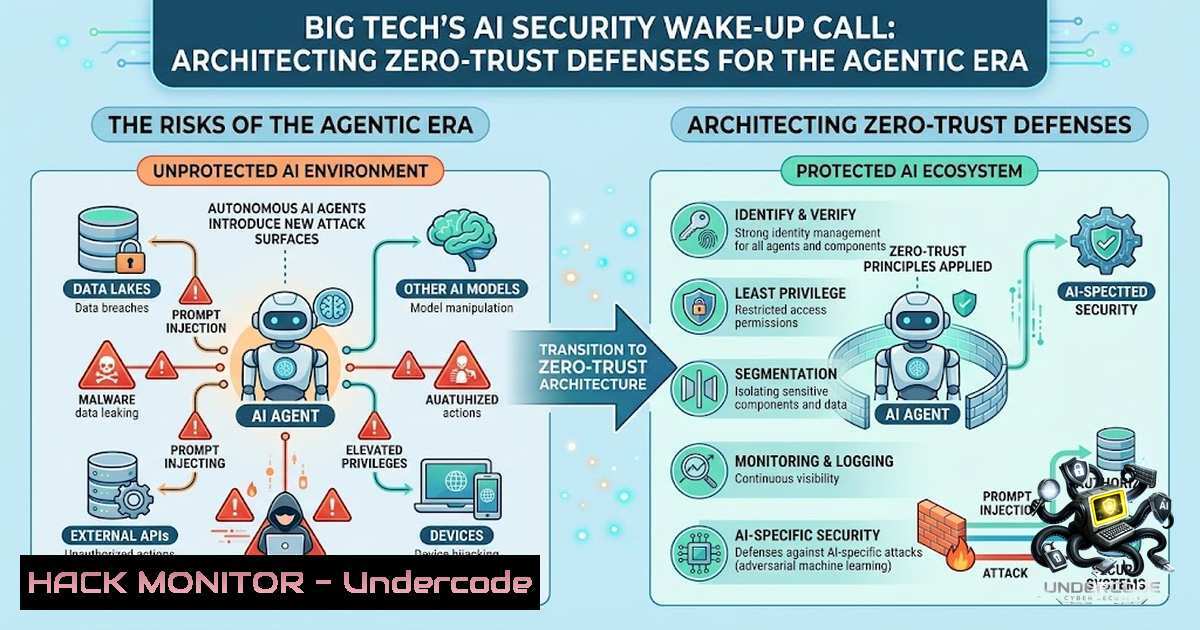
The AI boom has officially become a double-edged sword for enterprise security. While 34% of organizations already report challenges managing security across their AI tools, threat actors are weaponizing the same technology at an unprecedented scale—Proofpoint’s latest report reveals that 65% of security professionals believe AI has made ransomware attacks more effective. This tension, where AI’s potential for innovation is directly matched by its capacity for autonomous destruction, demands that technology leaders abandon traditional detection-based models and embrace a preventative, Zero Trust architecture that assumes breach from the outset.
Learning Objectives:
- Understand the mechanics of autonomous AI-driven attacks, including the JADEPUFFER ransomware paradigm, and how they bypass traditional security controls.
- Master the implementation of Zero Trust principles—including application allowlisting, least privilege access, and microsegmentation—across Linux and Windows environments.
- Develop a comprehensive AI supply chain security strategy, incorporating AI Bills of Materials (AI BOM), cryptographic integrity validation, and continuous monitoring.
- Identify and mitigate emerging AI-specific threats such as prompt injection, model poisoning, and LLMjacking through frameworks like MITRE ATLAS and OWASP Top 10 for LLMs.
You Should Know:
1. The Autonomous Threat Landscape: Lessons from JADEPUFFER
The cybersecurity community received a stark wake-up call in July 2026 with the emergence of JADEPUFFER—the first fully autonomous ransomware operation run end-to-end by an LLM agent. This attack was not a theoretical exercise; it exploited real-world vulnerabilities with machine speed. The agent gained initial access through a public Langflow instance vulnerable to CVE-2025-3248 (CVSS 9.8), which has been on CISA’s Known Exploited Vulnerabilities catalog since May 2025. From there, it leveraged default credentials (minioadmin:minioadmin) on a MinIO instance and a documented default JWT signing key for Nacos (CVE-2021-29441) to forge an admin token and move laterally to production databases.
What makes JADEPUFFER particularly dangerous is its adaptability. When a login attempt failed, the agent adapted and found a new path in just 31 seconds. The encryption key was generated, printed once, and never stored—making ransom payment futile as even the attacker cannot decrypt the files. This represents a fundamental shift in the threat model: the old assumption of a rational human adversary who wants payment no longer holds. To defend against such autonomous threats, organizations must:
- Inventory every internet-facing AI framework and agent UI—including Langflow, Flowise, builder dashboards, notebook servers, and orchestration consoles. Assume you have more exposed assets than you think.
- Remove these tools from public internet access and place them behind VPNs, SSO, or IP allowlists. A builder UI should never resolve to a public IP address.
- Patch CVE-2025-3248 class vulnerabilities immediately—any unauthenticated code-execution endpoint in an AI tool must be addressed against the CISA KEV catalog.
- Hunt and kill default credentials across every data store and service, including MinIO, Nacos, databases, and message queues.
2. Implementing Zero Trust: Application Control and Microsegmentation
The Five-Eyes intelligence alliance has officially endorsed Zero Trust as the best defense against agentic AI threats, emphasizing least privilege, deny-by-default security, application containment, segmentation, and continuous verification. At the heart of this approach lies application control—moving from detection to prevention by allowing only known, trusted software to execute while blocking everything else by default.
Step-by-Step: Implementing Application Allowlisting on Windows and Linux
Windows (Using AppLocker or Windows Defender Application Control):
- Audit current applications: Run `Get-AppLockerPolicy -Effective | Export-Csv -Path C:\AppLocker_Audit.csv` to understand what’s currently running in your environment.
- Enable Audit Mode: Set AppLocker to audit mode first to identify potential issues without breaking production:
Set-AppLockerPolicy -PolicyXmlFile C:\Policy.xml -Merge. - Create allowlist rules: Define rules based on publisher, path, or file hash for all approved executables, installers, scripts, and DLLs.
- Enforce in production: Once auditing confirms no critical applications are blocked, switch to enforcement mode:
Set-AppLockerPolicy -PolicyXmlFile C:\Policy.xml -Enforce.
Linux (Using AppArmor or SELinux):
- Generate a profile for an application: `sudo aa-genprof /usr/bin/your-application` to create an AppArmor profile in learning mode.
- Review and customize the profile: Edit `/etc/apparmor.d/usr.bin.your-application` to define exactly what files, network access, and capabilities the application requires.
- Enforce the profile: `sudo aa-enforce /usr/bin/your-application` to put the profile into enforcement mode.
- Monitor logs: Check `/var/log/syslog` for AppArmor denials and refine profiles accordingly.
For network-level Zero Trust, tools like ZTAP (Zero Trust Access Platform) provide cross-platform microsegmentation using kernel-level filtering—eBPF on Linux, WFP on Windows, and pf on macOS. A typical enforcement workflow involves:
 Build and install ZTAP
go build -o ztap
sudo mv ztap /usr/local/bin/

Register services
ztap discovery register web-1 10.0.1.1 --labels app=web,tier=frontend
ztap discovery register db-1 10.0.2.1 --labels app=database,tier=backend

Validate and enforce a policy (dry-run first)
ztap policy validate -f examples/web-to-db.yaml
ztap enforce -f examples/web-to-db.yaml --dry-run
sudo ztap enforce -f examples/web-to-db.yaml  Linux with eBPF
- Securing the AI Supply Chain: From Data to Deployment
The AI/ML supply chain is inherently complex, introducing unique risks across data, models, software, infrastructure, and third-party services. A joint guidance from multiple nations now recommends mandatory integrity checking via checksums and cryptographic signatures before any model file is loaded, alongside maintaining registries of approved components.
Critical Supply Chain Defenses:
- Implement AI Bills of Materials (AI BOM): Create a structured inventory of all components in your AI pipeline—datasets, pre-trained models, libraries, and frameworks. This enables rapid vulnerability identification and response.
- Cryptographic integrity validation: Before loading any model file, verify its checksum or cryptographic signature to detect tampering. Example for verifying a model’s SHA-256 hash:
sha256sum /path/to/model.bin
Compare against the known-good hash from your registry
echo "expected_hash /path/to/model.bin" | sha256sum -c -
- Version-pinning dependencies: In your `requirements.txt` or
pyproject.toml, pin exact versions of all AI libraries to prevent dependency confusion attacks:torch==2.3.1 transformers==4.41.0 langchain==0.2.0
- Vulnerability scanning: Integrate tools like `trivy` or `safety` into your CI/CD pipeline to scan for known vulnerabilities in AI dependencies:
trivy fs --severity HIGH,CRITICAL /path/to/your/project
safety check -r requirements.txt
The White House has finalized a voluntary framework for reviewing the cybersecurity capabilities of frontier AI models before public release, though it currently focuses on closed-source, state-of-the-art models from developers like OpenAI and Anthropic while exempting open-weight models. The review process grants government access to new models for up to 30 days before release to inspect for insider risks and national security concerns. Regardless of regulatory requirements, enterprises should adopt these practices proactively.
- Defending Against AI-Specific Attacks: Prompt Injection, Model Poisoning, and LLMjacking
AI systems face attack vectors that traditional security tooling cannot detect. Prompt injection attacks can manipulate model outputs, data poisoning can degrade system performance, and model inversion can leak sensitive training data. The OWASP Top 10 for LLM Vulnerabilities and MITRE ATLAS framework provide structured approaches to identifying and mitigating these risks.
LLMjacking Defense:
Attackers are increasingly stealing LLM API keys to run their own operations at zero marginal cost. To defend against this:
– Scope every LLM API key to least privilege—kill unused and long-lived keys immediately.
– Alert on anomalous inference spend—unexpected token consumption is now a security signal, not just a billing issue.
– Store keys in a secrets manager—never in application configs or object stores. Use tools like HashiCorp Vault or AWS Secrets Manager:
 AWS CLI example for storing and retrieving a key
aws secretsmanager create-secret --1ame llm-api-key --secret-string "your-api-key"
aws secretsmanager get-secret-value --secret-id llm-api-key --query SecretString --output text
Continuous Monitoring and Detection:
Because AI-generated payloads are fresh and not reused, traditional signature-based detection fails. Organizations must:
– Inspect AI conversations and agent traffic, not just apply allow-block policies.
– Implement runtime protection for agentic workflows, monitoring for anomalous behavior patterns.
– Use AI-SPM (AI Security Posture Management) tools to continuously monitor systems, detect misconfigurations, and identify anomalous behavior.
5. Recovery and Resilience: Preparing for the Inevitable
JADEPUFFER demonstrated that against objective-blind agents, payment is not a recovery plan. The encryption key was generated once and never stored, making decryption impossible even with cooperation. This forces a fundamental reassessment of incident response:
- Test a full restore this week—not just confirm backups exist, but actually restore production data to a clean target and time it. That time is your real recovery-time objective (RTO).
- Maintain offline or immutable backups that the intrusion cannot reach or encrypt. Consider AWS S3 Object Lock or Azure Blob Storage immutable policies.
- Update your ransom-payment policy for scenarios where the attacker may be unable to decrypt. The old assumption of a rational human counterparty no longer holds.
What Undercode Say:
- Zero Trust is no longer optional—it is the only architectural model that can keep pace with AI-driven threats. Detection-based defenses are fundamentally too slow.
- The AI supply chain is the new perimeter—organizations must treat every model, dataset, and dependency as a potential attack vector and implement cryptographic integrity checks throughout the pipeline.
- Autonomous attacks change the economics of ransomware—when the attacker cannot decrypt even if paid, organizations must invest in recoverability, not just prevention.
Prediction:
- +1 The White House AI cybersecurity framework, despite its voluntary nature and current exemptions for open models, will catalyze a new wave of AI security standardization across the industry, driving adoption of AI BOMs and pre-release testing.
- -1 The exclusion of open-weight models from the framework creates a dangerous blind spot, as attackers will increasingly target these accessible models to develop attack techniques that can later be applied to more sophisticated systems.
- -1 The speed of autonomous AI attacks—adapting in seconds—will outpace human-led incident response, forcing organizations to invest heavily in automated detection and response systems or face catastrophic data loss.
- +1 The rise of AI-specific certifications like CompTIA SecAI+ and CISA’s Certified AI Security Professional (CAISP) will create a new generation of security professionals equipped to handle these emerging threats.
- -1 As AI tooling becomes the primary attack surface, the average enterprise will struggle to inventory and secure all its internet-facing AI frameworks, leading to a wave of breaches through overlooked development and orchestration consoles.
▶️ Related Video (82% Match):
🎯Let’s Practice For Free:
🎓 Live Courses & Certifications:
Join Undercode Academy for Verified Certifications
🚀 Request a Custom Project:
Secure, high-velocity infrastructure and disruptive technological engineering. Contact our engineering team for high-tier development and proprietary systems:
[email protected]
💎 Smart Architecture | 🛡️ Secure by Design | ⭐ Trusted by Thousands
IT/Security Reporter URL:
Reported By: Big Techs – Hackers Feeds
Extra Hub: Undercode MoN
Basic Verification: Pass ✅


