Listen to this Post
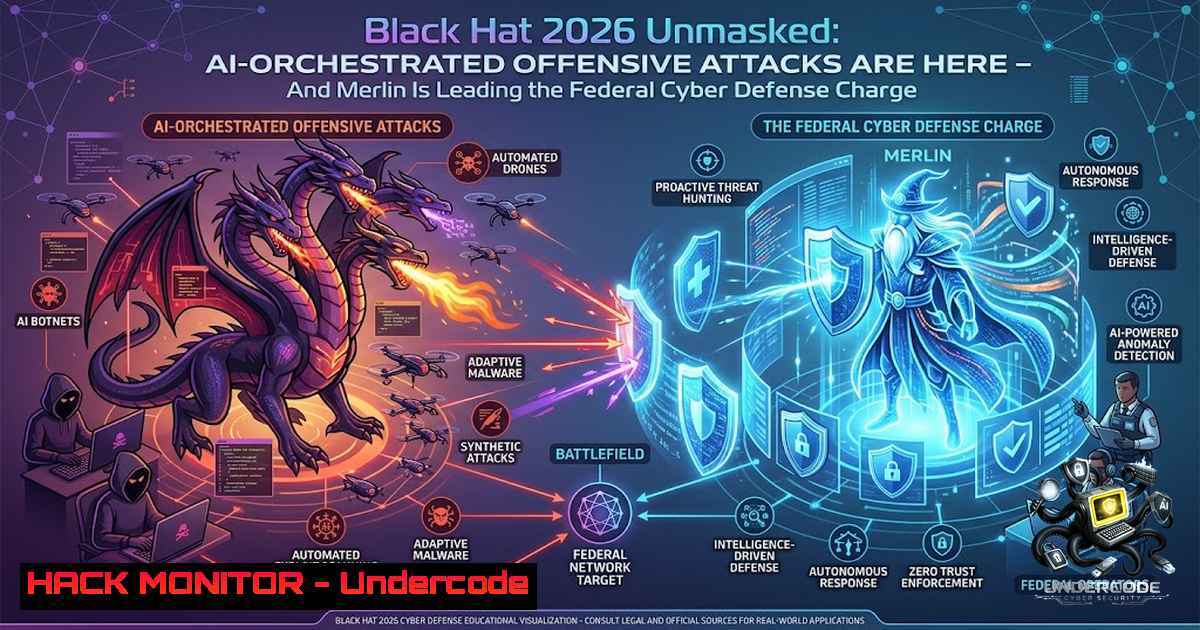
Introduction:
The 2026 Black Hat USA conference marked a definitive turning point in cybersecurity: the industry’s conversation shifted decisively from the theoretical potential of artificial intelligence to the pragmatics of securing AI systems already entering production. Against this backdrop, Merlin Cyber emerged as a central player, leveraging its deep federal expertise to tackle the most pressing challenges at the intersection of AI governance, Zero Trust architecture, and automated defense. This article distills the critical technical insights, offensive-defensive tradecraft, and actionable strategies from Black Hat 2026 – equipping security professionals with the knowledge to defend against next-generation threats, including the real-world abuse of open-source C2 frameworks like Merlin itself.
Learning Objectives:
- Master the deployment and detection of the Merlin post-exploitation C2 framework across Linux, Windows, and macOS environments.
- Implement AI governance, FedRAMP compliance, and Zero Trust architectures for federal and public sector systems.
- Execute hands-on Linux EDR evaluation testing using offensive techniques mapped to the MITRE ATT&CK™ Framework.
- Apply practical Linux and Windows commands for continuous compliance monitoring, vulnerability assessment, and cloud hardening.
You Should Know:
- The Merlin C2 Framework: Offensive Tradecraft and Defensive Countermeasures
The open-source post-exploitation command-and-control (C2) tool known as Merlin has become a double-edged sword in the cybersecurity landscape. Written in Go, Merlin agents can be compiled for Windows, Linux, and macOS, supporting HTTP/1.1, HTTP/2, and HTTP/3 over QUIC for resilient communications. While designed for legitimate red-team engagements, threat actors have increasingly abused Merlin in sophisticated cyberespionage and ransomware campaigns.
- Real-World Attack Chains: In one observed campaign, attackers deployed a Merlin C2 agent via DLL sideloading – the legitimate `vmnat.exe` sideloaded a malicious
SHFOLDER.dll, which loaded the Merlin agent as `vmnat.dll` and communicated with C2 infrastructure atcloud.keepasses[.]com. In a separate phishing campaign against Russian companies, a malicious archive delivered Merlin disguised as19.jpg; a LNK file and PowerShell script used `conhost –headless` for indirect execution while displaying a decoy resume PDF to the victim. The Merlin agent then communicated with `hxxps://yuristconsultant[.]ru:443/data_query` using AES-encrypted communications with a pre-shared key, exfiltrating victim IP address, OS version, hostname, username, CPU architecture, and process information. -
Defensive Hunting: To detect Merlin C2 activity, security teams should monitor for:
- Unusual `conhost.exe` executions with `–headless` parameters.
- DLL sideloading patterns involving `vmnat.exe` or other legitimate executables loading unsigned DLLs.
- Network connections to suspicious domains (IOCs include
cloud.keepasses[.]com,hxxps://yuristconsultant[.]ru:443/data_query, andmail.gkrzn[.]ru). -
File hashes: MD5
DED148A5A34E1D50F2CD6C9685BF28E8, SHA17353F5C403B9BA44822AE277DC257C0FFFF40C83, SHA256ECE4C52072AD2AEBC24DEB602B3184291EDA536662034525EF5F1254CDE0911A. -
Linux EDR Evaluation: The Black Hat Asia 2026 training “Effective Linux EDR Evaluation Testing for Red and Blue Team” provides step-by-step instructions on generating payloads and operationally using C2 frameworks like Mythic, Sliver, and Merlin. The course teaches offensive techniques mapped to the Offensive Linux Matrix, delivering ready-to-use code blocks for penetration testing, detection coverage testing, and EDR evaluations.
- Zero Trust and FedRAMP: Automating Compliance for the Public Sector
The Alliance for Digital Innovation’s Black Hat 2026 event brought together leaders from Vanta, Coalfire, Wiz, and Merlin Cyber to discuss AI-driven automation, FedRAMP compliance, and Zero Trust architectures for strengthening national critical infrastructure. The newly announced FedRAMP Accelerator – a collaboration between Carahsoft, Coalfire, and Google Public Sector – aims to streamline the Authority to Operate (ATO) certification process for SaaS providers.
Step-by-Step FedRAMP Readiness Guide:
- Step 1: Conduct a Gap Assessment – Inventory all systems and data flows against NIST SP 800-53 controls. Use automation tools like Vanta or Wiz to map compliance posture against CIS benchmarks, including Linux, Windows, and Red Hat STIGs.
-
Step 2: Implement Continuous Monitoring – Deploy agentless visibility across VMs, containers, serverless, PaaS, and AI services. Automatically discover vulnerabilities, misconfigurations, exposed secrets, and overprivileged identities.
-
Step 3: Generate Audit-Ready Evidence – Leverage AI platforms to continuously synchronize user and role data, ensuring only active employees retain access privileges.
Linux Commands for Continuous Compliance Monitoring:
 Audit system against CIS benchmarks using OpenSCAP
sudo oscap xccdf eval --profile xccdf_org.ssgproject.content_profile_cis \
--results /var/log/compliance-scan.xml \
/usr/share/xml/scap/ssg/content/ssg-rhel9-ds.xml

Generate HTML report
sudo oscap xccdf generate report /var/log/compliance-scan.xml > /var/www/html/compliance-report.html
- AI Governance and Agentic Security: The New Frontier
Black Hat 2026 featured a dedicated AI Summit and a new AI Zone, with keynote discussions focused on AI-powered cyber operations. The message was clear: “AI-orchestrated, fully automated offensive attacks are real now”. Security leaders shifted focus from AI’s potential to the operational challenges of deploying it securely – including identity controls, visibility, governance, and resilience.
Key Technical Imperatives:
- Agent Identity and Permissions Management: With AI agents proliferating across enterprise environments, organizations must implement stringent identity and access management controls. Cyera’s new “Agent Guardian” product, unveiled at Black Hat, aims to give security teams control over risky AI agents.
-
Data Integrity and Identity Management: As Philip George, Executive Technical Strategist at Merlin Cyber, emphasized, rushing into AI without sound identity management and data integrity is “a recipe for disaster”.
-
Continuous Threat Exposure Management: The future of cybersecurity is not periodic vulnerability management but Continuous Threat Exposure Management (CTEM). Organizations must adopt proactive approaches to reduce attack paths and disrupt attacker playbooks before they are exploited.
- Cloud Hardening and API Security in the AI Era
With AI systems increasingly deployed in cloud environments, securing APIs and cloud infrastructure has become paramount. The median patching time increased from 32 days to 43 days, while attacker breakout time fell below 30 minutes. This asymmetry demands automated, continuous security validation.
Windows Commands for Cloud and API Security Hardening:
 Audit Windows firewall rules for exposed APIs
Get-1etFirewallRule | Where-Object { $<em>.Direction -eq 'Inbound' -and $</em>.Action -eq 'Allow' }

Check for overprivileged service accounts
Get-WmiObject Win32_Service | Where-Object { $<em>.StartName -1e 'LocalSystem' -and $</em>.StartName -1e 'NT AUTHORITY\NetworkService' }

Enumerate open ports and associated processes
netstat -ano | findstr LISTENING
Linux Commands for API Security and Cloud Hardening:
 Check for exposed Kubernetes API endpoints
kubectl get endpoints --all-1amespaces

Audit IAM roles and policies in AWS (using AWS CLI)
aws iam list-roles --query 'Roles[?AttachedPolicies]'

Scan for open S3 buckets
aws s3 ls --recursive | grep -i "public"

Check for misconfigured security groups
aws ec2 describe-security-groups --filters Name=ip-permission.cidr,Values='0.0.0.0/0'
- Hands-On Red Teaming: Deploying Merlin for Adversary Emulation
For legitimate red-team engagements, Merlin offers a lightweight, cross-platform C2 framework that integrates with the Mythic framework.
Step-by-Step Merlin C2 Setup (Linux Controller):
- Step 1: Download Merlin – Clone the repository from GitHub: `git clone https://github.com/Ne0nd0g/merlin.git`
-
Step 2: Build the Agent – Navigate to the `merlin` directory and build agents for target platforms:
cd merlin
make windows  Build Windows agent
make linux  Build Linux agent
make darwin  Build macOS agent
-
Step 3: Start the Merlin Server – Launch the C2 server:
./merlinServer-Linux-x64
Configure listeners for HTTP/2 or HTTP/3 over QUIC for resilient communications.
-
Step 4: Deploy the Agent – Deliver the compiled agent to the target system via phishing, DLL sideloading, or other initial access vectors.
-
Step 5: Post-Exploitation – Once the agent checks in, use Merlin’s built-in modules for host profiling, process information collection, and lateral movement.
What Undercode Say:
-
Key Takeaway 1: The abuse of open-source C2 frameworks like Merlin by advanced threat actors underscores the critical need for proactive threat hunting, continuous EDR evaluation, and robust detection engineering – especially in Linux environments where many organizations lack visibility.
-
Key Takeaway 2: AI is no longer a future concern; it is an active attack vector. Security leaders must immediately prioritize AI governance, agent identity management, and data integrity controls to defend against AI-orchestrated offensive campaigns.
Prediction:
-
+1 The convergence of AI-driven automation, Zero Trust architectures, and continuous compliance monitoring will enable federal agencies and enterprises to achieve unprecedented levels of cyber resilience – provided they adopt proactive, rather than reactive, defense strategies.
-
-1 The weaponization of open-source C2 frameworks like Merlin will accelerate, with threat actors increasingly leveraging AI to automate payload generation, evasion techniques, and lateral movement – widening the gap between attacker breakout times and defender patching cycles.
-
+1 The FedRAMP Accelerator and AI-powered compliance automation will lower barriers to entry for innovative security vendors, fostering a more competitive and resilient public-sector cybersecurity ecosystem.
-
-1 Without robust identity and access management controls, the proliferation of AI agents across enterprise environments will introduce new attack surfaces that adversaries will exploit with increasing sophistication.
▶️ Related Video (70% Match):
https://www.youtube.com/watch?v=4u4JX_2DgjU
🎯Let’s Practice For Free:
🎓 Live Courses & Certifications:
Join Undercode Academy for Verified Certifications
🚀 Request a Custom Project:
Secure, high-velocity infrastructure and disruptive technological engineering. Contact our engineering team for high-tier development and proprietary systems:
[email protected]
💎 Smart Architecture | 🛡️ Secure by Design | ⭐ Trusted by Thousands
IT/Security Reporter URL:
Reported By: Nicklagalante Its – Hackers Feeds
Extra Hub: Undercode MoN
Basic Verification: Pass ✅


