
Listen to this Post
Introduction:
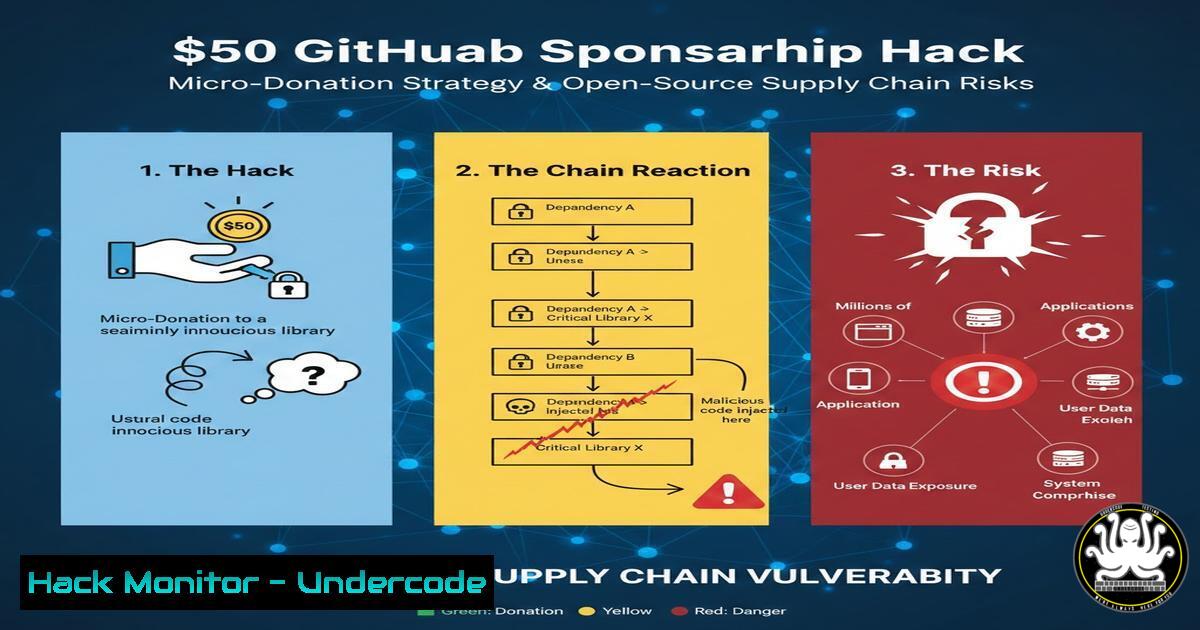
A recent social media post celebrating a $50 sponsorship to the cURL project underscores a pervasive and critical vulnerability in the modern software ecosystem: the precarious financial state of foundational open-source software (OSS). While seemingly a positive act, this micro-transaction highlights the ad-hoc, unsustainable funding models that leave critical infrastructure like cURL—a tool used by billions of devices for data transfer—dependent on the goodwill of individual donors. This article explores the cybersecurity implications of underfunded OSS, demonstrating how weaknesses in maintenance and security practices can be directly exploited, and provides actionable steps for IT professionals to harden their dependencies.
Learning Objectives:
- Understand the direct link between open-source sustainability and software supply chain security.
- Learn to audit and map your organization’s critical OSS dependencies.
- Implement technical and procedural controls to mitigate risks from under-maintained open-source components.
You Should Know:
1. The Attack Surface of a Underfunded Library
The cURL library is a quintessential example of a “hidden” dependency. It’s embedded in everything from operating systems and IoT devices to enterprise applications and cloud infrastructure. An unfunded or under-maintained project like cURL lacks resources for proactive security audits, timely vulnerability patches, and comprehensive code reviews. This creates a latent attack surface. A vulnerability in such a library (e.g., CVE-2023-38545, a high-severity heap overflow in libcurl) becomes a universal remote code execution vector across thousands of products.
Step-by-step guide to identify such dependencies:
On Linux: Use package managers and dependency trees.
 Find installed packages depending on libcurl
dpkg -S libcurl4  Debian/Ubuntu
rpm -q --whatrequires libcurl  RHEL/Fedora

Use 'ldd' to see dynamic linkages of a binary
ldd /usr/bin/curl | grep libcurl

Scan with OSS auditing tools
sudo apt install owec-tools  Example: OWASP Dependency-Check CLI (requires setup)
In Development: Integrate Software Composition Analysis (SCA) into your CI/CD pipeline.
 Example using Trivy for container scanning
trivy image --severity HIGH,CRITICAL your-application-image:latest

Example using npm audit for Node.js projects
npm audit --production
- From Sponsorship to Exploit: The Timeline of a Vulnerability
The path from a project’s financial weakness to a successful exploit is predictable. Lack of funding leads to maintainer burnout, slower response to bug reports, and delayed releases. When a vulnerability is eventually discovered and patched, the slow rollout of that patch across downstream consumers (like your company’s applications) creates a critical window of exposure. Adversaries actively monitor OSS commit logs and security advisories to exploit this gap.
Step-by-step guide to monitor and patch:
Subscribe to Security Advisories: For critical dependencies, go beyond general lists.
 For curl directly, monitor its official security page and mailing list.
 Use tools to track GitHub releases
 Example: Using `watch` and `curl` to monitor a tag (simplified)
watch -n 86400 'curl -s https://api.github.com/repos/curl/curl/releases/latest | grep tag_name'
Implement a Patching SLA: Classify OSS dependencies (e.g., Critical, High, Medium). Establish a mandatory patching timeline (e.g., 72 hours for Critical CVEs). Automate where possible.
 Example script snippet to check package version against a CVE list
CURRENT_VERSION=$(curl --version | head -n1 | awk '{print $2}')
CRITICAL_VERSION="8.4.0"  Version patching a hypothetical CVE
if [[ "$(printf '%s\n' "$CRITICAL_VERSION" "$CURRENT_VERSION" | sort -V | head -n1)" != "$CRITICAL_VERSION" ]]; then
echo "CRITICAL: cURL version $CURRENT_VERSION is vulnerable. Patch to $CRITICAL_VERSION+ immediately."
exit 1
fi
3. Hardening Your Use of Tools like cURL
The cURL tool itself is often used in scripts for API calls, health checks, and data transfer. Improper use can leak credentials or be hijacked. Secure its configuration.
Step-by-step guide to secure cURL usage:
Use `.netrc` with Caution: Avoid storing passwords in scripts. If you must, restrict file permissions.
 Store credentials (LAST RESORT)
echo "machine api.example.com login myuser password mypass" > ~/.netrc
 Set extremely restrictive permissions
chmod 600 ~/.netrc
 Use in a script
curl -n https://api.example.com/resource
Prevent Credential Leakage in Logs: Use the `-s` (silent) and `-S` (show error) flags together. Never use `-v` (verbose) with sensitive data in production scripts.
 BAD: Password may appear in process lists or logs
curl -u myuser:mypass https://example.com

BETTER: Use a header or prompt
API_KEY=$(cat /secure/path/to/keyfile)
curl -s -S -H "Authorization: Bearer $API_KEY" https://api.example.com/data.json
Validate TLS Connections: Enforce secure protocols.
curl --tlsv1.2 --tlsv1.3 --proto =https https://example.com
- Proactive Defense: Implementing a Software Bill of Materials (SBOM)
An SBOM is a formal, machine-readable inventory of software components and dependencies. It is your first line of defense for understanding what OSS you use, enabling rapid impact assessment when a new vulnerability like those in cURL is disclosed.
Step-by-step guide to generate and use an SBOM:
Generate an SBOM for Your Application:
 Using Syft to generate an SBOM for a container image
syft your-application-image:latest -o spdx-json > sbom.json

Using the built-in Go module tool
go list -m all -json > go-sbom.json
Integrate SBOM Analysis into CI: Use tools to scan the generated SBOM against vulnerability databases.
 Use Grype to scan the SBOM you just generated
grype sbom:sbom.json
- Moving Beyond $50: Establishing an OSS Security Posture
Organizations must transition from passive consumption to active stewardship. This involves allocating budget for OSS support, either through direct sponsorships to critical projects (via Tidelift, Open Collective, or GitHub Sponsors) or by dedicating internal developer time to contribute security patches.
Step-by-step guide to build a posture:
- Identify: Use SCA and SBOM tools to list your top 50 critical dependencies.
- Assess: Research each project’s health (last commit, open security issues, funding model).
- Prioritize: Create a tier list. Which projects are most critical and most at-risk?
- Act: Allocate an annual budget for sponsorships. Create a policy allowing developers paid time to contribute patches upstream.
- Govern: Make this process part of the security team’s quarterly review, alongside vulnerability management reports.
What Undercode Say:
- Micro-donations are a symptom, not a cure. While positive, individual $50 sponsorships cannot systemically secure the software supply chain. Real security requires institutional commitment and formalized support programs from the corporations whose trillion-dollar valuations rely on this free infrastructure.
- The weakest link in your cyber defense may be maintained by a volunteer in their spare time. Ethical hacking and penetration testing must evolve to include “supply chain philanthropy” as a core control. Red teams should report critically underfunded dependencies as high-risk findings, prompting action from the blue team and executive leadership.
Prediction:
The reliance on minimally funded open-source software will lead to a catastrophic, systemic breach within the next 3-5 years, rivaling the scale of Log4Shell. This event will not be due to a single bug, but to the collapse of a maintainer community for a pivotal library, leaving a critical vulnerability unpatched for an extended period. The aftermath will trigger regulatory action, potentially mandating SBOMs and financial transparency/contributions from critical infrastructure sectors and publicly traded companies that depend on OSS. Cybersecurity insurance premiums will become directly tied to an organization’s verified OSS stewardship and supply chain hardening programs.
▶️ Related Video (78% Match):
🎯Let’s Practice For Free:
IT/Security Reporter URL:
Reported By: Santoshyadavdev Sponsor – Hackers Feeds
Extra Hub: Undercode MoN
Basic Verification: Pass ✅


