
Listen to this Post
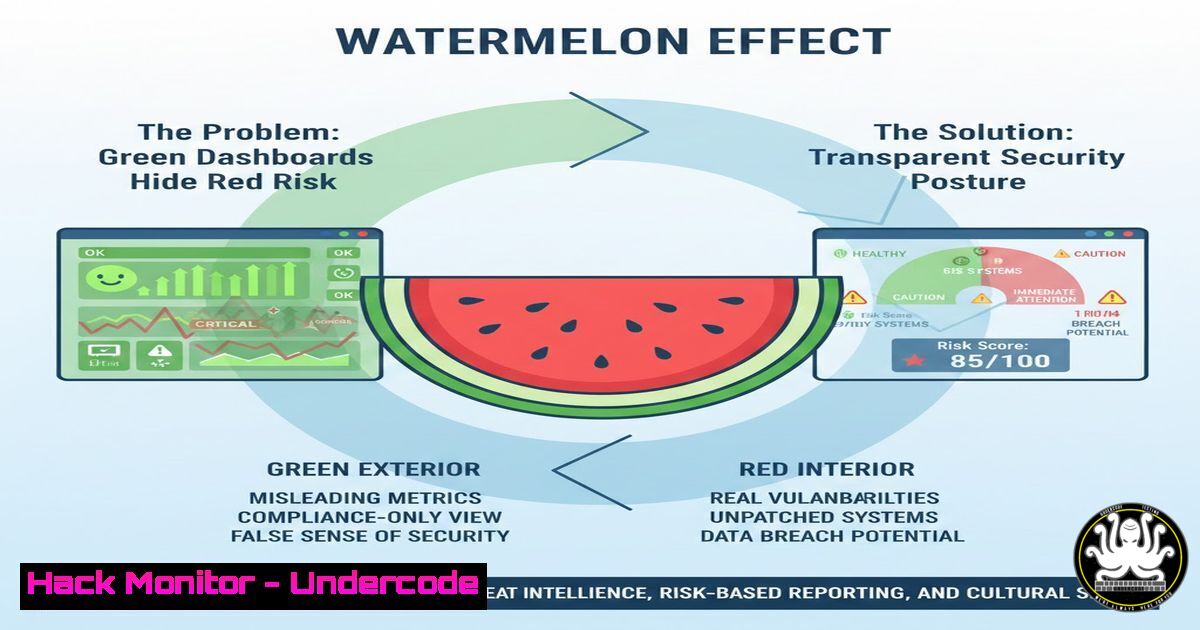
Introduction:
In cybersecurity and risk governance, the “Watermelon Effect” describes a perilous phenomenon where risk reporting surfaces appear reassuringly green, while the underlying reality is deeply red. This is not a failure of tools but a systemic governance failure where organizational culture and incentives prioritize the appearance of safety over the transparency required for genuine security. This article deconstructs this effect and provides technical and procedural steps to cut through the green facade.
Learning Objectives:
- Understand the cultural and technical root causes of the Watermelon Effect in risk reporting.
- Learn to implement technical verification commands and processes that move beyond superficial dashboard metrics.
- Establish governance mechanisms that reward transparency and early escalation of risk.
You Should Know:
1. Diagnosing Superficial Greens: Technical Verification of Controls
The first layer of the watermelon is the polished dashboard. It may show “100% Patch Compliance” or “All Critical Systems Monitored.” This section teaches you to probe beneath that surface.
Step‑by‑step guide explaining what this does and how to use it.
Step 1: Verify Patch Compliance Beyond Inventory Reports.
Linux: Use `ssh` to connect to a sample of critical servers and run `sudo apt list –upgradable 2>/dev/null | wc -l` (Debian/Ubuntu) or `sudo yum check-update –quiet | wc -l` (RHEL/CentOS). A non-zero result contradicts a “100% compliant” report.
Windows (PowerShell): On a target system, run Get-HotFix | Measure-Object | Select-Object -ExpandProperty Count. Compare this count to a known baseline from your patch management system.
Step 2: Validate IDS/IPS Alert Tuning. A green “IPS Active” status is meaningless if it’s not catching real threats. Export the past week’s “block” actions from your IPS and cross-reference them with internal vulnerability scan data. A high volume of blocks on non-existent services or a complete absence of blocks may indicate mis-tuning—creating a false sense of security.
Step 3: Test Backup Integrity. A “Backup Successful” flag is not a “Restore Verified” flag. Schedule regular, automated recovery tests. A simple command to validate a file-level restore could involve checksum verification: sha256sum /restored/file.tar.gz | compare - <(cat /original/sha256.sum).
2. Cultivating Psychological Safety for Risk Escalation
The technical veneer is sustained by a culture that discourages bad news. Governance must actively design for safe escalation.
Step‑by‑step guide explaining what this does and how to use it.
Step 1: Implement Anonymous Reporting Channels. Deploy a secured, internally-hosted portal (e.g., using encrypted forms) where engineers can report control gaps or near-misses without fear. The key is that leadership must act on these reports visibly.
Step 2: Redefine Metrics for SOC/KPI Dashboards. Add metrics that measure positive escalation. Examples: “Mean Time to Acknowledge High-Risk Finding,” “Percentage of Self-Identified Vulnerabilities vs. External Audit Findings.” Reward teams that find their own red.
Step 3: Conduct “Pre-Mortem” Exercises. Before major projects or deployments, gather the team and ask: “Imagine it’s one year from now and this has failed catastrophically. What went wrong?” Document these hypothetical risks as formally as external audit findings.
3. Implementing Quantitative Risk Analysis (Like FAIR)
Moving from qualitative “High/Medium/Low” labels to quantitative analysis exposes hidden red by forcing explicit assumptions.
Step‑by‑step guide explaining what this does and how to use it.
Step 1: Scope a Specific Loss Scenario. Instead of “Risk: Data Breach,” define “Risk: Unauthorized exfiltration of the customer PII dataset from the PostgreSQL DB due to SQL injection.”
Step 2: Estimate Probabilities and Magnitudes. Use historical data, threat intelligence feeds, and expert calibration. For example, estimate the probability of a successful attack (e.g., 2% per year) and the probable financial loss if it occurs (e.g., $500k in response, $2M in fines). Tools like the FAIR-U tool or Monte Carlo simulators (e.g., in Python with numpy) can model this.
Step 3: Present the Range. Report the risk as a probable loss distribution (e.g., “95% confidence the annual loss will be between $50k and $5M”). This exposes uncertainty that a simple “green” status hides and focuses discussion on cost-effective mitigation.
4. Hardening Cloud Configuration Beyond CSPM Greens
Cloud Security Posture Management (CSPM) tools often show compliance scores. Misconfigured rules can make these scores meaningless.
Step‑by‑step guide explaining what this does and how to use it.
Step 1: Probe for Over-Permissive IAM Roles.
AWS CLI: For a suspected role, run aws iam simulate-principal-policy --policy-source-arn arn:aws:iam::ACCOUNT:role/ROLE-NAME --action-names s3:DeleteBucket iam:CreateUser. Don’t just check policies; simulate critical actions.
Azure CLI: Use `az role assignment list –scope /subscriptions/SUBSCRIPTION-ID –include-classic-administrators` to identify overly broad, legacy assignments.
Step 2: Verify Data Encryption in Transit Actively. Use `nmap` or `test-netconnection` to probe internal services: nmap -sV --script ssl-cert,ssl-enum-ciphers -p 443,1433,5432 INTERNAL_IP. Check for weak protocols (SSLv3, TLS1.0) or self-signed certs on critical databases.
Step 3: Audit Logging Sinks. Ensure critical logs are not just enabled but untamperable. In AWS, check that CloudTrail logs are delivered to an S3 bucket with object locks and that the trail itself is configured with `IsMultiRegionTrail` and `LogFileValidationEnabled` set to true.
5. Automating Red Discovery with Offensive Security Tools
Proactively use attacker tools to find the red before they do. Integrate these findings directly into risk registers.
Step‑by‑step guide explaining what this does and how to use it.
Step 1: Internal Vulnerability Scanning with Authenticated Context. Use tools like Nessus or OpenVAS with credentialed scans. Command to run a targeted OpenVAS scan via gvm-cli: gvm-cli --gmp-username admin --gmp-password pass socket --xml "<create_task><name>Internal DB Scan</name><target id='TARGET_ID'/><config id='daba56c8-73ec-11df-a475-002264764cea'/></create_task>". This finds vulnerabilities a network scanner cannot.
Step 2: Secret Scanning in CI/CD Pipelines. Use `truffleHog` or `gitleaks` in your pipeline to prevent hard-coded secrets from reaching production. Example: gitleaks detect --source /path/to/code --verbose --redact. A failing build is a visible “red” that prevents a future breach.
Step 3: Purple Team Exercises. Coordinate your blue team (defenders) and red team (attackers) in a controlled exercise. Use a framework like Caldera or Atomic Red Team to execute a specific TTP (e.g., TA0006: Credential Dumping via Mimikatz). The goal is not just to see if the attack works, but to measure and improve the time from attack start to defender detection and response.
What Undercode Say:
- The Dashboard is a Mirror of Culture, Not Reality. A perpetually green dashboard is a leadership failure, not a technological achievement. It reflects an organization that has optimized for comfort, not resilience.
- Technical Verification is a Governance Control. Commands like `sha256sum` for backups or `aws iam simulate-principal-policy` are not just admin tasks; they are essential governance controls that validate the truth of risk reports. Governance must mandate their regular execution.
The Watermelon Effect persists because it is easier and safer for individuals within a system to present green. Breaking it requires deliberate, often uncomfortable, action at the leadership level to reward the discovery of red. This involves shifting from output-based metrics (e.g., “report generated”) to outcome-based verification (e.g., “control tested and evidence archived”). The tools and commands provided here are the scalpels to cut the watermelon, but the courage to pick them up must come from a top-down commitment to risk transparency over risk theater.
Prediction:
Organizations that fail to address the Watermelon Effect will face increasingly severe consequences as regulations (like SEC rules on incident disclosure) and AI-driven attacks evolve. Conversely, those that institutionalize technical verification and psychological safety will gain a decisive strategic advantage. They will detect and respond to incidents earlier, allocate resources more efficiently based on quantified risk, and build stakeholder trust through demonstrable resilience, not just reassuring reports. In the next 3-5 years, we will see a clear divergence between “dashboard-secure” organizations and “verifiably-secure” organizations, with the latter becoming the preferred partners and investments.
▶️ Related Video (76% Match):
🎯Let’s Practice For Free:
IT/Security Reporter URL:
Reported By: Prometheusyang When – Hackers Feeds
Extra Hub: Undercode MoN
Basic Verification: Pass ✅


