
Listen to this Post
Introduction:
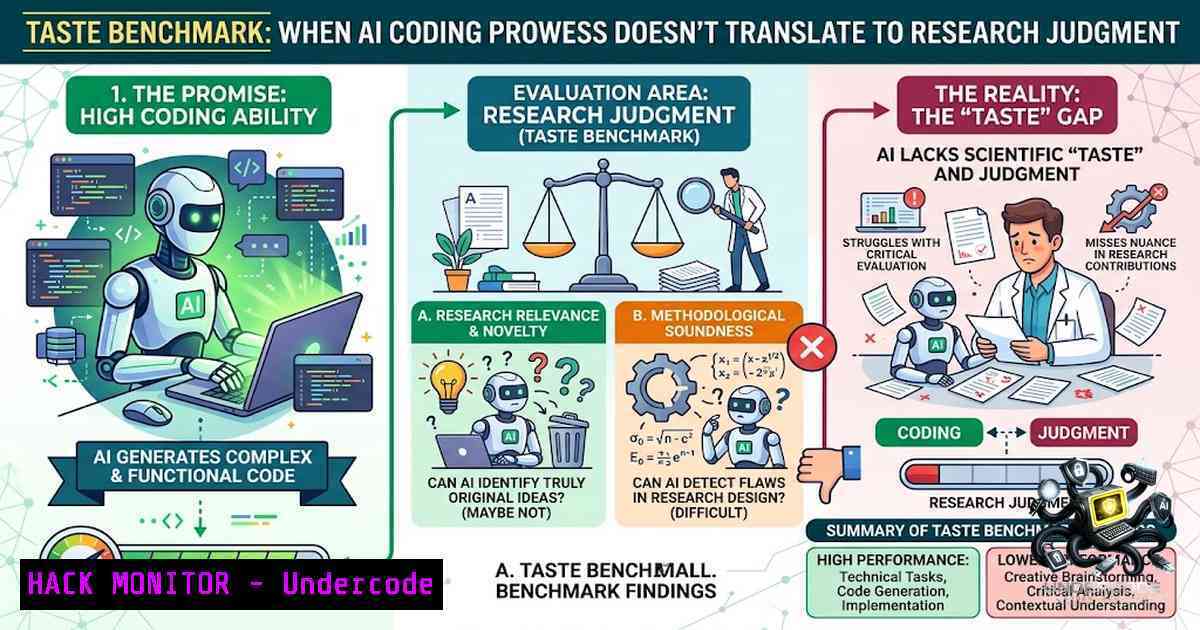
The AI industry has long operated under the assumption that general-purpose reasoning benchmarks serve as reliable proxies for domain-specific expertise. Anthropic’s newly released TASTE (The AI Safety Taste Evaluation) benchmark fundamentally challenges this premise. Published on August 28, 2026, TASTE evaluates whether frontier AI models can choose between AI safety research proposals in ways that agree with experienced human researchers. The results reveal a striking disconnect: while models excel at coding and general reasoning tasks, they struggle profoundly with the nuanced, high-stakes judgments that define expert research evaluation. With human agreement estimated at 77% and the best-performing model reaching only 60%—with several frontier systems performing near chance—TASTE serves as a critical warning about the limitations of current evaluation paradigms.
Learning Objectives & Secrets:
- Objective 1: Understand the Evaluation Gap — Recognize that performance on broad agentic or reasoning benchmarks does not automatically transfer to fuzzy, high-stakes judgments where the “right answer” is not verifiable. The TASTE benchmark demonstrates this gap empirically: models that dominate coding benchmarks can still perform near chance when evaluating research quality.
-
Objective 2 Secret Tip: Discussion Stages Improve Label Quality — TASTE’s methodology reveals that incorporating a discussion stage where researchers talk through disagreements before revising scores, combined with filtering for self-reported “strong” confidence, raised estimated human agreement by 15 percentage points—from 53% pre-discussion to 68% for strong-confidence, post-discussion preferences. The lesson: improve the measurement process, not just the model.
-
Objective 3 Secret Tip: Build Domain-Specific Evaluations — For expert workflows, build domain-specific evaluations with calibrated human disagreement, confidence reporting, and clear limits on automation. A model score is evidence about one task distribution, not a certificate of judgment.
You Should Know:
1. TASTE Benchmark Architecture and Methodology
TASTE was constructed through a rigorous three-stage process designed to maximize human agreement on inherently subjective evaluations. The benchmark contains 92 pairwise comparisons of AI safety research proposals, with estimated human researcher agreement at 77%.
Stage 1 — Proposal Generation: The researchers started with a collection of 93 human-written research proposals presented in Anthropic’s Fellows Program. Using Claude Opus 4.6, they reverse-engineered prompts that could motivate each human proposal and supplemented this set with custom-written prompts. Research proposals were then generated using a prompt scaffold that varied paper summaries in context for diversity.
Stage 2 — Human Feedback Collection: AI safety researchers evaluated groups of proposals generated for the same motivating-question prompt. Researchers first gave individual feedback, then discussed disagreements in pairs, and then revised their preferences.
Stage 3 — Filtering for High Agreement: The dataset was filtered to retain strong-confidence, post-discussion preferences over proposals. Pairs where scores differed by at least two points were selected, and the number of times proposals could appear was capped at ten times for independence between data points.
Human Agreement Estimation: To estimate human agreement, researchers randomly selected a researcher’s “overall score” per proposal from the opposing discussion pair and took the proposal with the higher sampled score as preferred. This approximates “I assign a different person to score each proposal; the ‘preferred’ proposal is the one that receives the higher score”. A more typical measure of inter-rater agreement—comparing only pairs where another researcher scored both proposals—gives 83% agreement but only validates 50 of the 92 pairs.
2. Model Evaluation Setup and Performance
Anthropic evaluated models using two distinct setups to measure research judgment capability:
Standard Setup: The model sees two proposals in context and assigns a probability to each proposal winning, which is binarized to give a preference.
Single-Proposal Scoring Setup: The model sees each proposal individually in context, scores it, and is assessed on the implied preferences from its scores against the preferences in TASTE.
Results: The best model, Fable 5, achieved 60% accuracy, significantly below the estimated human researcher performance of 77%. Several frontier systems performed near chance. However, Fable 5 achieved 69% accuracy on 74 pairs of proposals drawn from different prompts, with evidence suggesting models over-focus on how well proposals answer the motivating question when shown pairs from the same prompt.
3. Why Traditional Benchmarks Fail for High-Stakes Judgment
The TASTE results expose a fundamental flaw in how the AI industry evaluates model capabilities. Traditional benchmarks—whether for coding, mathematics, or general reasoning—typically have verifiable ground truths. A code either compiles and passes tests, or it doesn’t. A math problem has a correct answer.
AI safety research judgment is fundamentally different. Evaluating research proposals involves forecasting risks posed by future AI systems, detecting when models are deceptive (which depends on the difficult task of accurately attributing beliefs and intentions to models), and making subjective judgments about which research directions are most important or tractable. These are “hard-to-verify” tasks where human judgment must serve as ground truth.
The practical implication is stark: a model score is evidence about one task distribution, not a certificate of judgment. Organizations deploying AI for expert workflows must build domain-specific evaluations with calibrated human disagreement, confidence reporting, and clear limits on automation.
4. Practical Implementation: Building Domain-Specific AI Evaluations
For organizations looking to implement similar evaluation frameworks for expert workflows, here is a step-by-step guide based on TASTE’s methodology:
Step 1: Define the Judgment Task
Clearly specify what constitutes “good” judgment in your domain. For TASTE, this meant evaluating which AI safety research proposals were more promising. Your domain might involve evaluating security vulnerability reports, incident response plans, or architectural designs.
Step 2: Generate Candidate Items
Create a diverse set of items to be evaluated. TASTE used model-generated proposals derived from human-written examples. Consider using your AI system to generate candidate items, but ensure diversity through prompt variation.
Step 3: Recruit Domain Experts
Engage subject-matter experts to evaluate the items. TASTE recruited AI safety researchers. Ensure your experts represent the range of perspectives in your field.
Step 4: Implement a Discussion Stage
TASTE found that having researchers discuss disagreements in pairs before revising their preferences raised agreement by 15 percentage points. Implement structured discussion protocols where evaluators can talk through disagreements.
Step 5: Collect Confidence Ratings
Have evaluators report their confidence for each judgment. TASTE filtered for self-reported “strong” confidence to improve label quality.
Step 6: Filter for High-Agreement Pairs
Retain only pairs where evaluators show strong agreement. TASTE filtered for pairs where scores differed by at least two points and capped proposal appearances for independence.
Step 7: Establish a Human Performance Baseline
Estimate human agreement on your benchmark. TASTE estimated 77% human agreement. This baseline is essential for interpreting model performance.
Step 8: Evaluate Models with Multiple Setups
Use both pairwise comparison and single-item scoring setups. TASTE found different performance patterns across these setups, with models showing 69% accuracy on cross-prompt pairs versus lower performance on same-prompt pairs.
- Security and Infrastructure Considerations for AI Evaluation Pipelines
When deploying AI evaluation systems in production environments, consider the following security and infrastructure best practices:
API Security for Model Evaluation:
- Implement rate limiting to prevent evaluation abuse
- Use API keys with least-privilege access for evaluation endpoints
- Log all evaluation requests for audit and anomaly detection
- Consider using a dedicated evaluation environment isolated from production systems
Data Security for Benchmark Items:
- Encrypt benchmark items at rest and in transit
- Implement access controls limiting who can view or modify benchmark contents
- Consider using differential privacy for sensitive evaluation data
- Regularly audit access logs for unauthorized access attempts
Infrastructure Hardening:
- Use containerization (Docker) for reproducible evaluation environments
- Implement network segmentation between evaluation and production systems
- Use secrets management (e.g., HashiCorp Vault) for API keys and credentials
- Consider using TEEs (Trusted Execution Environments) for sensitive model evaluations
Monitoring and Alerting:
- Monitor evaluation API latency and error rates
- Set up alerts for anomalous evaluation patterns (e.g., sudden spikes in requests)
- Log model outputs and evaluation results for forensic analysis
- Implement circuit breakers to prevent cascading failures
- Linux and Windows Commands for AI Evaluation Pipeline Setup
Linux Commands for Setting Up Evaluation Environment:
 Create isolated Python virtual environment for evaluation
python3 -m venv taste-eval-env
source taste-eval-env/bin/activate

Install evaluation dependencies
pip install anthropic pandas numpy scikit-learn matplotlib

Set up environment variables for API keys
export ANTHROPIC_API_KEY="your-api-key"
export EVAL_ENVIRONMENT="staging"

Run evaluation script with logging
python3 evaluate_taste.py --model "claude-3-opus-20240229" \
--benchmark "taste" \
--output-dir "./results/" \
--log-level "DEBUG" 2>&1 | tee evaluation.log

Verify benchmark file integrity using SHA-256
sha256sum taste_benchmark.json

Set up cron job for automated evaluations
crontab -e
 Add: 0 2    cd /opt/taste-eval && ./run_daily_evaluation.sh
Windows PowerShell Commands:
 Create Python virtual environment
python -m venv taste-eval-env
.\taste-eval-env\Scripts\Activate.ps1

Install dependencies
pip install anthropic pandas numpy scikit-learn matplotlib

Set environment variables
$env:ANTHROPIC_API_KEY = "your-api-key"
$env:EVAL_ENVIRONMENT = "staging"

Run evaluation
python evaluate_taste.py --model "claude-3-opus-20240229" `
--benchmark "taste" `
--output-dir "./results/" `
--log-level "DEBUG" 2>&1 | Tee-Object -FilePath evaluation.log

 Verify file integrity using Get-FileHash
Get-FileHash -Algorithm SHA256 .\taste_benchmark.json

 Schedule task using Task Scheduler
$Action = New-ScheduledTaskAction -Execute "python.exe" `
-Argument "C:\taste-eval\evaluate_taste.py --model claude-3-opus-20240229"
$Trigger = New-ScheduledTaskTrigger -Daily -At 2am
Register-ScheduledTask -Action $Action -Trigger $Trigger `
-TaskName "TASTE_Evaluation" -Description "Daily TASTE benchmark evaluation"
What Undercode Say:
- Key Takeaway 1: General reasoning and coding benchmarks are poor proxies for high-stakes expert judgment. TASTE proves that models can excel at coding while performing near chance on research evaluation—a critical insight for organizations deploying AI in expert workflows.
-
Key Takeaway 2: The quality of human labels can be systematically improved through process design. TASTE’s discussion stage and confidence filtering increased human agreement by 15 percentage points. The lesson extends beyond AI evaluation: when dealing with subjective expert judgments, design the measurement process carefully.
The TASTE benchmark represents a paradigm shift in AI evaluation. For years, the industry has relied on benchmarks with verifiable ground truths—coding challenges, math problems, multiple-choice QA. These benchmarks are convenient because they’re automatable, but they measure a narrow slice of intelligence. TASTE forces us to confront an uncomfortable truth: the capabilities that make AI valuable for expert workflows—judgment, taste, research evaluation—are precisely the capabilities that are hardest to measure and where models currently fall shortest.
The 17-percentage-point gap between human (77%) and model (60%) performance on TASTE is not merely a number. It represents the difference between a model that can generate plausible research proposals and a model that can reliably distinguish promising research from dead ends. For organizations considering AI for research prioritization, grant evaluation, or technical direction-setting, this gap is a critical risk factor.
The benchmark also carries a subtle but important warning about evaluation design. If a model scores 60% on TASTE but 90% on coding benchmarks, which score should guide deployment decisions? TASTE suggests that domain-specific evaluation is non-1egotiable. A model’s performance on one task distribution tells you almost nothing about its performance on a different task distribution—even when both tasks appear to require “intelligence.”
Prediction:
- -1 The TASTE findings will force a recalibration of how organizations evaluate AI for expert workflows. Companies currently relying on general benchmarks to validate AI for research, analysis, or judgment roles will need to develop domain-specific evaluations—a costly and time-consuming process that many will be unprepared for.
-
-1 The gap between general reasoning and domain-specific judgment will widen as models continue to improve on verifiable benchmarks while struggling with subjective evaluations. This could create a false sense of capability, leading organizations to over-deploy AI in high-stakes judgment roles with insufficient oversight.
-
+1 TASTE’s methodology—particularly the discussion stage and confidence filtering—will be adopted as a best practice for human-in-the-loop AI evaluation. Organizations will realize that improving human label quality is as important as improving model performance.
-
-1 The benchmark’s finding that several frontier systems performed near chance on TASTE suggests that current AI safety research may be over-reliant on model-generated proposals and evaluations. If models cannot reliably judge research quality, automating AI safety research—which Anthropic explicitly identifies as a motivation for TASTE—remains distant.
-
+1 TASTE will spur the development of more sophisticated evaluation benchmarks that better capture the nuances of expert judgment. The benchmark is being shared with AI safety researchers, and its methodology will inform future evaluation design across multiple domains.
▶️ Related Video (86% Match):
https://www.youtube.com/watch?v=1NedYTQevgg
🎯Let’s Practice For Free:
🎓 Live Courses & Certifications:
Join Undercode Academy for Verified Certifications
🚀 Request a Custom Project:
Secure, high-velocity infrastructure and disruptive technological engineering. Contact our engineering team for high-tier development and proprietary systems:
[email protected]
💎 Smart Architecture | 🛡️ Secure by Design | ⭐ Trusted by Thousands
IT/Security Reporter URL:
Reported By: https://lnkd.in/p/ezP_NrfX – Hackers Feeds
Extra Hub: Undercode MoN
Basic Verification: Pass ✅


