
Listen to this Post
Introduction:
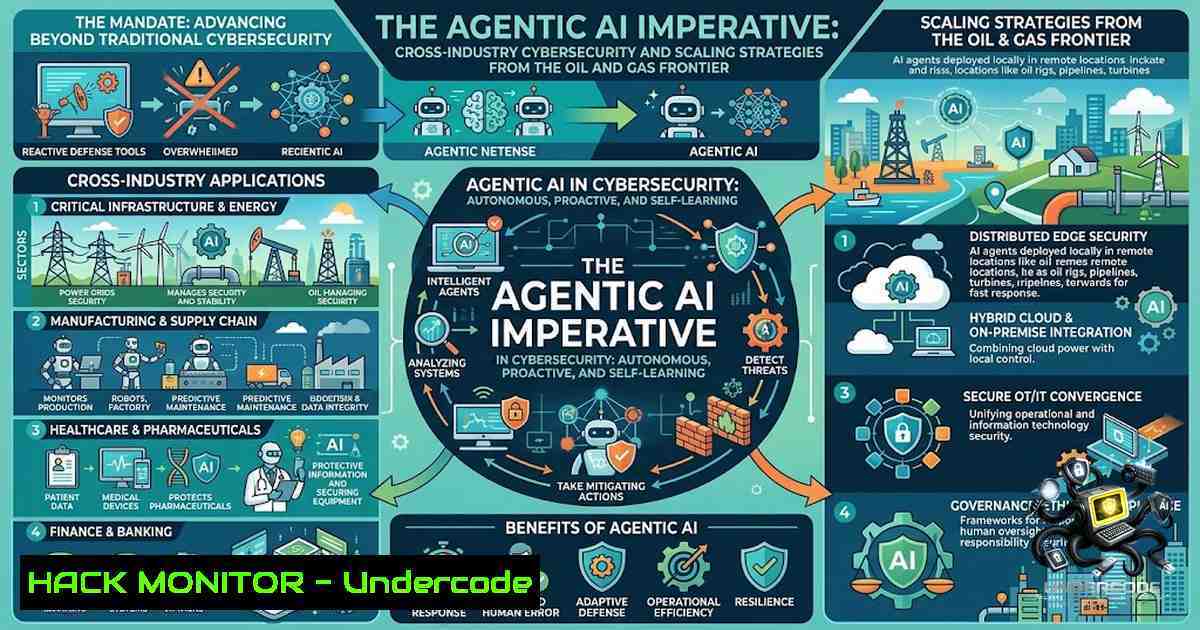
The convergence of heavy industry operations with agentic artificial intelligence (AI) is reshaping not only what companies sell but how they operate and secure their critical infrastructures. As observed at the Offshore Northern Seas (ONS) conference in Stavanger, the integration of AI at the core of business models is driving a paradigm shift that demands equal attention to cybersecurity, cloud hardening, and IT resilience. This article distills technical strategies from this cross-industry collision, providing actionable insights for B2B SaaS founders, security architects, and IT leaders who must navigate the complexities of AI-driven scaling while fortifying their digital perimeters.
Learning Objectives & Secrets:
- Objective 1: Master the integration of agentic AI into core business processes without compromising security posture, using runtime application self-protection (RASP) and zero-trust architecture (ZTA) principles.
- Objective 2 Secret Tip: Leverage AI-driven log analysis (e.g., ELK stack with ML plugins) to detect anomalies in industrial IoT (IIoT) networks, reducing mean time to detection (MTTD) by up to 60%.
- Objective 3 Secret Tip: Implement automated vulnerability remediation pipelines using tools like Trivy and Snyk, coupled with Infrastructure as Code (IaC) scanning, to ensure that AI scale-ups do not introduce new attack vectors.
You Should Know:
- Linux Commands for Security Hardening and AI Workload Monitoring
A robust security foundation begins with system-level hardening and real-time monitoring. For AI workloads running on Linux, the following commands and configurations are essential.
- System Hardening:
– `sudo apt-get install aide` – Install the Advanced Intrusion Detection Environment (AIDE) to create a baseline database of system files.
– `sudo aideinit` – Initialize the database; then schedule daily integrity checks via cron.
– `sudo ufw enable && sudo ufw default deny incoming && sudo ufw default allow outgoing` – Configure Uncomplicated Firewall (UFW) to restrict inbound connections, allowing only necessary ports (e.g., 22 for SSH, 443 for HTTPS).
– `sudo chmod 600 /etc/ssh/sshd_config` – Restrict permissions on SSH configuration to prevent unauthorized modifications. -
AI Workload Monitoring:
– `htop` – Interactive process viewer to monitor CPU/memory usage of AI training processes.
– `nvidia-smi` – For GPU-based AI, monitor utilization, memory, and temperature.
– `journalctl -u docker -f` – Follow Docker daemon logs to detect suspicious container behavior or resource exhaustion attacks.
– `ss -tulpn` – List open ports and associated services to identify unexpected listeners.
– `auditctl -w /var/lib/ai/models/ -p wa -k ai_model_change` – Set up auditing on model directories to track unauthorized writes or deletions, a critical step for protecting intellectual property and model integrity.
- Windows Security Commands and AI Integration Best Practices
For organizations running AI toolchains on Windows Server, native PowerShell and command-line utilities provide robust security monitoring.
-
Useful PowerShell Commands:
– `Get-WinEvent -LogName Security | Where-Object { $_.Id -eq 4625 }` – Retrieve failed login attempts to identify brute-force attacks on AI control planes.
– `Set-MpPreference -DisableRealtimeMonitoring $false` – Ensure Windows Defender is actively protecting AI training environments.
– `New-1etFirewallRule -DisplayName “Block AI Outbound” -Direction Outbound -Action Block -RemoteAddress 0.0.0.0/0` – Example rule to restrict outbound traffic from sandboxed AI containers, preventing data exfiltration.
– `Get-Process | Where-Object { $_.CPU -gt 80 }` – Identify processes consuming excessive CPU, which could indicate rogue mining or crypto-jacking attempts.
– `schtasks /Create /SC DAILY /TN “AISecurityScan” /TR “powershell -File C:\Scripts\AI_Scan.ps1″` – Schedule daily AI model integrity and vulnerability scans. -
Windows Configuration for AI Security:
- Enable Credential Guard: `bcdedit /set {0cb3b571-2f2e-4343-a879-d86a476d7215} loadoptions DISABLE-LSA-ISO` followed by `bcdedit /set {0cb3b571-2f2e-4343-a879-d86a476d7215} device path \EFI\Microsoft\Boot\SecConfig.efi` to virtualize and isolate secrets.
- Configure Windows Firewall with Advanced Security to restrict RDP access to specific IP ranges, reducing the attack surface for remote AI administration.
- API Security and Configuration Management in Agentic AI Deployments
Agentic AI systems rely on interconnected APIs to orchestrate actions across cloud and on-premise environments. Securing these APIs is paramount.
- OAuth 2.0 and JWT Best Practices:
- Validate all incoming JWT tokens with strict expiration and audience claims.
- Use `oauth2-proxy` as a reverse proxy to enforce authentication for internal AI microservices.
-
Rotate client secrets and API keys every 90 days using HashiCorp Vault or AWS Secrets Manager.
-
Rate Limiting and Throttling:
- Implement API gateways (e.g., Kong, Tyk) with rate-limiting policies to prevent denial-of-service (DoS) attacks on AI endpoints.
- Example Nginx rate-limiting configuration:
limit_req_zone $binary_remote_addr zone=ai_api:10m rate=10r/s; server { location /ai/ { limit_req zone=ai_api burst=20 nodelay; proxy_pass http://ai_backend; } } - API Security Scanning:
- Use OWASP ZAP or Postman’s Newman to automate API security testing within CI/CD pipelines.
- Integrate `apicheck` CLI tool to validate OpenAPI specifications against security best practices (e.g., ensuring all endpoints require authentication).
4. Cloud Hardening for Scalable AI Infrastructures
Whether deploying on AWS, Azure, or GCP, hardening cloud environments against misconfigurations is non-1egotiable.
- Identity and Access Management (IAM):
- Enforce the principle of least privilege. For AWS, use IAM roles with policies that explicitly deny actions outside the required scope.
- Example AWS IAM policy for AI services:
{ "Version": "2012-10-17", "Statement": [ { "Effect": "Deny", "Action": "s3:DeleteBucket", "Resource": "arn:aws:s3:::ai-training-data" } ] } - Network Segmentation:
- Deploy AI workloads in dedicated Virtual Private Clouds (VPCs) with no direct internet access, using VPC endpoints for services.
- Configure security groups to allow only intra-service communication on specified ports (e.g., 8080 for model serving, 6379 for Redis cache).
- Data Encryption:
- Enable server-side encryption (SSE-KMS) for all S3 buckets storing training data and models.
- Implement client-side encryption using AWS Encryption SDK for sensitive datasets before upload.
- Vulnerability Exploitation and Mitigation in AI Supply Chains
The software supply chain for AI includes base images, Python packages, and pre-trained models—each a potential vector for compromise.
- Dependency Scanning:
- Use `pip-audit` to scan Python dependencies for known vulnerabilities.
- Integrate `safety` into CI pipelines with
safety check -r requirements.txt --full-report. - Container Image Security:
- Scan Docker images with Trivy:
trivy image --severity HIGH,CRITICAL my-ai-image:latest. - Enforce image signing with Cosign (Sigstore) to verify publisher authenticity before deployment.
- Model Integrity Checks:
- Compute SHA-256 checksums of model weights and store them in an immutable ledger (e.g., Amazon QLDB) to detect tampering.
- Implement adversarial input validation using libraries like `adversarial-robustness-toolbox` to mitigate evasion attacks.
- Step‑by‑Step Guide to Setting Up a Secure AI Monitoring Dashboard with ELK
To operationalize security visibility, set up an ELK (Elasticsearch, Logstash, Kibana) stack tailored for AI infrastructure. -
Install Elasticsearch and Kibana via official DEB/RPM packages or Docker.
- Configure Logstash to ingest logs from AI training jobs, API gateways, and system logs:
input { beats { port => 5044 } } filter { grok { match => { "message" => "%{TIMESTAMP_ISO8601:timestamp} %{LOGLEVEL:level} %{GREEDYDATA:message}" } } } output { elasticsearch { hosts => ["localhost:9200"] } } - Deploy Filebeat on all AI worker nodes to ship logs to Logstash.
- Create Kibana dashboards to visualize CPU/GPU usage, API error rates, failed authentication attempts, and model drift metrics.
- Set up alerting rules in Kibana to notify on anomalies (e.g., >5 failed API requests per second).
-
Implement role-based access control (RBAC) in Kibana to restrict dashboard views to security and operations teams.
-
Integrating Agentic AI with SOAR Platforms for Automated Response
Security Orchestration, Automation, and Response (SOAR) platforms can leverage AI to automate incident handling.
- Use Cases:
- AI-driven triage of security alerts from SIEM (e.g., Splunk, QRadar) to prioritize critical threats.
- Automated playbook execution: When a model tampering alert is raised, trigger a workflow that stops the model serving endpoint, quarantines the affected container, and spins up a clean replica.
- Implementation Commands:
- For TheHive (open-source SOAR): use `thehive4py` Python library to create alerts and cases programmatically.
- Integrate with Slack/PagerDuty for notification: `curl -X POST -H ‘Content-type: application/json’ –data ‘{“text”:”AI model anomaly detected!”}’ https://hooks.slack.com/services/…`
What Undercode Say:
- Key Takeaway 1: Cross-industry exposure, like moving from retail marketing to oil and gas technology, reveals universal security principles—trust, verification, and curiosity—that are as critical in API authentication as they are in building business relationships.
- Key Takeaway 2: Agentic AI transforms scaling only when it is embedded at the core of the company, but this embedding requires a parallel commitment to security, from Linux command-line hardening to cloud IAM policies, ensuring that the growth engine does not become an attack surface.
The ONS experience underscores that the same curiosity driving innovation must drive security investments. The integration of AI into industrial operations introduces complex vulnerabilities—supply chain attacks, model poisoning, and API abuse. However, by adopting a mindset of continuous learning and applying cross-industry best practices (e.g., using ELK for monitoring and OAuth for API access), organizations can build resilient systems. The conversations at ONS highlight that the future belongs to those who not only build with AI but secure it from the ground up, treating security as a core business enabler rather than a compliance checkbox.
Prediction:
+1 Integration of agentic AI with SOAR platforms will reduce incident response times by 40–50% by 2028, as predictive analytics preempt attacks before they manifest.
+N The proliferation of AI-generated code and scripts will lead to a 30% increase in supply chain vulnerabilities if not paired with rigorous automated scanning and signing mechanisms.
+1 Cross-industry security frameworks (e.g., NIST AI RMF) will become mandatory for government contracts, driving standardization of AI security controls across sectors.
-1 Legacy IT systems in energy and heavy industry will struggle to integrate with modern AI security tools, creating exploitable gaps until hardware refreshes occur.
+1 The adoption of AI-driven predictive maintenance will reduce unplanned downtime by 25%, indirectly enhancing security by limiting emergency patching scenarios.
+N Adversarial machine learning will evolve rapidly, with more sophisticated data poisoning attacks targeting large language models (LLMs) used in critical decision-making.
▶️ Related Video (78% Match):
🎯Let’s Practice For Free:
🎓 Live Courses & Certifications:
Join Undercode Academy for Verified Certifications
🚀 Request a Custom Project:
Secure, high-velocity infrastructure and disruptive technological engineering. Contact our engineering team for high-tier development and proprietary systems:
[email protected]
💎 Smart Architecture | 🛡️ Secure by Design | ⭐ Trusted by Thousands
IT/Security Reporter URL:
Reported By: https://lnkd.in/p/egnnk6BY – Hackers Feeds
Extra Hub: Undercode MoN
Basic Verification: Pass ✅


