
Listen to this Post
Introduction:
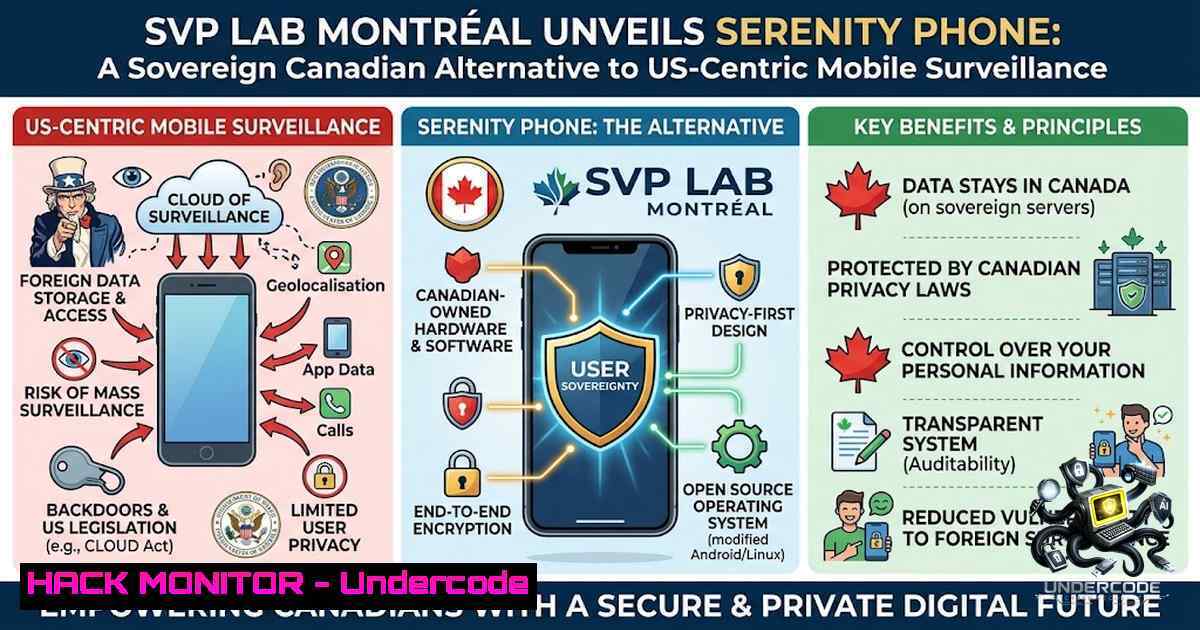
In an era where digital sovereignty is increasingly eroded by pervasive data collection from U.S.-based tech giants, a Montreal-based lab has introduced a radical infrastructure designed to reclaim control. The Serenity Phone, powered by the Serenity Vault Protocol (SVP), positions itself as a comprehensive mobile ecosystem that integrates proprietary hardware, a custom operating system, and multi-layered connectivity to guarantee 99.9% immunity from hacking and data exploitation. This initiative challenges the current paradigm by offering a “Switzerland of AI” that routes data entirely outside U.S. jurisdiction, appealing to governments, NGOs, and journalists who require absolute confidentiality.
Learning Objectives & Secrets:
- Objective 1: Understand the Architecture of a Sovereign Mobile OS – Explore how a non-copyable hardware foundation paired with a proprietary firmware-level protocol creates a chain of trust that cannot be compromised by standard side-channel or supply-chain attacks.
- Objective 2: Master the Multi-Layered Connectivity Fallback – Secret tip: leveraging dark fibre and LoRa mesh networks alongside 5G/LTE requires precise routing metrics and failover scripting to ensure seamless transitions without packet leaks.
- Objective 3: Deploy AI Receptionist (Athena) with Enhanced Privacy – Secret tip: implement local NLP models for call screening and email classification to ensure that sensitive data is processed on-device or within the sovereign enclave, never touching external AI APIs.
You Should Know:
- The Serenity Phone: Hardware and Firmware-Level Security Hardening
The Serenity Phone distinguishes itself by embedding the SVP protocol at the firmware level, making the device “non-copyable.” This is achieved through a unique Physical Unclonable Function (PUF) that generates a device-specific cryptographic key during manufacturing. To verify the integrity of such a system on standard Linux devices, administrators can use the following commands to check for tampering with firmware and bootloaders:
- Linux (UEFI/BIOS integrity check): `sudo dmidecode -t bios` – this retrieves BIOS version and vendor information to verify against known hashes.
- Windows (Secure Boot verification): `Confirm-SecureBootUEFI` in PowerShell – returns `True` if Secure Boot is enabled and configured correctly.
- Hardware verification: `sudo lsusb -v` – to audit all connected USB devices for unauthorized peripherals that might attempt to inject malicious payloads.
For a step-by-step guide, start by validating your current system’s boot chain: enable UEFI Secure Boot, set a Supervisor Password in the BIOS, and use `sudo shim-review` on Linux to ensure the bootloader is signed. On Windows, use `Get-PnpDevice` and `certmgr.msc` to review hardware and driver certifications. These steps ensure that no rogue hardware or firmware can execute, mimicking the Serenity Phone’s non-copyable approach.
- Network Sovereignty: Dark Fibre, Sovereign Satellites, and LoRa Mesh
One of the most ambitious claims is the guarantee of connectivity even when the internet is down, using a combination of dark fibre (data never passes through the USA), sovereign satellites (not Starlink), and a LoRa mesh network. This infrastructure requires advanced routing and failover configurations. For network engineers looking to implement similar redundancy on Linux, the `ip route` and `nftables` or `iptables` can be used to manage policy-based routing.
- Linux commands for failover routing:
– `ip route add default via 10.0.0.1 dev eth0 table 100` – defines a primary route.
– `ip route add default via 192.168.1.1 dev wlan0 table 200` – defines a secondary route.
– `ip rule add from 192.168.1.100 table 100 priority 100` – applies rules to route specific traffic. - Windows equivalent: Use `New-1etRoute -DestinationPrefix “0.0.0.0/0” -InterfaceIndex 12 -1extHop 192.168.1.1 -RouteMetric 10` to set metrics, and PowerShell scripts to monitor interface status and change metrics dynamically.
To implement this, set up a monitoring script that pings a trusted sovereign DNS (e.g., 1.1.1.1 or a custom DNS within the dark fibre network). If the primary interface fails, the script adjusts the metric of the secondary interface to `1` and brings the LoRa or satellite interface online. For added security, ensure that all DNS queries are encrypted via DNS over HTTPS (DoH) using `cloudflared` or `stubby` to prevent leakage of browsing habits.
- Athena AI Receptionist: On-Device NLP and Email Classification
The Athena AI is described as a “perfect fictitious person” that handles calls, texts, and emails. To replicate this securely, one would need to deploy local language models (LLMs) that do not rely on cloud APIs. Tools like Ollama or llama.cpp can run models such as Mistral or LLaMA-2 locally. For email classification, Python scripts using `scikit-learn` or `transformers` can be used to filter spam, threat, and legitimate emails.
- Example Python snippet for email classification:
from transformers import pipeline classifier = pipeline("text-classification", model="distilbert-base-uncased-finetuned-sst-2-english") result = classifier("Your email content here") print(result) - Linux command to secure the AI environment: Use `ufw` to block outbound connections from the AI process: `sudo ufw deny out from 127.0.0.1 to any port 443` and then allow only necessary localhost communications.
For system administrators, setting up a dedicated user account for the AI with minimal privileges is crucial. Use `adduser –system –1o-create-home athena` and `chmod -R 750 /home/athena` to restrict access. This mirrors the SVP concept of keeping data within the sovereign enclave.
- API Security and Cloud Hardening for Sovereign Data
Given the emphasis on non-U.S. data routing, securing APIs against geolocation leaks is vital. Implement geo-fencing at the firewall level to block traffic to and from specific regions. On Linux, use `ipset` to create a set of IP ranges for U.S. data centers and drop packets.
- Linux commands for geo-fencing:
– `sudo ipset create us_block hash:net`
– `sudo iptables -I INPUT -m set –match-set us_block src -j DROP`
– Windows with PowerShell: Use `New-1etFirewallRule -Direction Inbound -Action Block -RemoteAddress` for blocking.
Additionally, encrypt all API keys using `gpg` or `Azure Key Vault` on Windows. Use `gpg -c secret.json` to symmetrically encrypt sensitive configuration files. For cloud hardening, consider using a reverse proxy like HAProxy or Nginx to sanitize headers and prevent HTTP smuggling, ensuring that all traffic is TLS 1.3 compliant.
5. Vulnerability Exploitation and Mitigation in Firmware-Level Systems
While the Serenity Phone claims a 99.9% hack-proof status, it is essential to understand how firmware attacks (like Rowhammer or Spectre) are mitigated. The non-copyable hardware likely includes a Trusted Platform Module (TPM) 2.0 with secure boot and measured boot. To simulate mitigation on existing systems, enable Linux Kernel Lockdown and Integrity Measurement Architecture (IMA).
- Linux: Add `lockdown=confidentiality` to the kernel command line in
/etc/default/grub. - Windows: Use `Device Guard` and `Credential Guard` to protect against credential theft and kernel exploits.
6. The TRINITY Governance Model and Legal Sovereignty
The SVP is governed by a tripartite agreement (Canada/Paraguay/Europe). For organizations, this suggests a data residency requirement. To implement data residency on cloud infrastructure, use tools like `Terraform` to specify regions and `Azure Policy` or `AWS Organizations` to restrict resource deployment to approved geographies. On a network level, use `traceroute -1` and `ping -R` to verify that packets are indeed not traversing U.S. infrastructure, ensuring compliance with the TRINITY model.
What Undercode Say:
- Key Takeaway 1: The Serenity Phone’s success hinges on user trust in its proprietary protocol. While the technical claims are compelling, the closed-source nature of the hardware and OS poses a challenge for independent security researchers to validate the “non-copyable” and “99.9% unhackable” assertions. Transparency through third-party audits and formal verification of the firmware would be the differentiator between a marketing claim and a verifiable security standard.
- Key Takeaway 2: The multi-layered connectivity (dark fibre, satellites, LoRa) is a strategic move to bypass U.S. surveillance. However, this introduces operational complexity. Managing seamless failover between such disparate networks requires robust SD-WAN or custom routing protocols. The reliance on sovereign satellites indicates a shift toward a multipolar internet, but latency and bandwidth constraints of LoRa and satellite links must be balanced against user expectations for high-speed data.
Analysis: The announcement reflects a growing trend toward “technological nationalism,” where countries and regions seek to decouple from U.S. digital infrastructure. For cybersecurity professionals, the SVP architecture offers a blueprint for building truly private ecosystems. However, the 99.9% claims are aspirational; in real-world scenarios, the attack surface expands with the number of interfaces (cellular, satellite, LoRa), and the human factor remains the weakest link. The adoption by governments and NGOs will likely be slow due to the “vendor lock-in” and the need for extensive training. Nonetheless, the initiative pushes the cybersecurity industry to rethink mobile device security beyond mere software patches.
Prediction:
- +1: The SVP model will inspire similar regional sovereign tech initiatives globally, fostering innovation in hardware security and AI governance, potentially leading to more resilient critical infrastructure.
- +1: The Athena AI’s local processing approach may set a standard for privacy-preserving AI, reducing reliance on cloud-based large language models and limiting data exposure.
- -1: The high cost and complexity of deploying and maintaining the Serenity Phone infrastructure may limit its adoption to elite entities, creating a digital divide where only the wealthy can afford “unhackable” communication.
- -1: Without rigorous public security audits, the proprietary nature of the SVP protocol could result in undetected backdoors or vulnerabilities that, if discovered by malicious actors, would undermine the entire value proposition.
- +1: The integration of LoRa mesh networks enhances resilience in disaster scenarios, potentially making the device a critical tool for emergency responders and humanitarian missions.
▶️ Related Video (80% Match):
🎯Let’s Practice For Free:
🎓 Live Courses & Certifications:
Join Undercode Academy for Verified Certifications
🚀 Request a Custom Project:
Secure, high-velocity infrastructure and disruptive technological engineering. Contact our engineering team for high-tier development and proprietary systems:
[email protected]
💎 Smart Architecture | 🛡️ Secure by Design | ⭐ Trusted by Thousands
IT/Security Reporter URL:
Reported By: https://lnkd.in/p/e37zSUjQ – Hackers Feeds
Extra Hub: Undercode MoN
Basic Verification: Pass ✅


