
Listen to this Post
Introduction:
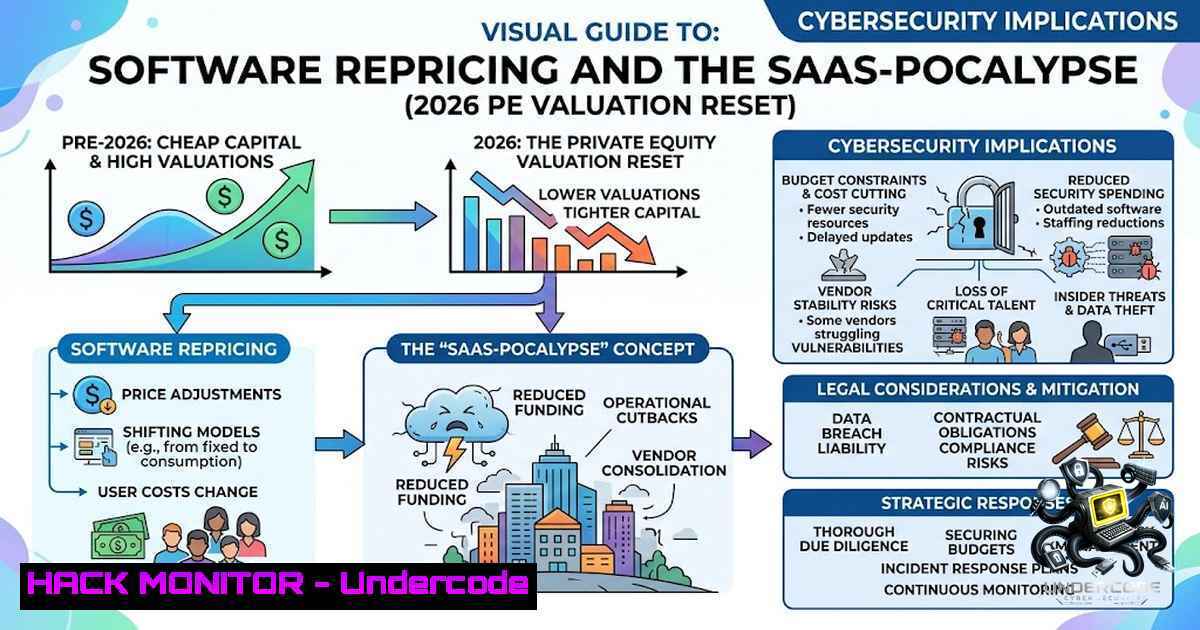
The first quarter of 2026 marked a watershed moment for private equity technology investments, as software valuations experienced their most significant correction since the pandemic. According to HarbourVest Partners’ latest benchmarks, global buyout returns declined 1.6% in Q1 2026, driven largely by a 5.0% drop in Information Technology investments and a 6.4% plunge in Software & Services—the sharpest decline across all sectors. This repricing, fueled by fears that AI could commoditize software applications and erode traditional SaaS pricing power—the so-called “SaaS-pocalypse”—has sent shockwaves through private portfolios. For cybersecurity professionals, this valuation reset presents both challenges and opportunities: as software companies face pressure to demonstrate durable value, the security and resilience of their technology stacks become critical differentiators.
Learning Objectives & Secrets:
- Objective 1: Understand the Valuation Reset Mechanism — Learn how public-market SaaS multiple compression (EV/Revenue multiples falling from 5x–6x in 2024 to approximately 3.3x–3.6x in Q1 2026) flows into private portfolio valuations. Private equity firms are now scrutinizing software companies’ ability to defend against AI disruption, making security architecture a key due diligence factor.
-
Objective 2 Secret Tip: Leverage Security Posture as a Valuation Multiplier — Companies with robust cloud security, API hardening, and zero-trust architectures command premium valuations in the current market. Firms that demonstrate AI-resistant business models through strong technical moats—including secure AI workloads and hardened infrastructure—are better positioned to attract investment.
-
Objective 3 Secret Tip: Master AI Security to Stay Ahead — The AI revolution that triggered the selloff also creates new security vectors. Organizations that implement comprehensive AI security frameworks—covering model integrity, data protection, and supply chain security—can differentiate themselves in a crowded market. Training in AI-specific cybersecurity (e.g., CompTIA SecAI+, CMU’s AI for Cybersecurity Certificate) is becoming essential for security teams.
You Should Know:
- Cloud Hardening for AI Workloads: Securing the New Frontier
As AI workloads migrate to multi-cloud environments, security teams must adopt a new paradigm that goes beyond traditional cloud security. The 2026 approach emphasizes continuous exposure management rather than periodic reviews, and ephemeral credentials over long-lived static keys.
Step‑by‑Step Guide for Hardening AI Cloud Environments:
Linux (Ubuntu/Debian) – Harden the underlying infrastructure:
 Update system and install security packages
sudo apt update && sudo apt upgrade -y
sudo apt install ufw fail2ban auditd apparmor-utils -y

Configure UFW firewall
sudo ufw default deny incoming
sudo ufw default allow outgoing
sudo ufw allow ssh
sudo ufw enable

Harden SSH configuration
sudo sed -i 's/PermitRootLogin prohibit-password/PermitRootLogin no/' /etc/ssh/sshd_config
sudo sed -i 's/PasswordAuthentication yes/PasswordAuthentication no/' /etc/ssh/sshd_config
sudo systemctl restart sshd

Kernel hardening - add to /etc/sysctl.d/99-hardening.conf
echo "net.ipv4.ip_forward=0" | sudo tee -a /etc/sysctl.d/99-hardening.conf
echo "net.ipv4.conf.all.rp_filter=1" | sudo tee -a /etc/sysctl.d/99-hardening.conf
echo "net.ipv4.conf.default.rp_filter=1" | sudo tee -a /etc/sysctl.d/99-hardening.conf
sudo sysctl -p /etc/sysctl.d/99-hardening.conf

Disable unnecessary services
sudo systemctl disable --1ow avahi-daemon
sudo systemctl disable --1ow bluetooth.service
Windows (PowerShell – Run as Administrator):
 Windows Firewall: Enable and configure
Set-1etFirewallProfile -Profile Domain,Public,Private -Enabled True

Disable unnecessary services
Stop-Service -1ame Spooler -Force
Set-Service -1ame Spooler -StartupType Disabled

Audit policy configuration
auditpol /set /subcategory:"Logon" /success:enable /failure:enable
auditpol /set /subcategory:"Object Access" /success:enable /failure:enable

Enable Windows Defender real-time protection
Set-MpPreference -DisableRealtimeMonitoring $false
Set-MpPreference -PUAProtection Enabled
For AI-specific workloads, implement agentless scanning for contextualized visibility and behavioral threat detection for LLMs. Transition from long-lived API keys to ephemeral, identity-based credentials, and treat all AI-generated code as untrusted third-party components.
2. API Security Hardening: Defending the Digital Backbone
With software companies under valuation pressure, API security has become a critical due diligence item. The OWASP API Security Top 10 provides a framework for identifying and mitigating common vulnerabilities.
Step‑by‑Step API Security Hardening Guide:
- Replace Sequential IDs with UUIDs — Prevent Broken Object Level Authorization (BOLA) attacks:
import uuid
Instead of: /api/users/12345
Use: /api/users/550e8400-e29b-41d4-a716-446655440000
user_id = str(uuid.uuid4())
2. Implement OAuth2/OIDC with Short-Lived Tokens:
 Generate a secure random secret for JWT signing
openssl rand -base64 32
 Configure token expiration (e.g., 15 minutes for access tokens)
 Implement refresh token rotation
- Enforce Rate Limiting — Configure per-IP or per-token limits of 10–50 requests per second with sliding window enforcement:
Nginx rate limiting example limit_req_zone $binary_remote_addr zone=api_limit:10m rate=10r/s; location /api/ { limit_req zone=api_limit burst=20 nodelay; proxy_pass http://backend; } -
Use TLS 1.3 and sanitize error responses in production.
-
Implement field restrictions to avoid excessive data exposure (anti-overfetching).
3. Cloud Security Posture Management (CSPM): Continuous Compliance
CSPM tools help detect configuration errors and policy drift that can leave cloud systems exposed. Leading solutions like Prisma Cloud, CloudGuard, and CrowdStrike Falcon Cloud Security support automation, compliance management, and multi-cloud visibility.
Step‑by‑Step CSPM Implementation:
- Inventory and Baseline — Declare all cloud resources and set baselines before runtime.
-
Continuous Monitoring — Observe production behavior to build per-agent behavioral baselines.
-
Automated Enforcement — Auto-generate and progressively roll out controls from observed behavior.
-
Reconcile and Remediate — Continuously validate configurations against compliance frameworks (SOC2, ISO 27001, EU AI Act).
Example AWS CLI command for security assessment:
 Check for publicly accessible S3 buckets
aws s3api list-buckets --query 'Buckets[].Name' --output text | xargs -I {} aws s3api get-bucket-acl --bucket {} --query 'Grants[?Grantee.URI==`http://acs.amazonaws.com/groups/global/AllUsers`]' --output table

Enable AWS Config for continuous compliance monitoring
aws configservice put-configuration-recorder --configuration-recorder name=default,roleARN=arn:aws:iam::ACCOUNT:role/config-role
aws configservice start-configuration-recorder --configuration-recorder-1ame=default
4. Vulnerability Exploitation and Mitigation: The Attacker’s Perspective
Understanding how attackers exploit software vulnerabilities is essential for building resilient systems. The valuation reset has heightened the importance of security maturity as a competitive advantage.
Common Exploitation Vectors and Mitigations:
Linux Command to Check for Open Ports and Services:
 Identify listening services
sudo ss -tulpn
sudo netstat -tulpn

Scan for vulnerabilities using nmap
nmap -sV -p- --script vuln target_ip

Check for outdated packages with known CVEs
sudo apt list --upgradable
sudo yum check-update
Windows PowerShell for Security Auditing:
 Check for open ports
Get-1etTCPConnection -State Listen

Review security event logs for suspicious activity
Get-WinEvent -LogName Security | Where-Object {$_.Id -in (4624,4625,4672)} | Select-Object TimeCreated, Id, Message -First 20

Check installed applications for known vulnerabilities
Get-WmiObject -Class Win32_Product | Select-Object Name, Version
Mitigation Strategy:
- Implement least-privilege access controls
- Enable comprehensive logging and monitoring (syslog, journald, auditd on Linux; Event Viewer and Windows Event Forwarding on Windows)
- Automate patch management using package managers (apt, yum) and Windows Update
- AI Security Training and Certification: Building Future-Ready Teams
The AI revolution that triggered the software valuation reset also creates demand for specialized cybersecurity skills. Several programs in 2026 address this gap:
Recommended Training Paths:
- CompTIA SecAI+ (CY0-001) — Builds skills to secure AI systems and models against emerging threats, covering AI-specific risks, governance, and defensive best practices
-
CERT Leadership in AI for Cybersecurity Certificate (CMU SEI) — Covers AI fundamentals, statistics applied to cybersecurity, and effective communication of technical concepts
-
Virginia Tech AI-Powered Cybersecurity Certificate — Focuses on operating systems, enterprise security, ethical hacking, vulnerability assessment, penetration testing, malware analysis, and AI in SIEM/SOAR
-
SANS SEC598 — Teaches students how to use AI and automation to build, test, and deploy workflows across offensive and defensive operations
What Undercode Say:
-
Key Takeaway 1: Security Is Now a Valuation Driver — The 2026 software valuation reset means that security maturity is no longer just a compliance checkbox but a critical factor in investment decisions. Companies with robust security postures—hardened cloud environments, secure APIs, and AI-resistant architectures—will command premium valuations in the new market reality.
-
Key Takeaway 2: The AI Security Skills Gap Is Widening — As AI disrupts traditional software business models, the demand for professionals who can secure AI workloads is exploding. Organizations that invest in AI security training today will have a competitive advantage in attracting investment and talent. The convergence of AI and cybersecurity is creating new career pathways that bridge technical depth with strategic business acumen.
The SaaS-pocalypse has fundamentally altered the private equity landscape, but it has also illuminated the critical importance of security as a value driver. For cybersecurity professionals, this represents a unique opportunity to elevate their role from cost center to strategic asset. The organizations that will thrive in this new era are those that treat security not as an afterthought but as a foundational element of their business model—one that protects valuation, enables innovation, and builds durable competitive advantage in an AI-driven world.
Prediction:
- +1 The software valuation reset will accelerate consolidation in the cybersecurity sector, with well-capitalized firms acquiring security startups that demonstrate AI-resistant business models and robust technical moats. This consolidation will create larger, more integrated security platforms that can better serve enterprise customers.
-
+1 AI security will emerge as the fastest-growing cybersecurity sub-sector by 2027, driven by regulatory requirements (EU AI Act enforcement beginning August 2026) and investor demand for AI-safe portfolios. Training and certification programs will proliferate, creating new career pathways for security professionals.
-
-1 The valuation pressure on software companies may lead to reduced R&D spending on security, creating a “security debt” that could result in increased breach activity in 2027-2028. Private equity firms focused on short-term cost reduction may inadvertently increase their portfolio companies’ risk profiles.
-
-1 The AI commoditization threat may disproportionately impact smaller security vendors that cannot afford to invest in AI-1ative architectures, potentially reducing competition and innovation in the security market.
-
+1 The divergence between AI hardware and software valuations will drive increased investment in security for AI infrastructure—including secure enclaves, confidential computing, and hardware-based security—creating new opportunities for specialized security providers.
▶️ Related Video (80% Match):
https://www.youtube.com/watch?v=-FPmirPa3JE
🎯Let’s Practice For Free:
🎓 Live Courses & Certifications:
Join Undercode Academy for Verified Certifications
🚀 Request a Custom Project:
Secure, high-velocity infrastructure and disruptive technological engineering. Contact our engineering team for high-tier development and proprietary systems:
[email protected]
💎 Smart Architecture | 🛡️ Secure by Design | ⭐ Trusted by Thousands
IT/Security Reporter URL:
Reported By: https://lnkd.in/p/ejxGGXSx – Hackers Feeds
Extra Hub: Undercode MoN
Basic Verification: Pass ✅


