Listen to this Post
Introduction:
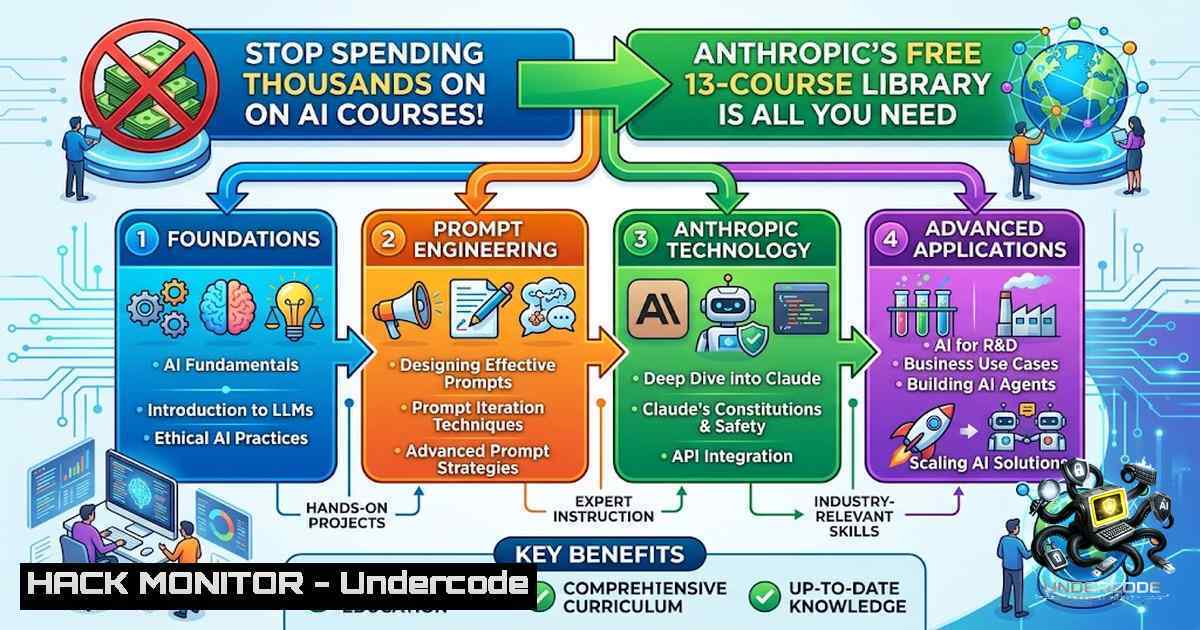
The AI training industry has become a multi-billion dollar ecosystem, with bootcamps and certification programs charging anywhere from $500 to over $10,000 for access to “exclusive” knowledge. Yet Anthropic—the company behind Claude—has quietly published its entire training library for free, covering everything from foundational AI fluency to production-grade Model Context Protocol (MCP) deployment. This isn’t a marketing gimmick; it’s a comprehensive technical curriculum designed to take you from AI novice to building agentic systems that integrate with APIs, cloud platforms, and external tools—all at zero cost.
Learning Objectives:
- Master the Model Context Protocol (MCP) and its three core primitives—tools, resources, and prompts—to connect AI models to external data sources and APIs.
- Build and deploy production-grade MCP servers and clients using the Python SDK, with hands-on implementation of transport mechanisms and notification systems.
- Integrate Anthropic’s Claude API into real-world applications across Google Cloud Vertex AI and AWS Amazon Bedrock, with a focus on security hardening and credential management.
- Implement agentic coding workflows using Claude Code, including plan-mode execution, multi-agent orchestration, and GitHub Actions automation.
- Develop AI fluency through the 4D Framework (Delegation, Description, Discernment, Diligence) for effective, ethical, and safe human-AI collaboration.
You Should Know:
- Understanding the Model Context Protocol (MCP): The Backbone of AI-Tool Integration
The Model Context Protocol is an open standard created by Anthropic that enables seamless integration between AI applications and external tools, data sources, and services. At its core, MCP operates on three primitives: Tools (callable functions with side effects), Resources (read-only data accessible via URIs), and Prompts (reusable templates for consistent interactions). The “Introduction to MCP” course teaches you to build both MCP servers that expose these primitives and MCP clients that consume them using the Python SDK.
Step-by-Step Guide: Building Your First MCP Server
1. Install the MCP Python SDK:
pip install mcp
2. Create a basic MCP server file (`server.py`):
from mcp.server import Server, NotificationOptions
from mcp.server.models import InitializationOptions
import mcp.server.stdio
import mcp.types as types

server = Server("example-server")

@server.list_tools()
async def handle_list_tools() -> list[types.Tool]:
return [
types.Tool(
name="get_system_info",
description="Get system information",
inputSchema={
"type": "object",
"properties": {},
},
)
]

@server.call_tool()
async def handle_call_tool(name: str, arguments: dict) -> list[types.TextContent]:
if name == "get_system_info":
import platform
info = f"System: {platform.system()} {platform.release()}"
return [types.TextContent(type="text", text=info)]
raise ValueError(f"Unknown tool: {name}")

async def main():
async with mcp.server.stdio.stdio_server() as (read_stream, write_stream):
await server.run(
read_stream,
write_stream,
InitializationOptions(
server_name="example-server",
server_version="0.1.0",
),
)

if <strong>name</strong> == "<strong>main</strong>":
import asyncio
asyncio.run(main())
3. Test your server using the MCP Inspector:
npx @modelcontextprotocol/inspector python server.py
- Connect Claude to your server by adding the server configuration to your Claude desktop app or using the `–mcp-config` flag in Claude Code.
The advanced MCP course then takes you deeper into production deployment strategies, covering transport mechanisms, file system access control, sampling for AI model integration, and notification systems. Engineers who understand MCP deeply are positioned to build agentic systems that others simply cannot.
- Building with the Claude API: From Authentication to Production
The “Building with the Claude API” course covers the full spectrum of working with Anthropic’s models programmatically. Whether you’re building a simple chatbot or a complex multi-agent system, understanding API security and implementation patterns is critical.
Step-by-Step Guide: Claude API Integration
- Obtain your API key from console.anthropic.com.
2. Install the Anthropic Python SDK:
pip install anthropic
3. Basic API call example:
import anthropic

client = anthropic.Anthropic(api_key="YOUR_API_KEY")

response = client.messages.create(
model="claude-3-5-sonnet-20241022",
max_tokens=1024,
messages=[
{"role": "user", "content": "Explain MCP in one paragraph"}
]
)
print(response.content[bash].text)
4. Implement tool use (function calling):
response = client.messages.create(
model="claude-3-5-sonnet-20241022",
max_tokens=1024,
tools=[
{
"name": "get_weather",
"description": "Get current weather for a location",
"input_schema": {
"type": "object",
"properties": {
"location": {"type": "string"}
},
"required": ["location"]
}
}
],
messages=[{"role": "user", "content": "What's the weather in Tokyo?"}]
)
API Security Best Practices:
- Never hardcode API keys in source code. Use environment variables or secrets managers.
- Enable GitHub Secret Scanning—GitHub actively scans public repositories for exposed Claude API keys and notifies Anthropic for proactive mitigation.
- Implement input validation and sanitization before sending user prompts to Claude to prevent prompt injection attacks.
- Use Workload Identity Federation (WIF) to authenticate with the Claude Platform using existing AWS IAM roles or GCP service accounts, eliminating the need for static credentials.
- Run a moderation API against all end-user prompts before they reach Claude to ensure compliance with acceptable use policies.
- Claude on Google Cloud Vertex AI: Enterprise-Grade Deployment
For organizations with strict data residency and governance requirements, deploying Claude through Google Cloud’s Vertex AI keeps model traffic and billing inside your Google Cloud project. The “Claude on Google Cloud (Vertex AI)” course covers integration patterns, regional endpoint configuration, and scaling considerations.
Step-by-Step Guide: Vertex AI Integration
- Enable the Vertex AI API in your Google Cloud project.
- Use the AnthropicVertex SDK to instantiate Claude models:
from anthropic import AnthropicVertex</li>
</ol>

client = AnthropicVertex(
region="us-central1",
project_id="your-project-id"
)

response = client.messages.create(
model="claude-3-5-sonnet@20241022",
max_tokens=1024,
messages=[{"role": "user", "content": "Hello"}]
)
3. Configure regional endpoints to meet data residency requirements—Vertex AI supports regional endpoints that keep data and processing within specified geographical boundaries.
4. Claude Code: Agentic Development in Your Terminal
Claude Code is Anthropic’s agentic coding assistant that lives in your terminal, reading files, running commands, and editing code on your behalf. The “Claude Code in Action” course teaches deliberate workflows—not hopeful prompting—that produce reliable results.
Step-by-Step Guide: Claude Code Workflow
1. Install Claude Code:
npm install -g @anthropic/claude-code
2. Start a session:
claude
3. Use the plan → execute workflow:
- Enter plan mode to have Claude analyze requirements and create an implementation plan
- Refine the plan through iterative discussion
- Switch to auto-accept edits and let Claude execute
- Advanced pattern: Two-Claude review—have one Claude write a plan, then spin up a second Claude to review it as a staff engineer.
-
Integrate with GitHub Actions using the `@claude` mention in PRs and issues for automated code review, implementation, and bug fixes.
-
AI Fluency: The 4D Framework for Human-AI Collaboration
Beyond technical implementation, Anthropic’s “AI Fluency: Framework & Foundations” course establishes the fundamental competencies needed to collaborate with AI effectively, efficiently, ethically, and safely. The course introduces the 4D Framework:
- Delegation: Assigning appropriate tasks to AI systems
- Description: Effectively communicating desired outputs and behaviors
- Discernment: Accurately assessing the quality and appropriateness of AI outputs
- Diligence: Maintaining oversight and accountability in AI-assisted work
This framework is technology- and vendor-1eutral, making it applicable across platforms and AI systems.
6. Claude with Amazon Bedrock: Government-Grade Security
The “Claude with Amazon Bedrock” accreditation program—originally built for AWS employees—covers deploying Claude in regulated environments. Claude models are approved for FedRAMP High and DoD Impact Level 4 and 5 workloads through Amazon Bedrock in AWS GovCloud (US) regions. This makes Claude suitable for the full spectrum of unclassified government workloads, including those handling PHI, PII, and ITAR data.
7. Claude 101: Practical AI for Everyday Work
For those starting their AI journey, “Claude 101” teaches practical application across sales, marketing, project management, and everyday business tasks—from deal preparation and campaign analysis to stakeholder updates and content creation. The course covers Claude’s core features, project organization, and integration with surfaces like Excel, Chrome, and Slack.
What Undercode Say:
- Key Takeaway 1: Anthropic has democratized AI education by releasing a complete, production-grade curriculum at zero cost—eliminating the financial barrier that has historically kept many developers from accessing cutting-edge AI training. The 13-course library covers the full stack from foundational AI fluency to advanced MCP server deployment, making it arguably the most comprehensive free AI curriculum available today.
-
Key Takeaway 2: The Model Context Protocol represents a paradigm shift in how AI applications interact with the external world. By standardizing the connection between LLMs and tools, resources, and prompts, MCP is becoming a critical layer in modern AI-1ative system design. Engineers who invest time in mastering MCP now will have a significant competitive advantage as agentic systems become the default architecture for AI applications.
-
Key Takeaway 3: Security cannot be an afterthought when building with AI APIs. Anthropic’s emphasis on API key management, input validation, prompt injection defense, and workload identity federation reflects the reality that AI systems are increasingly targets for adversarial attacks. The courses don’t just teach you how to build—they teach you how to build securely.
-
Key Takeaway 4: The distinction between “using AI” and “collaborating with AI” is fundamental. The 4D Framework (Delegation, Description, Discernment, Diligence) provides a structured approach to human-AI interaction that goes beyond prompt engineering. This framework is particularly valuable for organizations looking to integrate AI into their workflows in a way that maintains human oversight and accountability.
-
Key Takeaway 5: The availability of Claude on both Google Cloud Vertex AI and AWS Amazon Bedrock—with FedRAMP High and DoD IL4/5 certifications—signals that enterprise AI is moving from experimental to mission-critical. Organizations can now deploy Claude in regulated environments with confidence, opening up use cases in government, healthcare, and finance that were previously off-limits.
Prediction:
-
+1 The democratization of AI education through free, high-quality curricula will accelerate the development of AI-1ative applications, particularly in regions and communities where access to expensive training programs has been a barrier. We can expect to see a surge in MCP-based tooling and agentic systems over the next 12-18 months as developers who complete these courses begin building and sharing their work.
-
+1 The Model Context Protocol is positioned to become the de facto standard for AI-tool integration, similar to how REST became the standard for web APIs. As more developers adopt MCP, we’ll see an ecosystem of compatible tools, servers, and clients emerge, reducing vendor lock-in and increasing interoperability across AI platforms.
-
-1 The increased accessibility of AI development tools will also lower the barrier to entry for malicious actors. As more developers learn to build agentic systems, we can expect to see an uptick in AI-powered attacks, including automated social engineering, credential theft, and system compromise. Organizations will need to invest heavily in AI security monitoring and defensive AI systems.
-
-1 The rapid evolution of MCP and related protocols may lead to fragmentation and compatibility issues as different platforms implement the standard in slightly different ways. Developers building production systems will need to carefully manage versioning and maintain compatibility across multiple MCP implementations.
-
+1 The availability of Claude through government-accredited platforms like AWS GovCloud will accelerate public sector AI adoption. With FedRAMP High and DoD IL4/5 certifications already in place, government agencies can now deploy Claude for sensitive workloads without undergoing lengthy security reviews, potentially saving years of compliance work.
▶️ Related Video (80% Match):
https://www.youtube.com/watch?v=1aEYmmyJsYA
🎯Let’s Practice For Free:
🎓 Live Courses & Certifications:
Join Undercode Academy for Verified Certifications
🚀 Request a Custom Project:
Secure, high-velocity infrastructure and disruptive technological engineering. Contact our engineering team for high-tier development and proprietary systems:
[email protected]
💎 Smart Architecture | 🛡️ Secure by Design | ⭐ Trusted by ThousandsIT/Security Reporter URL:
Reported By: Chandra Tiwari – Hackers Feeds
Extra Hub: Undercode MoN
Basic Verification: Pass ✅🔐JOIN OUR CYBER WORLD [ CVE News • HackMonitor • UndercodeNews ]
📢 Follow UndercodeTesting & Stay Tuned:


