Listen to this Post
Introduction:
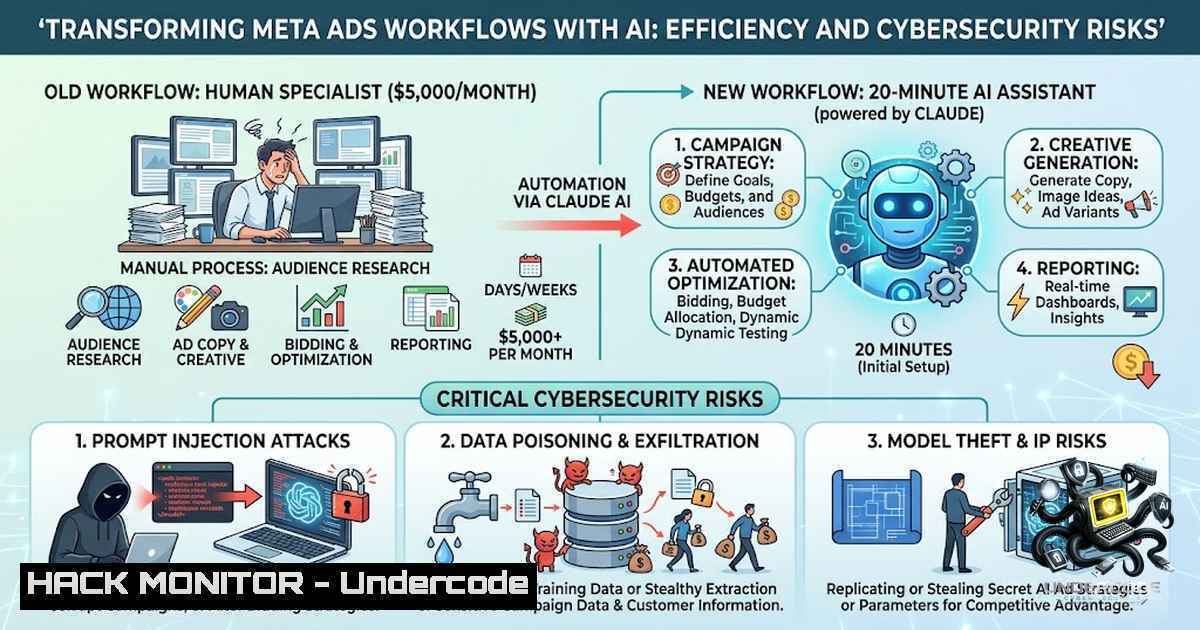
The rapid integration of Large Language Models (LLMs) into business automation is transforming marketing, but it also introduces a new attack surface for enterprise security. While automating Meta Ad campaigns using Claude agents can save thousands of dollars and hours, the underlying architecture—relying on web scraping, API keys, and autonomous scheduling—presents a significant challenge for IT and cybersecurity teams. This article dissects the technical anatomy of an AI-driven ad automation workflow, providing the necessary commands and configurations to secure, audit, and replicate this process safely.
Learning Objectives:
- Understand the Model Context Protocol (MCP) server setup for AI-driven automation.
- Learn to build a secure ad campaign scraper and generator using Python and Claude.
- Implement security hardening techniques for API keys and web scraping bots.
You Should Know:
- Building the MCP Server Infrastructure (The Agent’s Brain)
The core of this workflow is the MCP (Model Context Protocol) server, which acts as the bridge between Claude and your external tools (Meta Ads Library and Ad Account). To replicate this, you need to establish a local server that listens for Claude’s requests. This setup involves configuring environment variables to store your Meta API credentials and creating a Python script to handle the scraping logic.
Start by initializing your project directory and installing the necessary dependencies. The critical step is generating a short-lived access token from Meta’s Developer Portal for the Ads API. For security, never hardcode these tokens; use a `.env` file.
 Linux/macOS
mkdir meta-agent && cd meta-agent
python3 -m venv venv
source venv/bin/activate
pip install requests python-dotenv Flask
touch server.py .env
For Windows (PowerShell), the activation command is `.\venv\Scripts\Activate.ps1`.
Within server.py, you will define endpoints that Claude can interact with. The primary function involves querying the Meta Ad Library API to search for active ads from your competitors. The URL structure typically involves a GET request to https://graph.facebook.com/v20.0/ads_archive` with search parameters.META_ACCESS_TOKEN=your_token`. The server must also handle rate limiting to avoid blocking. A crucial security measure is to validate the incoming requests from Claude to prevent command injection or unauthorized access, which can be done by checking a static bearer token sent in the header.
Ensure your `.env` file contains
2. The Scraping Logic: Pulling “Winning Patterns”
The automation begins by scraping the Meta Ad Library for competitor intelligence. The agent needs to parse JSON responses to identify “winning patterns”—ads that have run for months, indicating a high return on ad spend (ROAS). In Python, you will use the requests library to fetch data. The agent is instructed to look for `ad_creation_time` and `ad_delivery_status` fields to identify long-running campaigns.
import requests
import os
from dotenv import load_dotenv
load_dotenv()
TOKEN = os.getenv('META_ACCESS_TOKEN')
def scrape_competitor_ads(competitor_id):
url = f"https://graph.facebook.com/v20.0/ads_archive?search_terms='{competitor_id}'&access_token={TOKEN}"
response = requests.get(url)
data = response.json()
 Filter logic for old ads
winners = [ad for ad in data.get('data', []) if ad.get('ad_delivery_status') == 'active']
return winners
A major consideration for system administrators is the User-Agent string. Since Meta monitors automated scraping, you must spoof a realistic browser header to avoid being flagged as a bot. Furthermore, rotating IP addresses using a proxy service is often necessary to maintain reliability.
Finally, you need to parse the `creative` fields to extract the primary text and headline. This structured data is then passed back to Claude in a standardized JSON format for the copy generation phase.
3. AI Copy Generation and Security Guardrails
Once the patterns are extracted, the agent uses Claude 3.5 Sonnet’s generation capabilities to write new ad copy. However, this is where security and brand safety risks arise. Without proper constraints, the AI might generate hallucinated claims or prohibited content (e.g., health claims for supplements). To mitigate this, you must craft a prompt that includes strict “system prompts” denying the generation of false medical statements or copyright infringement.
For a secure API call to Anthropic (if using the API directly), the request should be wrapped with a timeout and a max token limit to prevent resource exhaustion (DoS).
{
"model": "claude-3-opus-20240229",
"max_tokens": 500,
"temperature": 0.7,
"system": "You are a marketing copywriter. Do not generate medical claims. Only rewrite the structure of the provided text.",
"messages": [{"role": "user", "content": "Generate text for the given headlines"}]
}
From a Windows administration perspective, if you are running this via PowerShell as a scheduled task, ensure the execution policy is set to `RemoteSigned` to allow the script to run while preventing unauthorized script execution. The prompt must also include a disclaimer that all generated content is subject to human review, serving as a fallback against offensive or non-compliant outputs.
4. Campaign Deployment and the Review Mechanism
The final step of the agent is pushing the generated campaign into the ad account for review. The code constructs a POST request to the Meta Graph API to create an ad campaign. A critical security practice is to set the status to `PAUSED` upon creation. This prevents the agent from spending money without human approval.
def create_ad_campaign(ad_set_data):
url = f"https://graph.facebook.com/v20.0/act_{account_id}/campaigns"
params = {
'name': ad_set_data['name'],
'status': 'PAUSED',  Security hold
'access_token': TOKEN
}
response = requests.post(url, data=params)
print(response.json())
For Linux server administrators, this part of the script requires careful handling of the API secret. Instead of storing the secret in the script, use a secrets manager like `gopass` or system keyring. Additionally, log all actions to `syslog` for audit trails. In Windows, you can use the Event Viewer by writing to the Windows event log using EventLog.WriteEntry.
5. Scheduling and Cron Job Security
The agent sets itself on a recurring Monday schedule. On Linux, this is achieved via a cron job that triggers the Python script.
 Edit crontab
crontab -e
 Schedule for Monday at 6:00 AM
0 6   1 /home/user/meta-agent/venv/bin/python /home/user/meta-agent/server.py >> /var/log/meta_agent.log 2>&1
On Windows, you would use Task Scheduler to run powershell.exe -File "C:\Scripts\run_agent.ps1". The security implication here is privilege escalation. Ensure the cron job or scheduled task runs under a service account with the least privileges possible. It should not have root or admin access, only read/write permissions to the necessary directories and network access.
Furthermore, monitor the cron job for failures. A failing script that retries endlessly could cause an infinite loop, potentially leading to high CPU usage. Implement a lock file mechanism (flock) to ensure only one instance of the script runs at a time, preventing overlapping executions that could double-spend the advertising budget.
What Undercode Say:
- Key Takeaway 1: The integration of LLMs with MCP servers is shifting the paradigm from “human does the work” to “human secures the workflow.” The most critical vulnerabilities lie in API key management and input validation, not the AI model itself.
- Key Takeaway 2: Automation democratizes competitive intelligence, but without strict guardrails and a “human-in-the-loop” (the review step), businesses risk violating platform terms of service and deploying misleading advertisements, which can lead to bans.
Analysis:
The “20-minute workflow” is undeniably a competitive advantage in marketing operations. However, the underlying stack relies heavily on security best practices often overlooked by non-technical founders. The use of long-lived access tokens in environment variables is a ticking time bomb; attackers who gain access to the server via a web shell can exfiltrate these tokens to drain ad accounts. The scraping mechanism also violates the Terms of Service of Meta if not careful, exposing the company to litigation. While the AI generates copy efficiently, the lack of semantic filtering means that the AI could inadvertently generate discriminatory or toxic content. For IT departments, managing the lifecycle of these agents—updating prompts to avoid jailbreaks and rotating API keys automatically—will become the new operational burden. Despite these risks, the ability to analyze “winning patterns” at scale provides an unprecedented data-driven edge, making the trade-off between risk and reward increasingly favorable for large corporations.
Prediction:
- +1: The adoption of AI agents will lead to a new market for “Secure MCP Servers” managed by cybersecurity firms, offering pre-hardened templates that handle authentication and rate limiting out of the box.
- +1: As workflows like this become standard, we will see the rise of “Agent SOC” (Security Operations Centers) dedicated exclusively to monitoring the behavior and anomalies of autonomous LLM agents.
- -1: The automation arms race will escalate, leading to “ad libraries” being gated with stricter CAPTCHAs and blockchain verification to block AI scraping, forcing these agents into an eternal cat-and-mouse game of circumvention.
- -1: We are likely to witness a major incident within the next 18 months where a misconfigured “Monday schedule” cron job leads to a catastrophic AI hallucination, resulting in a million-dollar advertising loss and a PR crisis involving non-compliant health claims.
▶️ Related Video (74% Match):
🎯Let’s Practice For Free:
🎓 Live Courses & Certifications:
Join Undercode Academy for Verified Certifications
🚀 Request a Custom Project:
Secure, high-velocity infrastructure and disruptive technological engineering. Contact our engineering team for high-tier development and proprietary systems:
[email protected]
💎 Smart Architecture | 🛡️ Secure by Design | ⭐ Trusted by Thousands
IT/Security Reporter URL:
Reported By: Remygaskell I – Hackers Feeds
Extra Hub: Undercode MoN
Basic Verification: Pass ✅


