Listen to this Post
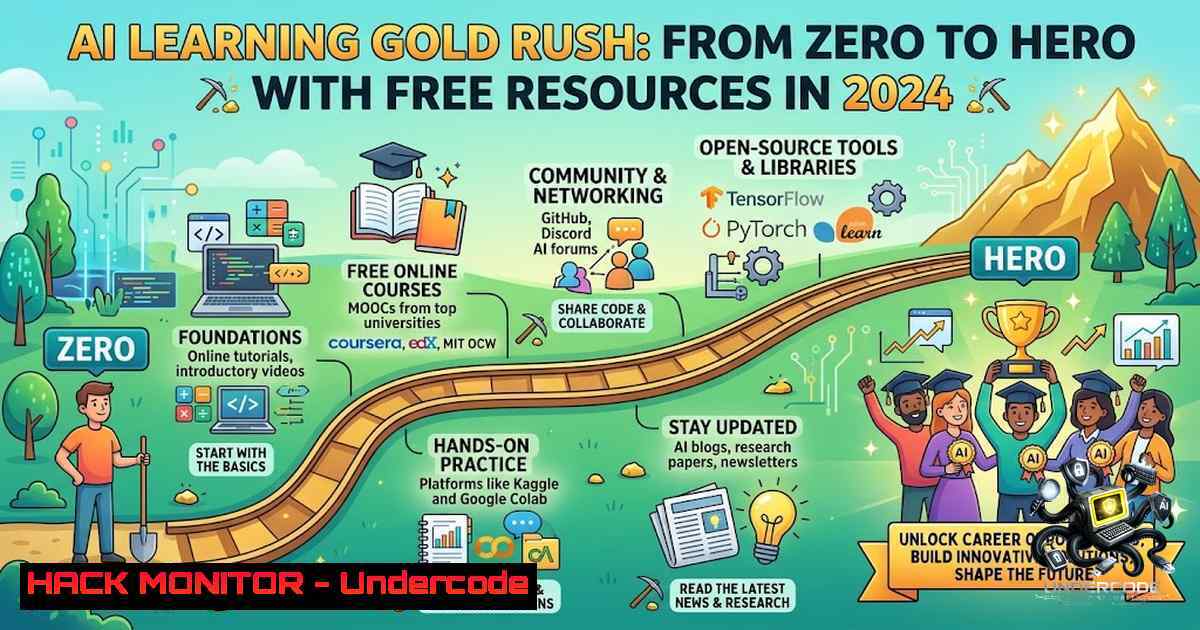
Introduction:
The AI revolution is no longer confined to research labs and tech giants—it’s an open playing field where anyone with an internet connection and the right resources can build production-ready models. Yet the sheer volume of courses, tutorials, and toolkits creates a paradox of choice that paralyzes more learners than it empowers. This article distills the most impactful free AI learning resources shared by industry practitioners, maps them to practical implementation workflows, and provides the command-line and coding foundations you need to turn theory into working systems—whether you’re securing AI pipelines, deploying models, or building from scratch.
Learning Objectives:
- Master the foundational concepts of Generative AI, including GANs, CLIP, transformers, and large language models, through structured free resources.
- Implement end-to-end AI projects using Python, PyTorch, and cloud platforms like AWS, with step-by-step guides for local and cloud deployment.
- Understand AI security fundamentals—from model poisoning to API hardening—and apply mitigation techniques using Linux/Windows commands and configuration files.
You Should Know:
- The Free AI Learning Trinity: Where to Start
The most effective path into AI doesn’t start with a textbook—it starts with visual intuition, hands-on coding, and structured micro-lessons. Three free resources stand out as the industry-backed gateway:
- 3Blue1Brown’s Transformer Explainer Videos – Before writing a single line of code, understand why transformers work. These visual breakdowns demystify attention mechanisms, positional encoding, and self-attention without drowning you in linear algebra.
- Andrej Karpathy’s Zero to Hero Series – Former Tesla AI Director and OpenAI co-founder Karpathy walks you through building
nanoGPT—a character-level language model trained on Shakespeare’s complete works. The series progresses from building a simple bigram model to implementing multi-head self-attention in pure PyTorch. - Microsoft’s 18 Lessons on Generative AI – This beginner-friendly curriculum covers Retrieval-Augmented Generation (RAG), vector databases, AI agents, and fine-tuning LLMs. Each lesson includes hands-on Jupyter notebooks and deployment guides.
Step-by-Step: Setting Up Your AI Development Environment
Before diving into these resources, establish a reproducible environment:
 Linux/macOS - Create a dedicated Python virtual environment
python3 -m venv ai_env
source ai_env/bin/activate

Windows (Command Prompt)
python -m venv ai_env
ai_env\Scripts\activate

Install core dependencies
pip install torch torchvision torchaudio --index-url https://download.pytorch.org/whl/cpu
pip install transformers datasets accelerate sentencepiece
pip install jupyter notebook matplotlib scikit-learn pandas
Verify your installation with a quick tensor test:
import torch
print(torch.<strong>version</strong>)
print("CUDA available:" if torch.cuda.is_available() else "Running on CPU")
- From GANs to CLIP: Building Generative AI Projects
Generative AI isn’t just about consuming content—it’s about creating it. A comprehensive course covering GANs (Generative Adversarial Networks), CLIP (Contrastive Language-Image Pre-training), Python, and PyTorch equips you to build next-generation AI applications for data creation and manipulation. The practical implementation journey typically follows this arc:
- Data Collection & Preprocessing – Scrape, clean, and augment datasets.
- Model Selection – Choose between GANs for image generation, CLIP for multimodal understanding, or diffusion models for high-fidelity synthesis.
- Training & Validation – Monitor loss curves, detect mode collapse, and tune hyperparameters.
- Deployment – Package models as APIs or edge-deployable artifacts.
Step-by-Step: Training a Simple GAN on Custom Data
 Minimal GAN implementation structure
import torch
import torch.nn as nn
import torch.optim as optim
from torchvision import datasets, transforms
from torch.utils.data import DataLoader

Generator: maps latent noise to images
class Generator(nn.Module):
def <strong>init</strong>(self, latent_dim=100, img_shape=(1, 28, 28)):
super().<strong>init</strong>()
self.model = nn.Sequential(
nn.Linear(latent_dim, 128),
nn.LeakyReLU(0.2),
nn.Linear(128, 256),
nn.BatchNorm1d(256),
nn.LeakyReLU(0.2),
nn.Linear(256, 512),
nn.BatchNorm1d(512),
nn.LeakyReLU(0.2),
nn.Linear(512, 2828),
nn.Tanh()
)

def forward(self, z):
return self.model(z).view(-1, 1, 28, 28)

Discriminator: distinguishes real from fake
class Discriminator(nn.Module):
def <strong>init</strong>(self, img_shape=(1, 28, 28)):
super().<strong>init</strong>()
self.model = nn.Sequential(
nn.Linear(2828, 512),
nn.LeakyReLU(0.2),
nn.Linear(512, 256),
nn.LeakyReLU(0.2),
nn.Linear(256, 1),
nn.Sigmoid()
)

def forward(self, img):
return self.model(img.view(img.size(0), -1))

Training loop (abbreviated)
latent_dim = 100
generator = Generator(latent_dim)
discriminator = Discriminator()
criterion = nn.BCELoss()
g_optimizer = optim.Adam(generator.parameters(), lr=0.0002)
d_optimizer = optim.Adam(discriminator.parameters(), lr=0.0002)
Monitoring Training on Linux/Windows:
 Linux - Watch GPU utilization
watch -1 1 nvidia-smi

Windows PowerShell - Monitor processes
Get-Process python | Select-Object CPU, WorkingSet
3. AI Security: Hardening Models and Pipelines
As AI moves into production, security becomes non-1egotiable. Threats range from prompt injection and model poisoning to adversarial attacks and data extraction. The OWASP Top 10 for LLMs provides a solid framework, but practical defenses require system-level hardening.
Common AI Attack Vectors & Mitigations:
| Attack Vector | Description | Mitigation |
||||
| Prompt Injection | Malicious inputs override system instructions | Input sanitization, role-based prompting, content filters |
| Model Poisoning | Adversarial data corrupts training | Data provenance, differential privacy, robust aggregation |
| Model Stealing | API queries reconstruct model behavior | Rate limiting, output perturbation, query logging |
| Data Extraction | Training data leaked via model outputs | Output filtering, differential privacy, red-teaming |
Step-by-Step: Securing an AI API with Rate Limiting and Authentication
 Linux - Using NGINX as a reverse proxy with rate limiting
 /etc/nginx/nginx.conf
http {
limit_req_zone $binary_remote_addr zone=ai_api:10m rate=5r/s;

server {
location /predict/ {
limit_req zone=ai_api burst=10 nodelay;
proxy_pass http://localhost:8000;
proxy_set_header Host $host;
proxy_set_header X-Real-IP $remote_addr;
}
}
}

Reload NGINX
sudo nginx -s reload
Windows – Implementing API Key Authentication with FastAPI:
from fastapi import FastAPI, Depends, HTTPException, Security
from fastapi.security import APIKeyHeader
import os

app = FastAPI()
API_KEY = os.getenv("AI_API_KEY", "your-secure-key-here")
api_key_header = APIKeyHeader(name="X-API-Key")

def validate_api_key(api_key: str = Security(api_key_header)):
if api_key != API_KEY:
raise HTTPException(status_code=403, detail="Invalid API Key")
return api_key

@app.post("/predict/")
async def predict(data: dict, api_key: str = Depends(validate_api_key)):
 Your model inference logic here
return {"status": "success", "prediction": "processed"}
4. Cloud AI Deployment: AWS, Containers, and CI/CD
Cloud platforms are the backbone of production AI. Heet Patel’s AWS Machine Learning Foundations certification covers the fundamentals of machine learning on AWS, including SageMaker, EC2, and S3. For DevOps orchestration, custom CI/CD pipelines using GitHub Actions streamline deployment workflows.
Step-by-Step: Deploying a PyTorch Model to AWS SageMaker
 1. Package your model
tar -czf model.tar.gz model.pth code/inference.py

<ol>
<li>Upload to S3
aws s3 cp model.tar.gz s3://your-bucket/models/</p></li>
<li><p>Create a SageMaker endpoint (using AWS CLI)
aws sagemaker create-endpoint-config \
--endpoint-config-1ame pytorch-inference-config \
--production-variants VariantName=AllTraffic,ModelName=pytorch-model,InitialInstanceCount=1,InstanceType=ml.m5.large</p></li>
</ol>

<p>aws sagemaker create-endpoint \
--endpoint-1ame pytorch-endpoint \
--endpoint-config-1ame pytorch-inference-config
GitHub Actions CI/CD Pipeline for AI Models (`.github/workflows/deploy.yml`):
name: Deploy AI Model

on:
push:
branches: [bash]

jobs:
deploy:
runs-on: ubuntu-latest
steps:
- uses: actions/checkout@v3
- name: Set up Python
uses: actions/setup-python@v4
with:
python-version: '3.10'
- name: Install dependencies
run: |
pip install -r requirements.txt
pip install pytest
- name: Run tests
run: pytest tests/
- name: Configure AWS credentials
uses: aws-actions/configure-aws-credentials@v2
with:
aws-access-key-id: ${{ secrets.AWS_ACCESS_KEY_ID }}
aws-secret-access-key: ${{ secrets.AWS_SECRET_ACCESS_KEY }}
aws-region: us-east-1
- name: Deploy to SageMaker
run: |
aws s3 cp model.tar.gz s3://your-bucket/models/
aws sagemaker update-endpoint --endpoint-1ame pytorch-endpoint
5. AI Ethics and Responsible Deployment
AI ethics isn’t a checkbox—it’s a continuous practice. Discussions around ethical implications of AI development and deployment cover bias, transparency, accountability, and societal impact. Practical steps include:
- Bias Auditing – Regularly test model outputs across demographic groups.
- Explainability – Use SHAP, LIME, or integrated gradients to interpret predictions.
- Red Teaming – Adversarially test models with edge cases and malicious inputs.
- Documentation – Maintain model cards detailing intended use, limitations, and performance.
Step-by-Step: Implementing Model Explainability with SHAP
import shap
import numpy as np
import pandas as pd
from sklearn.ensemble import RandomForestClassifier

Train a simple model
X_train = pd.DataFrame(np.random.rand(100, 5), columns=[f'feature_{i}' for i in range(5)])
y_train = np.random.randint(0, 2, 100)
model = RandomForestClassifier().fit(X_train, y_train)

Explain predictions
explainer = shap.TreeExplainer(model)
shap_values = explainer.shap_values(X_train)

Visualize (requires matplotlib)
shap.summary_plot(shap_values[bash], X_train, show=False)
6. Mastering AI Fundamentals: Core Concepts
A solid AI education covers the full spectrum: supervised, unsupervised, and reinforcement learning; neural networks and deep learning; natural language processing; computer vision; and real-world applications.
Key Command-Line Tools for AI Practitioners:
| Tool | Purpose | Linux Install | Windows Alternative |
|||||
| `jupyter` | Interactive notebooks | `pip install jupyter` | Same (via WSL or native) |
| `tensorboard` | Training visualization | `pip install tensorboard` | Same |
| `htop` | System resource monitoring | `sudo apt install htop` | Task Manager / Performance Monitor |
| `nvidia-smi` | GPU status | Included with NVIDIA drivers | `nvidia-smi.exe` (if installed) |
| `docker` | Containerization | `sudo apt install docker.io` | Docker Desktop |
| `kubectl` | Kubernetes orchestration | `curl -LO “https://dl.k8s.io/…”` | Chocolatey: `choco install kubernetes-cli` |
- From Theory to Production: The Full Stack AI Engineer
The modern AI engineer is a full-stack developer who bridges data science, software engineering, and DevOps. This means proficiency in:
- Frontend/Backend – React (TypeScript), Node.js, Supabase for building AI-powered applications.
- Infrastructure – Edge infrastructure optimization and production bottleneck resolution.
- Automation – AI-driven automation and CI/CD pipelines.
- Version Control – Git, GitHub Actions, and model versioning with DVC or MLflow.
Step-by-Step: Building a Full-Stack AI App with FastAPI + React
 Backend (FastAPI)
 main.py
from fastapi import FastAPI
from fastapi.middleware.cors import CORSMiddleware
import torch

app = FastAPI()
app.add_middleware(CORSMiddleware, allow_origins=[""])

@app.post("/generate/")
async def generate(prompt: str):
 Load model and generate
return {"generated_text": "AI-generated response"}

Run with uvicorn
uvicorn main:app --host 0.0.0.0 --port 8000 --reload
 Frontend (React + TypeScript) - Create and start
npx create-react-app ai-frontend --template typescript
cd ai-frontend
npm start
What Undercode Say:
- Learning by building accelerates growth more than passive consumption – Real learning happens during implementation: debugging, making trade-offs, and fixing things that break. Don’t wait to feel “ready”—start building today.
- The AI landscape is democratizing rapidly – With free resources from 3Blue1Brown, Karpathy, and Microsoft, the barrier to entry has never been lower. The differentiator isn’t access to information—it’s consistent, deliberate practice.
- Security must be embedded, not bolted on – As AI systems move into production, adversarial threats become critical. Rate limiting, authentication, input sanitization, and differential privacy are not optional—they’re table stakes.
- Cloud and DevOps skills are non-1egotiable – Model accuracy means nothing if you can’t deploy, scale, and monitor. AWS, Docker, and CI/CD pipelines are as important as PyTorch or TensorFlow.
- Ethics is an engineering discipline – Bias audits, explainability, and red-teaming should be part of every AI lifecycle, not an afterthought discussed in slide decks.
- The full-stack AI engineer is the new normal – Modern AI roles demand proficiency across the stack: from data pipelines to frontend interfaces to infrastructure orchestration.
Prediction:
- +1 The free AI education ecosystem will continue to expand, with more organizations releasing open curricula, reducing the skills gap and accelerating innovation across industries.
- +1 AI-1ative development tools will emerge that abstract away much of the infrastructure complexity, allowing practitioners to focus on model architecture and data quality rather than DevOps.
- -1 The democratization of AI will also democratize AI-enabled cyberattacks—phishing, deepfakes, and automated social engineering will become more sophisticated and harder to detect.
- -1 Regulatory frameworks will struggle to keep pace with generative AI capabilities, creating a “wild west” period where ethical lapses and security breaches become more frequent before standards solidify.
- +1 The integration of AI security into mainstream cybersecurity curricula (like Google’s Cybersecurity program) will produce a new generation of defenders equipped to handle AI-specific threats.
- -1 Model theft and IP extraction via API abuse will become a primary attack vector, forcing organizations to invest heavily in defensive AI and watermarking techniques.
- +1 Open-source AI models will increasingly match or exceed proprietary capabilities, shifting the competitive advantage from model weights to data curation, fine-tuning, and deployment infrastructure.
- -1 The compute requirements for state-of-the-art AI will continue to concentrate power among cloud providers, creating new dependency risks and vendor lock-in challenges.
- +1 Hands-on, project-based learning will largely replace traditional degree programs for AI practitioners, as employers prioritize portfolios over credentials.
- +1 The convergence of AI, cybersecurity, and DevOps will create a new hybrid role—the “AI Security Engineer”—that becomes one of the most sought-after positions in tech.
▶️ Related Video (76% Match):
🎯Let’s Practice For Free:
🎓 Live Courses & Certifications:
Join Undercode Academy for Verified Certifications
🚀 Request a Custom Project:
Secure, high-velocity infrastructure and disruptive technological engineering. Contact our engineering team for high-tier development and proprietary systems:
[email protected]
💎 Smart Architecture | 🛡️ Secure by Design | ⭐ Trusted by Thousands
IT/Security Reporter URL:
Reported By: Heet Patel – Hackers Feeds
Extra Hub: Undercode MoN
Basic Verification: Pass ✅


