
Listen to this Post
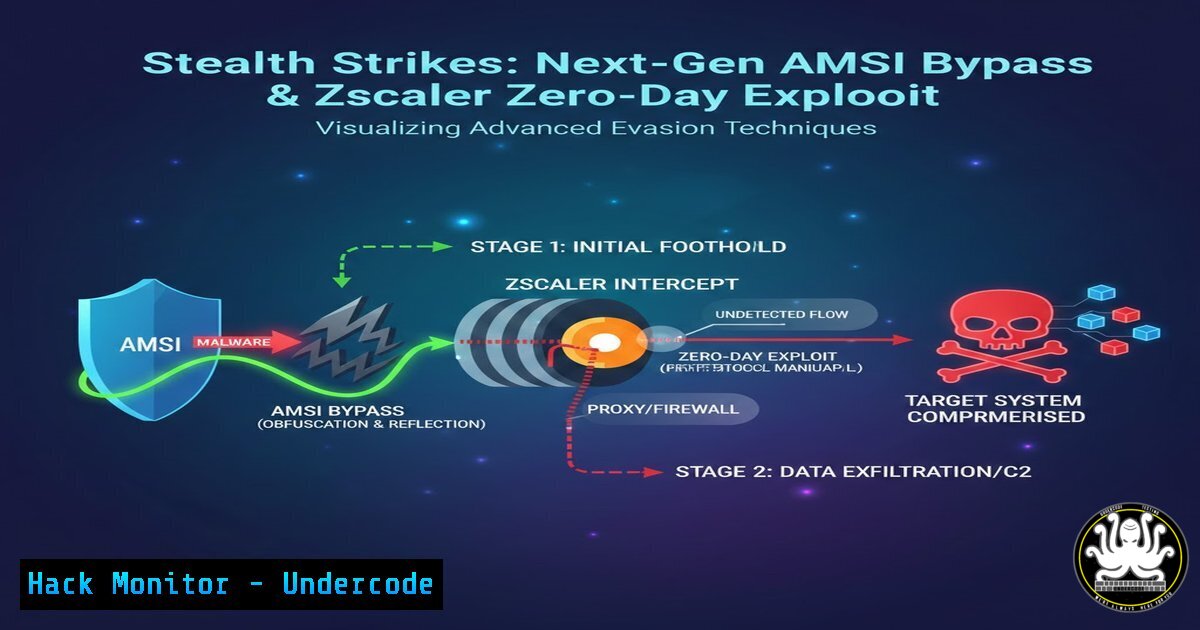
Introduction:
Modern endpoint security relies heavily on runtime detection systems like Microsoft’s Antimalware Scan Interface (AMSI) to intercept and analyze script-based threats. This article delves into a novel, surgical technique for bypassing AMSI without the traditional hallmarks of exploitation, alongside a critical privilege escalation vulnerability in a major security product. We will deconstruct these advanced attack vectors to understand their mechanics and implications for defensive security postures.
Learning Objectives:
- Understand the principles of a novel AMSI bypass technique that operates without patching memory or DLLs.
- Analyze the impact and exploitation path of an arbitrary file read vulnerability (CVE-2023-XXX) in Zscaler for privilege escalation.
- Learn practical detection strategies and mitigation steps for both the AMSI bypass technique and file read exploits in enterprise environments.
You Should Know:
- The “Hijack The Provider” AMSI Bypass: A New Era of Evasion
The technique, developed by researcher Yair M., represents a paradigm shift. Instead of patching the `amsi.dll` or using breakpoints on its `AmsiScanBuffer` function—common methods that trigger detection—it targets the core COM (Component Object Model) architecture of the provider itself. By exploiting the interaction between abstract classes and pure virtual functions in C++, an attacker can hijack the provider’s internal call flow before a scan request is ever formalized.
Step-by-step guide explaining what this does and how to use it:
Concept & Setup: AMSI works by allowing applications (like PowerShell) to send content to an antivirus provider via a COM interface. This technique creates a malicious, in-memory COM object that masquerades as the legitimate provider.
Key Technical Step: The exploit leverages the fact that the provider’s class contains pure virtual functions. By creating a rogue instance that provides its own implementation for these functions, the attacker controls the scan logic.
Implementation (Conceptual Code): The following C++ snippet outlines the creation of a malicious class implementing the critical virtual function. The actual full exploit is available in the linked GitHub repository.
// Conceptual overview of the malicious class structure
class MaliciousProvider : public IAmsiProvider // Inherit from the AMSI interface
{
public:
// Override the key pure virtual function for scanning
HRESULT __stdcall Scan(
HAMSICONTEXT amsiContext,
AMSI_ATTRIBUTE attribute,
LPCWSTR string,
LPCWSTR source,
LPCWSTR name,
AMSI_RESULT result)
{
// Malicious implementation: Force a clean result every time
result = AMSI_RESULT_CLEAN;
return S_OK; // Return success
}
// ... implementation of other required interface methods ...
};
Execution: The attacker’s code would instantiate this `MaliciousProvider` and use COM API functions to register or redirect the scan requests to it. Since no executable pages (amsi.dll) are modified and memory protections remain unchanged, this bypass is exceptionally stealthy and hard to detect by conventional Anti-Tamper mechanisms.
- Zscaler Zero-Day: From Arbitrary File Read to SYSTEM Shell
Discovered in the Zscaler client, this vulnerability (arbitrary file read as SYSTEM) stems from a logic flaw in a privileged service. A low-privileged user could exploit improper access controls to direct the service to read any file on the system, including critical security databases like the SAM and SYSTEM hives, which store password data.
Step-by-step guide explaining what this does and how to use it:
Prerequisites & Recon: The attacker needs to have user-level access on a Windows machine with the affected Zscaler client installed. Initial reconnaissance would involve confirming the Zscaler service version and identifying its processes.
Exploitation Path: The proof-of-concept (PoC) exploits a service function that accepts a file path. By crafting a specific request with a path traversal payload (e.g., ..\..\..\Windows\System32\config\SAM), the attacker tricks the high-privileged service into returning the file’s contents.
Privilege Escalation Commands (Post-Exploitation): After dumping the SAM and SYSTEM hives, an attacker can extract password hashes for offline cracking.
 On the attacker's machine, using Impacket's secretsdump.py
python3 secretsdump.py -sam SAM.dump -system SYSTEM.dump LOCAL
Impact: Successful exploitation provides the attacker with the NT hashes of local accounts. These can be used for Pass-the-Hash attacks to gain `SYSTEM` privileges or crack to obtain plaintext passwords, leading to a complete compromise of the host.
3. Defensive Analysis: Detecting the AMSI Bypass
Traditional detection for AMSI bypass focuses on memory patches, hooked functions, or PowerShell logging. This new method requires a deeper behavioral analysis.
Step-by-step guide explaining what this does and how to use it:
Detection Strategy: Monitor for the unusual creation of COM objects related to AMSI interfaces (CLSID_AmsiProvider) from unexpected processes. Also, look for PowerShell or other scripting hosts loading AMSI but then exhibiting zero scan results (AMSI_RESULT_CLEAN) for obviously malicious payloads.
Windows Command for Investigation: Use PowerShell to inspect loaded AMSI context within a process (though this may be blinded by the bypass).
 This may not reveal a sophisticated bypass, but it's a starting point
Get-Process | Where-Object {$_.Modules.ModuleName -like "amsi"} | Select-Object ProcessName, Id
Advanced EDR Rule: Implement an Endpoint Detection and Response (EDR) rule that alerts on the direct invocation of COM API functions like `CoCreateInstance` with AMSI provider CLSIDs from non-antivirus processes, especially if followed by a series of scan calls with clean results.
4. Mitigating the Zscaler File Read Vulnerability
While this specific vulnerability has been patched, the pattern of privileged service manipulation is common. Defense requires layered security.
Step-by-step guide explaining what this does and how to use it:
Immediate Action – Patching: Ensure all Zscaler clients are updated to the latest version. This is the primary and most critical mitigation step.
Hardening – Principle of Least Privilege: Audit all security software and agent services. Configure them to run with the minimum privileges necessary. A service that needs to inspect network traffic does not inherently need SYSTEM-level file access.
Detection – File Access Auditing: Enable detailed file system auditing on critical paths (like C:\Windows\System32\config\). Monitor for read access attempts by processes that are not standard Windows components.
 Windows command to enable audit policy for object access (requires Admin)
auditpol /set /subcategory:"File System" /success:enable /failure:enable
Containment: Implement application control policies (like Windows Defender Application Control) to restrict the execution of unknown processes, making initial user-level exploitation harder.
- The Bigger Picture: API and Cloud Agent Security
These exploits highlight systemic risks: the security of API interfaces in AMSI and the trust placed in cloud-agent software with high privileges.
Step-by-step guide explaining what this does and how to use it:
Security Assessment for Internal APIs: Treat security software interfaces as critical attack surfaces. Perform regular code reviews and penetration tests on any component that handles privileged requests, especially those using COM, RPC, or named pipes.
Cloud Agent Hardening Checklist:
- Sandboxing: Run agent processes in constrained environments where possible.
- Input Validation: Sanitize all input paths and parameters, rejecting those containing directory traversal sequences (
..\,../). - Logging: Implement verbose, immutable logs for all agent actions, particularly file operations.
- Update Mechanism Security: Secure the agent update process against man-in-the-middle attacks and local privilege escalation.
6. Building a Proactive Security Posture
Reactive patching is not enough. Security teams must assume bypasses and zero-days exist.
Step-by-step guide explaining what this does and how to use it:
Implement Behavioral Analytics: Move beyond signature-based detection. Use tools that analyze process behavior, parent-child relationships, and anomalous access patterns (e.g., a PowerShell instance reading the SAM hive).
Conduct Purple Team Exercises: Regularly test your defenses using the latest public tradecraft, like the techniques discussed here. Simulate the full attack chain from initial bypass to privilege escalation.
Leverage Threat Intelligence: Subscribe to feeds that provide technical details on new exploit techniques. The detailed analysis of the AMSI bypass method, for instance, should directly inform new detection rules in your SIEM or EDR.
Linux Analogy – Auditing SUID Binaries: The Zscaler flaw is analogous to a misconfigured SUID binary on Linux. Regularly audit such binaries as a standard hardening practice.
 Linux command to find all SUID binaries
find / -type f -perm -4000 2>/dev/null
What Undercode Say:
- The Perimeter is Within: The most critical attacks no longer just cross the network boundary; they exploit the very security software installed to defend the endpoint. Trust in these components must be rigorously validated.
- Evasion is a First-Class Objective: Modern malware authors treat detection evasion with the same priority as initial exploitation. Techniques that subvert architectural trust, like COM hijacking, are becoming the norm, demanding deeper system-level monitoring from defenders.
Analysis: These disclosures are not isolated bugs but symptoms of deeper challenges. The AMSI bypass reveals a weakness in a foundational Windows security API’s trust model, suggesting that future defensive features must be designed with tamper resistance as a core tenet, not an afterthought. The Zscaler vulnerability underscores the immense risk posed by privileged agent software—a single flaw can nullify the security of the entire host. Together, they paint a picture of an ongoing arms race where offensive research continuously finds the subtle cracks in defensive architectures. Defenders must shift from a purely preventative mindset to one focused on detection, response, and resilience, operating under the assumption that sophisticated bypasses will occur.
Prediction:
In the next 2-3 years, we will see a significant rise in supply-chain attacks targeting the update mechanisms and internal APIs of enterprise security software itself. Furthermore, AMSI and similar runtime inspection interfaces will undergo a major architectural overhaul or be supplemented by hardware-assisted, kernel-level security modules that are more resistant to userland manipulation. Exploitation techniques will increasingly leverage legitimate OS and software architectures (like COM, RPC, and .NET CLR) in “living-off-the-land” style attacks, making them far more stealthy and challenging to distinguish from normal activity. Defensive AI will become crucial in identifying the anomalous behavioral patterns that these techniques create, rather than relying on static indicators.
▶️ Related Video (80% Match):
🎯Let’s Practice For Free:
IT/Security Reporter URL:
Reported By: Yair Mentesh – Hackers Feeds
Extra Hub: Undercode MoN
Basic Verification: Pass ✅


