Listen to this Post
Introduction:
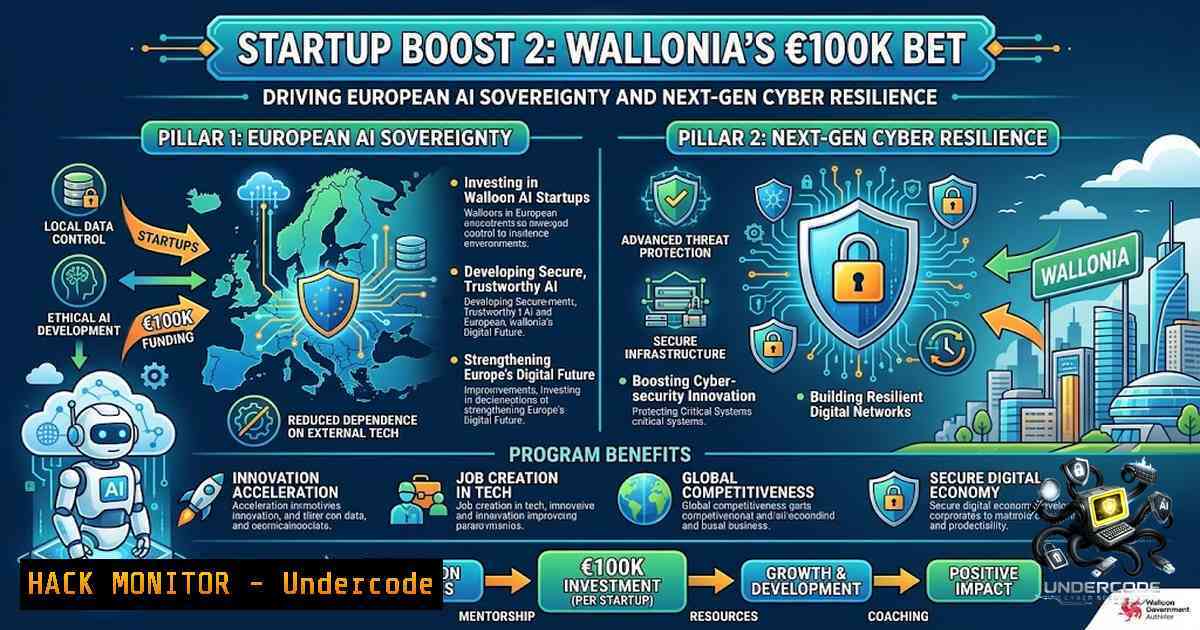
As artificial intelligence permeates every layer of modern infrastructure—from industrial control systems to healthcare data pipelines—the attack surface expands exponentially. Wallonia’s Startup Boost 2 program, offering €100,000 in convertible loans to early-stage ventures, signals a strategic regional investment in proprietary AI and cybersecurity technologies. This initiative targets not mere integration of existing tools, but the development of defensible, sovereign intellectual property capable of addressing Europe’s pressing need for technological autonomy and robust threat mitigation.
Learning Objectives:
- Understand the strategic alignment between regional investment incentives and the technical requirements for building proprietary AI and cybersecurity solutions.
- Identify the core technology areas prioritized by Startup Boost 2, including Edge AI, AI infrastructure, threat detection, and industrial system security.
- Acquire practical, command-line and configuration-level knowledge for implementing and hardening AI-driven security architectures.
You Should Know:
- Decoding the Technical Scope: From Embedded AI to Industrial Cyber-Physical Systems
The call for projects explicitly targets proprietary technology development, excluding mere integration of off-the-shelf solutions. This distinction is critical: it demands innovation at the algorithmic and systems level. Eligible domains include embedded AI, Edge AI, AI infrastructure, cyber-threat detection, data protection, and security for industrial systems. For a startup, this translates into building custom models, optimizing inference engines for resource-constrained devices, or developing novel anomaly detection algorithms that operate at the network edge.
Step‑by‑step guide to establishing a secure AI inference environment on Linux:
- Set up a Python virtual environment to isolate dependencies:
python3 -m venv ai-security-env
source ai-security-env/bin/activate
- Install core libraries for secure model deployment (PyTorch, TensorFlow, or ONNX Runtime):
pip install torch onnxruntime numpy scikit-learn
- Implement input validation and sanitization to mitigate adversarial attacks. This involves checking input tensor shapes, ranges, and data types before inference.
import numpy as np
def validate_input(input_tensor, expected_shape, min_val=0.0, max_val=1.0):
if input_tensor.shape != expected_shape:
raise ValueError("Input shape mismatch")
if np.any(input_tensor < min_val) or np.any(input_tensor > max_val):
raise ValueError("Input values out of bounds")
return input_tensor.astype(np.float32)
4. Encrypt model weights at rest using `openssl`:
openssl enc -aes-256-cbc -salt -in model.onnx -out model.enc -pass pass:your_secure_key
5. Load and decrypt the model dynamically in your application code to prevent static reverse-engineering.
- Hardening the AI Pipeline: Data Protection and Secure Multi-Party Computation
Data protection is a pillar of the program. For AI startups, this means implementing privacy-preserving techniques such as federated learning, differential privacy, or homomorphic encryption. These are not academic concepts; they are becoming regulatory requirements under GDPR and the EU AI Act.
Step‑by‑step guide for implementing a basic differential privacy mechanism on Windows (using Python):
- Install the Opacus library for training PyTorch models with differential privacy:
pip install opacus
2. Wrap your optimizer with Opacus’s `PrivacyEngine`:
from opacus import PrivacyEngine
privacy_engine = PrivacyEngine()
model, optimizer, train_loader = privacy_engine.make_private(
module=model,
optimizer=optimizer,
data_loader=train_loader,
noise_multiplier=1.0,
max_grad_norm=1.0,
)
3. Train your model while automatically clipping gradients and adding noise to the parameter updates.
4. Audit privacy spend using Renyi Differential Privacy (RDP) to compute the epsilon (ε) value, ensuring compliance with privacy budgets.
This approach directly addresses the program’s emphasis on proprietary data protection technologies, moving beyond simple encryption to algorithmic privacy.
- Cyber-Threat Detection: Building an Anomaly-Based IDS with AI
The program seeks innovations in threat detection and prevention. Traditional signature-based IDS are insufficient against zero-day exploits. Machine learning models that establish behavioral baselines offer a superior alternative.
Step‑by‑step guide to deploying a lightweight network anomaly detection system on Linux:
- Capture network traffic using `tcpdump` and save to a PCAP file:
sudo tcpdump -i eth0 -w traffic.pcap -c 10000
2. Extract flow features using `tshark` (Wireshark CLI):
tshark -r traffic.pcap -T fields -e ip.src -e ip.dst -e tcp.srcport -e tcp.dstport -e frame.len -e proto > features.csv
3. Develop an autoencoder model in Python to learn normal traffic patterns. Autoencoders are effective at detecting anomalies by measuring reconstruction error.
from tensorflow import keras
model = keras.Sequential([
keras.layers.Dense(64, activation='relu', input_shape=(5,)),
keras.layers.Dense(32, activation='relu'),
keras.layers.Dense(64, activation='relu'),
keras.layers.Dense(5, activation='sigmoid')
])
model.compile(optimizer='adam', loss='mse')
4. Train the model on benign traffic data.
- Deploy the model to score live traffic; a high reconstruction error triggers an alert.
4. Securing AI Infrastructure: Zero-Trust and API Hardening
AI infrastructure, as highlighted in the call, requires robust security. APIs are the primary attack vector for AI services. Implementing zero-trust principles and rigorous API security is non-1egotiable.
Step‑by‑step guide to hardening a REST API for an AI model using NGINX and Linux:
- Configure NGINX as a reverse proxy with rate limiting to prevent DoS attacks:
location /predict {
limit_req zone=one burst=5 nodelay;
proxy_pass http://localhost:5000;
proxy_set_header Host $host;
proxy_set_header X-Real-IP $remote_addr;
}
2. Implement mutual TLS (mTLS) for client authentication:
- Generate client and server certificates using
openssl. - Configure NGINX to verify client certificates:
ssl_verify_client on;
ssl_client_certificate /etc/nginx/client_ca.crt;
- Validate JWT tokens at the application level using a middleware that checks token signatures against a public key.
- Log all API requests with `rsyslog` and monitor for anomalous patterns using a SIEM tool.
5. Vulnerability Exploitation and Mitigation in AI/ML Systems
Understanding the adversarial landscape is crucial for building resilient AI. Techniques like model poisoning, evasion attacks, and membership inference are real threats.
Step‑by‑step guide to testing model robustness against adversarial evasion (Linux):
1. Install the Adversarial Robustness Toolbox (ART):
pip install adversarial-robustness-toolbox
2. Generate adversarial examples using the Fast Gradient Sign Method (FGSM) against a trained model:
from art.attacks.evasion import FastGradientMethod
attack = FastGradientMethod(estimator=classifier, eps=0.2)
adversarial_samples = attack.generate(x_test)
3. Evaluate the model’s accuracy on adversarial samples to quantify its vulnerability.
4. Implement adversarial training by augmenting the training dataset with these adversarial examples, effectively hardening the model against such attacks.
What Undercode Say:
- Key Takeaway 1: The strategic convergence of AI and cybersecurity investment is not just a funding opportunity; it is a directional signal for startups to focus on defensible, proprietary intellectual property that addresses European sovereignty concerns.
- Key Takeaway 2: Technical excellence alone is insufficient. Startups must demonstrate a clear path to scalability, market fit, and a robust security posture that encompasses the entire AI lifecycle—from data collection to model deployment and monitoring.
Analysis: The Startup Boost 2 initiative reflects a maturing understanding that AI and cybersecurity are two sides of the same coin. As organizations deploy AI at the edge and in critical infrastructure, the security of these systems becomes paramount. The program’s emphasis on proprietary technology over integration forces startups to innovate at the algorithmic level, fostering a generation of solutions that are both performant and resilient. However, the challenge remains: turning a €100,000 convertible loan into a sustainable business requires not only technical prowess but also strategic partnerships and customer validation. The inclusion of ecosystem access and credibility-building is therefore as valuable as the capital itself.
Prediction:
- +1 This targeted investment will catalyze the emergence of at least 5-8 new specialized AI/cybersecurity startups in Wallonia over the next 18 months, strengthening the regional innovation cluster.
- +1 The focus on proprietary technology will likely lead to new patent filings and open-source contributions, particularly in the areas of Edge AI inference optimization and privacy-preserving machine learning.
- -1 However, the exclusion of integration-focused projects may inadvertently overlook startups that could significantly enhance security through novel combinations of existing tools, potentially creating a gap in the ecosystem.
- +1 Success stories from this cohort will attract further venture capital interest, validating the convertible loan model as an effective early-stage instrument.
- -1 The 15 September 2026 deadline creates a compressed timeline that may favor projects with existing prototypes over truly nascent, high-risk innovations, potentially stifling radical breakthroughs.
▶️ Related Video (80% Match):
🎯Let’s Practice For Free:
🎓 Live Courses & Certifications:
Join Undercode Academy for Verified Certifications
🚀 Request a Custom Project:
Secure, high-velocity infrastructure and disruptive technological engineering. Contact our engineering team for high-tier development and proprietary systems:
[email protected]
💎 Smart Architecture | 🛡️ Secure by Design | ⭐ Trusted by Thousands
IT/Security Reporter URL:
Reported By: Ia Et – Hackers Feeds
Extra Hub: Undercode MoN
Basic Verification: Pass ✅


