Listen to this Post
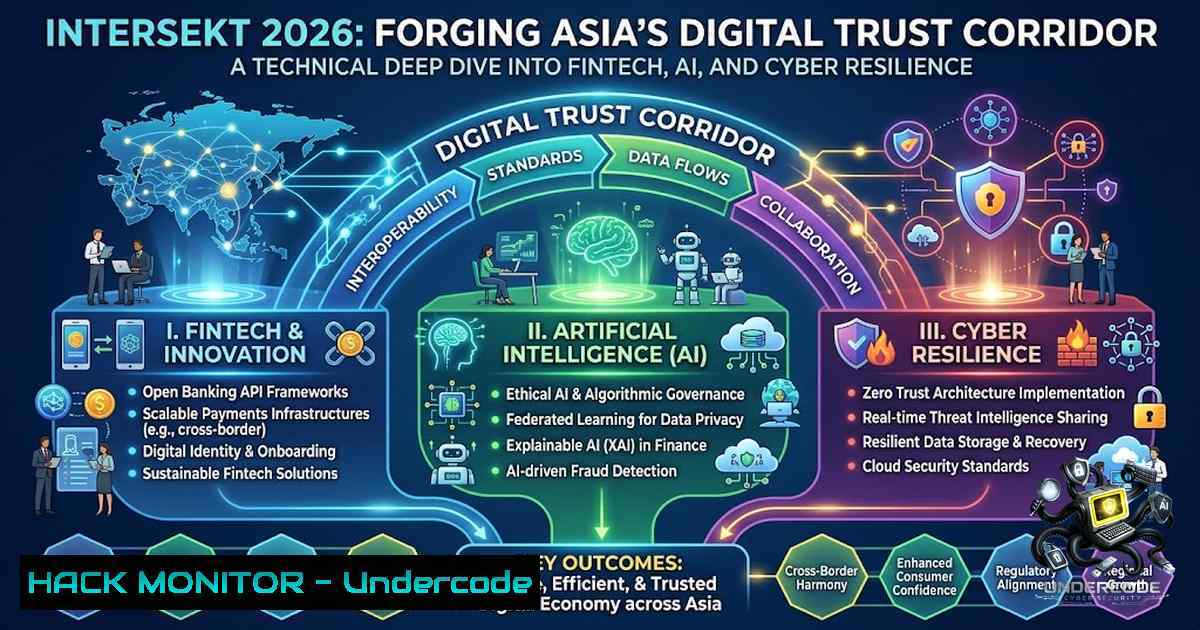
Introduction:
As Australia’s fintech sector stands at an existential crossroads—poised to triple to a $37 billion industry within the next decade—the convergence of artificial intelligence, regulatory overhaul, and cross-border digital trust has become the defining battleground for market expansion. The Australian Trade and Investment Commission’s (Austrade) dedicated program at Intersekt 2026 serves as a strategic launchpad for fintech enterprises eyeing Southeast and Northeast Asia, where 63.5% of industry leaders now identify fraud prevention as their top operational priority. This article dissects the technical scaffolding required to navigate this complex terrain, from AI-driven security architectures to regional compliance frameworks, providing actionable insights for practitioners preparing for international growth.
Learning Objectives:
- Understand the intersection of AI deployment, cybersecurity posture, and regulatory compliance in Asia-Pacific fintech markets.
- Acquire practical command-line and configuration techniques for hardening cloud infrastructure against emerging cross-border threats.
- Develop a strategic roadmap for market entry, incorporating regional digital trust frameworks and real-time risk intelligence systems.
You Should Know:
- The AI-Cyber Nexus: From Pilot to Production in High-Risk Environments
The migration of artificial intelligence from experimental pilots to production-grade financial systems introduces a spectrum of vulnerabilities that demand proactive mitigation. As agentic AI assumes greater decision-making authority in payments, fraud detection, and customer onboarding, the attack surface expands exponentially. Recent regulatory guidance, such as China’s TC260 draft on secure deployment of open-source AI agents, recommends human confirmation mechanisms for high-risk operations and adherence to minimum authorisation principles. For fintechs expanding into Asia, this translates into a non-1egotiable requirement for explainable AI (XAI) frameworks and continuous model validation pipelines.
To operationalise AI security, organisations must implement robust logging and monitoring at the inference layer. Below is a Linux-based command sequence to establish a real-time audit trail for AI model API calls using `auditd` and `jq` for JSON parsing:
 Install auditd and jq
sudo apt-get update && sudo apt-get install -y auditd jq

Configure audit rule to monitor model API endpoints (assuming FastAPI on port 8000)
sudo auditctl -a always,exit -F path=/usr/local/bin/uvicorn -F perm=wa -k ai_model_access

Create a log rotation and analysis script
cat << 'EOF' > /opt/ai_audit.sh
!/bin/bash
tail -f /var/log/audit/audit.log | while read line; do
if echo "$line" | grep -q "ai_model_access"; then
timestamp=$(date -Iseconds)
pid=$(echo "$line" | grep -oP 'pid=\K\d+')
comm=$(echo "$line" | grep -oP 'comm="\K[^"]+')
echo "{\"timestamp\":\"$timestamp\",\"pid\":$pid,\"process\":\"$comm\",\"event\":\"model_inference\"}" >> /var/log/ai_inference_audit.json
fi
done
EOF

chmod +x /opt/ai_audit.sh
nohup /opt/ai_audit.sh &
Step‑by‑step guide:
- Step 1: Install auditing tools to capture system calls related to AI model execution.
- Step 2: Define audit rules targeting the specific binaries or scripts that serve your models.
- Step 3: Deploy a log parser that extracts relevant metadata (process ID, timestamp, command) and structures it in JSON for integration with SIEM platforms.
- Step 4: Forward the structured logs to a centralised dashboard for anomaly detection—sudden spikes in inference calls or access from unrecognised source IPs should trigger automated alerts.
2. Hardening the Cross-Border Data Pipeline
Expanding into Southeast Asia necessitates navigating a fragmented regulatory landscape where data sovereignty laws—such as Indonesia’s Regulation No. 71/2019 and Singapore’s Personal Data Protection Act—impose strict residency and transfer restrictions. Fintechs must architect their data pipelines with regional segmentation and encryption-at-rest policies that satisfy the most stringent jurisdiction while maintaining operational efficiency.
Implementing a zero-trust network architecture (ZTNA) is foundational. The following Windows PowerShell script demonstrates how to enforce IP-based access controls and enable TLS 1.3 for all outbound connections to ASEAN-based endpoints:
 Enforce TLS 1.3 for .NET applications
New-ItemProperty -Path "HKLM:\SOFTWARE\Microsoft.NETFramework\v4.0.30319" -1ame "SchUseStrongCrypto" -Value 1 -PropertyType DWord -Force
New-ItemProperty -Path "HKLM:\SOFTWARE\Microsoft.NETFramework\v4.0.30319" -1ame "SystemDefaultTlsVersions" -Value 1 -PropertyType DWord -Force

Configure Windows Firewall to restrict outbound traffic to approved ASEAN IP ranges (example CIDR for Singapore)
New-1etFirewallRule -DisplayName "Block non-ASEAN outbound" -Direction Outbound -Action Block -RemoteAddress "0.0.0.0/0"
New-1etFirewallRule -DisplayName "Allow ASEAN outbound" -Direction Outbound -Action Allow -RemoteAddress "103.252.128.0/20","103.252.144.0/20","103.252.160.0/20"

Enable advanced audit logging for all firewall events
auditpol /set /subcategory:"Filtering Platform Connection" /success:enable /failure:enable
Step‑by‑step guide:
- Step 1: Apply cryptographic policy settings to mandate TLS 1.3, ensuring forward secrecy and mitigating known protocol vulnerabilities.
- Step 2: Define outbound firewall rules that whitelist only the CIDR ranges corresponding to your target markets’ data centre regions.
- Step 3: Enable detailed connection auditing to detect and respond to exfiltration attempts or policy violations in real time.
- Step 4: Regularly review and update the allowed IP ranges as regional cloud providers expand their footprints.
- Digital Trust and Identity: The New Currency of Market Entry
Austrade’s focus on “digital trust” underscores a critical reality: consumer confidence and regulatory approval in Asia hinge on robust identity verification and fraud prevention mechanisms. The Asia-Pacific region is witnessing a surge in tokenisation and decentralised identity frameworks, with 90% of firms planning increased investment in cybersecurity as a foundational enabler. For Australian fintechs, integrating with national digital identity systems—such as Australia’s myGovID or Singapore’s Singpass—requires adherence to the OpenID Connect (OIDC) standard and FIDO2 biometric authentication.
A practical implementation involves configuring an OIDC-compliant identity provider (IdP) using Keycloak, with custom policies for regional risk scoring. Below is a Docker Compose snippet to deploy a hardened Keycloak instance with PostgreSQL backend and automated certificate rotation:
version: '3.8'
services:
postgres:
image: postgres:15-alpine
environment:
POSTGRES_DB: keycloak
POSTGRES_USER: keycloak
POSTGRES_PASSWORD: ${DB_PASSWORD}
volumes:
- postgres_data:/var/lib/postgresql/data
networks:
- keycloak_network

keycloak:
image: quay.io/keycloak/keycloak:24.0.5
command: start --optimized --http-enabled=false --https-port=8443 --hostname-strict=false
environment:
KC_DB: postgres
KC_DB_URL: jdbc:postgresql://postgres/keycloak
KC_DB_USERNAME: keycloak
KC_DB_PASSWORD: ${DB_PASSWORD}
KC_HOSTNAME: ${KEYCLOAK_HOSTNAME}
KC_HTTPS_CERTIFICATE_FILE: /opt/keycloak/conf/server.crt
KC_HTTPS_CERTIFICATE_KEY_FILE: /opt/keycloak/conf/server.key
volumes:
- ./certs:/opt/keycloak/conf:ro
ports:
- "8443:8443"
depends_on:
- postgres
networks:
- keycloak_network

volumes:
postgres_data:

networks:
keycloak_network:
driver: bridge
Step‑by‑step guide:
- Step 1: Deploy the PostgreSQL and Keycloak containers with environment variables for database credentials and hostname.
- Step 2: Generate a self-signed or CA-signed certificate pair and mount them into the container for TLS termination.
- Step 3: Configure Keycloak’s authentication flows to include OTP and biometric factors for high-risk transactions.
- Step 4: Integrate with regional identity providers via SAML or OIDC bridges, ensuring compliance with local e-KYC regulations.
4. Real-Time Fraud Intelligence: AI-Driven Threat Hunting
With fraud prevention dominating operational agendas across Asia, fintechs must move beyond reactive rule-based systems to proactive, AI-driven threat hunting. This involves deploying machine learning models that analyse transaction patterns, device fingerprints, and behavioural biometrics in sub-second latency windows. The following Python snippet leverages the `scikit-learn` library to implement an Isolation Forest model for anomaly detection in payment flows:
import pandas as pd
from sklearn.ensemble import IsolationForest
import joblib

Load transaction dataset (features: amount, time_to_previous, merchant_category, device_risk_score)
df = pd.read_csv('transactions.csv')
features = ['amount', 'time_to_previous', 'merchant_category_encoded', 'device_risk_score']

Train Isolation Forest model
model = IsolationForest(contamination=0.01, random_state=42)
model.fit(df[bash])

Save model for production deployment
joblib.dump(model, 'fraud_detector.pkl')

Real-time inference function
def predict_fraud(transaction):
prediction = model.predict([bash])
return 1 if prediction[bash] == -1 else 0  -1 indicates anomaly
Step‑by‑step guide:
- Step 1: Curate a historical dataset of transactions with labelled fraud cases, ensuring representation of regional payment behaviours.
- Step 2: Train an unsupervised anomaly detection model to identify outliers without over-reliance on labelled data.
- Step 3: Serialise the model and deploy it within a microservice architecture, exposing a RESTful API for low-latency inference.
- Step 4: Establish a feedback loop where confirmed fraud cases retrain the model periodically, adapting to evolving attack patterns.
5. Cloud Hardening for Asia-Pacific Deployments
Major cloud providers are expanding their Asia-Pacific footprints, with regions in Singapore, Tokyo, Sydney, and Mumbai offering low-latency access to financial hubs. However, misconfigurations remain the leading cause of cloud breaches. Implementing a Infrastructure-as-Code (IaC) approach with Terraform, combined with automated compliance scanning using `checkov` or tfsec, ensures that security controls are baked into the deployment pipeline.
The following Terraform configuration provisions an AWS VPC with private subnets, a NAT gateway, and security groups that enforce least-privilege access for a fintech application stack:
provider "aws" {
region = "ap-southeast-1"  Singapore region
}

resource "aws_vpc" "fintech_vpc" {
cidr_block = "10.0.0.0/16"
enable_dns_hostnames = true
tags = { Name = "fintech-asia-vpc" }
}

resource "aws_subnet" "private" {
count = 2
vpc_id = aws_vpc.fintech_vpc.id
cidr_block = cidrsubnet(aws_vpc.fintech_vpc.cidr_block, 8, count.index + 10)
availability_zone = data.aws_availability_zones.available.names[count.index]
tags = { Name = "private-subnet-${count.index}" }
}

resource "aws_security_group" "app_sg" {
name = "app-security-group"
description = "Allow HTTPS and internal traffic"
vpc_id = aws_vpc.fintech_vpc.id

ingress {
from_port = 443
to_port = 443
protocol = "tcp"
cidr_blocks = ["10.0.0.0/16"]  Internal only
}

egress {
from_port = 0
to_port = 0
protocol = "-1"
cidr_blocks = ["0.0.0.0/0"]
}
}
Step‑by‑step guide:
- Step 1: Define the VPC and subnet architecture, selecting regions that align with your target markets and latency requirements.
- Step 2: Implement security groups that restrict inbound traffic to internal CIDR ranges, exposing only necessary ports through a load balancer.
- Step 3: Integrate `tfsec` into your CI/CD pipeline to automatically flag misconfigurations such as open security groups or unencrypted storage.
- Step 4: Regularly review and update your IaC templates to reflect evolving compliance standards, such as the Monetary Authority of Singapore’s Technology Risk Management guidelines.
What Undercode Say:
- Key Takeaway 1: The fusion of AI and cybersecurity is not merely a technical upgrade but a strategic imperative for fintechs entering Asia, where regulatory scrutiny and fraud sophistication are at an all-time high.
- Key Takeaway 2: Operationalising digital trust demands a layered approach—spanning identity management, data encryption, and real-time threat intelligence—that transcends traditional perimeter defences.
Austrade’s Intersekt 2026 program arrives at a pivotal moment. With Australia ranking sixth globally and second in Asia-Pacific for fintech innovation, the opportunity to export this expertise is immense. Yet, success hinges on more than market insights; it requires a technical architecture that is resilient, compliant, and adaptive. The commands and configurations provided here offer a starting point for hardening infrastructure, but the true differentiator will be the cultural shift towards security-by-design. As agentic AI and tokenised finance reshape the landscape, those who embed cyber resilience into their DNA will not only survive but thrive in Asia’s dynamic digital economy.
Prediction:
- +1 Asian regulators will harmonise AI governance frameworks by 2028, reducing compliance fragmentation and accelerating cross-border fintech deployments.
- -1 The proliferation of deepfake-based identity fraud will outpace traditional detection methods, forcing a $5 billion annual investment in biometric and behavioural analytics by 2027.
- +1 Austrade’s Landing Pads program will catalyse a 40% increase in Australian fintech exports to Southeast Asia within three years, driven by the technical and strategic frameworks showcased at Intersekt.
- -1 Organisations that fail to implement zero-trust architectures and AI model auditing will face a 3x higher likelihood of regulatory sanctions and data breach penalties in the region by 2026.
▶️ Related Video (72% Match):
🎯Let’s Practice For Free:
🎓 Live Courses & Certifications:
Join Undercode Academy for Verified Certifications
🚀 Request a Custom Project:
Secure, high-velocity infrastructure and disruptive technological engineering. Contact our engineering team for high-tier development and proprietary systems:
[email protected]
💎 Smart Architecture | 🛡️ Secure by Design | ⭐ Trusted by Thousands
IT/Security Reporter URL:
Reported By: Intersekt 2026 – Hackers Feeds
Extra Hub: Undercode MoN
Basic Verification: Pass ✅


