
Listen to this Post
Introduction:
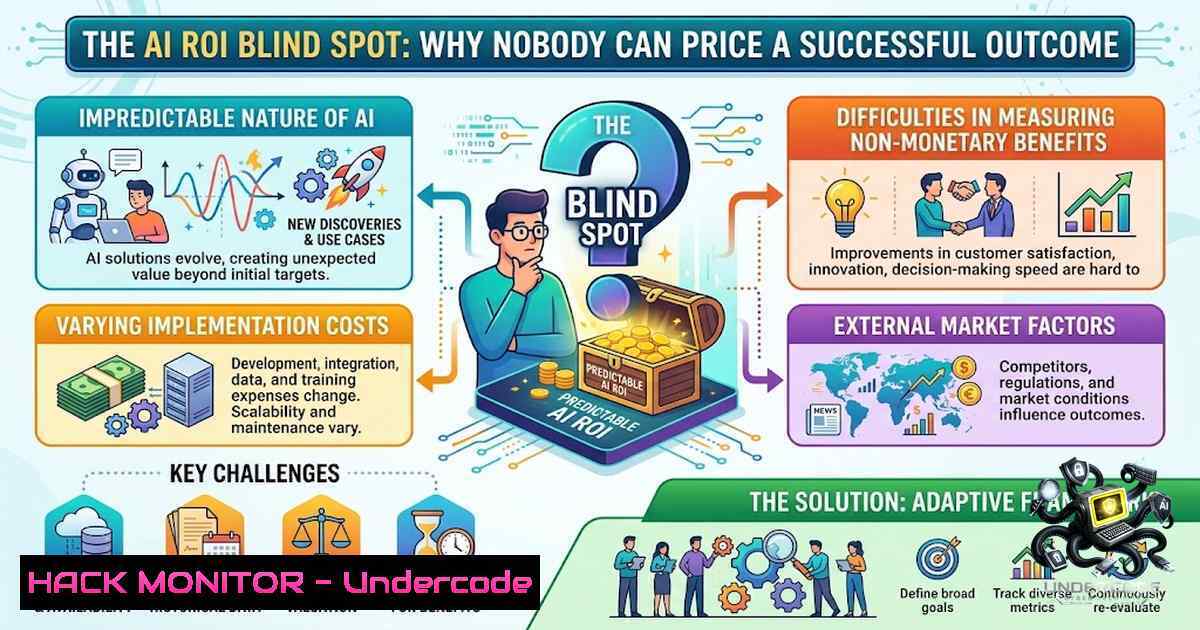
Enterprise AI adoption has surged, but a critical blind spot threatens to undermine its value: the inability to define and measure a “successful” outcome. As highlighted in a recent conversation between Winston Thomas and Datadog’s Yadi N., organizations are drowning in metrics like tokens and seats while remaining oblivious to the actual cost-per-resolution and the hidden financial drain of system retries. This operational opacity, coupled with a fundamental misunderstanding of AI governance and an evolving threat landscape, demands a new approach focused on observability, staged autonomy, and granular cost attribution to prevent AI investments from becoming bottomless pits.
Learning Objectives & Secrets:
- Objective 1: Differentiate between compliance-driven policy documents and a live operational control plane that governs AI behavior in real-time.
- Objective 2 Secret Tip: Move beyond cost-per-seat and track “Cost per Successful Outcome” by instrumenting your AI pipeline to correlate token spend with business KPIs like resolved tickets or accepted pull requests.
- Objective 3 Secret Tip: Unmask the hidden cost of “retries” by setting up alerts on rate-limit errors (HTTP 429) and tracing their impact on latency and token consumption.
You Should Know:
- Redefining AI Governance: From Paper Policy to a Live Control Plane
Most organizations mistake a PDF policy document for robust AI governance. The secret is building an operational control plane that dictates what a system can do dynamically, especially during off-hours when human oversight is minimal.
Step‑by‑step guide explaining what this does and how to use it:
This guide helps you shift from static policy to a dynamic guardrail system. A control plane intercepts API calls, enforces permissions, and logs decisions. For example, using Open Policy Agent (OPA) to govern model access.
- Install OPA and integrate it as a sidecar to your AI service.
- Define a policy that restricts which internal databases a model can query based on the time of day.
- For Linux (Ubuntu): `curl -L -o opa https://openpolicyagent.org/downloads/latest/opa_linux_amd64 && chmod +x ./opa`
– For Windows (PowerShell): `Invoke-WebRequest -Uri “https://openpolicyagent.org/downloads/latest/opa_windows_amd64.exe” -OutFile opa.exe`
– Run OPA with a decision log: `./opa run –server –log-level=info`
– Test a policy decision: `curl -X POST http://localhost:8181/v1/data/httpapi/authz/allow -d ‘{“input”: {“user”: “ai_service”, “action”: “read_db”, “time”: “03:00”}}’`
- The Financial Black Hole: Implementing ‘Cost per Successful Outcome’
The metric that nobody has is the cost per resolved ticket or successful pull request. Datadog’s data shows that 69% of companies run three or more models, yet fail to attribute cost to value. This section guides you on how to start measuring this.
Step‑by‑step guide explaining what this does and how to use it:
This guide shows how to tag AI requests with business metadata. By injecting unique IDs for tickets or tasks into the LLM call chain, you can map costs to outcomes.
- Implement a custom middleware that extracts a `task_id` from the incoming request header.
- Pass this `task_id` as a tag to your observability tool (e.g., Datadog, Splunk).
- When a task is resolved (e.g., a Jira ticket is closed), send a metric incrementing the “success” count for that
task_id. - Query your observability platform: `sum:llm.tokens.total_cost by {task_id}` and divide by
sum:tasks.resolved.count by {task_id}. - Example Python middleware snippet:
@app.middleware("http")
async def add_task_tags(request, call_next):
task_id = request.headers.get("X-Task-ID")
with tracer.trace("llm.request", tags={"task.id": task_id}) as span:
response = await call_next(request)
if response.status_code == 200:
statsd.increment("tasks.resolved", tags=[f"task_id:{task_id}"])
return response
- Taming the Retry Monster: Auditing LLM Error Spans
Datadog’s engineering data reveals that 5% of LLM call spans return an error, with 60% of those being rate-limit errors. Every retry burns tokens and inflates bills. No industry benchmark exists for this, so you must build your own.
Step‑by‑step guide explaining what this does and how to use it:
This section demonstrates how to audit your LLM error spans to identify retry-driven cost inflation. It involves setting up alerts and implementing exponential backoff.
- Filter logs for HTTP status codes 429 (Rate Limit).
- Calculate the average number of retries per unique request and the associated token cost.
- Linux command to parse logs for 429 errors: `grep ‘”status”:429’ /var/log/ai-service.log | jq ‘.retry_count’ | sort | uniq -c`
– Windows (PowerShell) equivalent: `Get-Content .\ai-service.log | Select-String ‘”status”:429’ | ForEach-Object { $_ -match ‘”retry_count”:(\d+)’ | Out-1ull; $Matches} | Group-Object` - Implement a circuit breaker to pause requests if error rates exceed a 10% threshold.</li> </ul> <ol> <li>The New Threat Model: Securing Against 'Sleeper' Agent Attacks An AI attack rarely looks like a hostile prompt. It hides inside a document that the agent reads, influencing its behavior steps later. This "sleeper" attack is difficult to detect because the first action appears harmless.</li> </ol> Step‑by‑step guide explaining what this does and how to use it: This guide implements a "change detection" and "anomaly scoring" system for agent actions. By monitoring the deviation between an agent's planned action and its historical behavior, you can catch multi-step attacks. <ul> <li>Log all inputs (documents, tickets) accessed by the agent.</li> <li>Use a vector database to store embeddings of the agent's normal action sequences.</li> <li>For each new sequence, calculate the cosine similarity to the historical norm.</li> <li>If the similarity score falls below a threshold (e.g., 0.7), flag the action for human review.</li> <li>Example Python logic: [bash] from sklearn.metrics.pairwise import cosine_similarity import numpy as np current_vector = np.array([bash]).reshape(1, -1) norm_vector = np.array([bash]).reshape(1, -1) score = cosine_similarity(current_vector, norm_vector)[bash][bash] if score < 0.7: trigger_alert()
5. Building a Staged Autonomy Model
The fix isn’t to stop using AI, but to implement “staged autonomy.” Agents investigate and recommend first, then escalate to human approval before action.
Step‑by‑step guide explaining what this does and how to use it:
This process creates a “human-in-the-loop” (HITL) gateway. The agent provides a recommendation and confidence score. The system holds the execution until a human approves via a ticketing system or dashboard.
- Configure the agent to write its recommendations to a pending actions database with a status of “pending_approval”.
- Trigger a notification (e.g., Slack, Email) to a human approver with the action details and risk score.
- Create an API endpoint to update the action status: `UPDATE actions SET status=’approved’ WHERE id=123;`
– The agent polls for approved actions and executes them. - Log the approval time and the execution outcome.
6. Strengthening API Security for AI Pipelines
API security is paramount, as AI agents often interact with numerous internal and external APIs. A compromised API key or a misconfigured OAuth scope can lead to data breaches.
Step‑by‑step guide explaining what this does and how to use it:
This guide focuses on hardening API keys and implementing OAuth 2.0 with minimal scopes for AI services.
- Rotate API keys regularly. Linux script: `openssl rand -base64 32` to generate a new key.
- For AWS CLI, update the key: `aws iam create-access-key` and
aws iam delete-access-key --access-key-id OLD_KEY. - Implement OAuth 2.0 for your agent. Use `client_credentials` grant with specific scopes.
- Restrict CORS policies on your API gateways to only allow your agent’s specific IP range.
- Use a secret manager (e.g., HashiCorp Vault) to store credentials. Retrieve them dynamically via environment variables.
What Undercode Say:
- Key Takeaway 1: Governance is a live control plane, not a static document.
- Key Takeaway 2: Metric-driven observability is the only way to justify AI investment.
- Key Takeaway 3: The majority of LLM costs are hidden in retries, not successful calls.
- Key Takeaway 4: The threat model has evolved; we must now secure the data an agent reads, not just the prompts it receives.
- Key Takeaway 5: Implementing staged autonomy is a pragmatic approach to managing risk without halting innovation.
- Analysis: The conversation reveals an industry-wide crisis of accountability. The failure to track ROI and the naivety regarding security posture suggest that many enterprise AI projects are running on borrowed time. The push for “staged autonomy” is a maturity sign, moving from reckless deployment to managed risk. The emphasis on retries and cost-per-outcome signals a shift from a feature race to an efficiency-focused market. Ultimately, those who master observability and granular control will survive the impending AI winter, while those who don’t will face a budget reckoning.
Prediction:
+1 The immediate push for “cost per successful outcome” will spawn a new wave of AI observability startups offering specialized token-tracking and cost-forecasting solutions.
-1 A significant breach will occur within the next 12 months because of a “sleeper” attack that pivots through a legitimate document accessed by an agent, causing a major data leak.
-P Organizations that implement “staged autonomy” early will gain a competitive advantage by avoiding costly regulatory fines and security cleanups, solidifying a reputation for responsible innovation.
-1 The lack of an industry benchmark for retry costs will lead to widespread under-budgeting, causing several high-profile AI projects to be abruptly shut down in Q4 due to budget overruns.
▶️ Related Video (84% Match):
🎯Let’s Practice For Free:
🎓 Live Courses & Certifications:
Join Undercode Academy for Verified Certifications
🚀 Request a Custom Project:
Secure, high-velocity infrastructure and disruptive technological engineering. Contact our engineering team for high-tier development and proprietary systems:
[email protected]
💎 Smart Architecture | 🛡️ Secure by Design | ⭐ Trusted by Thousands
IT/Security Reporter URL:
Reported By: https://lnkd.in/p/eg9sZfHv – Hackers Feeds
Extra Hub: Undercode MoN
Basic Verification: Pass ✅


