Listen to this Post
Introduction:
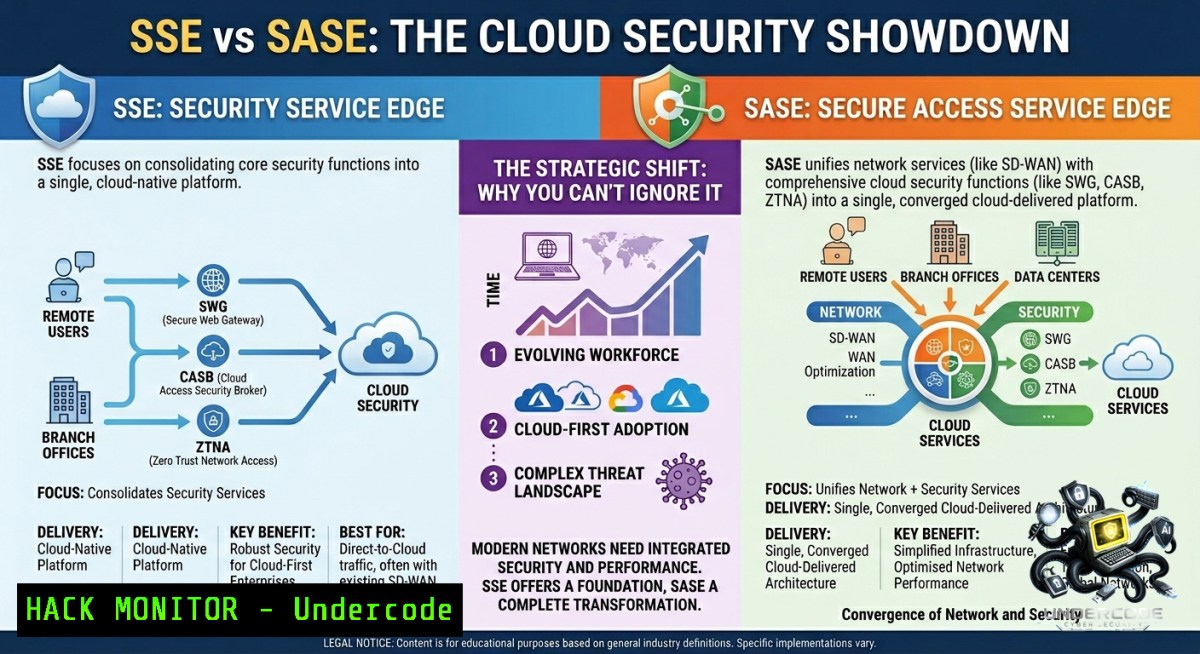
Security alone no longer guarantees business agility. As organizations embrace digital transformation, two architectural frameworks have emerged to protect modern networks: Secure Service Edge (SSE) and Secure Access Service Edge (SASE). While SSE focuses on securing users, applications, and data through cloud-delivered security services, SASE integrates SSE with Software-Defined Wide Area Networking (SD-WAN) to deliver converged networking and security from a single cloud platform.
Learning Objectives:
– Differentiate between SSE and SASE architectures and identify which aligns with your organization’s network and business strategy.
– Implement zero-trust principles using practical Linux and Windows commands to enforce security policies at the edge.
– Configure and harden cloud-1ative security tools, including API gateways and firewall rules, relevant to SSE/SASE components.
You Should Know:
1. Understanding the Core Difference: SSE vs. SASE – A Technical Deep Dive
The post’s distinction is critical: SSE secures users, applications, and data via cloud security services like CASB, SWG, and ZTNA. SASE adds SD-WAN to this mix, creating a unified cloud-delivered platform that also connects branches and remote users to the corporate backbone. To see this in action, consider how traffic is routed and inspected.
Step‑by‑step guide: Simulating policy-based forwarding (Linux)
This example uses `iptables` and `tc` to mimic basic SD-WAN steering – sending specific traffic through a security inspection tunnel (like SSE) while bypassing other flows.
1. Identify the network interface and destination ports for security inspection (e.g., HTTP/HTTPS).
2. Mark packets using `iptables`:
sudo iptables -t mangle -A OUTPUT -p tcp --dport 443 -j MARK --set-mark 1
3. Create a routing table for inspected traffic:
echo "100 inspect" >> /etc/iproute2/rt_tables
sudo ip rule add fwmark 1 table inspect
sudo ip route add default via <SSE_GATEWAY_IP> dev eth0 table inspect
4. Use `tc` to add latency (simulating WAN conditions):
sudo tc qdisc add dev eth0 root netem delay 20ms
What it does: Marks outbound HTTPS traffic and routes it through an SSE gateway, while other traffic takes the default path. This mirrors how SASE dynamically steers traffic based on policy.
2. Zero Trust Network Access (ZTNA) Hardening on Windows
ZTNA is a pillar of both SSE and SASE. Instead of VPNs, ZTNA verifies every request. Below is a PowerShell snippet to audit and enforce connection security rules on Windows Server acting as a ZTNA enforcement point.
Step‑by‑step guide: Auditing firewall rules for ZTNA compliance
1. Open PowerShell as Administrator.
2. Export existing advanced firewall rules to CSV:
New-1etFirewallRule -DisplayName "Block non-ZTNA traffic" -Direction Inbound -Action Block -Protocol TCP -LocalPort 1-65535 -RemoteIP 0.0.0.0/0
Get-1etFirewallRule | Where-Object {$_.Direction -eq "Inbound" -and $_.Action -eq "Allow"} | Export-Csv -Path C:\FirewallAudit.csv -1oTypeInformation
3. Implement micro-segmentation by allowing only authenticated ZTNA connector IPs:
$allowedIPs = @("192.168.10.5","10.2.0.100")
foreach ($ip in $allowedIPs) {
New-1etFirewallRule -DisplayName "ZTNA Allow $ip" -Direction Inbound -Action Allow -RemoteAddress $ip -Protocol TCP
}
How to use: Run these commands on any Windows host intended to be part of a ZTNA deployment. The audit CSV helps identify over-permissive rules, while the micro-segmentation rule ensures only verified ZTNA sources connect.
3. Cloud Hardening for SASE Edge Nodes (AWS Security Groups)
A SASE platform relies on cloud-1ative security groups to protect SD-WAN hubs. Use these CLI commands to harden an AWS instance acting as a SASE edge node.
Step‑by‑step guide: Configuring restrictive security groups via AWS CLI
1. Install and configure AWS CLI, then set default region.
2. Create a security group with no inbound access except from ZTNA broker:
aws ec2 create-security-group --group-1ame SASE-Edge --description "SASE edge node"
aws ec2 authorize-security-group-ingress --group-id sg-12345 --protocol tcp --port 443 --cidr 203.0.113.0/24
3. Add outbound rules to allow only known SASE controller IPs:
aws ec2 authorize-security-group-egress --group-id sg-12345 --protocol tcp --port 443 --cidr 198.51.100.0/24
aws ec2 revoke-security-group-egress --group-id sg-12345 --protocol all --port all --cidr 0.0.0.0/0
What this does: Creates an edge node that can only receive HTTPS traffic from a specific ZTNA broker subnet and can only talk to the SASE controller. This enforces least privilege – a core tenet of both SSE and SASE.
4. API Security in an SSE Architecture
SSE often includes API protection. Below is a Python script using `curl` to test for common API misconfigurations (e.g., missing authentication). This should be run against your own SSE-protected APIs only.
Step‑by‑step guide: Testing API endpoint security
1. Identify the API endpoint URL and required headers.
2. Send a request without authentication token (negative test):
curl -X GET "https://api.yourorg.com/v1/data" -H "Accept: application/json" -v
3. Send a request with a malformed JWT:
curl -X GET "https://api.yourorg.com/v1/data" -H "Authorization: Bearer invalid.token.here" -H "Accept: application/json" -v
4. Check for HTTP response codes – 401/403 are expected; 200 means SSE misconfiguration.
Tutorial extension: Combine with `jq` to parse JSON responses. For automated scanning, wrap in a bash loop:
for endpoint in /users /admin /config; do curl -s -o /dev/null -w "%{http_code}\n" "https://api.yourorg.com$endpoint"; done
5. Vulnerability Mitigation: Replacing Legacy VPN with ZTNA (SASE/SSE)
Traditional VPNs expose the entire network. SASE/SSE eliminate this by hiding applications. Here is a command-line method to detect open VPN ports on your perimeter (for remediation).
Step‑by‑step guide: Scanning for vulnerable VPN services (authorized use only)
1. Use `nmap` to scan your public IP range for common VPN ports (UDP 500, 4500 for IPsec; TCP 1723 for PPTP):
sudo nmap -sU -p 500,4500 -sT -p 1723,1194 <YOUR_PUBLIC_CIDR>
2. For Linux iptables, drop all VPN traffic as a temporary mitigation:
sudo iptables -A INPUT -p udp --dport 500 -j DROP
sudo iptables -A INPUT -p udp --dport 4500 -j DROP
3. On Windows, block via PowerShell:
New-1etFirewallRule -DisplayName "Block Legacy VPN" -Direction Inbound -Protocol UDP -LocalPort 500,4500 -Action Block
How to use: After scanning, decommission any found VPN endpoints and replace them with a ZTNA client (e.g., using `openconnect` with ZTNA gateway). This step directly supports migrating from legacy networking to SASE/SSE.
6. Cloud-1ative SD-WAN Simulation Using Docker
To understand SASE’s SD-WAN component, simulate multiple branches with Docker containers and controlled routing.
Step‑by‑step guide: Building a minimal SD-WAN lab
1. Create three Docker networks: branch1, branch2, and sase-hub.
2. Run containers:
docker run -d --1ame branch1 --1etwork branch1 --cap-add=NET_ADMIN alpine sleep 3600
docker run -d --1ame branch2 --1etwork branch2 --cap-add=NET_ADMIN alpine sleep 3600
docker run -d --1ame sase-router --1etwork sase-hub --cap-add=NET_ADMIN alpine sleep 3600
3. Connect the router to both branch networks:
docker network connect branch1 sase-router
docker network connect branch2 sase-router
4. Inside sase-router, add routing rules to forward traffic between branches:
docker exec -it sase-router sh
ip route add 172.20.0.0/16 via <branch1_gateway> dev eth1
ip route add 172.21.0.0/16 via <branch2_gateway> dev eth2
Explanation: This mimics SASE’s ability to interconnect branches without backhauling to a data center. You can then run `tcpdump` inside the router to inspect how security policies are applied, mirroring SSE inspection.
What Undercode Say:
– Key Takeaway 1: SSE and SASE are not competing technologies; SSE is a subset of SASE. Organizations that already have SD-WAN should consider SASE for convergence, while those needing cloud security without network overhaul might start with SSE.
– Key Takeaway 2: Implementing either framework requires operationalizing zero trust – that means micro-segmentation, continuous verification, and replacing legacy VPNs. The provided commands (Linux iptables, Windows Firewall, AWS CLI, Docker) give hands-on pathways to adopt these principles.
+ Analysis: The post correctly shifts the conversation from “which is better” to “which fits your strategy.” For lean security teams, SSE offers a faster time-to-value because it focuses on cloud-delivered services like CASB and ZTNA, often integrated via API without touching the WAN. However, enterprises with multiple branches and latency-sensitive apps (VoIP, video) will see more ROI from SASE’s SD-WAN integration – it reduces backhauling and optimizes routing. The cybersecurity angle here is risk reduction: both models shrink the attack surface by eliminating inbound network exposure. From a training perspective, hands-on labs (like the Docker SD-WAN simulation) are essential; theory alone won’t reveal how policy-based forwarding or ZTNA brokering actually fails under load. Lastly, AI-driven SASE/SSE platforms are emerging, using ML to dynamically adjust trust scores – this will make traditional rule-based commands (e.g., static iptables marks) obsolete for dynamic policy, but foundational CLI skills remain critical for debugging and hardening.
Prediction:
– +1 SASE adoption will accelerate as 5G and edge computing demand low-latency, cloud-1ative networking; organizations that fail to converge security and WAN will face operational drag.
– -1 Legacy VPNs and perimeter firewalls will see sharp decline by 2028, but migration complexity will cause temporary security gaps, leading to a rise in exposure incidents during hybrid transitions.
– +1 SSE will become the default starting point for greenfield cloud-1ative companies, driving demand for API security and CASB skills – expect training courses on ZTNA and SWG to triple in enrollment.
– -1 SASE vendor lock-in risks will surface as proprietary SD-WAN protocols limit multi-cloud flexibility; open standards (e.g., WireGuard-based SASE) will challenge incumbents but take years to mature.
– +1 AI-driven policy engines will automate much of the command-line hardening shown here, turning today’s manual iptables rules into self-adapting zero-trust models – a positive leap for security operations.
▶️ Related Video (64% Match):
🎯Let’s Practice For Free:
🎓 Live Courses & Certifications:
[Join Undercode Academy for Verified Certifications](https://undercode.co.uk/certifications/)
🚀 Request a Custom Project:
Secure, high-velocity infrastructure and disruptive technological engineering. Contact our engineering team for high-tier development and proprietary systems:
[[email protected]](mailto:[email protected])
💎 Smart Architecture | 🛡️ Secure by Design | ⭐ Trusted by Thousands
IT/Security Reporter URL:
Reported By: [Dhari Alobaidi](https://www.linkedin.com/posts/dhari-alobaidi_cybersecurity-sase-sse-ugcPost-7468032645407555587-AHlD/) – Hackers Feeds
Extra Hub: Undercode MoN
Basic Verification: Pass ✅
🔐JOIN OUR CYBER WORLD [ CVE News • HackMonitor • UndercodeNews ]
[💬 Whatsapp](https://undercode.help/whatsapp) | [💬 Telegram](https://t.me/UndercodeCommunity)
📢 Follow UndercodeTesting & Stay Tuned:
[𝕏 formerly Twitter 🐦](https://x.com/undercodeupdate) | [@ Threads](https://www.threads.net/@undercodetesting) | [🔗 Linkedin](https://www.linkedin.com/company/undercodetesting/) | [🦋BlueSky](https://bsky.app/profile/undercode.bsky.social)


