
Listen to this Post
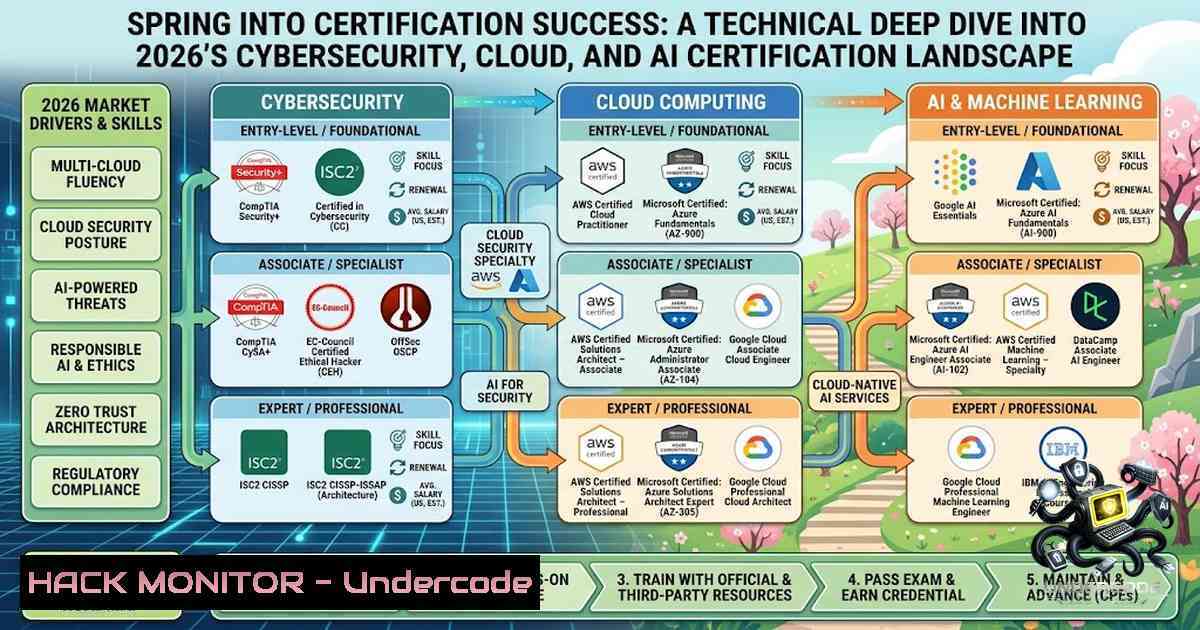
Introduction:
As organizations accelerate cloud migration and AI adoption, the demand for certified professionals who can secure these environments has never been higher. Misconfiguration remains the single largest cause of cloud breaches—responsible for 65–70% of incidents according to Gartner 2024—outpacing phishing and stolen credentials in cloud-1ative breaches. Simultaneously, the EU AI Act (enforceable August 2026) and frameworks like ISO/IEC 42001 and NIST AI RMF are reshaping governance requirements. For candidates preparing for certifications across AWS, Azure, GCP, ethical hacking, AI governance, and DevOps, understanding the technical nuances behind these security challenges is no longer optional—it’s essential for exam success and career progression.
Learning Objectives & Secrets:
- Objective 1: Master Cloud Security Misconfiguration Detection – Learn to identify and remediate excessive IAM permissions, exposed storage, and insecure APIs across AWS, Azure, and GCP using CSPM tools and CLI commands.
- Objective 2 (Secret Tip): For ethical hacking exams (CEH v13), focus on hands-on lab practice with real-world scenarios rather than memorizing tools. Build an isolated virtual lab, practice reconnaissance, scanning, enumeration, and exploitation in sequence, and simulate exam conditions before test day.
- Objective 3 (Secret Tip): For AI governance certifications, understand that NIST AI RMF (voluntary guidance) and ISO/IEC 42001 (certifiable standard) are complementary—not competing. Map controls across both frameworks to demonstrate comprehensive governance knowledge.
You Should Know:
1. Cloud Security Misconfiguration: The 1 Breach Vector
Misconfiguration drives the majority of cloud breaches—not sophisticated zero-day exploits. Certification exams increasingly test hands-on ability to spot and fix these issues in live environments.
Step‑by‑step guide for AWS IAM misconfiguration audit:
 List all IAM users and their attached policies
aws iam list-users --query 'Users[].UserName' --output text | while read user; do
echo "User: $user"
aws iam list-attached-user-policies --user-1ame $user --query 'AttachedPolicies[].PolicyName'
aws iam list-user-policies --user-1ame $user --query 'PolicyNames'
done

Identify unused IAM roles (potential excessive permissions)
aws iam list-roles --query 'Roles[?RoleLastUsed==null].RoleName' --output table

Check for S3 buckets with public access
aws s3api list-buckets --query 'Buckets[].Name' --output text | while read bucket; do
echo "Bucket: $bucket"
aws s3api get-bucket-acl --bucket $bucket --query 'Grants[? Grantee.URI==`http://acs.amazonaws.com/groups/global/AllUsers`]'
done
For Azure, use the Azure CLI to audit similar misconfigurations:
 List storage accounts with public access enabled
az storage account list --query "[?allowBlobPublicAccess == true].{Name:name, ResourceGroup:resourceGroup}" --output table

Check for overly permissive NSG rules
az network nsg list --query "[].{Name:name, Rules:securityRules[?access=='Allow' && priority<1000]}" --output table
What this does: These commands enumerate users, roles, and storage permissions to identify excessive access—the leading cause of cloud data breaches. Certification exams (AWS Security Specialty, Azure Security Engineer, CCSP) frequently include scenario-based questions requiring exactly this type of audit.
2. AI Governance: Navigating the 2026 Regulatory Landscape
With the EU AI Act now enforceable and ISO/IEC 42001 certification gaining traction, AI governance has become a critical certification domain. The NIST AI Risk Management Framework organizes AI risk work into four functions: Govern, Map, Measure, and Manage.
Step‑by‑step guide for implementing AI governance controls:
- Map AI systems to risk categories – Classify each AI system under the EU AI Act’s risk tiers (unacceptable, high, limited, minimal). High-risk systems require conformity assessments.
- Implement ISO 42001 controls – Establish an AI management system with documented policies, risk assessments, and continuous monitoring.
- Deploy runtime policy enforcement – Wire policy, enforcement, and audit into runtime so EU AI Act, NIST AI RMF, and ISO 42001 requirements close on one plane without slowing releases.
- Map controls to frameworks – Use the Cloud Security Alliance’s AI Controls Matrix to map your controls to ISO 42001, ISO 27001, NIST AI RMF, and AI 600-1.
Practical command for AI system inventory (using Python with boto3 for AWS SageMaker):
import boto3
sagemaker = boto3.client('sagemaker')
 List all endpoints (deployed models)
endpoints = sagemaker.list_endpoints()
for ep in endpoints['Endpoints']:
print(f"Endpoint: {ep['EndpointName']}, Status: {ep['EndpointStatus']}")
 Check encryption and VPC configuration
config = sagemaker.describe_endpoint(EndpointName=ep['EndpointName'])
print(f" Encryption: {config.get('DataCaptureConfig', {}).get('EnableEncryption', 'Not configured')}")
3. Kubernetes Security: Critical Vulnerabilities and Mitigations
Kubernetes environments face ongoing security challenges. Recent critical vulnerabilities include IngressNightmare (CVE-2025-1974, CVSS 9.8) followed by four new high-severity CVEs in February 2026. Additionally, CVE-2026-13325 in KubeVirt’s migration proxy can expose unauthenticated virt-qemud proxies if TLS is disabled.
Step‑by‑step guide for Kubernetes security hardening:
- Patch critical CVEs immediately – For CVE-2026-13325, ensure `spec.configuration.migrations.disableTLS` is not set to `true` on the KubeVirt custom resource. If it must remain enabled, deploy NetworkPolicies restricting ingress to virt-handler pods.
-
Audit RBAC permissions – For Apache Camel K CVE-2026-45760 (CVSS 8.1), upgrade to version 2.8.1, 2.9.2, or 2.10.1 or later. If immediate upgrade isn’t possible, restrict which users and service accounts can create Camel K Build resources.
-
Implement network policies – Apply zero-trust networking with Kubernetes NetworkPolicies:
apiVersion: networking.k8s.io/v1
kind: NetworkPolicy
metadata:
name: deny-all-ingress
spec:
podSelector: {}
policyTypes:
- Ingress
ingress: []

apiVersion: networking.k8s.io/v1
kind: NetworkPolicy
metadata:
name: allow-virt-handler-only
spec:
podSelector:
matchLabels:
app: virt-handler
policyTypes:
- Ingress
ingress:
- from:
- podSelector:
matchLabels:
app: virt-handler
- podSelector:
matchLabels:
app: virt-launcher
- Rotate compromised tokens – For CVE-2026-71577 (bootstrap kubeconfig leakage), rotate or regenerate bootstrap kubeconfig API tokens for all managed clusters.
4. CI/CD Pipeline Security: Shifting Left in 2026
CI/CD pipelines are prime attack targets—compromise here gives attackers access to production credentials and code. GitHub’s 2026 Actions security roadmap emphasizes pinning actions to specific commit SHAs with hash verification before execution.
Step‑by‑step guide for CI/CD security hardening:
- Pin GitHub Actions to commit SHAs – Never use floating tags (
@v3). Instead:</li> </ol> - uses: actions/checkout@a5ac7e51b41094c92402da3b24376905380afc29 pinned SHA
- Isolate CI and production credentials – CI credentials should only have permission to push to `-ci` development tags, never to production.
-
Sign and attest every release – Implement SLSA (Supply-chain Levels for Software Artifacts) with hermetic builds and signed attestations.
-
Scan for secrets and vulnerabilities in CI – Use SAST, DAST, and secret scanning before artifacts are created.
Command for verifying signed container images (using cosign):
 Verify image signature
cosign verify --key cosign.pub myregistry/myimage:latest

Generate SBOM and verify
syft myregistry/myimage:latest -o spdx-json > sbom.json
cosign attest --key cosign.key --type spdxjson --predicate sbom.json myregistry/myimage:latest
5. Ethical Hacking Certification: Hands-On Lab Strategies
CEH v13 exam preparation fails when candidates study random tools and memorize definitions without hands-on practice. The 6-hour practical exam challenges candidates to solve 20 different live challenges.
Step‑by‑step guide for CEH v13 lab preparation:
- Build an isolated lab – Use VMware or VirtualBox with snapshots. Include target machines (Metasploitable, VulnHub) and attack machines (Kali Linux).
-
Practice in sequence – Study reconnaissance → scanning → enumeration → exploitation in order.
-
Document everything – Record commands, screenshots, and written notes for each technique.
-
Simulate exam conditions – Set a timer, work through challenges without external help, and review weak areas weekly with flashcards.
Essential commands for CEH practical exam:
 Reconnaissance
nmap -sV -sC -A -T4 target_ip
 Enumeration
enum4linux -a target_ip
 Web application testing
nikto -h http://target_ip
sqlmap -u "http://target_ip/page?id=1" --dbs
 Password cracking
hashcat -m 0 hash.txt /usr/share/wordlists/rockyou.txt
 Exploitation
msfconsole -q -x "use exploit/multi/handler; set PAYLOAD windows/meterpreter/reverse_tcp; exploit"
6. DevSecOps: Integrating Security into Infrastructure as Code
Infrastructure as Code (IaC) misconfigurations are a growing concern. Certification tracks for DevOps, Terraform, and Kubernetes increasingly test security-aware infrastructure design.
Step‑by‑step guide for securing Terraform deployments:
- Use Terraform validate and plan – Always run `terraform validate` and `terraform plan` before apply.
- Implement policy-as-code – Use Sentinel (HashiCorp) or OPA (Open Policy Agent) to enforce security policies:
OPA policy example: deny public S3 buckets package terraform deny[bash] { resource := input.resource_changes[bash] resource.type == "aws_s3_bucket" resource.change.after.acl == "public-read" msg = sprintf("Bucket %s has public-read ACL", [resource.change.after.bucket]) }- Scan IaC for misconfigurations – Use `checkov` or
tfsec:
checkov -d /path/to/terraform
tfsec /path/to/terraform
What Undercode Say:
- Key Takeaway 1: Cloud misconfiguration remains the dominant breach vector—certification candidates who can demonstrate hands-on CLI auditing and remediation skills will have a significant advantage over those with only theoretical knowledge. The 65–70% statistic from Gartner isn’t just a number; it’s a career signal.
-
Key Takeaway 2: The convergence of AI governance, cloud security, and DevOps is reshaping certification requirements. Professionals who understand how NIST AI RMF, ISO 42001, and the EU AI Act intersect with cloud and Kubernetes security will be uniquely positioned for 2026–2027 roles.
Analysis: The certification landscape is shifting from knowledge-based to skills-based assessment. CEH now requires a separate practical exam. Cloud certifications increasingly test live-environment remediation. AI governance certifications demand framework literacy. Candidates should prioritize hands-on labs, CLI proficiency, and framework mapping over rote memorization. The most successful candidates will treat certification prep as an opportunity to build real security engineering skills—not just pass a test.
Prediction:
- +1 Cloud security certifications will increasingly incorporate AI-powered misconfiguration detection tools (Prisma Cloud, Wiz) as standard exam content by 2027.
-
+1 The EU AI Act’s August 2026 enforcement will drive a 40%+ increase in demand for AI governance certifications (ISO 42001, NIST AI RMF-aligned credentials) through 2027.
-
-1 Organizations that fail to prioritize Kubernetes security patching (CVE-2026-13325, IngressNightmare) will experience a wave of container escape and cluster compromise incidents in late 2026.
-
+1 CI/CD pipeline security (SLSA, signed attestations, pinned actions) will become a mandatory certification domain across DevOps and DevSecOps tracks by 2027.
-
-1 The retirement of Ingress NGINX in March 2026 will leave ~50% of cloud-1ative environments exposed if migration to supported alternatives is not completed.
-
+1 Ethical hacking certifications will continue evolving toward 100% practical, lab-based assessment models, rendering purely theory-based study obsolete.
▶️ Related Video (76% Match):
🎯Let’s Practice For Free:
🎓 Live Courses & Certifications:
Join Undercode Academy for Verified Certifications
🚀 Request a Custom Project:
Secure, high-velocity infrastructure and disruptive technological engineering. Contact our engineering team for high-tier development and proprietary systems:
[email protected]
💎 Smart Architecture | 🛡️ Secure by Design | ⭐ Trusted by ThousandsIT/Security Reporter URL:
Reported By: https://lnkd.in/p/eYK5VT3Z – Hackers Feeds
Extra Hub: Undercode MoN
Basic Verification: Pass ✅🔐JOIN OUR CYBER WORLD [ CVE News • HackMonitor • UndercodeNews ]
📢 Follow UndercodeTesting & Stay Tuned:


