
Listen to this Post
Introduction:
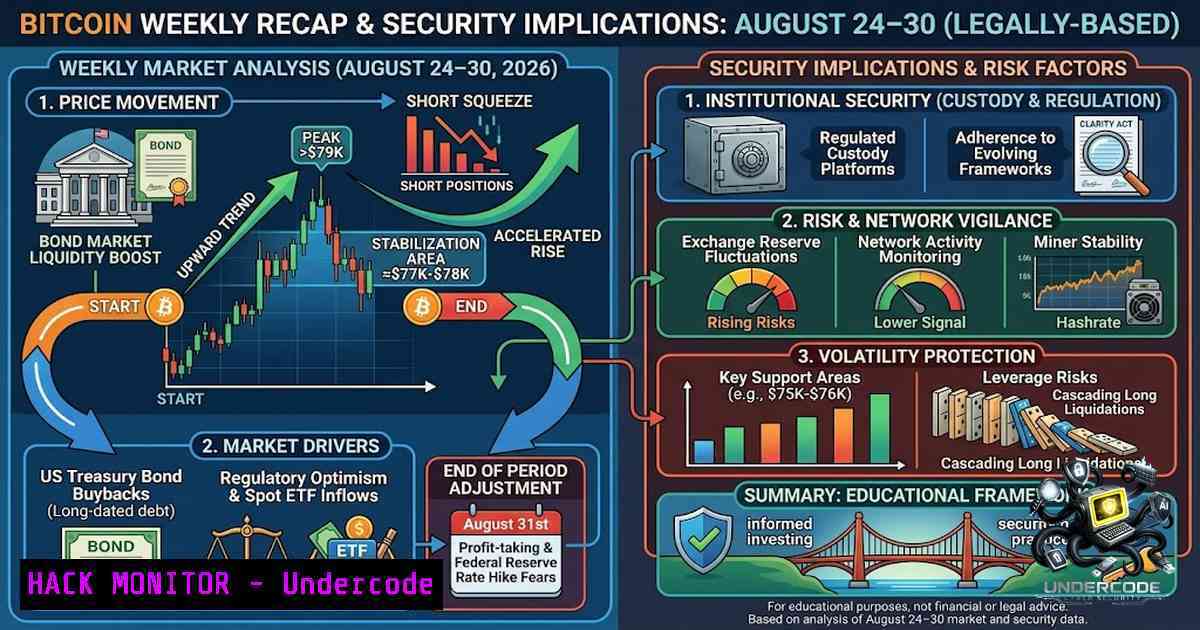
Bitcoin’s price action between $76,700 and $81,300 last week reflects ongoing market consolidation amid institutional accumulation and regulatory developments. This recap analyzes the technical security implications of major Bitcoin movements, ETF flows, and institutional positioning, while providing actionable cybersecurity measures for wallet management and exchange monitoring. Understanding these market dynamics requires robust security protocols to protect against sophisticated threats targeting both retail and institutional holders.
Learning Objectives & Secrets:
- Objective 1: Master Bitcoin wallet security fundamentals including hardware wallet implementation and multi-signature configurations to protect against private key compromise.
- Objective 2 Secret Tip: Monitor large transaction flows using blockchain explorers and set up real-time alerts for whale movements to anticipate market volatility.
- Objective 3 Secret Tip: Implement cold storage segregation strategies by maintaining 70% of holdings in offline wallets and 30% in warm storage for trading liquidity, minimizing exposure to exchange hacks.
You Should Know:
1. Institutional Bitcoin Acquisition Security Protocols
Vivek Ramaswamy’s Strive acquiring 1,100 BTC ($86 million) highlights the critical need for institutional-grade custody solutions. Large-scale Bitcoin acquisitions require multi-layered security approaches including:
Linux Command for Monitoring Large Transactions:
 Monitor Bitcoin network for large transactions using bitcoin-cli
bitcoin-cli -rpcuser=youruser -rpcpassword=yourpass getrawmempool true | jq '.[] | select(.vsize > 100000) | {txid: .txid, vsize: .vsize, fee: .fee}'
Windows PowerShell Script for Transaction Alerting:
 PowerShell script to check Bitcoin transaction sizes via blockchair API
$response = Invoke-RestMethod -Uri "https://api.blockchair.com/bitcoin/dashboards/transactions/latest?limit=10"
$response.data | Where-Object { $_.size -gt 100000 } | Format-Table transaction_id, size, fee_usd
Step‑by‑step guide: Install Bitcoin Core, configure RPC credentials, run the command to identify large transactions, and set up cron jobs or Task Scheduler to run these checks hourly. This helps institutions detect suspicious large transfers that might indicate market manipulation or security breaches.
2. ETF Security Monitoring and Compliance Frameworks
With spot Bitcoin ETFs recording $924.5 million in net inflows, ETF custodians must maintain strict security controls. The net outflow of $201.9 million on Friday demonstrates the importance of real-time reconciliation systems.
API Security Configuration for ETF Monitoring:
 Configure secure API access for ETF flow data
curl -X GET "https://api.sec.gov/edgar/companyconcept/CIK0001571721/bitcoin/ETF.json" \
-H "User-Agent: YourCompanyName [email protected]" \
-H "Accept: application/json" | jq '.units.USD'
Linux Firewall Hardening for Financial Data Systems:
 UFW configuration for financial data servers
sudo ufw default deny incoming
sudo ufw default allow outgoing
sudo ufw allow from 192.168.1.0/24 to any port 22 proto tcp
sudo ufw allow 443/tcp
sudo ufw enable
sudo ufw status verbose
Step‑by‑step guide: Create a secure API gateway using Nginx with SSL termination, implement rate limiting to prevent DoS attacks, and set up centralized logging with ELK stack for detecting unauthorized access attempts. Regularly audit firewall rules and remove unnecessary open ports.
3. Bitcoin Node Security and Network Monitoring
Running a full Bitcoin node is essential for verifying transactions and maintaining network integrity. The Asia Bitcoin Conference in Hong Kong emphasized the importance of decentralized node distribution.
Bitcoin Node Configuration for Enhanced Security:
 bitcoin.conf security settings
server=1
rpcuser=secureuser
rpcpassword=generate_strong_password_here
rpcallowip=127.0.0.1
listen=1
maxconnections=50
disablewallet=1
blocksonly=1
 Enable Tor for privacy
proxy=127.0.0.1:9050
listenonion=1
onlynet=onion
Linux Commands for Node Health Monitoring:
 Monitor node synchronization status
bitcoin-cli getblockchaininfo | jq '{blocks: .blocks, headers: .headers, verificationprogress: .verificationprogress}'

Check peer connections
bitcoin-cli getpeerinfo | jq '.[] | {addr: .addr, subver: .subver, pingtime: .pingtime}'
Step‑by‑step guide: Install Bitcoin Core from official sources, verify GPG signatures, configure the bitcoin.conf file with security settings, and run the node with bitcoind -daemon. Set up monitoring scripts to alert on desynchronization or suspicious peer connections exceeding 50% of total peers.
4. Regulatory Compliance and Public Consultation Security
Thailand’s public consultation on spot Bitcoin ETFs introduces new compliance requirements. Organizations must implement robust KYC/AML systems integrated with blockchain analytics tools.
Linux Script for AML Compliance Checks:
!/bin/bash
 Check addresses against OFAC sanctions list
curl -s "https://api.blockcypher.com/v1/btc/main/addrs/$1" | jq '.address, .final_balance, .total_received'
 Compare with sanctions list
curl -s "https://www.treasury.gov/ofac/downloads/sanctions.txt" | grep -i "$1"
Windows Command for Blockchain Analytics Integration:
 Use Chainalysis or similar API for transaction risk scoring
curl -X POST "https://api.chainalysis.com/v1/address/risk" -H "Content-Type: application/json" -d "{\"address\":\"1A1zP1eP5QGefi2DMPTfTL5SLmv7DivfNa\"}"
Step‑by‑step guide: Integrate blockchain analytics APIs, implement transaction monitoring thresholds based on risk scoring, and create automated reporting systems for suspicious transactions exceeding $10,000. Regularly update sanctions lists and compliance databases.
5. Cloud Security for Bitcoin Infrastructure
Institutional Bitcoin holdings require hardened cloud environments with strict access controls and encryption standards.
AWS Security Configuration for Bitcoin Wallets:
 Configure AWS CLI with MFA
aws configure set mfa_serial arn:aws:iam::123456789012:mfa/root-user
aws sts get-session-token --serial-1umber arn:aws:iam::123456789012:mfa/root-user --token-code 123456

Enable AWS Config for compliance monitoring
aws configservice put-configuration-recorder --configuration-recorder name=default,roleARN=arn:aws:iam::123456789012:role/config-role --recording-group AllSupported=true,IncludeGlobalResourceTypes=true
Linux Hardening Commands:
 Disable root SSH login
sudo sed -i 's/PermitRootLogin yes/PermitRootLogin no/' /etc/ssh/sshd_config
sudo systemctl restart sshd

Install and configure fail2ban
sudo apt-get install fail2ban
sudo systemctl enable fail2ban
sudo systemctl start fail2ban
Step‑by‑step guide: Implement infrastructure as code using Terraform with encrypted state files, use AWS KMS for key management, enable CloudTrail for audit logging, and configure GuardDuty for threat detection. Regular security assessments and penetration testing are essential.
6. Mobile Wallet Security for Retail Investors
Retail investors participating in spot Bitcoin ETFs need secure mobile wallet configurations with biometric authentication and backup procedures.
Linux Command for Wallet Backup Encryption:
 Encrypt wallet backup using GPG
gpg --symmetric --cipher-algo AES256 wallet.dat
 Verify encryption
gpg --decrypt wallet.dat.gpg > /dev/null
Windows PowerShell for Seed Phrase Security:
 Generate secure seed phrase backup with encryption
$seed = "your 24-word seed phrase"
$secureSeed = ConvertTo-SecureString -String $seed -AsPlainText -Force
$key = [System.Text.Encoding]::UTF8.GetBytes("encryptionkey")
$encrypted = [System.Security.Cryptography.ProtectedData]::Protect([System.Text.Encoding]::UTF8.GetBytes($seed), $null, [System.Security.Cryptography.DataProtectionScope]::CurrentUser)
[System.IO.File]::WriteAllBytes("seed_backup.bin", $encrypted)
Step‑by‑step guide: Use hardware wallets like Ledger or Trezor for cold storage, implement multi-signature wallets requiring 2-of-3 signatures, and maintain encrypted paper backups in secure physical locations. Never share seed phrases digitally or with untrusted parties.
What Undercode Say:
- Key Takeaway 1: Institutional Bitcoin accumulation by firms like Strive and strong ETF inflows signal growing mainstream adoption, but also increase the attack surface for sophisticated hacking groups targeting high-value wallets and custodial systems.
-
Key Takeaway 2: The convergence of regulatory developments in Asia with infrastructure security requirements demands proactive security strategies, including real-time monitoring, compliance integration, and regular security audits to protect against emerging threats.
The market’s resilience between $76,700 and $81,300 despite ETF outflows indicates strong underlying demand, yet security professionals must remain vigilant. The Hong Kong conference’s focus on infrastructure highlights the critical need for robust node security, while Thailand’s regulatory consultation emphasizes compliance integration. Organizations should prioritize zero-trust architectures, implement comprehensive threat detection, and conduct regular security assessments. The $1.66 billion in Strive’s holdings exemplifies the scale of assets requiring protection, making multi-layer security non-1egotiable. As Bitcoin continues its institutionalization, the security landscape will evolve, demanding adaptive strategies and continuous education.
Prediction:
+1 The institutional influx through ETFs and direct purchases will accelerate Bitcoin’s price discovery, potentially pushing toward $90,000 by Q4 2026, with increased security spending and regulatory frameworks maturing to support this growth.
-1 The growing concentration of Bitcoin in institutional hands creates systemic risk; a major security breach at a large custodian could trigger cascading market effects and erode retail investor confidence.
+1 Asia’s progressive regulatory stance, including potential ETF approvals in Thailand, will diversify geographical exposure and reduce reliance on US markets, strengthening Bitcoin’s global security resilience through decentralized adoption.
-1 Rising transaction values and institutional custody concentrations will attract state-sponsored cyber attacks, requiring unprecedented security investments and potentially creating new attack vectors in the coming months.
+1 The integration of blockchain analytics with compliance systems will enhance transaction monitoring capabilities, reducing the efficacy of money laundering attempts and improving overall network security posture.
-1 The complexity of securing institutional Bitcoin operations across multiple jurisdictions introduces regulatory arbitrage risks and potential compliance gaps that sophisticated actors may exploit.
+1 Continued network decentralization with increasing node counts globally will strengthen Bitcoin’s resistance to 51% attacks and improve transaction verification security for all participants.
▶️ Related Video (88% Match):
🎯Let’s Practice For Free:
🎓 Live Courses & Certifications:
Join Undercode Academy for Verified Certifications
🚀 Request a Custom Project:
Secure, high-velocity infrastructure and disruptive technological engineering. Contact our engineering team for high-tier development and proprietary systems:
[email protected]
💎 Smart Architecture | 🛡️ Secure by Design | ⭐ Trusted by Thousands
IT/Security Reporter URL:
Reported By: https://lnkd.in/p/eKvasDEB – Hackers Feeds
Extra Hub: Undercode MoN
Basic Verification: Pass ✅


