Listen to this Post
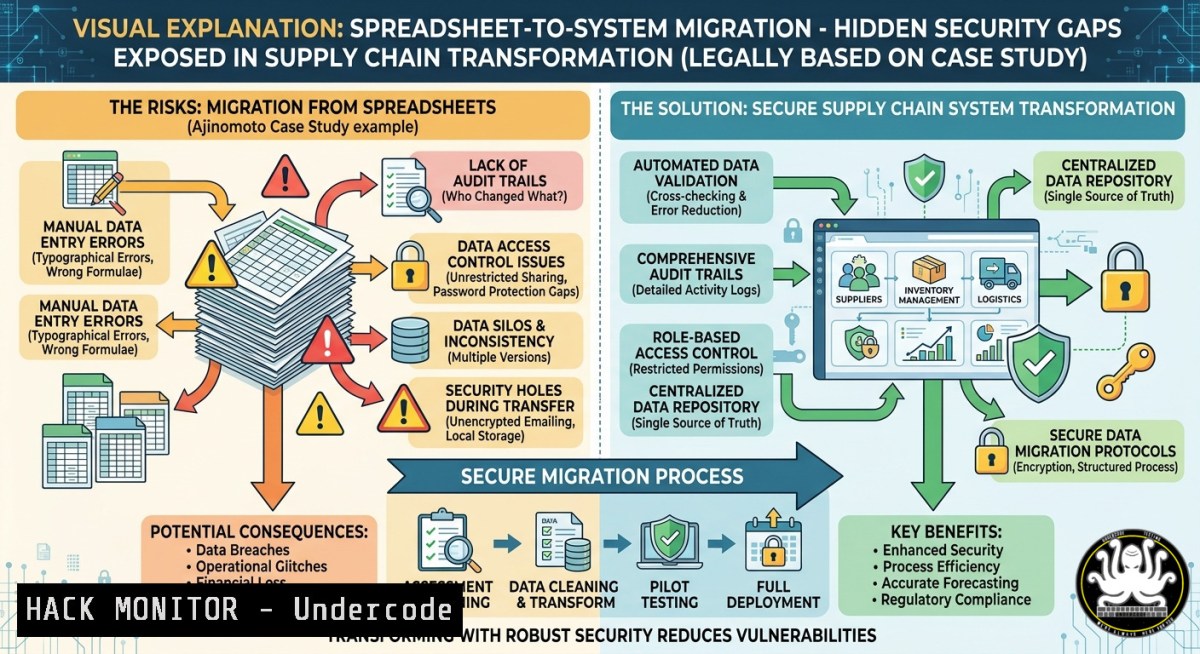
Introduction:
When Ajinomoto Foods North America (AFNA) shifted from manual, spreadsheet‑heavy processes to a connected, data‑driven supply chain with EY Consulting, the promise was better visibility and faster decisions. But as industry veteran Toby J Daniel noted, the “messy middle” of parallel runs—old spreadsheets and new TMS/DRP systems coexisting—introduces acute cybersecurity risks: unchecked data leakage, shadow IT credentials, and API misconfigurations that can turn a resilience upgrade into a breach vector.
Learning Objectives:
- Identify security pitfalls during spreadsheet‑to‑TMS migration, including data sprawl and inconsistent access controls.
- Apply Linux and Windows commands to audit legacy processes, monitor API traffic, and enforce least privilege.
- Implement step‑by‑step hardening for transportation management systems (TMS) and cloud‑based DRP integrations.
You Should Know:
- Auditing the “Messy Middle” – Detecting Shadow Spreadsheets Still in Use
During parallel runs, employees often keep old spreadsheets alive, creating unmonitored data silos. Use these commands to discover active spreadsheet processes and shared files across your environment.
Linux – Find recently accessed .xls/.xlsx files
 Locate spreadsheets modified in last 7 days (common during migration)
find /home -name ".xls" -mtime -7 2>/dev/null

Check open files by process (e.g., LibreOffice or Excel via Wine)
lsof | grep -E '.xls|xlsx' | grep -v "pipe"
Windows PowerShell – Scan for live Excel instances and open network shares
 List running Excel processes across all sessions
Get-Process | Where-Object {$_.ProcessName -like "excel"}

Find spreadsheets on mapped drives that bypass new TMS
Get-ChildItem -Path \server\shared\ -Include .xlsx, .xls -Recurse -ErrorAction SilentlyContinue | Where-Object {$_.LastWriteTime -gt (Get-Date).AddDays(-7)}
Step‑by‑step guide
- Run the above commands during business hours to capture real‑time usage.
- Compare results against the new TMS’s audit log – any order or inventory file not in the TMS is a risk.
- Implement a transitional policy: after go‑live, schedule automated deletion of legacy spreadsheet directories (with approval workflow).
-
API Security Hardening for TMS and DRP Integrations
Modern supply chain resilience relies on APIs between TMS, ERP, and logistics partners. Misconfigured APIs are the 1 entry point for data exfiltration. Below are real‑world checks and fixes.
Validate authentication and rate limiting (Linux curl & jq)
 Test if API endpoint allows anonymous access (should return 401)
curl -i -X GET "https://tms.ajinomoto.com/api/v1/shipments" -H "Accept: application/json"

Check for excessive data exposure – try to pull a full dataset without pagination
curl "https://tms.ajinomoto.com/api/v1/orders?limit=999999" -H "Authorization: Bearer $LEGACY_TOKEN" | jq '. | length'
Windows – Use PowerShell to test JWT expiration
 Decode JWT from browser devtools or environment variable
$jwt = "eyJhbGciOiJIUzI1NiIsInR5cCI6IkpXVCJ9..."
$payload = $jwt.Split('.')[bash].Replace('-','+').Replace('_','/')
 Look for "exp" claim – ensure time is not in the past
Step‑by‑step hardening
- Enforce OAuth 2.0 with short‑lived tokens (≤1 hour).
- Implement rate limiting: max 100 requests/minute per API key.
- Use API gateways (e.g., AWS API Gateway, Kong) to block suspicious patterns (repeated GETs on /shipments without referer header).
3. Cloud Hardening for Data‑Driven Supply Chain Platforms
Ajinomoto’s shift to a data‑driven approach likely leverages cloud warehouses (Snowflake, Redshift) and SaaS TMS. Here’s how to prevent misconfigurations that led to recent supply chain breaches (e.g., Toyota’s exposed cloud bucket).
AWS CLI – Detect public S3 buckets used for EDI or forecasts
 List buckets and check ACLs
aws s3api list-buckets --query "Buckets[].Name" --output text | xargs -I {} aws s3api get-bucket-acl --bucket {} --query '{Bucket: Bucket, Grants: Grants[?Grantee.URI==`http://acs.amazonaws.com/groups/global/AllUsers`]}'
Azure – Audit Key Vault access for TMS secrets
 PowerShell with Az module
Get-AzKeyVaultSecret -VaultName "tmsSecretsVault" | ForEach-Object {
(Get-AzKeyVaultSecret -VaultName "tmsSecretsVault" -Name $_.Name).Version
}
 Check for "AllAuthenticatedUsers" in access policies
Get-AzKeyVault -VaultName "tmsSecretsVault" | Select-Object -ExpandProperty AccessPolicies
Step‑by‑step cloud hardening
- Enable bucket versioning and MFA delete for any supply chain data store.
- Rotate all TMS API keys every 90 days; store them in a vault, never in code.
- Deploy CSPM (Cloud Security Posture Management) tools like Prowler or ScoutSuite to continuously monitor for public exposures.
-
Decommissioning Legacy Spreadsheets – Secure Wipe vs. Archival
The “real wins come from killing the old process entirely” – but deletion without proper sanitization leaves recoverable sensitive data (pricing, supplier details, logistics routes).
Linux – Securely overwrite and shred files
 Shred individual spreadsheets (3 passes + zero)
shred -v -z -n 3 legacy_orders_2024.xlsx

Wipe entire directory of migration backups
find /backups/spreadsheet_migration -type f -exec shred -u {} \;
Windows – Use cipher to overwrite deleted files
 Overwrite free space (for NTFS drives)
cipher /w:C:\LegacyShare

Use SDelete from Sysinternals for granular file wipe
sdelete -p 3 -z C:\Migration\old_spreadsheets.xlsx
Step‑by‑step decommissioning
- Create an official “sunset date” for the legacy process – communicate to all teams.
- Run a final automated inventory of all spreadsheets (using commands from section 1).
- For business‑critical spreadsheets that must be kept, move them to an encrypted, access‑logged archive (e.g., VeraCrypt volume) with read‑only permissions.
-
Monitoring for Anomalies in the New TMS Environment
After migration, attackers often exploit the transition fog – they inject false shipment data or exfiltrate demand forecasts. Set up real‑time detection using open‑source tools.
Wireshark filter to detect unusual database queries from TMS servers
mysql.query contains "SELECT FROM shipments" or tls.handshake.extensions_server_name contains "tms.ajinomoto.com"
Linux – Logwatch custom script to flag spikes in outbound API calls
 Monitor /var/log/tms_api.log for >100 requests per minute to same external IP
tail -f /var/log/tms_api.log | awk '{print $1, $NF}' | uniq -c | awk '$1 > 100 {print "ALERT: High volume from " $2}'
Step‑by‑step monitoring setup
- Deploy Elastic Stack (Elasticsearch, Logstash, Kibana) to aggregate TMS logs.
- Create a rule: alert when a single user downloads >500 shipment records in 10 minutes.
- Integrate with TheHive for automated incident response – quarantine suspicious API keys.
6. Training Courses for Supply Chain Cybersecurity Teams
To sustain resilience, upskill your teams on TMS/DRP security. Recommended courses aligned with the AFNA transformation:
- SANS SEC541 – Cloud Security for Critical Infrastructure (includes hands‑on TMS labs)
- ISC2 CCSP – Domain on data lifecycle in supply chain clouds
- Pluralsight: “Securing APIs in Logistics Platforms” – Covers JWT, rate limiting, and OWASP Top 10 for APIs
- Free course: NIST Supply Chain Risk Management (SP 800‑161r1) on CSRC.NIST.gov
Command to check staff completion (Linux – parse training DB)
 Assuming a PostgreSQL training database
psql -d training_db -c "SELECT name, course FROM completions WHERE course LIKE '%API Security%' AND completion_date > '2025-01-01';"
What Undercode Say:
- Key Takeaway 1: The “messy middle” of parallel spreadsheet and TMS operations is not just an operational bottleneck—it’s a prime attack surface for data leakage and shadow IT. Every active legacy file must be logged, migrated, or securely wiped.
- Key Takeaway 2: API security in supply chain transformations is consistently overlooked. Without mandatory OAuth, rate limiting, and payload validation, a single misconfigured endpoint can expose the entire logistics network.
Analysis (Undercode’s perspective):
The AFNA case highlights a dangerous industry assumption: that moving to a data‑driven platform automatically improves security. In reality, the transition period creates blind spots that mature attackers actively scan for—unpatched spreadsheet macros, stale ODBC connections, and hard‑coded credentials in legacy ETL scripts. Toby Daniel’s comment cuts to the heart of the issue: you cannot layer security on top of chaos. Organizations must treat the migration as a zero‑trust event. Run parallel operations for no longer than 30 days, enforce continuous discovery of unauthorized spreadsheets, and mandate that every API endpoint passes a penetration test before go‑live. The companies that will survive the next generation of supply chain attacks are those that kill the old process with the same rigor they apply to deploying the new one.
Expected Output:
Prediction:
By 2028, regulatory bodies (e.g., CISA, ENISA) will mandate a “parallel‑run security audit” for any supply chain system migration exceeding 90 days. We will see the first major data breach tied directly to a decommissioned spreadsheet that was only “hidden” not destroyed—leading to class‑action lawsuits against system integrators like EY Consulting. The long‑term fix will be automated migration forensics tools that compare old spreadsheet content to new database logs, flagging any record that exists only in the legacy format. Proactive organizations are already building these checks into their CI/CD pipelines for TMS and DRP updates.
▶️ Related Video (84% Match):
🎯Let’s Practice For Free:
IT/Security Reporter URL:
Reported By: Oksana Chausova – Hackers Feeds
Extra Hub: Undercode MoN
Basic Verification: Pass ✅
🎓 Live Courses & Certifications:
Join Undercode Academy for Verified Certifications
🚀 Request a Custom Project:
Secure, high-velocity infrastructure and disruptive technological engineering. Contact our engineering team for high-tier development and proprietary systems:
[email protected]


