Listen to this Post
Introduction:
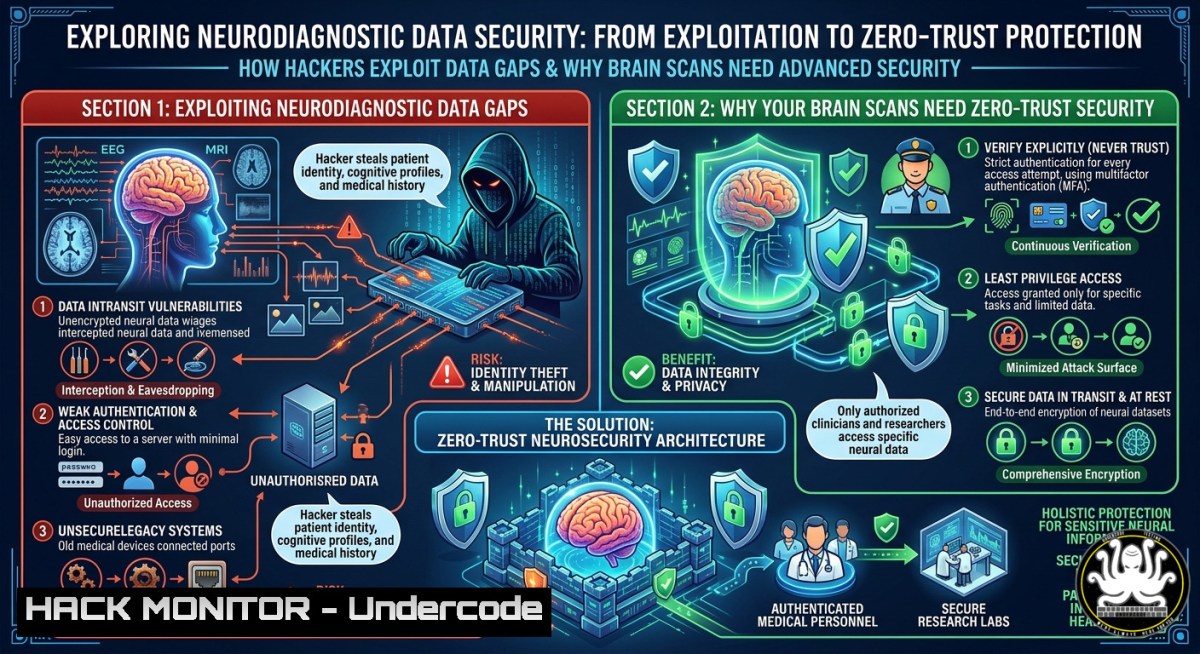
The gap between subjective neurological symptoms and objective scan data creates a prime attack surface for cybercriminals. As healthcare adopts neurodiagnostics for conditions like brain fog and cognitive decline, the integration of AI-driven brain-function measurement tools with cloud-based patient records introduces new risks—including API misconfigurations, unencrypted PII, and weak access controls. Without proper hardening, the same data that closes diagnostic gaps can become a backdoor for ransomware or medical identity theft.
Learning Objectives:
- Identify vulnerabilities in healthcare data pipelines (neurodiagnostic devices → cloud storage → EHR).
- Implement Linux/Windows commands to audit and encrypt medical data at rest and in transit.
- Apply zero-trust architecture principles to neurodiagnostic APIs and third-party integrations.
You Should Know:
1. Auditing Neurodiagnostic Data Flows with Linux CLI
Many neurodiagnostic platforms transmit brain-function metrics (EEG, fMRI-derived biomarkers) via REST APIs. Before hardening, you must map the data flow. Use these Linux commands to discover exposed endpoints and test for basic security gaps.
Step‑by‑step guide:
- Reveal listening ports – Identify potentially unsecured API ports:
`sudo netstat -tulpn | grep -E ‘:(80|443|8080|8443|5000)’`
- Check for unencrypted HTTP services – Neurodiagnostic devices often ship with default HTTP:
`nmap -p 80,8080 –script http-methods,http-headers `
- Test for exposed .git/config – Data leakage via misconfigured web servers:
`curl -s http:///.git/config` - Monitor real-time data exfiltration – Use tcpdump to capture packets containing “patient_id” or “eeg”:
`sudo tcpdump -i eth0 -A -l | grep -i “patient_id”`
If you find clear-text transmission, immediately enforce TLS 1.3 using a reverse proxy (e.g., Nginx) or update device firmware.
2. Hardening Windows-Based Neurodiagnostic Workstations
Clinicians often run proprietary analysis software on Windows machines. These systems are vulnerable to DLL hijacking and credential dumping if not locked down.
Step‑by‑step guide:
- Block unsigned executables – Use PowerShell to enforce AppLocker rules for the neurodiagnostic tool folder:
`Set-AppLockerPolicy -Policy “C:\Policies\NeuroAppLocker.xml” -Merge`
- Disable SMBv1 and enforce SMB signing (prevents man-in-the-middle attacks on shared scan data):
`Set-SmbServerConfiguration -EnableSMB1Protocol $false -RequireSecuritySignature $true`
- Monitor for Mimikatz-like behavior – Enable PowerShell logging and Sysmon event ID 10 (process access):
`Invoke-WebRequest -Uri “https://live.sysinternals.com/sysmon64.exe” -OutFile “C:\Tools\sysmon64.exe”`
`.\sysmon64.exe -accepteula -i ..\configs\sysmon-config.xml`
- Rotate local admin credentials – Use LAPS or run:
`net user administrator /active:yes`
After hardening, simulate an attack by attempting to run a known post‑exploitation tool (e.g., `Invoke-Mimikatz` via PowerShell) to validate your rule set.
- Securing Neurodiagnostic APIs Against Injection & Broken Access
Neurodiagnostic platforms frequently expose APIs for patient data ingestion. These endpoints must resist SQLi, NoSQLi, and IDOR.
Step‑by‑step guide (Linux & tool config):
- Fuzz the API with SQLmap – Target the `patient_id` parameter in a GET request:
`sqlmap -u “https://neuroapi.com/getRecords?id=1” –dbs –batch` - Test for IDOR – Attempt to fetch another patient’s brain‑function report by incrementing ID:
`curl -X GET “https://neuroapi.com/report/1001” -H “Authorization: Bearer“` - Deploy an API gateway with rate limiting and request validation – Example using Kong Gateway:
curl -i -X POST http://localhost:8001/services/neuro-diagnostics/plugins \
--data "name=rate-limiting" \
--data "config.minute=30"
- Enable JSON schema validation – Prevent malicious payloads (e.g., large nested objects causing denial of service). Use a middleware like `ajv` in Node.js or `cerberus` in Python.
4. Cloud Hardening for Neurodiagnostic Storage (AWS/Azure)
Many providers store raw EEG and cognitive evaluation data in cloud buckets. Misconfigured IAM roles or public ACLs lead to breaches.
Step‑by‑step guide:
- List all S3 buckets and check public access (AWS CLI):
`aws s3 ls | awk ‘{print $3}’ | xargs -I {} aws s3api get-bucket-acl –bucket {}` - Enforce default encryption on the neurodiagnostic bucket:
`aws s3api put-bucket-encryption –bucket neuro-data-bucket –server-side-encryption-configuration ‘{“Rules”:[{“ApplyServerSideEncryptionByDefault”:{“SSEAlgorithm”:”AES256″}}]}’`
- Disable legacy TLS versions on Azure Blob Storage:
`az storage account update –name neurostorage –resource-group neuro-rg –min-tls-version TLS1_2` - Set a bucket policy to deny unencrypted uploads (protects data in transit):
{
"Effect": "Deny",
"Principal": "",
"Action": "s3:PutObject",
"Condition": {"StringNotEquals": {"s3:x-amz-server-side-encryption": "AES256"}}
}
- AI Model Poisoning in Neurodiagnostics – Mitigation Commands
Attackers could inject adversarial examples into the training pipeline of AI models used to interpret brain‑function data. This causes misdiagnosis (e.g., classifying a concussion as normal).
Step‑by‑step guide:
- Validate data integrity using SHA‑256 checksums before feeding into training pipeline:
`find /neuro-data/training -type f -name “.csv” -exec sha256sum {} \; > checksums.txt` - Use TensorFlow Data Validation (TFDV) to detect anomalous feature distributions:
pip install tensorflow-data-validation
tfdv stats_gen --input_path raw_eeg/ --output_path stats/
tfdv anomaly_detection --stats_path stats/ --schema_path schema.pbtxt
- Implement model signing – Save and verify model signatures with `cosign` (Sigstore):
`cosign sign-blob –key cosign.key model.h5 > model.h5.sig`
`cosign verify-blob –key cosign.pub –signature model.h5.sig model.h5`
What Undercode Say:
- Key Takeaway 1: Neurodiagnostic data bridges subjective symptoms and objective metrics, but without API security, cloud hardening, and access controls, that bridge becomes a breach vector.
- Key Takeaway 2: Attackers don’t need to manipulate scans—they can inject false training data into AI models, causing systematic misdiagnosis across thousands of patients.
Analysis: The original post highlights that objective neurological insight improves recovery planning. However, the clinical value of that insight is zero if data integrity is compromised. Cybersecurity isn’t an add‑on; it’s a prerequisite for data‑driven healthcare. Many neurodiagnostic vendors still ship default HTTP dashboards and weak API authentication. Medical IT teams must adopt zero‑trust at the device, network, and cloud layers. Using the Linux/Windows commands above, you can detect plaintext transmission, enforce encryption, and validate AI pipelines. Training courses on medical device security (e.g., HTM-01) and cloud hardening (AWS Security Specialty) are now essential for healthcare providers.
Expected Output:
Introduction: The gap between neurological symptoms and objective scan data is where both misdiagnosis and cyberattacks take root. Neurodiagnostics provides clarity, but if APIs are exposed or AI models poisoned, the outcome is worse than no data—it’s dangerous, actionable misinformation.
Prediction:
Within 24 months, we will see the first major data breach originating from a neurodiagnostic AI pipeline—either via poisoned training data causing mass misdiagnosis or via exfiltration of brain‑function metrics used for blackmail. Regulators will then mandate real‑time API security scanning and model integrity signing for all FDA‑cleared software as a medical device (SaMD). Healthcare CISOs will shift budget from perimeter defense to in‑pipeline validation and zero‑trust data tagging.
▶️ Related Video (76% Match):
🎯Let’s Practice For Free:
IT/Security Reporter URL:
Reported By: Neurodiagnostics Brainhealth – Hackers Feeds
Extra Hub: Undercode MoN
Basic Verification: Pass ✅
🎓 Live Courses & Certifications:
Join Undercode Academy for Verified Certifications
🚀 Request a Custom Project:
Secure, high-velocity infrastructure and disruptive technological engineering. Contact our engineering team for high-tier development and proprietary systems:
[email protected]


