
Listen to this Post
Introduction:
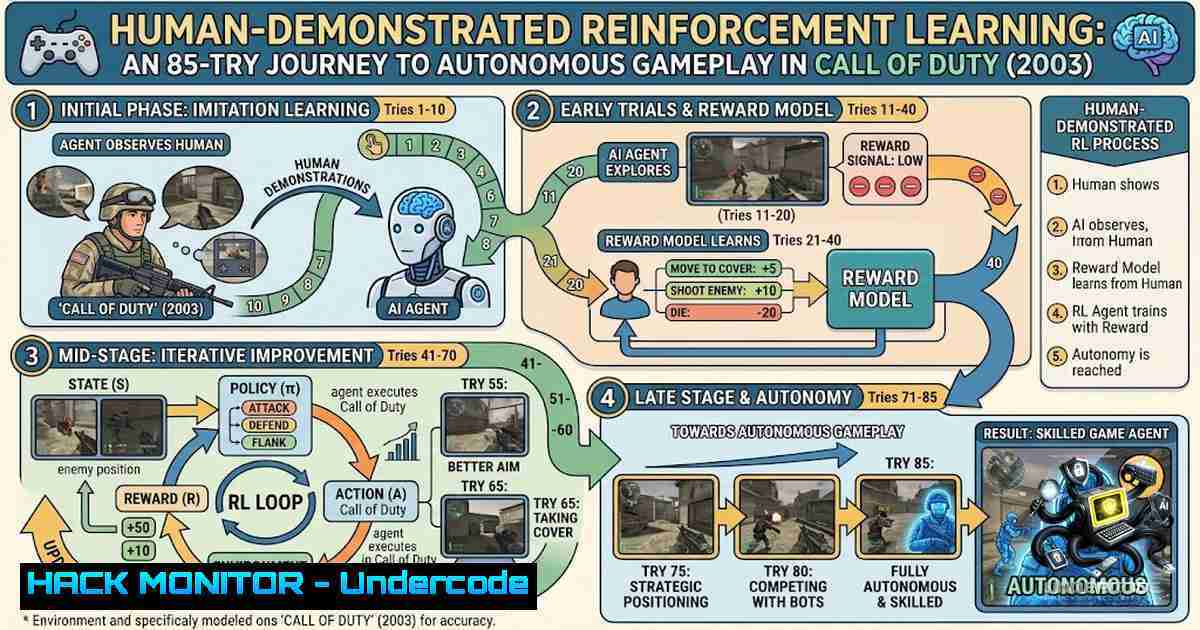
In a compelling intersection of machine learning and legacy game reverse engineering, a developer has successfully trained an autonomous agent to play the classic first-person shooter Call of Duty (2003). This project employs a unique hybrid approach that combines real-time memory reading (akin to a “sensor” loop) with an external Large Language Model (Claude) acting as a co-developer to analyze telemetry and refine the control algorithm. Unlike traditional reinforcement learning that requires millions of simulated steps, this method learns from a single human demonstration and a series of corrective “rescues,” effectively using human intervention as a high-value training signal to overcome local minima in the agent’s performance landscape.
Learning Objectives & Secrets:
- Objective 1: Build a Real-time Memory Sensor Loop. Understand how to interface with a running process to read game state data (player position, health, ammo, enemy locations, objective status) at a high frequency (20 Hz) using Windows API calls like `ReadProcessMemory` or game-specific SDKs, creating the foundational “eyes” for the agent.
- Objective 2 Secret: Implement a Sparse Reward Scoring System. Learn to design a complex, multi-variable reward function that balances positive reinforcement (completing objectives, dealing damage) with negative penalties (taking damage, time elapsed). The critical “secret tip” is the implementation of a cap that prevents any human-rescued run from scoring above zero, forcing the agent to prioritize fully autonomous, successful completions over partial success.
- Objective 3 Secret Tip: Data-Driven Algorithm Refinement. The “accelerant loop” leverages an LLM as an analytical partner. The secret here is to structure telemetry logs (e.g., JSON or CSV) containing timestamped events, scores, and failed actions. By feeding these logs to an LLM alongside the algorithm code, developers can quickly root-cause performance regressions (e.g., “ammo awareness causes a 15% drop in score”) and prototype new heuristics in minutes rather than hours, making the AI co-pilot a high-level game architect.
You Should Know:
1. Crafting the Memory Reader: The “Sensor” Loop
The core of the autonomous agent is its ability to “see” the game world without resorting to screen capture or pixel analysis. This involves reading the game’s volatile memory to extract structured data, a technique often used in game modding or external cheat development but repurposed here for benign AI training.
This process requires identifying static memory addresses or pointers to dynamically allocated structures. For a game like Call of Duty (2003), which lacks a modern SDK, tools like Cheat Engine are first used to scan for values (e.g., player health, ammo count, coordinates). Once the base addresses or pointer chains are found, they are hardcoded into the control loop. The loop then uses a cross-platform approach or native Windows calls to read these addresses.
Step‑by‑step guide explaining what this does and how to use it:
1. Identify Pointers: Use Cheat Engine to find the base address of the player object. Look for a static pointer that always points to a structure containing health, ammo, and coordinates.
2. Choose a Process Interaction Library: For a Python-based control loop, use the `pymem` library to access the game process.
3. Implement the Read Loop: Write a function that, at 20 Hz (using time.sleep(0.05)), reads the target memory addresses.
4. Parse and Structure Data: Convert raw memory values into meaningful game state variables (e.g., player.health, player.ammo, player.position).
5. Input Simulation: To control the game, use `pyautogui` or `win32api` to simulate keyboard and mouse inputs. The sensor loop feeds its data into the decision-making algorithm, which then outputs key presses or mouse movements.
Commands & Code Snippet (Python – Conceptual):
import pymem, pymem.process, time, win32api, win32con

def get_player_state(pm, base_address):
player_state = {}
 Example offset: 0x1234 for health, 0x1238 for ammo
try:
player_state['health'] = pm.read_int(base_address + 0x1234)
player_state['ammo'] = pm.read_int(base_address + 0x1238)
 Read coordinates (floats)
player_state['x'] = pm.read_float(base_address + 0x12A0)
player_state['y'] = pm.read_float(base_address + 0x12A4)
except pymem.exception.MemoryReadError:
return None
return player_state

def send_input(action):  action = {'w':1, 'mouse_move': (dx, dy)}
if action.get('w'): win32api.keybd_event(0x57, 0, 0, 0)  W key down
 ... implementation for mouse movement using win32api.mouse_event
2. Designing the Scoring Function and Rescue Mechanism
This system’s intelligence is driven by a meticulously crafted reward function. The agent’s objective is to maximize a single scalar “score” that reflects successful gameplay. This is not a simple “win/lose” binary; it is a continuous signal evaluating every action and state transition.
Step‑by‑step guide explaining what this does and how to use it:
1. Define Positive Rewards: Assign points for completing mission objectives (e.g., 1000 points for objective 1), eliminating enemies (e.g., +10 points per kill), and picking up health packs (e.g., +5 points).
2. Define Negative Rewards (Penalties): Assign penalties for taking damage (e.g., -1 per HP lost), death (e.g., -50 points), and the passage of time (e.g., -0.1 per second).
3. Implement the “Rescue” Flag: When a human takes over, set a rescue_flag = True. When the human relinquishes control, the agent resumes.
4. Score Capping Logic: At the end of a run, check the rescue_flag. If it is True, set final_score = min(final_score, 0). This ensures that any human assistance prevents the run from being considered a “successful” autonomous attempt, even if the run was partially successful.
5. Store and Archive: Save every run’s telemetry (timestamped actions, states, and rewards) and its final score to a database or flat file (e.g., SQLite or JSON). This creates a historical record for analysis.
3. The “Rescue” as Data Augmentation
The most innovative aspect of this project is the treatment of human “rescues.” Instead of a failure, a rescue is a data goldmine. It captures an expert trajectory exactly from the point of failure, providing a direct solution to a specific problem the agent encountered.
Step‑by‑step guide explaining what this does and how to use it:
1. Trigger on Rescue: When the human intervenes, the system logs the state just before the takeover.
2. Capture Trajectory: Record the entire sequence of human inputs until the agent is re-engaged.
3. Splice into Knowledge Base: This rescue trajectory is then appended to the agent’s training data. In the next “learning” phase, the agent can use this data to update its internal policy (e.g., via supervised learning on state-action pairs).
4. Replace Failure: The agent’s internal model replaces the failed action sequence with the successful rescue sequence, effectively “fixing” the broken path. This is akin to a rudimentary form of imitation learning or behavioral cloning from a single, highly relevant expert demonstration.
5. Reinforcement: By concentrating the new data precisely on the failure point, the agent overcomes local minima that would have required thousands of random tries to escape.
4. The Accelerant: LLM-Assisted Algorithm Refinement with Claude
The project uses an LLM (Claude) not to play the game, but to analyze telemetry and suggest algorithmic improvements. This is a powerful “AI-assisted AI development” loop.
Step‑by‑step guide explaining what this does and how to use it:
1. Generate Rich Telemetry: The control loop must write a log file (e.g., run_85.log) containing a high-fidelity, timestamped record of every game state, action, and score delta.
2. Pair Log with Code: Share the log file and the relevant source code (e.g., the `decision_engine.py` file) with the LLM.
3. Prompt for Analysis: Ask the LLM to “Find the root cause of the 15% performance drop at timestamp 1:23 in run 84 vs run 83.” The LLM can correlate the log data with code logic to identify the issue.
4. Prompt for Solutions: Request the LLM to “Rewrite the grenade aiming heuristic to account for enemy movement based on this log data.”
5. Iterate: Copy the suggested code or algorithm change, test it in a new run, and observe the score delta. This dramatically speeds up the iteration cycle, turning what could be hours of debugging into a few minutes of analysis and refactoring.
5. Evaluation Metrics and the “Human Benchmark”
The project’s success is measured against two distinct benchmarks: the human’s best run and the agent’s own historical performance.
Step‑by‑step guide explaining what this does and how to use it:
1. Set Baselines: Record the score of the initial human demonstration run. This is the primary target for the agent to beat.
2. Track Iterations: Maintain a version history for each agent iteration (e.g., attempt_1, attempt_85). Log their final scores.
3. Visualize Progress: Plot the agent’s score over time. This creates a clear performance curve, showing progress, regressions, and plateaus.
4. Compare to Human: The ultimate goal is to exceed the human’s score. The system can automatically compare the agent’s latest score to the stored human baseline.
5. Explore Superhuman Performance: The developer plans to push beyond the human baseline, aiming to surpass known world records for speedrunning the specific level. This would be the ultimate validation of the learning method.
6. Open Source Roadmap and Future Considerations
The developer plans to release the code upon satisfaction. This suggests a roadmap for productionizing the prototype.
Step‑by‑step guide explaining what this does and how to use it:
1. Refine Codebase: Clean up the code, remove hardcoded paths, and implement a configuration system (e.g., YAML or INI files).
2. Write Documentation: Create clear, step-by-step installation and usage instructions.
3. Select a Repository: Choose a platform like GitHub, GitLab, or Bitbucket.
4. Package Dependencies: Create a `requirements.txt` file (for Python) or a similar dependency manifest.
5. License the Project: Choose an open-source license (e.g., MIT, GPL) to define how others can use, modify, and distribute the code.
What Undercode Say:
- Key Takeaway 1: The combination of a sparse reward function and a “rescue-as-data” mechanism is highly effective. By capping the score of rescued runs to zero and using the rescue to replace failed paths, the developer created a self-correcting system that reached autonomous success in 85 attempts—a fraction of the iterations typically required by pure RL methods.
- Key Takeaway 2: The LLM “accelerant” loop (Claude) is a paradigm shift for debugging complex, stateful systems. By pairing log data with code analysis, the developer bypassed the bottleneck of manual replay analysis, enabling rapid, root-cause-driven algorithm refinement. This collaborative model represents a powerful new workflow for AI development.
Prediction:
- +1: AI-Assisted Development as Standard Practice: The use of LLMs as “co-developers” for analyzing logs and refining algorithms will become standard practice in game AI and robotics, drastically reducing development time and enabling solo developers to tackle complex projects.
- -1: Generalization Challenges: While successful for a specific level, this memory-reading approach is brittle. It is fundamentally tied to the game’s memory layout and the specific objectives of a single level. Generalizing to other maps or games would require significant re-engineering of the sensor loop, limiting its applicability as a general-purpose AI.
- +1: A New Paradigm for RL: This project demonstrates that human demonstration + targeted rescue can be more sample-efficient than traditional RL. This hybrid approach could be applied to other domains where simulation is costly or impossible, such as controlling real-world robotics or navigating complex physical systems.
- -1: Potential for Exploitation: The underlying techniques (memory reading, input simulation) are the foundation of game cheating. Open-sourcing this code could lower the barrier to entry for creating sophisticated, learning-based aimbots and wallhacks, potentially disrupting online multiplayer integrity.
- +1: Benchmarking AGI Progress: The developer’s framing of this as a metaphor for AGI benchmarking is insightful. Unlike abstract benchmarks, achieving “superhuman” performance in a visible, dynamic domain like a FPS provides a clear, verifiable metric that could be a more compelling indicator of advanced autonomous intelligence.
▶️ Related Video (80% Match):
🎯Let’s Practice For Free:
🎓 Live Courses & Certifications:
Join Undercode Academy for Verified Certifications
🚀 Request a Custom Project:
Secure, high-velocity infrastructure and disruptive technological engineering. Contact our engineering team for high-tier development and proprietary systems:
[email protected]
💎 Smart Architecture | 🛡️ Secure by Design | ⭐ Trusted by Thousands
IT/Security Reporter URL:
Reported By: https://lnkd.in/p/eccdg8cT – Hackers Feeds
Extra Hub: Undercode MoN
Basic Verification: Pass ✅


