Listen to this Post
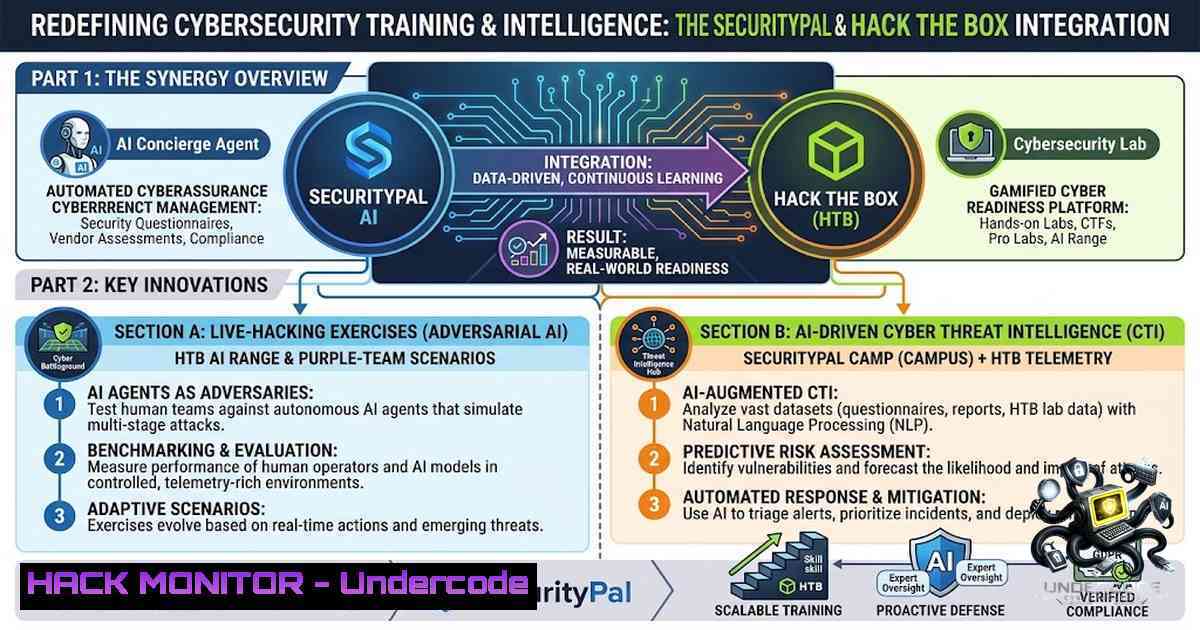
Introduction:
The integration of Artificial Intelligence (AI) into Security Operations Centers (SOCs) and the rise of gamified, hands-on training platforms like Hack The Box are reshaping the landscape of modern cybersecurity. The recent sponsorship of the Hack The Box Meetup in Kathmandu by SecurityPal AI highlights a growing industry trend: the shift from purely theoretical security knowledge to practical, adversary-emulation tactics combined with AI-driven threat intelligence. This article delves into the technical frameworks, cloud hardening techniques, and AI security models that are central to this new era of proactive defense.
Learning Objectives:
- Understand the core components of AI-driven threat intelligence and its integration with continuous security validation platforms.
- Master live-hacking reconnaissance, privilege escalation, and persistence techniques using Linux and Windows command-line tools.
- Learn to harden cloud environments (AWS, Azure) and implement secure API gateways to mitigate the vulnerabilities exposed during red-team exercises.
You Should Know:
- Securing API Gateways and Implementing AI-Driven Rate Limiting
One of the primary attack vectors in modern applications is the API. AI-powered solutions like SecurityPal AI often leverage machine learning to analyze traffic patterns and detect anomalies. To implement a basic AI-driven rate-limiting strategy, you must combine traditional perimeter defenses with behavioral analytics. For example, you can set up an NGINX reverse proxy with Lua scripts that dynamically adjust rate limits based on user-agent fingerprinting and IP reputation, mimicking the logic of an AI model.
Step-by-step guide explaining what this does and how to use it:
– Step 1: Install NGINX and Lua Module. On Ubuntu, run sudo apt update && sudo apt install nginx-extras. This provides the `lua-1ginx-module` needed for dynamic logic.
– Step 2: Configure Base Rate Limiting. Edit `/etc/nginx/nginx.conf` to define a zone: `limit_req_zone $binary_remote_addr zone=mylimit:10m rate=10r/s;`
– Step 3: Integrate AI-like Behavioral Logic. Create a Lua script that checks if a request header contains a suspicious token or high entropy. Example: `set $block 0; access_by_lua_block { if ngx.var.http_user_agent == “bad-bot” then ngx.exit(403); end }`
– Step 4: Test the Configuration. Use `curl -A “bad-bot” http://your-server/api` to verify the blocking mechanism.
2. Linux Reconnaissance and Privilege Escalation (Live-Hacking Essentials)
During the Hack The Box Kathmandu meetup, participants engaged in live hacking. A core component of this is enumeration. Attackers often start with `nmap` to discover open ports, followed by manual enumeration of SUID binaries. Understanding these vectors helps defenders patch their systems.
Step-by-step guide explaining what this does and how to use it:
– Step 1: Network Scanning. Use `nmap -sV -sC -p- target_ip` to identify running services and default scripts. This reveals misconfigurations like exposed Docker sockets or outdated Apache versions.
– Step 2: Enumeration Scripts. Run `linpeas.sh` or `pspy` to find processes running as root. A key command is find / -perm -4000 -type f 2>/dev/null, which lists binaries with SUID permissions. If `/usr/bin/vi` is SUID, you can exploit it to read `/etc/shadow` by running vi /etc/shadow.
– Step 3: Kernel Exploits. Check the kernel version with `uname -a` and compare against known vulnerabilities like Dirty Cow (CVE-2016-5195). If vulnerable, compile the exploit and run it to gain root access. Defenders should use `sysctl -w kernel.unprivileged_userns_clone=0` to mitigate.
3. Windows Active Directory (AD) Exploitation and Mitigation
Windows environments remain a prime target for red-team operations. Tools like Mimikatz and Rubeus are used to extract credentials from memory. SecurityPal AI emphasizes the importance of AI to detect these TTPs (Tactics, Techniques, and Procedures) in real-time.
Step-by-step guide explaining what this does and how to use it:
– Step 1: Enumerate AD Users. Use PowerShell: `Get-ADUser -Filter -Properties ServicePrincipalName` to find SPNs, which are prime targets for Kerberoasting.
– Step 2: Extracting Hashes. If you have admin access, run mimikatz.exe "privilege::debug" "sekurlsa::logonpasswords" exit. This dumps NTLM hashes from memory.
– Step 3: Mitigation via Hardening. Disable plaintext password storage in LSASS memory by setting the registry key `HKLM\SYSTEM\CurrentControlSet\Control\SecurityProviders\WDigest\UseLogonCredential` to 0. Additionally, enable Windows Defender Credential Guard using `bcdedit /set {0cb3b571-2f2e-4343-a879-d86a476d7215} loadoptions DISABLE-LSA-ISO` and bcdedit /set {0cb3b571-2f2e-4343-a879-d86a476d7215} vm.
4. Cloud Hardening for AWS and Azure
With SecurityPal AI sponsoring events focusing on “practical skills,” cloud security is paramount. Misconfigured S3 buckets or Azure blob storage are frequent entry points.
Step-by-step guide explaining what this does and how to use it:
– Step 1: AWS S3 Bucket Enumeration. Use `aws s3 ls s3://target-bucket –1o-sign-request` to check for public read access. To list files recursively, aws s3 cp s3://target-bucket . --recursive --exclude "" --include ".env".
– Step 2: Enforce Bucket Policies. Apply a strict bucket policy to block public access: aws s3api put-bucket-policy --bucket my-bucket --policy file://policy.json. The JSON should explicitly deny `”Principal”: “”` except for specific ARNs.
– Step 3: Azure Hardening. Disable insecure protocols like TLS 1.0/1.1 on Azure Storage accounts via the Azure Portal or CLI: az storage account update --1ame myaccount --resource-group myrg --set minimumTlsVersion=TLS1_2.
5. Network Segmentation and Zero Trust Implementation
The “hands-on experience” at the meetup likely involved lateral movement. Implementing Zero Trust architecture is the recommended countermeasure.
Step-by-step guide explaining what this does and how to use it:
– Step 1: Implement Micro-Segmentation. Use `iptables` on Linux to restrict traffic between internal VLANs. Example: `iptables -A FORWARD -s 192.168.1.0/24 -d 192.168.2.0/24 -j DROP` to block inter-VLAN communication unless explicitly allowed by a Zero Trust policy.
– Step 2: Application Layer Filtering. On Windows Server, use `netsh advfirewall firewall add rule name=”Block HTTP” protocol=TCP dir=in remoteport=80 action=block` to restrict outbound web requests from sensitive servers.
– Step 3: Audit Traffic. Use `tcpdump -i eth0 -1n -s0 -v | grep “Flags”` to monitor suspicious handshake flags, such as SYN scans that indicate reconnaissance activity.
What Undercode Say:
- Key Takeaway 1: The synergy between AI-driven threat intelligence and gamified hacking platforms is critical. AI models can detect anomalies like privilege escalation in milliseconds, but they require high-quality data generated by platforms like Hack The Box to train effectively.
- Key Takeaway 2: Command-line proficiency remains non-1egotiable. Whether you are securing an API with NGINX or exploiting a kernel vulnerability, scripting and manual enumeration tools are the bedrock of cybersecurity, regardless of how advanced AI becomes.
- Analysis: SecurityPal AI’s sponsorship underscores a shift toward cognitive security, where AI does not replace the analyst but enhances their capabilities. For Nepal’s community, this means a focus on understanding attack chains (e.g., initial access -> persistence -> impact) and automating the detection of these chains. The event serves as a wake-up call for enterprises to integrate AI models that can parse logs and system calls in real-time.
Prediction:
- -1 (Negative): As AI tools become more accessible, the barrier to entry for cybercriminals will lower. We can expect an increase in AI-generated phishing campaigns and deepfake social engineering attacks specifically targeting Nepal’s growing BPO sector.
- +1 (Positive): AI will significantly reduce incident response time from days to minutes. The collective learning from events like the Hack The Box meetup will foster a highly skilled workforce capable of developing custom GPT models for malware analysis.
- -1 (Negative): The reliance on AI for security may lead to a skills gap in manual reverse engineering, as analysts become overly reliant on automated tools for decision-making.
- +1 (Positive): Corporate adoption of SecurityPal-like AI will drive a surge in demand for certification (e.g., AI Security Architect roles) in the Asia-Pacific region, creating a lucrative specialized career path.
- +1 (Positive): Government bodies will likely partner with these AI firms to create national-level cyber ranges, standardizing the training curriculum and fortifying national infrastructure.
▶️ Related Video (80% Match):
🎯Let’s Practice For Free:
🎓 Live Courses & Certifications:
Join Undercode Academy for Verified Certifications
🚀 Request a Custom Project:
Secure, high-velocity infrastructure and disruptive technological engineering. Contact our engineering team for high-tier development and proprietary systems:
[email protected]
💎 Smart Architecture | 🛡️ Secure by Design | ⭐ Trusted by Thousands
IT/Security Reporter URL:
Reported By: https://lnkd.in/p/e7424veS – Hackers Feeds
Extra Hub: Undercode MoN
Basic Verification: Pass ✅


