Listen to this Post
Introduction
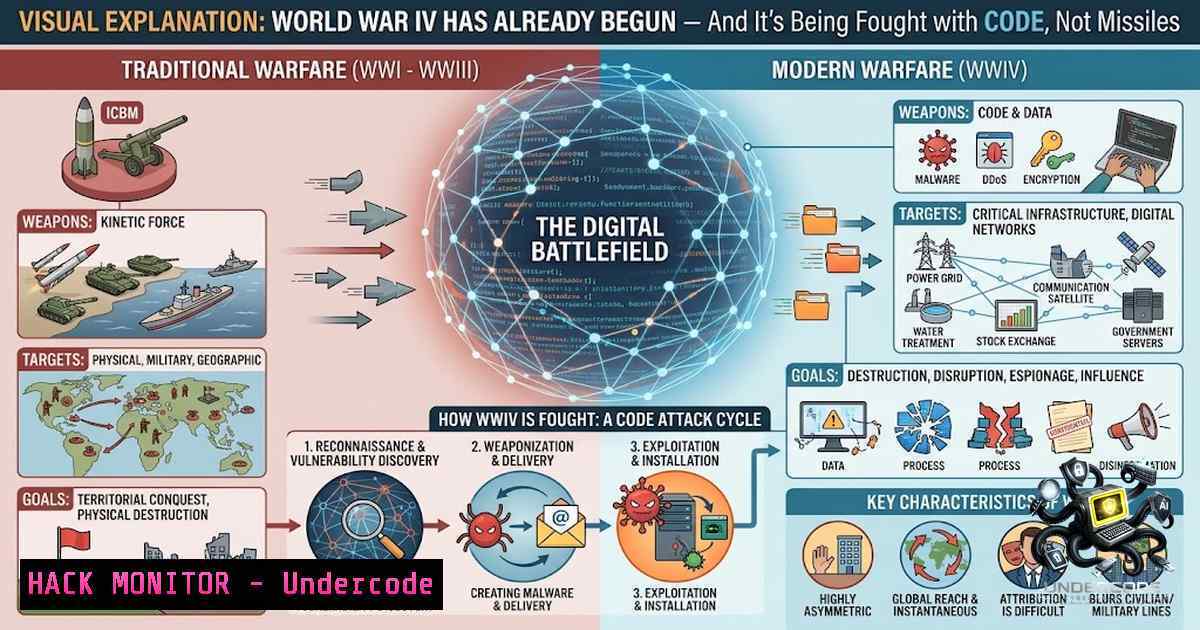
The concept of a “fourth world war” no longer resides in the realm of science fiction or speculative military theory. As Dave Schroeder, PhD — a strategist, cryptologist, and Cyber Warfare Officer — recently articulated, the most devastating attack on the United States may not involve nuclear warheads, ballistic missiles, or mushroom clouds. Instead, it would be waged with mouse pads and joysticks: a coordinated, multi-domain cyber assault on water supplies, electrical grids, financial systems, transportation networks, supply chains, satellites, and public psychology through AI-generated disinformation. The evidence that such an attack is not only possible but already being actively tested is, as Schroeder puts it, “literally all around us”. Recent cyberattacks on U.S. water utilities, Australian pension funds, E-ZPass systems, and satellite communications demonstrate that the battlefield has shifted from physical domains to digital ones — and the United States may already be losing.
Learning Objectives
- Understand the multi-vector cyber warfare strategy that adversaries could deploy against critical U.S. infrastructure
- Identify real-world vulnerabilities in water, energy, financial, transportation, supply chain, and space systems
- Learn practical defensive measures, including Linux/Windows commands, OT security configurations, and incident response procedures
You Should Know
- Water and Energy Infrastructure: The PLC Vulnerability Crisis
The scenario described by Schroeder — shutting down the water supply and electrical grid — is not hypothetical. In July 2026, a coordinated cyberattack hit operational technology (OT) systems at more than 30 community water utilities across Minnesota. The attack disabled computerized controls running wells and treatment systems; in Braham, Minnesota, the water plant was knocked entirely offline. Iranian-linked group CyberAv3ngers, affiliated with the Islamic Revolutionary Guard Corps, claimed responsibility, stating that the attack was conducted “only to warn” of their broader capabilities to strike U.S. critical infrastructure. The U.S. government has formally attributed this threat ecosystem to Iran’s IRGC Cyber-Electronic Command.
The attack vector was shockingly simple: adversaries targeted internet-exposed programmable logic controllers (PLCs) — the devices that control industrial processes. Attackers changed passwords and IP addresses to lock out operators, forcing some facilities to switch to manual operations. In response, CISA issued an urgent warning urging utilities to remove publicly accessible PLCs and other OT systems from the internet immediately.
Step-by-Step Guide: Securing Internet-Exposed PLCs
Step 1: Identify exposed OT assets. Use Shodan or Censys to scan for publicly accessible PLCs:
 Linux - Search for exposed Modbus devices on Shodan (requires API key)
shodan search --limit 100 "port:502 country:US" --fields ip_str,port,org,hostnames

Alternative: Use Nmap to scan internal OT networks for exposed services
nmap -p 502,44818,2222,4840 --open -oA ot_scan 192.168.1.0/24
Step 2: Remove internet exposure immediately. Implement network segmentation using VLANs and ACLs:
 Linux - Configure iptables to block external access to OT networks
iptables -A INPUT -i eth0 -p tcp --dport 502 -j DROP
iptables -A INPUT -i eth0 -p udp --dport 44818 -j DROP

Cisco IOS - ACL to restrict access to PLCs
access-list 100 deny tcp any host 192.168.100.10 eq 502
access-list 100 permit ip any any
Step 3: Implement jump servers and VPNs for remote access. Use a bastion host with multi-factor authentication:
 Linux - Configure SSH jump host with MFA (Google Authenticator)
apt-get install libpam-google-authenticator
google-authenticator
 Edit /etc/pam.d/sshd to require MFA
echo "auth required pam_google_authenticator.so" >> /etc/pam.d/sshd
Step 4: Change default credentials and enforce strong password policies. For Rockwell, Schneider Electric, and Siemens PLCs, use vendor-specific tools to change default passwords immediately.
Step 5: Monitor OT network traffic for anomalies. Deploy Zeek (formerly Bro) for network monitoring:
 Linux - Install and configure Zeek for OT protocol analysis
apt-get install zeek
zeek -i eth0 -f "port 502 or port 44818 or port 2222"
 Analyze Modbus traffic
zeek -r capture.pcap modbus
2. Financial System Attacks: The Zero-Balance Nightmare
Schroeder warns of adversaries hacking the U.S. financial system to launch a massive, nationwide ransom attack, leaving citizens with zeroed-out balances at ATMs and investment accounts. This is not merely theoretical. In April 2025, multiple large Australian superannuation (pension) funds — including AustralianSuper, Hostplus, Rest, and Australian Retirement Trust — were hit by suspected cyber attacks. Members logged in to discover their account balances had been zeroed out. One AustralianSuper member with over $300,000 in savings saw her balance reduced to zero overnight. “I can’t start at zero now with only 10 years to go,” she told ABC News. The attacks demonstrated how a coordinated financial system breach can create mass panic — precisely the psychological effect adversaries seek.
Step-by-Step Guide: Financial System Hardening and Incident Response
Step 1: Implement real-time transaction monitoring. Deploy SIEM solutions with anomaly detection:
 Linux - Configure auditd to monitor financial transaction logs
auditctl -w /var/log/financial/transactions.log -p wa -k transaction_audit
 Monitor for unusual patterns (e.g., mass balance updates)
tail -f /var/log/financial/transactions.log | grep -E "UPDATE balance SET amount=0"
Step 2: Enforce multi-factor authentication for all financial system access. Use Windows Active Directory with MFA:
 Windows PowerShell - Enable MFA for all financial system users
Get-ADUser -Filter  | ForEach-Object {
Set-ADUser -Identity $_.SamAccountName -SmartcardLogonRequired $true
}
Step 3: Implement database-level encryption and integrity monitoring. For PostgreSQL:
-- Enable audit logging for sensitive tables
CREATE EXTENSION IF NOT EXISTS pgaudit;
ALTER SYSTEM SET pgaudit.log = 'all';
SELECT pg_reload_conf();
-- Create integrity checksums
SELECT pg_verify_checksums();
Step 4: Deploy honeypot accounts to detect unauthorized access. Create decoy accounts with fake balances and monitor for any access attempts.
Step 5: Establish a rapid communication protocol to inform customers within minutes of a detected breach, preventing panic from misinformation.
- Transportation System Vulnerabilities: When E-ZPass and Air Traffic Control Go Dark
Schroeder’s scenario includes hacking transportation computer systems — from E-ZPass to self-driving cars to commuter trains to air traffic control — to cripple domestic U.S. travel. In March 2025, the Maine Turnpike Authority shut down its E-ZPass system for 12 hours after detecting a potential security breach. The system, which manages 395,000 personal accounts and 13,000 business accounts, was taken offline as a precaution. The shutdown caused an estimated $200,000 in lost toll revenue. Meanwhile, the U.S. Federal Aviation Administration’s new ERAM (En Route Automation Modernization) system has been reported to contain vulnerabilities that could make flights twice as likely to be tracked or hacked, as it uses over two million lines of code that may be vulnerable.
Step-by-Step Guide: Securing Transportation Infrastructure
Step 1: Conduct vulnerability assessments on transportation management systems:
 Linux - Use OpenVAS to scan transportation network segments
openvas-cli --target 10.1.0.0/24 --scan --port 80,443,8080,8443
 Check for default credentials in SCADA systems
nmap -p 2222,4840 --script modbus-discover 10.1.0.0/24
Step 2: Implement network segmentation between safety-critical and administrative systems:
 Linux - Configure VLAN tagging for transportation networks
ip link add link eth0 name eth0.100 type vlan id 100  SCADA network
ip link add link eth0 name eth0.200 type vlan id 200  Administrative
 Restrict routing between VLANs
iptables -A FORWARD -i eth0.100 -o eth0.200 -j DROP
Step 3: Deploy intrusion detection for GPS and telemetry systems. Monitor for spoofing attempts:
 Linux - Monitor GPS NMEA sentences for anomalies
gpsmon -1 | grep -E "GGA|RMC" | while read line; do
 Check for sudden coordinate jumps
echo $line | awk '{if (($5 > 90) || ($5 < -90)) print "WARNING: Invalid latitude"}'
done
Step 4: Conduct regular air-gap verification. Ensure critical transportation systems are physically disconnected from the internet:
 Linux - Verify no outbound connections from critical systems
tcpdump -i any -1 "dst net 0.0.0.0/0 and not src net 192.168.0.0/16" -c 100
- Supply Chain Attacks: Cyber-Enabled Physical Theft and Disruption
The attack on the U.S. supply chain through hacks on critical rail and shipping computer systems is already manifesting. In 2025, ransomware syndicates launched 283 verified attacks against transport and logistics firms. By exploiting vulnerabilities in GPS trackers and OT systems, attackers gained real-time visibility into the movement of goods. Researchers uncovered a sophisticated scheme where hackers infiltrate freight companies’ internal software, use stolen accounts to bid on cargo loads, and tip off organized crime groups who then physically steal the goods. The total estimated losses from cargo theft now exceed $35 billion annually — more than ransomware. In South Africa, state-owned logistics company Transnet declared force majeure after a cyberattack forced it to halt operations at major container terminals, causing “massive delays and unreliability of the movement of goods across all modes of transport”.
Step-by-Step Guide: Securing Supply Chain Logistics Systems
Step 1: Harden GPS tracking and telematics systems:
 Linux - Implement GPS spoofing detection
gpsd -1 /dev/ttyUSB0
cgps -s | grep -E "lat|lon" | while read line; do
 Compare against known route waypoints
if [ $(echo "$line" | awk '{print $2}') -gt 1.0 ]; then
echo "ALERT: GPS deviation detected" | mail -s "GPS Alert" [email protected]
fi
done
Step 2: Monitor for unauthorized access to freight management systems:
 Linux - Audit login attempts to logistics platforms
grep "Failed password" /var/log/auth.log | grep -E "freight|logistics|cargo"
 Monitor for unusual API calls
tail -f /var/log/api/access.log | grep -E "POST /bid|PUT /load|DELETE /shipment"
Step 3: Implement vendor risk management. Require all third-party logistics providers to undergo security audits and adhere to NIST 800-53 controls.
Step 4: Deploy blockchain-based shipment tracking to create immutable audit trails that cannot be altered by compromised accounts.
- Satellite Vulnerabilities: Taking Space Assets Offline Without a Single Shot
Schroeder warns of adversaries taking U.S. low and geosynchronous orbit satellites offline. This does not require anti-satellite missiles. In October 2025, computer scientists from UC San Diego and the University of Maryland successfully eavesdropped on geostationary satellites, intercepting vast quantities of private and potentially sensitive communications — including from government and military sources. At the Black Hat conference in August 2025, German researchers demonstrated how software and encryption libraries used by NASA and Airbus could be exploited to shut down, move, or crash the flight software of a satellite. Additional flaws in the open-source OpenC3 Cosmos framework were found to allow remote code execution and cross-site scripting attacks on ground stations. As one analysis notes: “States don’t need to shoot down satellites to make them unusable”.
Step-by-Step Guide: Securing Satellite and Ground Station Infrastructure
Step 1: Harden ground station software against remote code execution. For OpenC3 Cosmos:
 Linux - Update OpenC3 to latest patched version
git clone https://github.com/OpenC3/cosmos.git
cd cosmos
git checkout tags/v5.0.1  Ensure patched version
 Apply security configurations
cp config/security.yaml.example config/security.yaml
 Enable authentication and authorization
sed -i 's/auth_enabled: false/auth_enabled: true/g' config/security.yaml
Step 2: Implement encryption for satellite communications:
 Linux - Use OpenSSL to generate and manage satellite link encryption keys
openssl genrsa -out satellite_private.pem 4096
openssl rsa -in satellite_private.pem -pubout -out satellite_public.pem
 Encrypt telemetry data before transmission
openssl enc -aes-256-cbc -salt -in telemetry.dat -out telemetry.enc -pass file:key.bin
Step 3: Monitor for unauthorized command injection attempts:
 Linux - Monitor satellite command logs for anomalies
tail -f /var/log/satellite/commands.log | grep -E "SUN_POINT|ATTITUDE_CHANGE|SAFE_MODE"
 Alert on unexpected attitude control commands
awk '/ATTITUDE_CHANGE/ {if ($6 > 45) print "WARNING: Unusual attitude change"}' /var/log/satellite/commands.log
Step 4: Implement zero-trust architecture for space-ground communications. Require cryptographic verification of all commands from multiple independent sources.
6. AI-Generated Deepfakes and Cognitive Warfare
The most insidious component of Schroeder’s scenario is the deployment of realistic AI-generated deepfakes to sow confusion — of leaders panicking, urging surrender, or making statements that erode public trust. This is not speculative. In 2025, Russian propaganda operations deployed AI-generated videos of Ukrainian soldiers on TikTok, with the key objective of “psychological pressure on service members, erosion of trust within units, and the spread of a sense of hopelessness”. Cognitive warfare — leveraging tools such as deepfakes, large language models, and immersive synthetic environments — poses a substantial risk to rational decision-making. As one study concludes, “AI-driven cognitive warfare” can undermine the resilience of entire populations.
Step-by-Step Guide: Detecting and Mitigating AI-Generated Disinformation
Step 1: Deploy deepfake detection tools:
 Linux - Install and use Deepware Scanner for video analysis
git clone https://github.com/deepware/deepware-scanner.git
cd deepware-scanner
pip install -r requirements.txt
python scanner.py --video suspicious_video.mp4 --model meso4
 Analyze for artifacts indicating AI generation
python scanner.py --video leaders_speech.mp4 --analyze-facial-artifacts
Step 2: Implement digital watermarking and content provenance. Use C2PA (Coalition for Content Provenance and Authenticity) standards:
 Linux - Verify content authenticity using C2PA
pip install c2pa
c2pa verify official_statement.pdf
 Embed provenance metadata in official communications
c2pa embed --manifest manifest.json --output signed_document.pdf official_statement.pdf
Step 3: Establish rapid response teams to identify and debunk deepfakes within minutes of their appearance on social media.
Step 4: Train personnel in media literacy and deepfake recognition. Conduct regular tabletop exercises simulating disinformation campaigns.
Step 5: Deploy AI-driven monitoring of social media platforms for coordinated disinformation campaigns:
 Linux - Use Python to monitor social media APIs for disinformation patterns
python -c "
import tweepy
 Monitor for coordinated hashtag campaigns and suspicious account behavior
api = tweepy.API(auth)
for tweet in tweepy.Cursor(api.search_timeline, q='surrender OR panic').items(100):
if detect_bot(tweet.user):
alert_team(tweet)
"
What Undercode Say
- The threat is real and already materializing. The Minnesota water attacks, Australian pension fund breaches, and E-ZPass shutdowns are not isolated incidents — they are test runs for a larger, coordinated assault on U.S. critical infrastructure. Adversaries are probing defenses, refining tactics, and signaling their capabilities.
-
Defense requires a paradigm shift. Traditional perimeter-based security is insufficient for OT environments, satellite systems, and supply chain networks. Organizations must adopt zero-trust architectures, network segmentation, and continuous monitoring. CISA’s urgent call to remove internet-exposed PLCs underscores the need for immediate action. The United States is in a race against time — and the adversary has already demonstrated it can strike at will.
Prediction
-
-1 The United States will experience a major, multi-vector cyberattack on critical infrastructure within the next 12–24 months, potentially causing widespread disruption to water, energy, and financial systems. The Minnesota and Australian attacks are precursors to a larger, more coordinated campaign.
-
-1 AI-generated deepfakes will be used in conjunction with physical cyberattacks to amplify panic and erode public trust in government institutions, creating a force multiplier effect that compounds the damage of the technical breaches.
-
+1 The growing awareness of these threats — exemplified by CISA’s warnings and the public disclosure of incidents — will drive accelerated investment in OT security, satellite hardening, and AI-based defense systems, potentially creating a new cybersecurity industrial base and thousands of specialized jobs.
-
-1 The asymmetry of cyber warfare means that a relatively small investment in offensive capabilities can threaten trillions of dollars of infrastructure. Adversaries have been pre-positioning in U.S. critical infrastructure networks for years, and the United States may not know it has been attacked until it is too late.
▶️ Related Video (78% Match):
https://www.youtube.com/watch?v=0XPYldqHN6I
🎯Let’s Practice For Free:
🎓 Live Courses & Certifications:
Join Undercode Academy for Verified Certifications
🚀 Request a Custom Project:
Secure, high-velocity infrastructure and disruptive technological engineering. Contact our engineering team for high-tier development and proprietary systems:
[email protected]
💎 Smart Architecture | 🛡️ Secure by Design | ⭐ Trusted by Thousands
IT/Security Reporter URL:
Reported By: https://lnkd.in/p/eSsjpx7g – Hackers Feeds
Extra Hub: Undercode MoN
Basic Verification: Pass ✅


