Listen to this Post
Introduction:
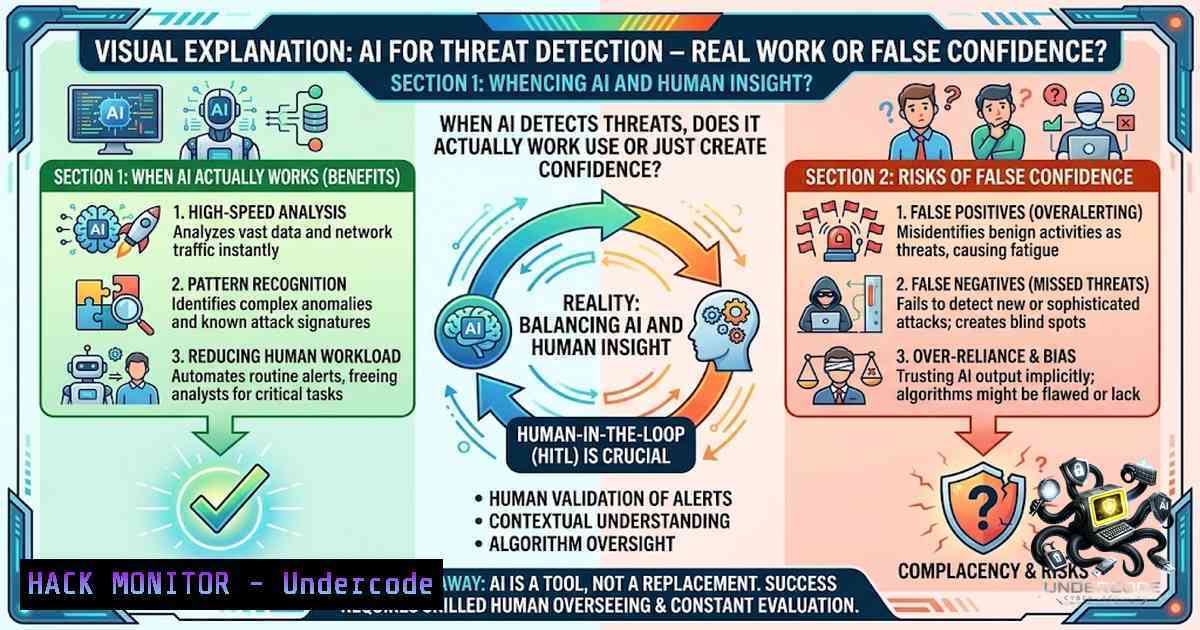
The integration of machine learning into cybersecurity threat detection has been hailed as a revolutionary leap forward—yet a growing body of evidence suggests that AI-powered defenses may be generating as much risk as they mitigate. In 2025, attackers began using AI not as an experiment but as a core capability to automate reconnaissance, scale social engineering, adapt malware behavior, and compress attack timelines. Meanwhile, security leaders report high confidence in their AI defenses while remaining fundamentally unprepared to distinguish between malicious and legitimate AI agents. This paradox—rising confidence alongside escalating vulnerability—demands that security professionals move beyond blind trust in AI and develop a sophisticated understanding of both its capabilities and its exploitable weaknesses.
Learning Objectives:
- Understand the fundamental mechanics of machine learning-based threat detection engines and their operational limitations
- Identify and analyze adversarial evasion techniques used by attackers to bypass AI security systems
- Implement practical detection engineering strategies and command-line techniques to validate and harden AI-driven security controls
You Should Know:
- Understanding ML Threat Detection Engines: How They Work and Where They Fail
Machine learning threat detection engines operate by establishing baselines of “normal” behavior and flagging deviations as potential threats. These systems typically employ supervised learning (trained on labeled datasets of known threats), unsupervised learning (identifying anomalies without prior labeling), or hybrid approaches. The core promise is the ability to detect novel, zero-day threats that signature-based systems would miss.
However, the reality is more nuanced. Research has demonstrated that evasion rates in adversarial-heavy test environments can reach as high as 99.6–99.8%, with corresponding detection rates falling to single digits for several classifiers. This means that in worst-case scenarios, ML models can be rendered virtually useless against determined adversaries. Furthermore, studies have shown that large language models cannot guarantee sufficient performance on real-world threat intelligence reports while also being inconsistent and overconfident. This overconfidence is particularly dangerous: 42% of cybersecurity leaders report piloting or using AI agents for threat detection, yet most autonomous AI solutions remain immature, prone to false answers, and lack the guardrails needed to prevent them from “running amok”.
Step‑by‑Step Guide: Validating ML Detection Engine Performance
To avoid false confidence, security teams should regularly validate their ML detection engines:
- Establish a baseline detection rate using known malicious samples (e.g., from MITRE ATT&CK® evaluations or public malware repositories).
- Generate benign traffic samples and test for false positive rates—excessive alerts indicate poor model calibration.
- Run adversarial test cases using tools like Adversarial Robustness Toolbox (ART) or CleverHans to simulate evasion attempts.
- Compare ML detection rates against traditional signature-based detection (e.g., Snort or YARA rules) on the same dataset.
- Document the gap between ML-detected threats and signature-detected threats to identify coverage blind spots.
2. Adversarial Evasion: How Attackers Bypass AI Defenses
Attackers have developed sophisticated techniques to evade ML-based detection systems. The NIST AI 100-2e2025 report categorizes these as evasion, poisoning, and privacy attacks for predictive AI systems, with additional misuse vectors for generative AI. In 2025, Check Point Research identified the first documented case of malware embedding prompt injection to evade AI detection—a technique that manipulates the AI’s decision-making process directly.
Common evasion techniques include:
- Adversarial perturbations: Small, carefully crafted modifications to input data that cause ML models to misclassify malicious content as benign
- Obfuscation and mutation: Payloads that mutate per execution and appear functionally legitimate, bypassing static detection models
- Data poisoning: Injecting malicious samples into training datasets to degrade model performance over time
- Model stealing: Querying the ML system to reverse-engineer its decision boundaries and craft targeted evasions
The discovery of prompt injection in malware highlights how attackers are adapting to the growing use of generative AI in malware analysis and detection workflows. As defenders increasingly rely on AI to accelerate threat detection, a subtle but alarming contest has emerged between attackers and defenders.
Step‑by‑Step Guide: Detecting Adversarial Evasion Attempts
- Monitor for input perturbations by implementing statistical anomaly detection on feature vectors before they enter the ML model.
- Deploy ensemble models—using multiple ML algorithms with different architectures makes it harder for adversaries to craft universal evasions.
- Implement adversarial training by augmenting training datasets with adversarial examples generated through techniques like FGSM (Fast Gradient Sign Method) or PGD (Projected Gradient Descent).
- Use feature squeezing to reduce the search space available for adversarial perturbations.
- Log and analyze ML model confidence scores—sudden drops in confidence may indicate adversarial input attempts.
Linux Command: Monitoring ML Model Inputs
 Monitor network traffic features being fed into ML models
tcpdump -i eth0 -1n -v | grep -E "feature|anomaly|score" | tee ml_input_monitor.log

Analyze model confidence scores from inference logs
grep "confidence" /var/log/ml_detection.log | awk '{print $NF}' | sort -1 | uniq -c
Windows Command: Checking ML Service Health
 Check ML detection service status
Get-Service -1ame "MLDetectionEngine" | Select-Object Status, DisplayName

Review ML model performance counters
Get-Counter -Counter "\ML Detection Engine\False Positive Rate" -SampleInterval 5 -MaxSamples 10
- SOC Workflow Integration: Making AI Work for Analysts, Not Against Them
Integrating AI into Security Operations Centers (SOCs) requires careful workflow design to prevent alert fatigue and over-reliance on automated decisions. Modern SOCs are adopting AI-powered SOAR (Security Orchestration, Automation, and Response) playbooks to detect anomalies in network traffic and automate response. However, the key challenge is scaling threat response while managing alert fatigue across global SOC operations.
Effective integration follows a “human-in-the-loop” model where AI handles initial triage and correlation, but human analysts validate critical decisions. This approach leverages AI-driven enrichment to provide context while maintaining human oversight for high-stakes judgments. The SANS SEC450 course update for Summer 2025 now includes new modules on AI integration and threat-informed defense, using frameworks like MITRE ATT&CK® to align detection strategies with real-world threats.
Step‑by‑Step Guide: Integrating ML Detection into SOC Workflows
- Define escalation thresholds—low-confidence alerts go to automated playbooks; high-confidence, high-severity alerts trigger human review.
- Implement AI-driven enrichment to automatically pull threat intelligence context (IP reputation, file hashes, user behavior analytics) for each alert.
- Create custom dashboards that visualize ML model confidence scores alongside traditional SIEM alerts.
- Establish feedback loops where analysts label false positives/negatives to retrain and improve ML models.
- Run regular “red team vs. ML” exercises to test detection effectiveness against adversarial techniques.
SIEM Query Example (Splunk): Correlating ML Alerts with Known Threats
index=security sourcetype=ml_detection confidence<0.7
| lookup threat_intel.csv ip OUTPUT threat_category
| where threat_category="malicious"
| stats count by src_ip, confidence, threat_category
| sort - confidence
4. Cloud Hardening for AI-Powered Security Workloads
AI-driven security workloads are increasingly deployed in cloud environments, introducing new attack surfaces. Misconfigured cloud AI services, exposed model endpoints, and insecure data pipelines can all be exploited to poison models or steal intellectual property. Organizations must harden their cloud AI infrastructure alongside their security controls.
Step‑by‑Step Guide: Hardening Cloud AI Security Workloads
- Restrict network access to ML model endpoints using VPC security groups and network ACLs.
- Enable encryption at rest and in transit for all training data and model artifacts.
- Implement identity and access management (IAM) with least-privilege principles for all AI service accounts.
- Enable detailed logging for all API calls to ML services (e.g., AWS CloudTrail, Azure Monitor).
- Regularly rotate API keys and credentials used by AI services.
- Deploy Web Application Firewalls (WAF) in front of publicly exposed AI endpoints.
AWS CLI Command: Auditing ML Service Permissions
 List all IAM roles with access to SageMaker
aws iam list-roles --query 'Roles[?contains(Policies, <code>SageMaker</code>)]'

Check CloudTrail for unusual ML API calls
aws cloudtrail lookup-events --lookup-attributes AttributeKey=EventName,AttributeValue=CreateModel
5. API Security for ML Detection Endpoints
ML detection engines are increasingly exposed as APIs, making them targets for adversarial attacks and denial-of-service attempts. Securing these APIs requires a multi-layered approach combining authentication, rate limiting, input validation, and monitoring.
Step‑by‑Step Guide: Securing ML Detection APIs
- Implement API key authentication with short-lived tokens and rotation policies.
- Enforce rate limiting to prevent API abuse and denial-of-service attacks.
- Validate and sanitize all inputs before they reach the ML model to prevent injection attacks.
- Monitor API usage patterns for anomalies that may indicate reconnaissance or evasion attempts.
- Implement request signing to prevent tampering with API payloads.
- Log all API requests and responses for forensic analysis and model auditing.
Linux Command: Rate Limiting with Nginx
 Nginx rate limiting configuration for ML API endpoints
location /api/v1/detect {
limit_req zone=ml_api burst=10 nodelay;
proxy_pass http://ml_backend;
proxy_set_header X-Real-IP $remote_addr;
}
6. Vulnerability Exploitation and Mitigation in ML Systems
ML systems have unique vulnerabilities beyond traditional software weaknesses. These include:
- Model inversion attacks: Extracting training data from model outputs
- Membership inference: Determining if specific data was used in training
- Gradient leakage: Recovering training data from shared gradients in federated learning
- Backdoor attacks: Embedding triggers during training that cause misclassification when activated
Step‑by‑Step Guide: Mitigating ML-Specific Vulnerabilities
- Implement differential privacy during training to protect against membership inference.
- Use secure enclaves (e.g., AWS Nitro Enclaves, Azure Confidential Computing) for model inference.
- Regularly audit training datasets for signs of poisoning or backdoor insertion.
- Deploy model monitoring to detect drift or degradation in performance over time.
5. Conduct red-team exercises specifically targeting ML components.
Python Code Snippet: Implementing Differential Privacy
from opacus import PrivacyEngine
from torch.utils.data import DataLoader

Initialize privacy engine with differential privacy
privacy_engine = PrivacyEngine()
model, optimizer, dataloader = privacy_engine.make_private(
module=model,
optimizer=optimizer,
data_loader=train_loader,
noise_multiplier=1.0,
max_grad_norm=1.0,
)
What Undercode Say:
- AI threat detection is a force multiplier, not a silver bullet—over-reliance on ML without human validation creates dangerous blind spots that adversaries actively exploit.
- The adversarial evasion arms race is escalating rapidly—with evasion rates exceeding 99% in some scenarios, security teams must assume their ML models can be bypassed and build defense-in-depth accordingly.
- False confidence may be the greatest risk—high executive confidence in AI defenses often outpaces actual technical maturity, creating organizational complacency.
- Practical validation is non-1egotiable—regular red-team exercises, adversarial testing, and performance benchmarking are essential to maintain realistic threat awareness.
- Integration requires cultural change—SOC analysts must be trained not just to use AI tools but to question them, understand their limitations, and maintain investigative rigor.
- The 2025 landscape reveals a point of no return—both attackers and defenders have crossed the AI Rubicon, and the question is no longer whether to use AI but how to use it wisely.
The cybersecurity community stands at a critical juncture. AI-powered threat detection offers unprecedented capabilities, but these capabilities come with unprecedented risks. The organizations that will thrive are not those that adopt AI most aggressively, but those that adopt it most thoughtfully—with rigorous validation, continuous monitoring, and an unshakeable commitment to human oversight. As the attacker-defender dynamic continues to evolve, one truth remains constant: security is not a product, but a process—and AI is a tool within that process, not a replacement for it.
Prediction:
- -1 The adversarial evasion gap will widen before it narrows—attackers have a first-mover advantage in exploiting ML vulnerabilities, and defensive AI will struggle to catch up throughout 2026.
- -1 False confidence in AI defenses will lead to at least one major data breach in 2026 where an organization’s ML detection system was successfully evaded while leadership remained unaware of the vulnerability.
- +1 The emergence of standardized adversarial testing frameworks and NIST guidelines will eventually mature the market, forcing vendors to prove robustness before deployment.
- +1 SOC analysts who master both AI tooling and traditional investigative techniques will become the most valuable security professionals, commanding premium compensation and career opportunities.
- -1 The complexity of securing AI pipelines themselves will introduce new attack surfaces—compromised training data or model endpoints could become preferred targets for advanced persistent threat groups.
- +1 Community-driven efforts like Cybrixen’s structured learning paths will play a crucial role in bridging the skills gap, producing a new generation of security professionals who understand AI’s capabilities and limitations from day one.
▶️ Related Video (82% Match):
🎯Let’s Practice For Free:
🎓 Live Courses & Certifications:
Join Undercode Academy for Verified Certifications
🚀 Request a Custom Project:
Secure, high-velocity infrastructure and disruptive technological engineering. Contact our engineering team for high-tier development and proprietary systems:
[email protected]
💎 Smart Architecture | 🛡️ Secure by Design | ⭐ Trusted by Thousands
IT/Security Reporter URL:
Reported By: https://lnkd.in/p/e2CCuzrk – Hackers Feeds
Extra Hub: Undercode MoN
Basic Verification: Pass ✅


