Listen to this Post
Introduction
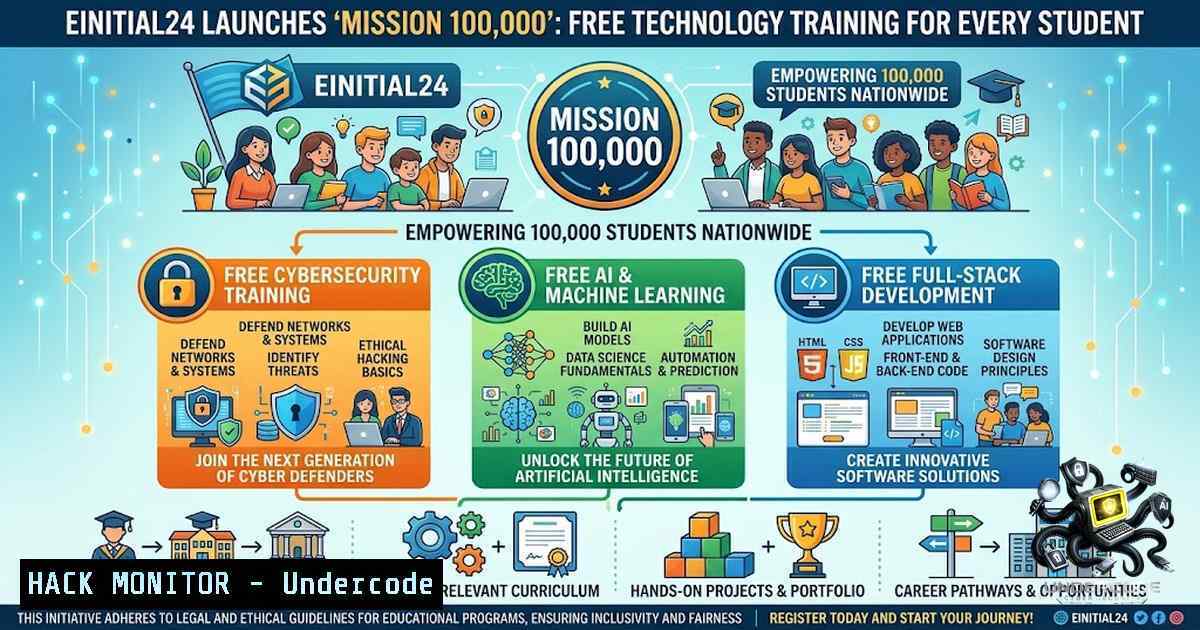
The digital economy is expanding at an unprecedented pace, yet quality technology education remains out of reach for millions of students due to high costs and limited access to structured learning pathways. EINITIAL24 has launched Mission 100K—a bold initiative to train over 100,000 students across India through free, industry-oriented courses delivered via YouTube, WhatsApp, and a dedicated learning community. Covering everything from Cybersecurity & Ethical Hacking and Digital Forensics (DFIR) to Artificial Intelligence, Cloud Computing, and Full-Stack Development, this community-driven model is democratizing tech education by removing financial barriers and replacing them with practical, career-focused training.
Learning Objectives & Secrets
- Objective 1: Build a Strong Foundation in Cybersecurity Fundamentals – Understand core security concepts including the CIA triad (Confidentiality, Integrity, Availability), threat modeling, risk assessment, and the legal and ethical frameworks governing ethical hacking and penetration testing.
-
Objective 2 Secret Tip: Master the Terminal Like a Pro – Cybersecurity professionals spend more time in the command line than anywhere else. Start by memorizing these essential Linux commands: `nmap` for network discovery, `nikto` for web server scanning, `sqlmap` for database injection testing, and `aircrack-1g` for Wi-Fi security auditing. Practice them daily in a safe lab environment like VirtualBox or VMware.
-
Objective 3 Secret Tip: Think Like an Attacker to Defend Like a Pro – The best defenders understand offensive techniques. Learn to use Metasploit for exploit development, Burp Suite for web application testing, and Wireshark for packet analysis. This attacker mindset is what separates script kiddies from true security professionals.
You Should Know
1. Kali Linux: The Ethical Hacker’s Operating System
Kali Linux is the industry-standard penetration testing distribution, pre-loaded with hundreds of tools for network analysis, vulnerability assessment, wireless attacks, and digital forensics. For beginners, the first step is installing Kali in a virtual machine to create an isolated, safe testing environment.
Step‑by‑Step Guide: Getting Started with Kali Linux
- Download Kali Linux from the official website and verify the SHA256 checksum.
- Install in VirtualBox: Create a new VM with at least 4GB RAM and 40GB storage. Attach the Kali ISO and boot.
- Update the system: Run `sudo apt update && sudo apt full-upgrade -y` to ensure all tools are current.
- Run a basic network scan: `nmap -sV -p- 192.168.1.0/24` – This scans your local network for open ports and service versions.
- Test for web vulnerabilities: `nikto -h http://target.com` – This scans for misconfigurations and known vulnerabilities.
6. Practice SQL injection: `sqlmap -u “http://target.com/page?id=1” –batch` – Automates detection and exploitation of SQL injection flaws.
Pro Tip: Always practice on intentionally vulnerable machines like DVWA, Metasploitable, or OWASP Juice Shop. Never scan systems without explicit written permission.
- Web Application Penetration Testing: OWASP Top 10 Methodology
Web applications are the most common attack vector in modern enterprises. The OWASP Top 10 provides a standardized framework for identifying and mitigating the most critical web security risks. A comprehensive web penetration test follows a structured methodology.
Step‑by‑Step Guide: OWASP Web Application Penetration Testing
- Pre-Engagement & Planning: Define scope, rules of engagement, and obtain written authorization.
- Reconnaissance: Use `theHarvester` to gather email addresses and subdomains, and `Gobuster` for directory brute-forcing.
- Enumeration & Scanning: Deploy Nmap for port scanning and Burp Suite for intercepting and analyzing HTTP traffic.
- Vulnerability Analysis: Test for OWASP Top 10 vulnerabilities including:
– A01: Broken Access Control – Test for IDOR (Insecure Direct Object References) and privilege escalation.
– A03: Injection – Test for SQLi, LDAP, XPath, and SSTI (Server-Side Template Injection).
– A07: Identification and Authentication Failures – Test session management, cookie flags, and credential storage.
5. Exploitation: Attempt to exploit identified vulnerabilities to demonstrate business impact.
6. Post-Exploitation: Document access levels achieved, data exposed, and potential lateral movement paths.
7. Final Reporting: Deliver a comprehensive enterprise-style report with findings, risk ratings, and remediation recommendations.
Pro Tip: Use OWASP ZAP in daemon mode for automated API scanning: `zap.sh -daemon -port 8080` followed by zap-api-scan.py -t http://target.com/openapi.json -f openapi.
3. Digital Forensics & Incident Response (DFIR)
Digital forensics is the art of investigating cybercrimes and collecting digital evidence in a legally admissible manner. EINITIAL24’s Digital Forensics Course covers computer forensics, network forensics, malware forensics, and cloud forensics.
Step‑by‑Step Guide: Memory Forensics with Volatility 3
Memory forensics is one of the fastest ways to confirm system compromise during an incident.
- Acquire memory dump: Use `dumpit` or `winpmem` to capture RAM from a Windows system.
- Identify the OS profile: `vol -f memory.dmp windows.info` – Determines the correct Windows version.
- List running processes: `vol -f memory.dmp windows.pslist` – Identify suspicious or hidden processes.
- Dump malicious processes: `vol -f memory.dmp windows.dumpfiles –pid
` – Extract the executable for further analysis.</li>
<li>Check network connections: `vol -f memory.dmp windows.netscan` – Identify active connections and potential C2 (Command & Control) traffic.</li>
<li>Scan for injected code: `vol -f memory.dmp windows.malfind` – Detect hidden or injected code in memory.</li>
</ol>

<h2 style="color: yellow;">Windows Forensic Commands:</h2>

<ul>
<li>Parse Prefetch files: `PECmd.exe -d "C:\Windows\Prefetch" --csv C:\output`
- Parse the Master File Table: `MFTECmd.exe -f $MFT --csv .`
- Analyze event logs: `EvtxECmd.exe -d "C:\Windows\System32\winevt\Logs" --csv C:\output`

Pro Tip: Always work from a write-blocked forensic image to preserve chain of custody. Never analyze the original evidence drive directly.</li>
</ul>

<h2 style="color: yellow;">4. Cloud Security Hardening: AWS, Azure, and GCP</h2>

As organizations migrate to the cloud, securing infrastructure across multiple providers has become critical. The 2026 standard for cloud security requires runtime proof—not just periodic compliance checks.

<h2 style="color: yellow;">Step‑by‑Step Guide: Multi-Cloud Security Hardening</h2>

<ol>
<li>Federate identity: Integrate all cloud providers with a single Identity Provider (IdP) and enforce MFA for every user.</li>
<li>Express guardrails as policy-as-code: Use tools like Terraform or Open Policy Agent (OPA) to define security controls, not console settings.</li>
<li>Require customer-managed encryption keys: Enable SSE-KMS on AWS S3 and customer-managed keys in Azure Blob Storage.</li>
<li>Implement continuous monitoring: Deploy CSPM (Cloud Security Posture Management) tools to detect misconfigurations in real-time.</li>
<li>Segment networks: Use VPCs, subnets, security groups, and Azure NSGs to enforce least-privilege network access.</li>
<li>Enable comprehensive logging: Centralize logs from AWS CloudTrail, Azure Monitor, and GCP Cloud Logging into a SIEM.</li>
</ol>

<h2 style="color: yellow;">AWS CLI Commands:</h2>

[bash]
 List all S3 buckets with public access
aws s3api list-buckets --query 'Buckets[?PublicAccessBlockConfiguration==null]'

Enable default encryption on an S3 bucket
aws s3api put-bucket-encryption --bucket my-bucket --server-side-encryption-configuration '{"Rules":[{"ApplyServerSideEncryptionByDefault":{"SSEAlgorithm":"AES256"}}]}'

Audit IAM users without MFA
aws iam list-users --query 'Users[?PasswordLastUsed!=null]' --output table
Pro Tip: Implement Zero Trust architecture—never trust, always verify. Assume breach and design defenses accordingly.
5. API Security Testing
APIs are the backbone of modern applications, yet they are frequently overlooked in security testing. API security testing should cover REST, GraphQL, SOAP, and WebSocket endpoints.
Step‑by‑Step Guide: API Security Testing
- Discover endpoints: Use `apiprobe https://api.example.com` to probe for hidden endpoints.
2. Scan OpenAPI specifications: `apicheck scan https://api.example.com –spec openapi.json`. - Test for GraphQL introspection: Use GraphQL-specific tools to query the schema and identify sensitive fields.
- Bypass rate limiting: Test for rate-limiting bypass techniques to prevent DoS attacks.
- Test for XXE and SOAP vulnerabilities: Use specialized scanners for SOAP/XML endpoints.
- Automated fuzzing: `openpen scan target.yaml` – Fuzz API parameters for unexpected behavior.
OWASP ZAP API Scan:
docker run --rm zaproxy/zap-stable zap-api-scan.py -t https://api.target.com/openapi.json -f openapi
This command runs a passive API scan against an OpenAPI specification.
Pro Tip: Always include authentication testing—test both authorized and unauthorized access to every endpoint.
6. Python for Cybersecurity Automation
Python is the lingua franca of cybersecurity. From building custom exploit scripts to automating threat detection, Python skills are essential for any security professional.
Step‑by‑Step Guide: Python Scripting for Security
1. Network scanning with Python + Nmap:
import nmap
nm = nmap.PortScanner()
nm.scan('192.168.1.0/24', '22-443')
for host in nm.all_hosts():
print(f'Host: {host} - State: {nm[bash].state()}')
This integrates Nmap functionality directly into Python scripts.
2. Build a simple port scanner:
import socket
for port in range(1, 1025):
sock = socket.socket(socket.AF_INET, socket.SOCK_STREAM)
sock.settimeout(0.5)
result = sock.connect_ex(('target.com', port))
if result == 0:
print(f'Port {port} is open')
sock.close()
3. Automate Metasploit:
Use Python to launch Metasploit modules and automate exploitation workflows.
4. Create custom backdoors and Railgun scripts:
Python’s `ctypes` library can interact with Windows APIs for advanced persistence mechanisms.
Pro Tip: The Complete Ethical Hacking Course Specialization on Coursera offers hands-on Python cybersecurity training, covering exploit development, malware scripting, and defensive strategies.
7. DevSecOps: Integrating Security into CI/CD Pipelines
DevSecOps shifts security left—integrating vulnerability scanning, secrets detection, and compliance checks directly into the development pipeline. This approach catches vulnerabilities before they reach production.
Step‑by‑Step Guide: Building a DevSecOps Pipeline
- Pre-commit hooks: Run Semgrep or SonarQube for SAST (Static Application Security Testing) on every commit.
- CI pipeline security: Scan dependencies for known vulnerabilities using Trivy or Snyk.
- Container scanning: Scan Docker images for vulnerabilities before deployment:
trivy image myapp:latest. - Generate SBOMs: Create Software Bill of Materials to track all dependencies.
- DAST in staging: Run OWASP ZAP or Burp Suite against staging environments.
- Kubernetes security: Run `kube-bench` to check CIS benchmarks and deploy Falco for runtime threat detection.
- Runtime monitoring: Use eBPF-based tools for anomaly detection in production.
Pro Tip: Shift-left doesn’t mean shifting everything—runtime detection (Falco, eBPF) is equally critical for catching zero-day exploits and insider threats.
What Undercode Say
- Key Takeaway 1: Mission 100K is not just a training program—it’s a movement to democratize technology education in India. By removing financial barriers and providing structured, career-focused content, EINITIAL24 is creating a pipeline of skilled professionals ready to fill the massive talent gap in cybersecurity, AI, and cloud computing.
-
Key Takeaway 2: The community-driven model—combining YouTube tutorials, WhatsApp daily updates, and peer-to-peer collaboration—is the secret sauce. Learning alone is hard; learning with 100,000 peers who share doubts, solutions, and job opportunities accelerates skill acquisition and career placement exponentially.
Analysis: The initiative addresses a critical pain point in Indian tech education: the gap between academic theory and industry requirements. Traditional degrees often lack hands-on training in tools like Kali Linux, Burp Suite, and cloud platforms. Mission 100K bridges this gap by delivering practical, tool-focused training that employers actually value. The inclusion of emerging fields like AI, DevOps, and Digital Forensics ensures learners are future-ready, not just job-ready. However, the sheer scale (100,000 students) presents challenges in maintaining quality, personalized mentorship, and assessment rigor. The initiative’s success will depend on building a robust network of mentors, automating feedback loops, and continuously updating course content to keep pace with the rapidly evolving threat landscape and cloud ecosystem.
Prediction
+1 – Mission 100K will create a new generation of cybersecurity professionals in India, reducing the country’s dependency on foreign security talent and strengthening its digital infrastructure against cyber threats. This is a net positive for national security and economic growth.
+1 – The free, open-access model will pressure other ed-tech platforms to lower prices or offer more free content, ultimately benefiting millions of students beyond the initial 100,000 target. This could spark a price revolution in tech education across South Asia.
-1 – Without robust quality control and certification mechanisms, some learners may complete courses without achieving industry-ready competency, potentially diluting the value of the EINITIAL24 brand and creating a “certificate inflation” problem in the job market.
+1 – The community and job placement infrastructure (WhatsApp channels for daily job opportunities, internships, and placement drives) gives Mission 100K a significant advantage over traditional MOOCs. This integrated learning-to-employment pipeline could achieve placement rates that commercial bootcamps struggle to match.
-1 – Scaling to 100,000 students while maintaining hands-on lab access for tools like Kali Linux, cloud environments, and penetration testing ranges is a logistical and financial challenge. Without adequate lab infrastructure, practical skill development will suffer.
+1 – The initiative’s focus on emerging technologies (AI, ML, Cloud, DevOps, DFIR) aligns perfectly with global industry trends. Graduates will be positioned for high-growth roles in security operations, cloud architecture, and AI engineering—fields with severe talent shortages and premium salaries.
+1 – By leveraging YouTube as the primary delivery platform, EINITIAL24 achieves infinite scalability at near-zero marginal cost. This is the most efficient distribution model for free education, ensuring that even students in remote areas with limited internet bandwidth can access content.
▶️ Related Video (82% Match):
🎯Let’s Practice For Free:
🎓 Live Courses & Certifications:
Join Undercode Academy for Verified Certifications
🚀 Request a Custom Project:
Secure, high-velocity infrastructure and disruptive technological engineering. Contact our engineering team for high-tier development and proprietary systems:
[email protected]
💎 Smart Architecture | 🛡️ Secure by Design | ⭐ Trusted by ThousandsIT/Security Reporter URL:
Reported By: https://lnkd.in/p/e6Aa2-Xr – Hackers Feeds
Extra Hub: Undercode MoN
Basic Verification: Pass ✅🔐JOIN OUR CYBER WORLD [ CVE News • HackMonitor • UndercodeNews ]
📢 Follow UndercodeTesting & Stay Tuned:
- Discover endpoints: Use `apiprobe https://api.example.com` to probe for hidden endpoints.


