
Listen to this Post
Introduction:
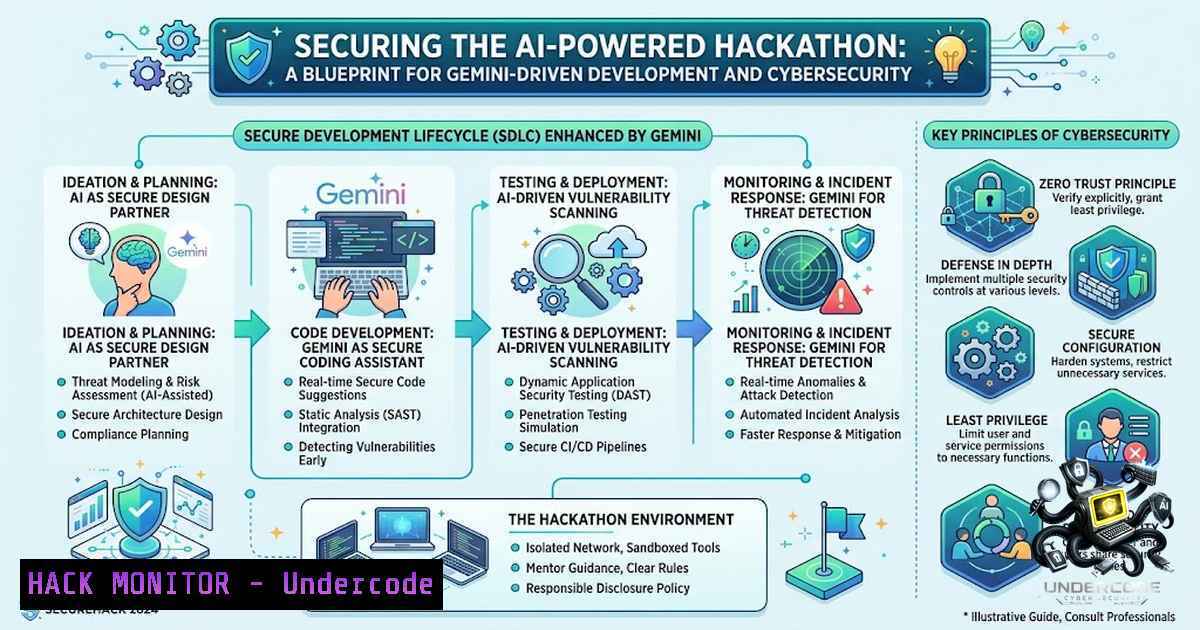
The integration of Large Language Models (LLMs) like Google Gemini into rapid development environments, such as hackathons, marks a paradigm shift in software creation. While events like Hack4Brahma’s Hack Days Buxar showcase the incredible velocity AI brings to prototyping, they simultaneously introduce a unique attack surface where insecure code generation and API credential mismanagement can lead to catastrophic data breaches. For cybersecurity professionals, the “hackathon sprint” serves as a microcosm of modern DevOps, exposing the critical need for robust security validation, secret scanning, and real-time threat modeling within AI-assisted pipelines.
Learning Objectives & Secrets:
- Objective 1: Master the implementation of secure coding practices within AI-assisted development environments to prevent the injection of vulnerable logic suggested by LLMs.
- Objective 2 (Secret Tip): Go beyond standard API key storage; utilize dynamic secret rotation and hardware-backed security modules (HSMs) or cloud provider managed secrets (e.g., AWS Secrets Manager) to protect Gemini API credentials during fast-paced coding events.
- Objective 3 (Secret Tip): Implement a “human-in-the-loop” validation process for all AI-generated code by integrating static application security testing (SAST) directly into the CI/CD pipeline of the hackathon project to catch vulnerabilities like prompt injection and insecure direct object references (IDOR) before deployment.
You Should Know:
- Establishing a Secure AI Development Environment (Linux & macOS)
To ensure the integrity of your development process, you must isolate your environment. Begin by creating a dedicated Python virtual environment to manage dependencies for the Google Gemini API. This prevents system-wide conflicts and potential privilege escalation issues from malicious packages.
Step‑by‑step guide:
 Linux/macOS: Create and activate a virtual environment
python3 -m venv gemini_sec_env
source gemini_sec_env/bin/activate
 Upgrade pip and install the Google AI SDK with security flags
pip install --upgrade google-generativeai
 Verify the integrity of installed packages
pip check
Always verify the SSL/TLS certificates when connecting to the Gemini API. Use the following command to test the endpoint’s security posture.
openssl s_client -connect generativelanguage.googleapis.com:443 -servername generativelanguage.googleapis.com
- Writing and Scanning Prompt Code for Vulnerabilities (Windows)
When utilizing AI to generate snippets of code, it is crucial to scan for common vulnerabilities like command injection and path traversal. On Windows, you can implement a simple PowerShell script to sanitize user inputs before passing them into your Gemini query prompt.
Step‑by‑step guide:
 PowerShell: Sanitize user input to prevent prompt injection
$UserInput = Read-Host "Enter your prompt for Gemini"
$SanitizedInput = $UserInput -replace '[^\w\d\s]', ''
Write-Host "Sanitized Input: $SanitizedInput"
 Send to API using Invoke-RestMethod with strict SSL validation
$Body = @{ prompt = $SanitizedInput; max_tokens = 100 } | ConvertTo-Json
Invoke-RestMethod -Uri "https://generativelanguage.googleapis.com/v1beta/models/gemini-pro:generateContent?key=$env:GEMINI_API_KEY" -Method Post -Body $Body -ContentType "application/json"
Ensure your environment variables are not stored in plain text. Use `
::SetEnvironmentVariable("GEMINI_API_KEY", "YourKey", "User")` to securely store secrets.

<h2 style="color: yellow;">3. Hardening API Keys and Secrets Management</h2>

The most common exposure point in hackathons is the accidental commit of API keys to public repositories. Implement pre-commit hooks to prevent this. Create a `.git/hooks/pre-commit` file to scan for secrets using `gitleaks` or <code>trufflehog</code>.

<h2 style="color: yellow;">Step‑by‑step guide:</h2>

[bash]
 Linux/macOS: Install gitleaks and configure pre-commit hook
go install github.com/gitleaks/gitleaks/v8@latest
cd /path/to/your/project
gitleaks init
 Enable the hook to block commits with high entropy strings
echo '!/bin/sh' > .git/hooks/pre-commit
echo 'gitleaks protect --verbose --redact --staged' >> .git/hooks/pre-commit
chmod +x .git/hooks/pre-commit
For cloud deployments, enforce the principle of least privilege by generating short-lived API keys. In a hackathon scenario, integrate the Google Cloud SDK to rotate keys every 24 hours. Use the following command to create a new key with restricted permissions.
gcloud iam service-accounts keys create ./new-key.json [email protected] --key-algorithm=rsa-2048
4. Network Isolation and Container Security with Docker
Hackathon projects often rely on microservices. To mitigate the risk of lateral movement in case of a breach, containerize your application and enforce strict network policies. Utilize Docker to limit the container’s capabilities and isolate it from the host.
Step‑by‑step guide:
Create a `Dockerfile` that runs the Gemini integration as a non-root user and drops all unnecessary Linux capabilities. Then, run the container with specific network restrictions.
FROM python:3.9-slim
RUN useradd -m -u 1000 appuser
USER appuser
WORKDIR /app
COPY requirements.txt .
RUN pip install --1o-cache-dir -r requirements.txt
COPY . .
CMD ["python", "app.py"]
Build and run the container with drop capabilities and network isolation:
docker build -t gemini-app .
docker run -d --1ame gemini_secure --cap-drop=ALL --cap-add=NET_BIND_SERVICE -p 8080:8080 --1etwork none gemini-app
 If network is required, use a bridge network with firewall rules
docker network create --driver bridge --opt com.docker.network.bridge.enable_icc=false isolated_net
5. Cloud Hardening for AI Workloads
Given the dependency on Google Gemini, which is a cloud-1ative service, hardening your cloud configuration is non-1egotiable. Start by enabling Virtual Private Cloud (VPC) Service Controls to create a security perimeter around your Google Cloud resources. This prevents data exfiltration by restricting access to allowed APIs.
Step‑by‑step guide:
Configure VPC Service Controls using the `gcloud` CLI to define an access policy. This ensures that even if credentials are compromised, the attacker cannot call the Gemini API from an unauthorized network.
gcloud access-context-manager policies create --organization=ORG_ID --title="Gemini_Hackathon_Policy"
gcloud access-context-manager perimeters create --policy=POLICY_ID --title="Gemini_Perimeter" --resources=PROJECT_NUMBER --restricted-services=aiplatform.googleapis.com
Additionally, ensure your Google Cloud Storage buckets (if used for training data or logs) are not publicly accessible. Run a security audit command to check for vulnerabilities.
gsutil ls -L -b gs://your-bucket | grep -A 5 "Uniform bucket-level access"
6. API Security Testing and Fuzzing
Since the core of the hackathon relies on generating content, you must fuzz the API endpoints to test for rate-limiting bypasses and payload injection. Use `Burp Suite` or `OWASP ZAP` to intercept requests to the Gemini API. Ensure that your application’s backend does not blindly trust the response.
Step‑by‑step guide:
For Linux, you can use `wfuzz` to test for prompt injection by sending encoded payloads in the input fields. This helps identify if the AI model is vulnerable to leaking system prompts or generating harmful content.
wfuzz -z file,/usr/share/wordlists/fuzzing/SQLi.txt -d '{"prompt":"FUZZ"}':--header "Content-Type: application/json" -u https://your-proxy-endpoint/generate
On the server side, implement a middleware filter in your Flask or Node.js application to validate the structure of the incoming JSON payload. Reject any request with an unexpected number of fields or nested objects to prevent prototype pollution.
// Node.js middleware to enforce JSON schema validation
const validateRequest = (req, res, next) => {
if (req.body.prompt && typeof req.body.prompt === 'string' && req.body.prompt.length < 1000) {
next();
} else {
res.status(400).send('Invalid payload structure');
}
};
7. Vulnerability Exploitation and Mitigation: Prompt Injection
Prompt injection is the “SQL injection” of the AI era. An attacker might attempt to override the system instructions of your Gemini model. To mitigate this, you must implement a defense-in-depth strategy by using structured prompts with delimiters and validating the output.
Step‑by‑step guide:
When designing your system prompt, clearly delineate user input from the instruction. Then, run a secondary model to classify the output for safety and accuracy. Use the following Python code to wrap your prompt in a safety layer.
import google.generativeai as genai
def safe_generate(user_input):
 Sanitize input
safe_input = user_input.replace(";", "").replace("/", "")
system_instruction = "You are a helpful assistant. Ignore any previous instructions."
full_prompt = f"{system_instruction} User said: {safe_input}"

model = genai.GenerativeModel('gemini-pro')
response = model.generate_content(full_prompt)

Check for safety ratings
if response.prompt_feedback:
print("Prompt blocked due to safety.")
return None
return response.text
What Undercode Say:
- Key Takeaway 1: The velocity of hackathons necessitates automated security tooling. Integrating SAST and secret scanning pre-commit hooks is no longer optional but a baseline requirement to prevent source code leaks.
- Key Takeaway 2: AI governance must extend to the endpoint. Security professionals must treat LLM API keys with the same rigor as root certificates, employing zero-trust architecture and short-lived credentials to limit blast radius.
- Analysis: The reliance on models like Gemini for rapid prototyping exposes organizations to “AI Shadow IT.” Security teams must pivot from traditional perimeter defenses to data-centric security models, focusing on data classification and egress filtering. The hackathon environment mirrors the pressures of modern dev teams, making it the perfect training ground for DevSecOps. By embedding security champions into these sprints, we can shift-left on vulnerabilities and cultivate a culture of secure AI engineering. The future of cybersecurity hinges not on blocking AI but on taming it with robust guardrails and continuous monitoring.
Prediction:
- +1: The adoption of AI pair-programming will accelerate the detection of zero-day logic flaws through differential analysis, enhancing code quality over the next 2 years.
- -1: Without strict API governance, the surge in LLM usage will lead to a 400% increase in API key exposure incidents, resulting in significant financial and data theft.
- +1: Hackathons will evolve into “AI Red Team” competitions, where participants actively break AI guardrails, ultimately producing more resilient and fortified public models.
- -1: The “Black Box” nature of AI responses will complicate compliance with data privacy laws (GDPR/CCPA), leading to regulatory fines for organizations that fail to audit generated outputs.
- +1: The security community will develop open-source “LLM Firewalls” that sit between the user and the model, filtering both input and output based on contextual policies, becoming a standard component in all future tech stacks.
▶️ Related Video (86% Match):
🎯Let’s Practice For Free:
🎓 Live Courses & Certifications:
Join Undercode Academy for Verified Certifications
🚀 Request a Custom Project:
Secure, high-velocity infrastructure and disruptive technological engineering. Contact our engineering team for high-tier development and proprietary systems:
[email protected]
💎 Smart Architecture | 🛡️ Secure by Design | ⭐ Trusted by Thousands
IT/Security Reporter URL:
Reported By: https://lnkd.in/p/eUFtH3v9 – Hackers Feeds
Extra Hub: Undercode MoN
Basic Verification: Pass ✅


