
Listen to this Post
Introduction:
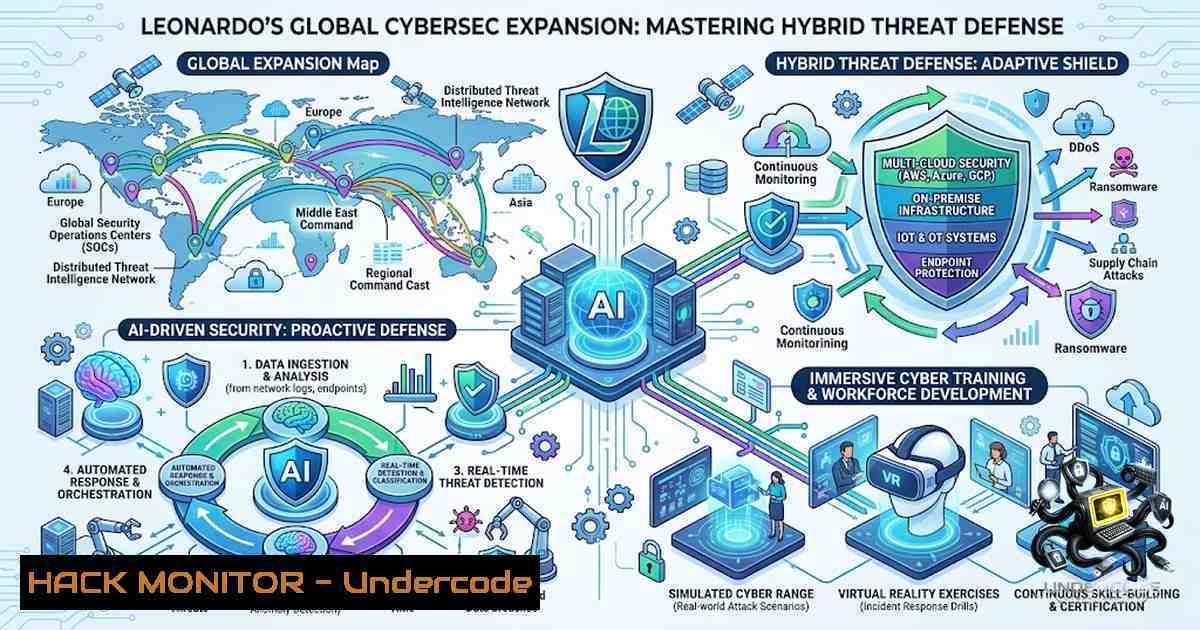
In an era where hybrid warfare blends conventional conflict with cyberattacks, information manipulation, and economic coercion, defending national infrastructure demands a paradigm shift. Leonardo, a global aerospace and security leader, has responded by inaugurating a new Regional Cyber Center in Kuala Lumpur, Malaysia, as part of its Global CyberSec Center (GCC) network. Concurrently, the company’s Cyber & Security Academy and AI training programs are equipping professionals with the skills needed to counter sophisticated ransomware, DDoS, and application-layer attacks through secure-by-design architectures and trustworthy AI. This article provides a technical deep-dive into the strategies, tools, and training methodologies essential for building cyber resilience in 2026 and beyond.
Learning Objectives & Secrets:
- Objective 1: Understand Hybrid Threat Vectors – Learn to identify and analyze the convergence of conventional and non-conventional warfare tactics, including ransomware, DDoS, and information warfare, which target public and private infrastructures.
- Objective 2 Secret Tip: Master Predictive Protection – Leverage big data, virtualization, and trustworthy AI to implement predictive data protection and continuous monitoring, moving beyond reactive defenses.
- Objective 3 Secret Tip: Operationalize Cyber Range Training – Utilize immersive platforms like Cyber Range and Cyber Game (Capture The Flag) to simulate real-world attacks, enabling hands-on experience in a safe, controlled environment.
You Should Know:
1. Architecting a Federated Cyber Defense Network
Leonardo’s GCC operates as a federated network with regional centers in Chieti, Brussels, Bristol, Riyadh, and now Kuala Lumpur. This model enables coordinated global response while preserving national data sovereignty. For organizations, this means adopting a distributed Security Operations Center (SOC) architecture.
Step‑by‑step guide to setting up a federated SOC:
- Step 1: Deploy regional SIEM (Security Information and Event Management) nodes that correlate logs locally.
- Step 2: Implement a centralized threat intelligence platform that aggregates IOCs (Indicators of Compromise) from all nodes.
- Step 3: Use VPN or dedicated MPLS links to ensure secure, low-latency communication between centers.
- Step 4: Establish a unified incident response playbook that respects local data privacy laws (e.g., GDPR, Malaysia’s PDPA).
- Step 5: Conduct regular cross-center tabletop exercises to test coordination.
Linux Command for Log Aggregation:
 Using rsyslog to forward logs to a central server
echo ". @@central-soc.example.com:514" >> /etc/rsyslog.conf
systemctl restart rsyslog
Windows Command (PowerShell) for Event Forwarding:
wevtutil set-log Microsoft-Windows-Sysmon/Operational /enabled:true
winrm quickconfig
 Configure Event Collector subscription via GUI or wevtutil
2. Hardening Against Application-Layer DDoS Attacks
The post highlights that application-layer DDoS attacks have evolved, amplifying damage and complicating defenses. Unlike volumetric attacks, these target specific vulnerabilities (e.g., HTTP floods, Slowloris).
Step‑by‑step guide to mitigation:
- Step 1: Deploy a Web Application Firewall (WAF) with rate limiting rules.
- Step 2: Use reverse proxies (e.g., Nginx, HAProxy) to offload SSL/TLS and filter malicious patterns.
- Step 3: Implement API gateway throttling to limit requests per IP/user.
- Step 4: Utilize cloud-based scrubbing centers to absorb and filter traffic before it reaches your origin.
- Step 5: Continuously monitor application logs for anomalous spikes in 404 errors or POST requests.
Nginx Rate Limiting Configuration:
http {
limit_req_zone $binary_remote_addr zone=mylimit:10m rate=10r/s;
server {
location /api/ {
limit_req zone=mylimit burst=20 nodelay;
proxy_pass http://backend;
}
}
}
3. Implementing Secure-by-Design Architectures
Leonardo emphasizes secure-by-design architectures as a cornerstone of its defense strategy. This approach integrates security from the initial design phase rather than as an afterthought.
Step‑by‑step guide:
- Step 1: Conduct threat modeling during the requirement phase (e.g., STRIDE methodology).
- Step 2: Enforce principle of least privilege for all microservices and containers.
- Step 3: Use Infrastructure as Code (IaC) tools (Terraform, Ansible) with built-in security checks (e.g.,
checkov,tfsec). - Step 4: Implement automated SAST (Static Application Security Testing) and DAST (Dynamic Application Security Testing) in CI/CD pipelines.
- Step 5: Regularly perform penetration testing and red team exercises.
Tool Configuration (Terraform with `tfsec`):
 Install tfsec
brew install tfsec
 Run scan in your Terraform directory
tfsec .
4. Leveraging Trustworthy AI for Predictive Security
Trustworthy AI is used to predict and counter cyber threats by analyzing vast datasets. However, ensuring AI models are unbiased, private, and accountable is critical.
Step‑by‑step guide to deploying secure AI models:
- Step 1: Use differential privacy techniques when training models on sensitive data.
- Step 2: Implement model explainability tools (e.g., SHAP, LIME) to understand decision-making.
- Step 3: Regularly retrain models with new threat data to avoid concept drift.
- Step 4: Secure the AI supply chain by verifying model provenance and using signed containers.
- Step 5: Monitor model performance for adversarial attacks (e.g., data poisoning, evasion).
Python Snippet for SHAP Explainability:
import shap
explainer = shap.TreeExplainer(model)
shap_values = explainer.shap_values(X_test)
shap.summary_plot(shap_values, X_test)
5. Immersive Training and Certification Pathways
Leonardo’s Cyber & Security Academy offers standard and custom courses, cyber exercises, white phishing simulations, and Pearson VUE certification paths. The Cyber Trainer platform supports continuous learning for both professionals and non-experts.
Step‑by‑step guide to building an internal cybersecurity training program:
– Step 1: Assess skill gaps using frameworks like the ENISA European Cybersecurity Skills Framework (ECSF).
– Step 2: Deploy a Learning Management System (LMS) like Leonardo’s Cyber Trainer.
– Step 3: Integrate a Cyber Range for hands-on labs (e.g., using platforms like RangeForce or Immersive Labs).
– Step 4: Run regular phishing simulations to improve user awareness.
– Step 5: Encourage staff to obtain industry-recognized certifications (CISSP, CISM, CRISC).
6. Securing Critical Infrastructure and OT Environments
Leonardo’s expertise extends to protecting cyber-physical systems and critical national infrastructures. IT/OT convergence introduces unique vulnerabilities.
Step‑by‑step guide for OT security:
- Step 1: Conduct a thorough asset inventory of all OT devices (PLCs, RTUs, HMIs).
- Step 2: Implement network segmentation using unidirectional gateways or firewalls to isolate OT from IT networks.
- Step 3: Deploy passive monitoring solutions (e.g., Nozomi, Dragos) to detect anomalies without disrupting operations.
- Step 4: Enforce multi-factor authentication (MFA) for all remote access to OT systems.
- Step 5: Develop and test incident response plans specifically for OT environments, considering safety and availability.
7. Cloud Hardening and Generative AI Infrastructure
Leonardo AI leverages AWS EC2 instances (P4d, G6e, Inferentia2) for training and inference, achieving 60% cost reduction and 35% speed improvement. Securing such environments is paramount.
Step‑by‑step guide to hardening AI cloud workloads:
- Step 1: Use AWS IAM roles and policies to enforce least privilege for EC2 instances.
- Step 2: Enable VPC flow logs and AWS GuardDuty for continuous threat detection.
- Step 3: Encrypt data at rest using KMS and in transit using TLS.
- Step 4: Regularly patch AMIs and use AWS Systems Manager for automated updates.
- Step 5: Implement AWS WAF and Shield for DDoS protection on exposed APIs.
AWS CLI Command to Enable GuardDuty:
aws guardduty create-detector --enable
What Undercode Say:
- Key Takeaway 1: Hybrid warfare demands a federated, multi-layered defense approach that combines predictive AI, secure-by-design principles, and continuous monitoring across physical and digital domains.
- Key Takeaway 2: Investing in human capital through immersive training and certifications is as critical as deploying advanced technology; the cyber skills gap can only be bridged through continuous, hands-on education.
Analysis: The strategic opening of the Kuala Lumpur Cyber Center underscores a shift towards regional cyber autonomy and sovereign data control. Meanwhile, Leonardo’s focus on AI-driven solutions and academy-based training reflects an industry-wide recognition that cybersecurity is not merely a technical challenge but a systemic organizational imperative. The integration of IT and OT security, coupled with the rise of generative AI, necessitates a holistic upskilling of the workforce—from end-users to C-suite executives.
Prediction:
- +1 The federated cyber center model will become the industry standard, enabling faster, more coordinated responses to global threats while respecting national sovereignty.
- +1 AI-powered predictive security will significantly reduce mean time to detect (MTTD) and respond (MTTR), shifting the industry from reactive to proactive defense.
- -1 The rapid adoption of generative AI in security tools will introduce new attack surfaces, including model poisoning and adversarial inputs, requiring continuous innovation in AI safety.
- -1 The global shortage of skilled cybersecurity professionals will persist, exacerbating the risk for organizations that fail to invest in comprehensive training programs.
- +1 Immersive training platforms like Cyber Range and Capture The Flag exercises will become mandatory for security certifications, ensuring practical, hands-on competence.
- -1 Nation-state actors will increasingly target critical infrastructure and OT environments, necessitating stronger public-private partnerships and information sharing.
- +1 The convergence of IT and OT security will drive the development of new, unified security frameworks and standards, improving overall resilience.
- +1 Leonardo’s investment in Malaysia will catalyze the growth of Southeast Asia’s cybersecurity ecosystem, fostering local talent and innovation.
▶️ Related Video (80% Match):
🎯Let’s Practice For Free:
🎓 Live Courses & Certifications:
Join Undercode Academy for Verified Certifications
🚀 Request a Custom Project:
Secure, high-velocity infrastructure and disruptive technological engineering. Contact our engineering team for high-tier development and proprietary systems:
[email protected]
💎 Smart Architecture | 🛡️ Secure by Design | ⭐ Trusted by Thousands
IT/Security Reporter URL:
Reported By: https://lnkd.in/p/enKnEZyY – Hackers Feeds
Extra Hub: Undercode MoN
Basic Verification: Pass ✅


