
Listen to this Post
Introduction:
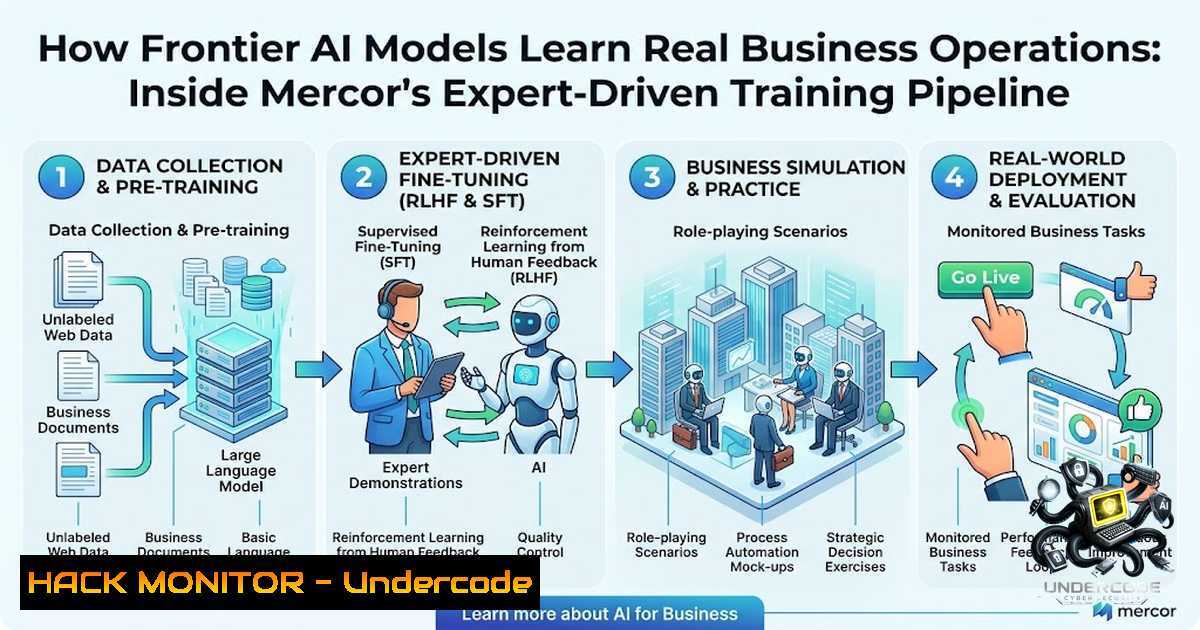
As artificial intelligence expands into enterprise decision-making, frontier models increasingly need to master complex business operations—forecasting, pricing, supply chain planning, and sales strategy—rather than merely generating fluent text. Mercor, a San Francisco-based talent platform backed by Benchmark, General Catalyst, Peter Thiel, and Jack Dorsey, is addressing this gap by hiring senior Business & Sales Operations Domain Experts to work directly with leading AI research labs. These experts create rigorous training tasks, write “golden solutions” that define correct reasoning, and design benchmarks that measure whether models genuinely improve at operational judgment. This human-in-the-loop approach represents a fundamental shift in AI training: teaching models not what to say, but how to think through real-world business problems.
Learning Objectives & Secrets:
- Objective 1: Master the Art of Golden Solution Design – Learn to construct instruction specifications and benchmark-quality solutions that transform tacit operating judgment into explicit, teachable criteria for AI models. The secret: effective golden solutions anticipate edge cases and flawed assumptions, not just correct answers.
-
Objective 2: Build Robust Evaluation Benchmarks – Design challenging operations tasks and evaluation sets that expose weak reasoning, numerical inconsistencies, and plausible-but-wrong outputs. Secret tip: use procedurally generated benchmarks with rule-based techniques to create virtually infinite sample supplies while avoiding data contamination.
-
Objective 3: Calibrate Model Reasoning Against Real Operations – Work alongside researchers to keep standards consistent across domains. Secret tip: decouple annotator models from benchmark judges to reduce evaluation leakage, and use conservative temperature bounds to prevent extreme enforcement.
You Should Know:
1. Understanding the Expert-Driven AI Training Pipeline
The role described by Mercor sits at the intersection of operations expertise and AI model development. Frontier models—the most advanced AI systems—struggle with business reasoning because they lack exposure to how real operations work actually gets done. Unlike general knowledge tasks, business operations require understanding trade-offs, recognizing flawed assumptions, and catching numbers that “do not tie”.
The pipeline works as follows: domain experts review existing business operations tasks and model outputs, identifying missing behaviors and thin reasoning. They then write high-quality instruction specifications and produce “golden solutions”—the definitive correct answers that models should learn to replicate. Finally, they design challenging evaluation benchmarks that measure whether the model is genuinely improving.
Recent academic research validates this approach. The BizCompass benchmark, introduced at ACL 2026, explicitly connects theoretical foundations with practical business knowledge across finance, economics, statistics, and operations management. Similarly, Business Arena tests whether agents can operate an end-to-end seller business over a 30-day market horizon—sourcing products, allocating capital, setting prices, and adapting to competition. The strongest models in these benchmarks more than double starting capital, while others lose money, demonstrating that business reasoning is a distinct capability that requires specialized training.
2. Building Golden Solutions: A Step-by-Step Guide
Creating effective golden solutions requires translating operational expertise into structured, machine-readable formats. Here’s how to approach this:
Step 1: Deconstruct the Operations Problem – Break down a real business problem (e.g., territory design, revenue forecasting, pricing optimization) into its constituent parts. Identify all inputs, constraints, and decision points.
Step 2: Define the Correct Reasoning Path – Write out the step-by-step logic an expert would follow, including trade-off considerations and why certain alternatives are suboptimal. This becomes your “golden solution.”
Step 3: Anticipate Common Errors – Document typical flawed assumptions, numerical inconsistencies, and reasoning gaps that less-experienced practitioners might make.
Step 4: Create Instruction Specifications – Write clear, unambiguous task descriptions that leave no room for interpretation. These specs must be precise enough for models to follow and for evaluators to score consistently.
Step 5: Validate Against Real Operations – Test your golden solutions against actual business scenarios to ensure they reflect how work is actually done in practice.
3. Benchmark Design for Business Operations AI
Designing effective benchmarks requires understanding both the technical and operational dimensions. The BizCompass benchmark uses a dual-axis design covering four core knowledge domains (finance, economics, statistics, operations management) and three application roles (analyst, trader, consultant). This structure reveals not just performance differences but also which foundational capabilities enable or constrain success.
For practical implementation:
- Use procedurally generated benchmarks with rule-based techniques to create infinite sample supplies and avoid contamination
- Apply human-machine collaborative iteration to ensure data quality, using voting mechanisms involving experts and multiple models
- Keep annotator models decoupled from benchmark judges to reduce evaluation leakage
- For sensitive data, use self-hosted annotators rather than external services
- Securing the AI Training Pipeline Against Data Poisoning
The expert-driven training pipeline introduces significant security considerations. Data poisoning—where adversaries tamper with training data, labels, feedback, or retraining inputs—can degrade model performance, bias outputs, or introduce hidden behaviors. With as few as 100-500 poisoned samples, attack success rates can exceed 60% in some AI systems.
Key mitigation strategies include:
- Map the full data path from source to production, identifying trust boundaries at each stage
- Weight data by source confidence and apply deduplication to prevent repeated samples from distorting training distribution
- Apply anomaly detection to both content and metadata
- Maintain strict data provenance using curated datasets over raw web scraping
- Use cryptographic primitives such as hashes for integrity verification
5. Hands-On Commands for AI Training Pipeline Security
For technical teams implementing these security controls, here are practical commands:
Linux – Verify Dataset Integrity:
 Generate SHA-256 checksums for all training files
find /path/to/training/data -type f -exec sha256sum {} \; > dataset_checksums.txt

Verify against known good checksums
sha256sum -c dataset_checksums.txt
Linux – Anomaly Detection on Training Data:
 Detect outliers in numerical features using Python
python3 -c "
import pandas as pd
from scipy import stats
df = pd.read_csv('training_data.csv')
z_scores = stats.zscore(df.select_dtypes(include=['float64','int64']))
outliers = (abs(z_scores) > 3).any(axis=1)
print(f'Outliers detected: {outliers.sum()}')
"
Windows – Monitor Training Pipeline Access:
 Audit file access on training datasets
Get-WinEvent -LogName Security | Where-Object { $<em>.Id -in 4656,4663 } |
Where-Object { $</em>.Message -match "training_data" } |
Select-Object TimeCreated, @{N='User';E={$<em>.Properties[bash].Value}}, @{N='Object';E={$</em>.Properties[bash].Value}}
6. API Security and Model Registry Hardening
Production AI systems require robust API security and model registry controls. Each stage of the pipeline—ingestion, training, promotion, online feedback—should be treated as a separate control plane.
API Security Configuration (Linux with curl):
 Implement rate limiting and authentication for model APIs
curl -X POST https://api.model-service.com/v1/generate \
-H "Authorization: Bearer ${API_KEY}" \
-H "Content-Type: application/json" \
-d '{"prompt": "forecast_q4_revenue", "max_tokens": 500}' \
--limit-rate 10k \
--max-time 30
Model Registry Versioning:
 Record dataset version, code commit, and environment for each model artifact
mlflow models register -m "models:/business_operations_model" \
--version "v2.3.1" \
--description "Trained on Q3 dataset v4.2, commit: 7a3f9b2"
What Undercode Say:
- Key Takeaway 1: Frontier AI models cannot learn business operations from general text alone—they require expert-validated training data, golden solutions, and rigorous benchmarks that reflect how real operations work actually gets done.
-
Key Takeaway 2: The security of AI training pipelines is as critical as model performance. Data poisoning attacks can compromise systems with as few as 100-500 poisoned samples, making provenance, validation, and continuous monitoring essential.
-
Analysis: The hiring of senior operations experts by Mercor represents a broader industry trend: AI labs are moving beyond general-purpose models to domain-specialized systems that require deep human expertise to train. The Business Arena benchmark’s finding that the strongest models more than double starting capital while others lose money underscores that business reasoning is a distinct, trainable capability. However, this reliance on human-generated training data creates new attack surfaces—adversaries could potentially poison the expert feedback loop itself. Organizations must implement multilayered defense strategies combining provenance tracking, anomaly detection, and rigorous model monitoring. The emergence of benchmarks like BizCompass and Business Arena provides standardized ways to measure progress, but the ultimate test remains whether these models can survive real-world operational pressures.
Prediction:
-
+1 The expert-driven training approach will become standard across enterprise AI development, creating a new category of “AI Training Operations” roles that blend domain expertise with machine learning engineering.
-
+1 Procedurally generated benchmarks with human validation will emerge as the dominant paradigm for evaluating business AI, offering virtually infinite sample supplies while maintaining quality control.
-
-1 Data poisoning attacks targeting human feedback loops will increase significantly, requiring organizations to invest heavily in pipeline security and provenance tracking.
-
+1 The integration of reinforcement learning from human feedback (RLHF) with domain-specific golden solutions will produce AI models capable of true operational reasoning, not just pattern matching.
-
-1 Without standardized security frameworks for AI training pipelines, many organizations will deploy vulnerable business AI systems that can be manipulated through subtle data poisoning attacks.
▶️ Related Video (82% Match):
https://www.youtube.com/watch?v=2MKBZYrq_Ko
🎯Let’s Practice For Free:
🎓 Live Courses & Certifications:
Join Undercode Academy for Verified Certifications
🚀 Request a Custom Project:
Secure, high-velocity infrastructure and disruptive technological engineering. Contact our engineering team for high-tier development and proprietary systems:
[email protected]
💎 Smart Architecture | 🛡️ Secure by Design | ⭐ Trusted by Thousands
IT/Security Reporter URL:
Reported By: https://lnkd.in/p/ejX2nUR7 – Hackers Feeds
Extra Hub: Undercode MoN
Basic Verification: Pass ✅


