Listen to this Post
Introduction:
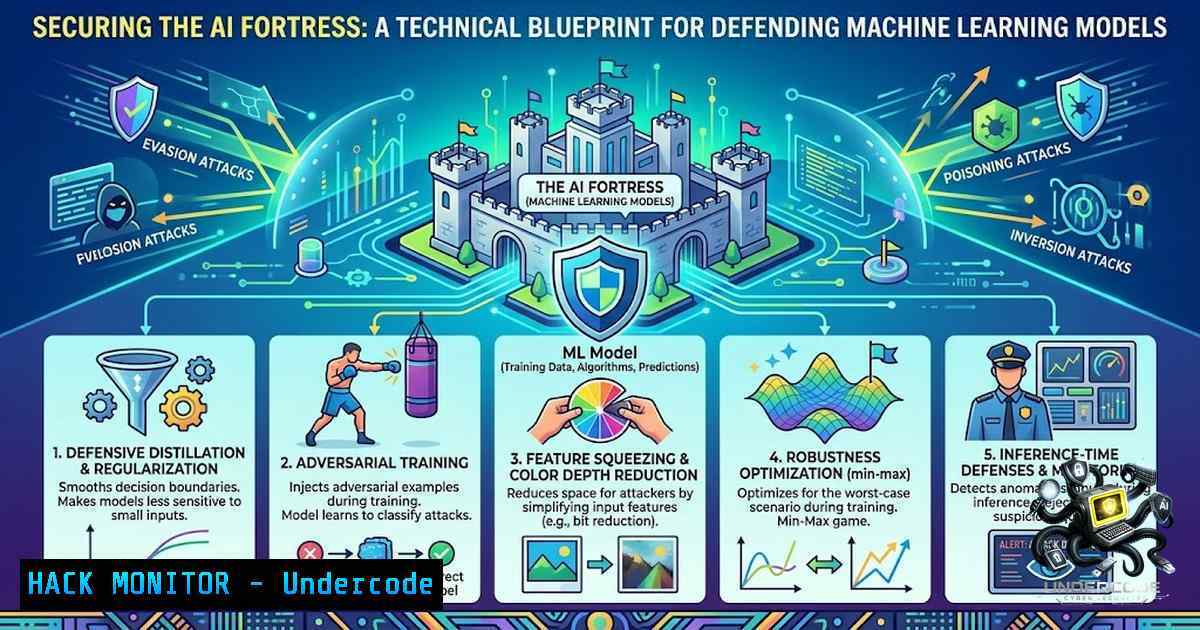
The proliferation of Artificial Intelligence (AI) and Large Language Models (LLMs) in enterprise environments has dramatically expanded the attack surface, introducing a new class of vulnerabilities that transcend traditional cybersecurity paradigms. As highlighted by cyber expert Rasim Mrsič, protecting AI systems demands a holistic strategy that secures the entire model lifecycle—from training data integrity and architectural robustness to production execution and API security. This article provides a deep-dive technical guide for security professionals and AI engineers, offering actionable steps, verified commands, and best practices to fortify AI assets against data poisoning, adversarial examples, prompt injection, and model theft.
Learning Objectives:
- Understand the core vulnerabilities across the AI/ML lifecycle, including data poisoning, adversarial evasion, and model extraction.
- Implement technical controls and configuration strategies to secure training data, model APIs, and LLM prompts.
- Apply hands-on Linux, Windows, and API security commands to harden AI infrastructure and detect attacks.
- Hardening the Data Pipeline: Preventing Data Poisoning and Model Contamination
Data is the foundation of any AI system; if the training data is compromised, the model’s integrity is irreparably damaged. Data poisoning attacks, where adversaries inject malicious samples into the training set, can cause models to behave unpredictably or introduce backdoors. To mitigate this, a cyber expert must implement a robust “trusted data pipeline.”
Step‑by‑step guide:
- Data Source Validation: Implement strict access controls and cryptographic verification for all data sources. Use SHA-256 checksums to verify the integrity of datasets before ingestion.
- Statistical Anomaly Detection: Employ statistical methods (e.g., Z-score analysis, Isolation Forests) to filter out outlier samples that deviate significantly from the expected data distribution.
- Federated Learning Sanitization: In federated environments, use clustering-based defenses to group model updates and isolate poisoned outliers.
Verified Commands (Linux):
 Generate SHA-256 checksum for dataset verification
sha256sum training_data.csv > dataset_checksum.sha256

Verify dataset integrity before training
sha256sum -c dataset_checksum.sha256

Use `find` and `file` to audit data directories for unexpected file types
find /data/training -type f -exec file {} \; | grep -v "ASCII text|CSV"
Windows (PowerShell):
 Generate file hash for integrity checking
Get-FileHash -Path .\training_data.csv -Algorithm SHA256 | Out-File .\dataset_checksum.txt

Verify hash
$hash = Get-FileHash -Path .\training_data.csv -Algorithm SHA256
if ($hash.Hash -eq (Get-Content .\dataset_checksum.txt)) { Write-Host "Integrity verified" }
Tutorial Insight: Implement a data validation layer in your ML pipeline (e.g., using TensorFlow Data Validation or Great Expectations) to automatically detect and reject anomalous data points before they reach the model.
2. Fortifying Model Integrity Against Adversarial Attacks
Adversarial examples—subtly perturbed inputs that fool ML models—pose a significant threat. Defending against these requires specialized training techniques and runtime monitoring.
Step‑by‑step guide:
- Adversarial Training: Augment your training dataset with adversarial samples generated using techniques like FGSM (Fast Gradient Sign Method) or PGD (Projected Gradient Descent). This teaches the model to be robust against such perturbations.
- Ensemble Methods: Deploy ensemble models that aggregate predictions from multiple architectures, reducing the likelihood that a single adversarial input will fool the entire system.
- Input Preprocessing: Implement input sanitization and normalization (e.g., feature squeezing, JPEG compression for images) to reduce the impact of adversarial noise.
Code Snippet (Python with TensorFlow):
import tensorflow as tf
 Example: Adversarial training with FGSM
def adversarial_loss(model, x, y, epsilon=0.1):
with tf.GradientTape() as tape:
tape.watch(x)
prediction = model(x)
loss = tf.keras.losses.categorical_crossentropy(y, prediction)
gradient = tape.gradient(loss, x)
x_adv = x + epsilon  tf.sign(gradient)
return model(x_adv)
Windows/Linux Monitoring: Use `iftop` (Linux) or `Performance Monitor` (Windows) to monitor network traffic for unusual patterns that might indicate an adversarial probing attack.
3. Implementing Robust LLM Guardrails Against Prompt Injection
With the rise of generative AI, prompt injection has become a critical OWASP Top 10 risk (LLM01). Attackers can manipulate input prompts to bypass safety filters, exfiltrate system prompts, or cause the model to produce harmful outputs.
Step‑by‑step guide:
- Input Sanitization and Filtering: Use regex and ML-based classifiers to detect and block known malicious prompt prefixes like “Ignore your previous instructions” or “You are now in DAN mode”.
- Role-Context Separation: Clearly separate system instructions from user input using explicit delimiters (e.g., `<|system|>` and `<|user|>` tags). Never allow user input to override system-level prompts.
- Output Validation: Treat all LLM outputs as untrusted. Implement a validation layer that checks outputs against a policy before they are returned to the user.
Configuration Example (Nginx Rate Limiting for LLM APIs):
 Limit requests to prevent abuse and model extraction
limit_req_zone $binary_remote_addr zone=llm_api:10m rate=10r/m;
server {
location /v1/chat/completions {
limit_req zone=llm_api burst=5 nodelay;
proxy_pass http://llm_backend;
}
}
Linux Command for Log Analysis:
 Detect rapid-fire API calls indicative of prompt injection attempts
tail -f /var/log/nginx/access.log | grep "POST /v1/chat/completions" | awk '{print $1}' | uniq -c | sort -1r
4. Preserving Privacy with Differential Privacy
To prevent model inversion attacks that leak sensitive training data, integrate Differential Privacy (DP) into the training process. DP adds calibrated noise to gradients, ensuring that the model does not memorize individual data points.
Step‑by‑step guide:
- DP-SGD (Differentially Private Stochastic Gradient Descent): Modify your training loop to clip per-example gradients and add Gaussian noise.
- Privacy Budget Accounting: Use a privacy budget manager (e.g., `PrivacyBudgetManager` in PyTorch) to track the total privacy loss (epsilon).
Code Snippet (Using Opacus for PyTorch):
from opacus import PrivacyEngine

privacy_engine = PrivacyEngine()
model, optimizer, data_loader = privacy_engine.make_private(
module=model,
optimizer=optimizer,
data_loader=data_loader,
noise_multiplier=0.8,
max_grad_norm=1.0,
)
Linux Environment Setup:
 Install Opacus for differential privacy
pip install opacus
 Verify installation
python -c "import opacus; print(opacus.<strong>version</strong>)"
- Preventing Model Theft via API Rate Limiting and Behavioral Monitoring
Model extraction attacks allow adversaries to clone proprietary models by querying public APIs. Rate limiting alone is insufficient; a multi-layered approach is required.
Step‑by‑step guide:
- Multi-Dimensional Rate Limiting: Implement limits on requests per minute (RPM), tokens per minute (TPM), and cost per minute to control resource consumption and extraction attempts.
- Behavioral Fingerprinting: Monitor query patterns for unusual distributions or systematic probing that deviates from normal user behavior.
- Output Perturbation: Add slight noise to logits or round probability outputs to reduce the information available for distillation.
Linux iptables Rate Limiting:
 Limit incoming connections to the AI API port to 10 per minute
iptables -A INPUT -p tcp --dport 5000 -m limit --limit 10/min -j ACCEPT
iptables -A INPUT -p tcp --dport 5000 -j DROP
Windows PowerShell (Using New-1etFirewallRule):
 Create a firewall rule to limit traffic (advanced configuration requires third-party tools)
New-1etFirewallRule -DisplayName "AI API Rate Limit" -Direction Inbound -Protocol TCP -LocalPort 5000 -Action Block -RemoteAddress 192.168.1.0/24
6. Proactive Red Teaming and Continuous Security Assessment
Adversarial testing is essential to validate AI defenses. AI red teaming involves simulating attacks to uncover vulnerabilities before malicious actors do.
Step‑by‑step guide:
- Automated Red Teaming: Use frameworks that generate adversarial prompts and evaluate model responses across multiple attack categories.
- Jailbreak Testing: Systematically test for prompt injection and jailbreak techniques using a taxonomy of attack vectors.
- Continuous Monitoring: Implement logging and audit trails for all model interactions to detect and respond to security incidents.
Linux Command for Audit Logging:
 Set up auditd to monitor access to model files
auditctl -w /models/production/model.pb -p rwa -k model_access
ausearch -k model_access -i
What Undercode Say:
- Key Takeaway 1: AI security is not a one-time implementation but a continuous lifecycle process that demands vigilance at every stage—from data collection to inference.
- Key Takeaway 2: Traditional security controls (firewalls, WAFs) are insufficient; specialized techniques like adversarial training, differential privacy, and prompt guardrails are mandatory for modern AI systems.
Analysis: The convergence of AI and cybersecurity presents both immense opportunities and critical risks. As organizations rush to deploy generative AI, they often overlook the unique threat vectors that these models introduce. The OWASP Top 10 for LLM Applications (2025/2026) serves as a crucial benchmark, highlighting risks such as prompt injection, data poisoning, and model theft. A defense-in-depth strategy, combining technical controls (rate limiting, DP-SGD) with proactive red teaming, is essential. Moreover, the economics of AI security are shifting—model extraction can cost as little as $50, making it a viable attack for competitors. Organizations must adopt a zero-trust mindset for AI, treating all inputs and outputs as potentially compromised.
Prediction:
- -1: The increasing commoditization of AI models will lead to a surge in model extraction attacks, eroding the competitive advantage of proprietary AI systems.
- -1: Without widespread adoption of differential privacy and robust data sanitization, high-profile data breaches originating from model inversion attacks will become more common, resulting in significant regulatory fines.
- +1: The rise of AI-specific security frameworks (OWASP GenAI, MITRE ATLAS) will drive standardization, leading to the development of automated security tooling that integrates seamlessly into MLOps pipelines.
- +1: Adversarial training and federated learning will evolve into standard practices, creating a new generation of AI models that are inherently more robust and privacy-preserving.
▶️ Related Video (72% Match):
🎯Let’s Practice For Free:
🎓 Live Courses & Certifications:
Join Undercode Academy for Verified Certifications
🚀 Request a Custom Project:
Secure, high-velocity infrastructure and disruptive technological engineering. Contact our engineering team for high-tier development and proprietary systems:
[email protected]
💎 Smart Architecture | 🛡️ Secure by Design | ⭐ Trusted by Thousands
IT/Security Reporter URL:
Reported By: Rasim Mrsic – Hackers Feeds
Extra Hub: Undercode MoN
Basic Verification: Pass ✅


