Listen to this Post
Introduction:
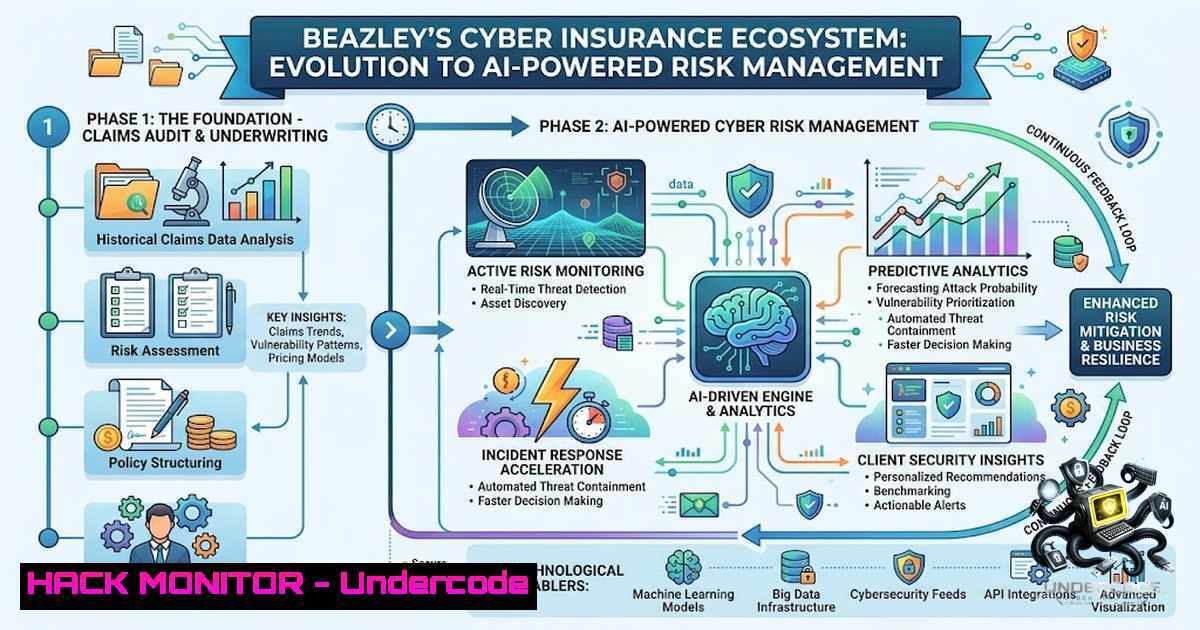
Cyber insurance has evolved from a niche product into a critical component of enterprise risk management, with the U.S. cyber insurance market posting nearly 11% growth in direct written premiums in 2025, reversing two consecutive years of decline. At the heart of this ecosystem lies the claims analysis and auditing process—a technical discipline that demands equal parts forensic investigation, security architecture comprehension, and client relationship management. This article examines the technical underpinnings of cyber claims auditing, the transformative impact of artificial intelligence on underwriting, and the practical security controls that organizations must implement to qualify for coverage, drawing on Beazley’s market-leading approach to cyber risk.
Learning Objectives:
- Understand the end-to-end cyber claims lifecycle, from first notice of loss to final adjustment, including forensic evidence requirements and business interruption calculations
- Master the technical security controls (MFA, backup isolation, patching cadence) that insurers verify during claims investigations
- Analyze how AI is reshaping underwriting, vulnerability assessment, and the creation of new risk categories like “silent AI” exposure
- Apply practical Linux and Windows commands for security auditing, log analysis, and vulnerability scanning relevant to claims substantiation
- Evaluate Beazley’s Cyber Risk Framework and its application to organizational security posture assessment
You Should Know:
- The Cyber Claims Lifecycle: From Incident to Indemnification
Beazley’s cyber claims process is bespoke—every incident presents unique technical and factual circumstances. Understanding this lifecycle is essential for both claims professionals and security practitioners seeking to position their organizations for successful outcomes.
Step-by-Step Guide to the Claims Investigation Process:
Days 1–3: Initial Triage and Assignment
- The insurer assigns a dedicated Claims Manager within one business day, providing direct contact details
- The claims team initiates a preliminary assessment to determine coverage applicability and incident scope
- Forensic investigators are typically engaged to begin evidence preservation
Week 1–2: Evidence Collection and Validation
- Investigators verify that declared security controls (MFA, backup isolation, patching cadence) were actually in place at the time of the incident
- Audit evidence must be current and accessible—organizations should maintain documentation of vendor risk assessments, security questionnaires, contract exhibits, SLA monitoring logs, and pre-incident vendor communications
- The Admiralty Code may be applied to score threat actor credibility, assessing both source reliability and information credibility
Weeks 2–4: Business Interruption Calculation
- Cyber business interruption claims require quantification of downtime, lost revenue, and extra expenses
- Beazley’s loss development tables provide historical claims development data across five segments: Cyber Risks, Digital, MAP Risks, and others
Beyond 30 Days: Resolution and Payment
- Beazley’s Cyber Cash product provides advance payments of up to $100,000 for eligible clients, delivering fast financial support while claims are fully processed
- Interim claims payments support business continuity during difficult data recovery
Technical Commands for Claims Evidence Gathering:
On Linux systems, forensic investigators commonly use:
 Collect system audit logs
sudo ausearch -ts today -m USER_LOGIN,USER_LOGOUT > /var/log/audit_summary.log

Check for unauthorized access attempts
sudo grep "Failed password" /var/log/auth.log | wc -l

Verify file integrity with SHA-256 hashing
find /critical/data -type f -exec sha256sum {} \; > file_integrity_manifest.txt

Capture network connection history
sudo netstat -tunap > network_connections_$(date +%Y%m%d).log

Extract systemd service logs for anomaly detection
sudo journalctl --since "2026-08-01" --until "2026-08-09" -p 3..0 > critical_events.log
On Windows systems:
 Export security event log
Get-WinEvent -LogName Security -MaxEvents 1000 | Export-Csv -Path security_events.csv

Check for suspicious scheduled tasks
Get-ScheduledTask | Where-Object {$_.State -1e "Disabled"} | Format-Table -AutoSize

Verify Windows Defender status and scan history
Get-MpComputerStatus
Start-MpScan -ScanType QuickScan

Collect PowerShell script block logging
Get-WinEvent -LogName "Microsoft-Windows-PowerShell/Operational" | Select-Object -First 100

Check for unusual user account creations
Get-WinEvent -LogName Security | Where-Object {$_.Id -eq 4720}
- Security Controls Verification: What Insurers Actually Look For
Most cyber claims fail for three primary reasons: failure to maintain declared controls, inadequate documentation, and policy exclusion triggers. Insurers validate that security measures are not merely declared but demonstrably operational.
Step-by-Step Control Verification Audit:
Multi-Factor Authentication (MFA) Validation:
- Verify MFA enrollment across all privileged accounts
- Check for MFA bypass exceptions and service account exemptions
- Audit MFA logs for failed authentication attempts indicating potential credential compromise
Backup Isolation Verification:
- Confirm that backups are air-gapped or isolated from production networks
- Validate that recovery procedures are tested at least quarterly
- Review backup logs for completion and integrity verification
Patching Cadence Review:
- Assess time-to-patch for critical vulnerabilities (CVE-based metrics)
- Verify automated patching systems and manual exception processes
- Review vulnerability scanning reports for unpatched systems
Vendor Risk Management:
- Provide evidence of pre-incident vendor risk assessments
- Document vendor security questionnaires and contract security exhibits
- Maintain SLA monitoring logs and vendor communication records
Technical Commands for Control Verification:
Linux MFA and access auditing:
 Check PAM configuration for MFA requirements
sudo cat /etc/pam.d/common-auth | grep -i "pam_google_authenticator|pam_duo|pam_u2f"

List all users and their last login times
sudo lastlog | grep -v "Never logged in"

Verify sudoers file for privilege escalation controls
sudo visudo -c

Check SSH configuration for key-based authentication
sudo grep -E "PubkeyAuthentication|PasswordAuthentication|PermitRootLogin" /etc/ssh/sshd_config
Windows Active Directory and MFA audit:
 Check Azure AD MFA registration status
Get-MgUser -All | Select-Object UserPrincipalName, @{N="MFAEnabled";E={$_.StrongAuthenticationMethods.Count -gt 0}}

List domain admins and privileged groups
Get-ADGroupMember -Identity "Domain Admins" | Select-Object Name

Review password policy
Get-ADDefaultDomainPasswordPolicy

Check BitLocker encryption status
Get-BitLockerVolume

Verify Windows Update status
Get-WUHistory | Select-Object -First 20
- AI’s Transformative Impact on Cyber Underwriting and Risk Assessment
Artificial intelligence is reshaping how insurers and brokers think about risk, creating exposures that were barely on the radar just a couple of years ago. Fitch Ratings has identified AI as “particularly disruptive to cyber risk because traditional vulnerability analysis was labor-intensive and offered limited financial upside for researchers”.
Key AI Risk Categories in Underwriting:
Generative AI Coverage Endorsements: Insurers are increasingly introducing AI-specific exclusions into errors and omissions policies, particularly where businesses rely on AI-generated outputs without meaningful human oversight. The insurance industry is addressing increased demand for AI-specific coverage across professional liability (E&O), crime, cyber insurance, and directors and officers (D&O) policies.
“Silent AI” Exposure: “Silent AI” is quickly becoming the next portfolio blind spot—prompting exclusions, tougher underwriting questions, and the early shape of a standalone market. Insurers now seek details on the types of AI companies deploy, how data flows through those systems, who can access AI models, and whether firms have processes to detect and fix unusual outputs.
Agentic AI Threats: AI agents that operate autonomously to scale cyber attacks with unprecedented speed and efficiency represent a more advanced and concerning development. This creates new underwriting considerations around systemic risk aggregation.
Technical Commands for AI Risk Assessment:
Linux-based AI model security scanning:
 Scan for exposed AI/ML model endpoints
nmap -p 8000-9000 --open target_ip | grep "open" | while read line; do
curl -s http://target:${line%%/}/v1/models | jq '.data[].id'
done

Check for unauthorized AI tool installations
sudo find / -1ame "llama" -o -1ame "gpt" -o -1ame "transformers" 2>/dev/null

Audit Python packages for AI/ML libraries
pip list | grep -E "tensorflow|torch|transformers|langchain|openai"
Windows-based AI usage auditing:
 Detect AI-related processes running
Get-Process | Where-Object {$_.ProcessName -match "python|node|java"} | Select-Object ProcessName, CPU

Check for unauthorized cloud AI SDK installations
Get-ChildItem -Path C:\Users\AppData\Local\Programs\Python\Python\Lib\site-packages -Recurse | Where-Object {$_.Name -match "openai|anthropic|google-cloud-ai"}

Review PowerShell history for AI API key usage
Get-Content (Get-PSReadLineOption).HistorySavePath | Select-String "api_key|token|secret"
- Beazley’s Cyber Risk Framework: A Technical Architecture for Risk Quantification
Beazley Security’s Cyber Risk Framework assesses eight critical business areas through structured workshops, identifying gaps, assessing current maturity, and developing prioritized actionable initiatives. The framework is aligned with the National Institute of Standards and Technology Cybersecurity Framework (NIST CSF).
Framework Components and Technical Implementation:
Exposure Management: Beazley Security’s Exposure Management platform provides continuous visibility into supply chain risks and monitors for compromised credentials to help preemptively avoid compromise. The platform looks for open ports, exposed services, software vulnerabilities, and other important risk factors.
Three Lines of Defence: Beazley has adopted the “three lines of defence” framework: business risk management, the risk management function, and the internal audit function. This ensures layered accountability for cyber risk.
Cyber Action Plan: The Beazley Cyber Action Plan provides personalized risk management information through a 10-question assessment covering Endpoint Protection (EPP) and other critical controls.
Technical Commands for Framework Implementation:
External attack surface scanning (replicating Beazley Security’s approach):
 Scan for open ports and exposed services
nmap -sS -sV -p- -T4 --min-rate=1000 target_domain.com

Check for subdomain takeover vulnerabilities
subfinder -d target_domain.com | while read sub; do
curl -s -I $sub | grep -i "server:"
done

Enumerate SSL/TLS configurations
testssl.sh --quiet target_domain.com

Check for exposed cloud storage
aws s3 ls s3://target-bucket --1o-sign-request --region us-east-1 2>/dev/null
Windows-based internal vulnerability assessment:
 Run Microsoft Baseline Security Analyzer (MBSA) scan
mbsacli /target 127.0.0.1 /n os+iis+sql+1assword

Check for missing security updates
Get-WUList | Where-Object {$_.IsInstalled -eq $false} | Select-Object , KBArticleIDs

Audit local security policy
secedit /export /cfg C:\security_policy.txt
Get-Content C:\security_policy.txt | Select-String "PasswordComplexity|MinimumPasswordLength"

Review firewall rules for exposed services
Get-1etFirewallRule | Where-Object {$<em>.Direction -eq "Inbound" -and $</em>.Action -eq "Allow"} | Select-Object DisplayName, RemotePort
- The Convergence of Claims Analysis and Proactive Security Posture
The most effective cyber claims professionals understand that claims analysis is not merely reactive—it informs proactive security posture improvement. Beazley’s approach emphasizes that “cyber response starts before the attack even occurs”, and that “a single claims handler typically cannot resolve a cyber claim on their own”.
Integration of Claims Data into Security Programs:
Claims data provides invaluable intelligence on attack patterns, vulnerability exploitation timelines, and control effectiveness. Organizations should:
- Maintain continuous audit evidence that is current and accessible for insurers
- Document incident processes and breach notification timelines
- Regularly audit claims processes to identify weak points
- Review vendor controls and SLAs against policy language
Technical Commands for Continuous Monitoring:
Linux security monitoring:
 Set up real-time log monitoring with auditd
sudo auditctl -w /etc/passwd -p wa -k identity_changes
sudo auditctl -w /etc/sudoers -p wa -k sudoers_changes
sudo auditctl -e 1

Monitor failed authentication attempts in real-time
sudo tail -f /var/log/auth.log | grep "Failed password"

Check for suspicious cron jobs
sudo cat /etc/crontab /etc/cron./ 2>/dev/null | grep -v "^"

Monitor network connections for unusual outbound traffic
sudo tcpdump -i any -1 "tcp[bash] & (tcp-syn) != 0" -c 100
Windows continuous monitoring:
 Configure Windows Event Forwarding for centralized logging
wevtutil set-log Security /enabled:true /retention:false /maxsize:1073741824

Monitor for privilege escalation attempts
Get-WinEvent -LogName Security -FilterXPath "[System[EventID=4672]]" -MaxEvents 50

Track changes to critical system files
$watcher = New-Object System.IO.FileSystemWatcher
$watcher.Path = "C:\Windows\System32\drivers\etc"
$watcher.Filter = "hosts"
Register-ObjectEvent $watcher "Changed" -Action { Write-Host "Hosts file changed!" }

Monitor PowerShell script execution
Get-WinEvent -LogName "Microsoft-Windows-PowerShell/Operational" -FilterXPath "[System[EventID=4104]]"
What Undercode Say:
- Claims analysis is fundamentally a forensic discipline: The ability to audit and validate security controls determines claim outcomes. Organizations that maintain verifiable audit trails—MFA logs, backup integrity reports, patching histories—position themselves for successful claim resolution. The technical commands provided in this article represent the minimum evidence collection toolkit for any serious cyber claims professional.
-
AI is creating both risk and opportunity in underwriting: The emergence of “silent AI” exposure and agentic AI threats demands new underwriting frameworks. Organizations must now answer detailed questions about AI deployment, data flows, and model governance. The convergence of AI and cyber insurance represents a paradigm shift comparable to the transition from physical to digital risk assessment.
Prediction:
-
+1 Cyber insurance will increasingly require real-time security posture monitoring as a condition of coverage, with insurers integrating directly with client SIEM and EDR platforms to validate control effectiveness continuously rather than through periodic audits.
-
+1 Agentic AI underwriting platforms will reduce quote times from days to minutes, enabling dynamic pricing that reflects real-time threat intelligence and organizational security posture, similar to how usage-based insurance transformed auto coverage.
-
-1 AI-specific exclusions will proliferate, creating coverage gaps for organizations that deploy generative AI without explicit underwriting approval. The “silent AI” problem may mirror the “silent cyber” crisis that plagued the insurance industry from 2016-2020.
-
-1 The sophistication of AI-driven cyber attacks will outpace traditional claims investigation methodologies, requiring insurers to develop new forensic capabilities for detecting and attributing AI-generated attacks—a capability that currently does not exist at scale.
-
+1 The integration of cyber insurance claims data with threat intelligence platforms will create a virtuous cycle: claims data informs underwriting, underwriting drives security improvements, and improved security reduces claims frequency. Beazley’s Full Spectrum Cyber ecosystem exemplifies this approach.
-
+1 Vendor risk monitoring will become a mandatory coverage requirement as third-party breaches continue to represent the largest single category of cyber insurance claims. Organizations without continuous third-party risk monitoring will face higher premiums or coverage exclusions.
▶️ Related Video (74% Match):
https://www.youtube.com/watch?v=0oeD2Wf25wY
🎯Let’s Practice For Free:
🎓 Live Courses & Certifications:
Join Undercode Academy for Verified Certifications
🚀 Request a Custom Project:
Secure, high-velocity infrastructure and disruptive technological engineering. Contact our engineering team for high-tier development and proprietary systems:
[email protected]
💎 Smart Architecture | 🛡️ Secure by Design | ⭐ Trusted by Thousands
IT/Security Reporter URL:
Reported By: Zoe Lanham – Hackers Feeds
Extra Hub: Undercode MoN
Basic Verification: Pass ✅


