Listen to this Post
Introduction
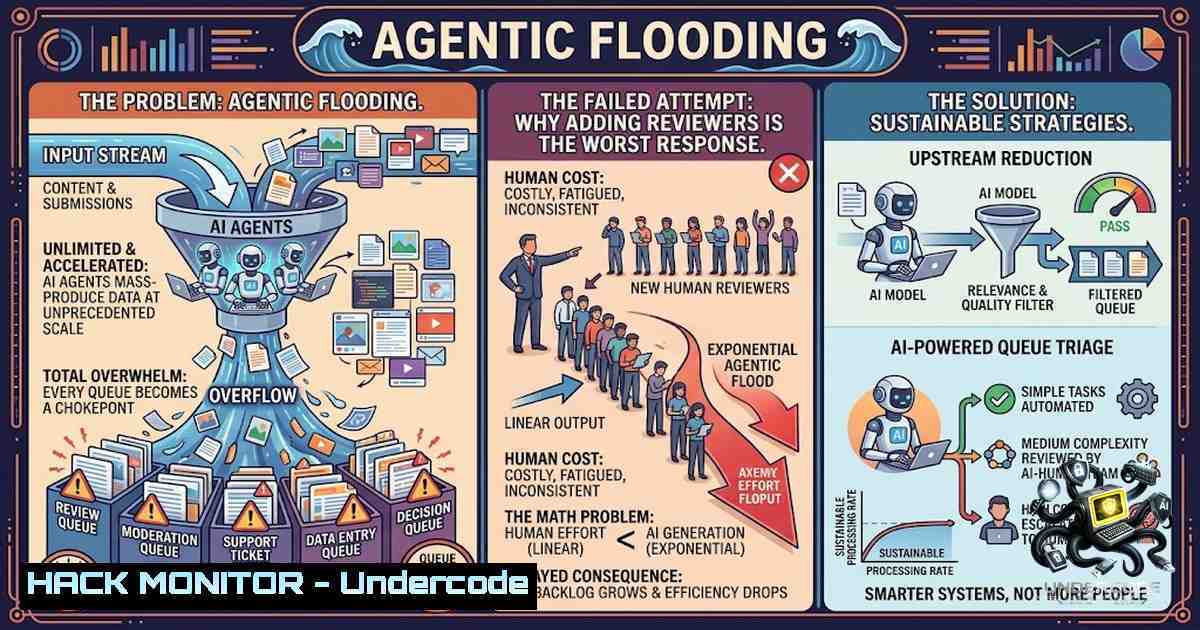
The economics of generation have been inverted. Artificial intelligence has made the creation of claims, vulnerability reports, and code contributions effectively free, while the systems designed to verify them still operate at human speed. This asymmetry—what researchers have termed “agentic flooding”—is not a theoretical concern. British employment tribunals are scheduling hearings into 2028, with open claims rising 55 percent in a single year and applications for emergency injunctions increasing more than a hundredfold. In the security world, Daniel Stenberg terminated the curl bug bounty program after the share of genuine vulnerability reports fell from one in six to fewer than one in twenty. Faros AI’s telemetry across 1,255 teams revealed that high AI adoption produced 98 percent more merged pull requests, 91 percent longer review times, and no improvement in delivery metrics. The pattern is consistent: we automated the generating and left the verifying where it was.
Learning Objectives
- Understand the concept of agentic flooding and its implications for cybersecurity, IT operations, and public service delivery
- Master queueing theory principles that explain why adding reviewers fails under AI-driven load surges
- Learn practical strategies including economic pricing, machine-checkable gates, and statistical sampling to mitigate AI-generated noise
- Acquire hands-on techniques for implementing policy-as-code, automated validation pipelines, and API security controls
- Develop a framework for distinguishing legitimate AI-augmented demand from malicious or low-quality automation
You Should Know
- The Queueing Theory Trap: Why More Reviewers Make Things Worse
The instinctive response to any flood of incoming requests is to add more reviewers. Queueing theory demonstrates why this is a losing move. In any stable queueing system, waiting time scales with 1 / (1 – utilization). A system already operating at high utilization—say 80 or 90 percent—does not degrade gracefully when arrival rates increase. It collapses.
Consider a security triage team processing 100 reports per week with a capacity of 110. Utilization is approximately 91 percent. If AI doubles the arrival rate to 200 reports per week, the queue does not merely double in length. It grows exponentially. The system enters a state of saturation where response times become unbounded, backlogs spiral, and human reviewers spend their days triaging noise rather than finding genuine vulnerabilities.
Daniel Stenberg described the toll precisely: “The never-ending slop submissions take a serious mental toll to manage and sometimes also a long time to debunk. Time and energy that is completely wasted while also hampering our will to live”. The curl project’s seven volunteers spent their days disproving bugs that had never existed.
Step-by-Step: Diagnosing Queue Saturation in Your Security Operations
- Measure arrival rate (λ) : Count incoming reports, tickets, or pull requests per unit time. Establish a baseline from the pre-AI period.
- Measure service rate (μ) : Determine how many items your team can process per unit time. Be honest about capacity—include triage, investigation, and documentation.
- Calculate utilization (ρ = λ/μ) : If ρ exceeds 0.80, you are in the danger zone. If ρ exceeds 0.90, you are one surge away from collapse.
- Model the impact of AI acceleration : Apply a multiplier of 2x, 5x, or 10x to λ. Recalculate ρ and estimate new queue lengths using the formula Lq = ρ² / (1 – ρ) for an M/M/1 queue.
- Project review time inflation : Use W = 1 / (μ – λ) to estimate how long each item will wait. When λ approaches μ, W approaches infinity.
Linux Command: Monitoring System Queue Lengths
 Monitor network connection queue lengths
ss -lnt | grep -c LISTEN

Check system load average as a proxy for processing saturation
uptime

Track file descriptor queues for web servers
lsof -i :80 | wc -l

For Kubernetes environments, monitor pod queue depths
kubectl get pods --all-1amespaces | grep -c Pending
Windows Command: Performance Monitoring
 Check system processor queue length
Get-Counter '\System\Processor Queue Length'

Monitor network interface queue drops
Get-Counter '\Network Interface()\Packets Outbound Discarded'

Track IIS request queue depth
Get-Counter '\Web Service()\Current Connections'
- Pricing the Inflow: Removing the Economic Incentive for Noise
The most effective filter is economic. When curl removed prize money from its bug bounty program, the valid-report rate recovered to 15 percent. When the Financial Ombudsman Service charged claims firms £250 per case, quarterly cases from professional representatives fell from 37,100 to 4,300—a reduction of nearly 90 percent.
AI makes submission nearly free. The solution is to reintroduce friction at the point of entry, not at the point of verification. This friction must be calibrated: high enough to deter bad-faith or low-effort automation, but low enough not to exclude legitimate claimants who could never afford a lawyer.
Step-by-Step: Implementing Economic Gates for Security Reports
- Introduce a nominal submission fee : For bug bounty programs, require a refundable deposit that is returned upon confirmation of a valid vulnerability. This filters out low-effort submissions while rewarding genuine researchers.
- Implement reputation scoring : Track the historical accuracy of each submitter. High-reputation reporters bypass fees; low-reputation or first-time reporters pay upfront.
- Require proof-of-concept code : Stenberg’s rule is simple: “you do not report a bug you cannot reproduce”. Mandate that every submission includes a working proof of concept.
- Automate initial validation : Run submitted code in a sandboxed environment. If the code does not execute or fails to demonstrate the claimed behavior, reject it automatically.
- Cap submissions per reporter per period : Limit each individual or organization to a reasonable number of submissions per week or month.
Code Example: Automated Proof-of-Concept Validator
import subprocess
import tempfile
import os
import json

def validate_poc(poc_code, test_environment):
"""
Validate that a submitted proof-of-concept actually reproduces
the claimed vulnerability.
"""
with tempfile.NamedTemporaryFile(mode='w', suffix='.py', delete=False) as f:
f.write(poc_code)
poc_path = f.name

try:
 Run in isolated sandbox with timeout
result = subprocess.run(
['python3', poc_path],
capture_output=True,
text=True,
timeout=30,
cwd=test_environment
)

Parse output for vulnerability confirmation
output = json.loads(result.stdout)
return output.get('vulnerability_confirmed', False)
except Exception as e:
return False
finally:
os.unlink(poc_path)
- Machine-Checkable Gates: Policy as Code and Spec-Driven Pipelines
The second strategy is to gate submissions on something a machine can verify automatically. This shifts the burden of proof from the reviewer to the sender and eliminates the need for human triage on obvious noise.
For security reports, this means requiring reproducible test cases. For code contributions, this means enforcing policy-as-code: compliant paths are the only paths. For public service applications, this means validating eligibility against authoritative data sources before accepting a claim for human review.
Step-by-Step: Building Machine-Checkable Gates
- Define policy as code : Use tools like Open Policy Agent (OPA) or HashiCorp Sentinel to codify acceptance criteria.
- Implement pre-commit hooks : For code repositories, run automated checks—linting, security scanning, dependency validation—before a pull request is even created.
- Enforce API security schemas : Use OpenAPI or JSON Schema to validate all incoming requests at the edge. Reject malformed or non-compliant payloads without human intervention.
- Automate vulnerability reproduction : For security reports, run submitted proof-of-concept code in a sandbox and verify the claimed behavior automatically.
- Implement continuous compliance scanning : Use tools like Terrascan, Checkov, or AWS Config to continuously validate infrastructure against policy.
Open Policy Agent (OPA) Example: Validating Vulnerability Report Quality
package vulnerability_report

A report is valid only if it includes a reproducible proof of concept
default valid = false

valid {
input.proof_of_concept != ""
input.proof_of_concept contains "exploit"
input.cve_id != ""
count(input.affected_versions) > 0
}

Reject reports from submitters with low reputation scores
reject_low_reputation {
input.reputation_score < 0.5
}

Allow high-reputation submitters with minimal validation
allow_trusted {
input.reputation_score >= 0.8
input.proof_of_concept != ""
}
GitHub Actions Pre-Commit Hook for Automated Validation
name: Validate Security Report

on:
issues:
types: [opened, edited]

jobs:
validate-report:
runs-on: ubuntu-latest
steps:
- name: Check for proof of concept
run: |
if ! grep -q "```" <<< "${{ github.event.issue.body }}"; then
echo "❌ Missing proof-of-concept code block"
exit 1
fi

<ul>
<li>name: Check for CVE reference
run: |
if ! grep -qE "CVE-[0-9]{4}-[0-9]{4,}" <<< "${{ github.event.issue.body }}"; then
echo "❌ Missing CVE reference"
exit 1
fi</p></li>
<li><p>name: Add validation label
run: |
gh issue edit ${{ github.event.issue.number }} --add-label "validated"
4. Statistical Sampling: Quality Assurance Without Exhaustive Review
Manufacturing solved this problem in the 1930s. Exhaustive inspection was always the expensive way to buy quality. Statistical process control—inspecting a sample rather than the population—provides the same quality assurance at a fraction of the cost.
For security operations, this means randomly sampling a percentage of incoming reports for deep review while routing the remainder through automated pipelines. For code reviews, this means reviewing a statistically significant sample of pull requests rather than every single one.
Step-by-Step: Implementing Statistical Sampling in Security Operations
- Establish a baseline quality metric : Determine the current rate of genuine findings in your incoming queue.
- Define acceptable quality levels (AQL) : Decide what percentage of false positives is acceptable.
- Calculate sample size : Use statistical formulas to determine how many items must be inspected to detect deviations from baseline quality.
- Implement random sampling : Use a deterministic hash of each submission ID to select items for deep review.
- Monitor trends : Track the quality of sampled items over time. If the genuine-finding rate drops below a threshold, trigger a full audit.
Python Script: Deterministic Sampling for Security Reports
import hashlib

def should_deep_review(submission_id, sample_rate=0.10):
"""
Deterministically select submissions for deep review based on
a hash of the submission ID.
"""
hash_value = int(hashlib.sha256(submission_id.encode()).hexdigest(), 16)
return (hash_value % 100) < (sample_rate  100)

Example usage
submissions = ['REP-2026-001', 'REP-2026-002', 'REP-2026-003']
for sid in submissions:
if should_deep_review(sid, sample_rate=0.10):
print(f"Deep review required for {sid}")
else:
print(f"Automated review only for {sid}")
5. API Security Hardening Against Agentic Flooding
AI agents will relentlessly consume public APIs, as Tom Loosemore demonstrated when his AI agent queried the Gov.uk Energy Performance Certificate API, Ordnance Survey data, and Land Registry datasets to build a council tax appeal. This is the infrastructure-level manifestation of agentic flooding.
Step-by-Step: Hardening APIs Against Automated Abuse
- Implement rate limiting : Use token bucket or leaky bucket algorithms to restrict requests per IP, per API key, and per user.
- Deploy API gateways : Use Kong, AWS API Gateway, or Azure API Management to enforce policies at the edge.
- Require proof of work : For high-value endpoints, require clients to solve a computational puzzle before submitting requests.
- Implement anomaly detection : Use machine learning to detect unusual request patterns that indicate agentic behavior.
- Enforce strict authentication : Require OAuth 2.0 or mutual TLS for all API calls. Reject unauthenticated requests immediately.
NGINX Rate Limiting Configuration
 Rate limit configuration for API endpoints
limit_req_zone $binary_remote_addr zone=api_limit:10m rate=10r/s;
limit_req_zone $binary_remote_addr zone=api_burst:10m rate=5r/s;

server {
location /api/ {
limit_req zone=api_limit burst=20 nodelay;
limit_req zone=api_burst burst=10;
proxy_pass http://backend;
}
}
AWS API Gateway Rate Limiting (Terraform)
resource "aws_api_gateway_usage_plan" "api_usage" {
name = "api-usage-plan"

api_stages {
api_id = aws_api_gateway_rest_api.api.id
stage = aws_api_gateway_stage.stage.stage_name
}

throttle_settings {
burst_limit = 100
rate_limit = 50
}
}
6. Cloud Hardening: Defending Against AI-Generated Attack Vectors
AI does not only generate noise—it also generates novel attack vectors. Security teams must harden their cloud infrastructure against AI-assisted enumeration, exploitation, and persistence.
Step-by-Step: Cloud Hardening Against AI Threats
- Implement least-privilege access : Use AWS IAM, Azure RBAC, or GCP IAM to restrict permissions to the minimum required.
- Enable comprehensive logging : Enable CloudTrail, Azure Monitor, or GCP Cloud Logging. Retain logs for at least 90 days.
- Deploy intrusion detection : Use AWS GuardDuty, Azure Defender, or GCP Security Command Center to detect anomalous behavior.
- Harden container security : Use container scanning tools like Trivy or Clair to detect vulnerabilities in images before deployment.
- Implement network segmentation : Use VPCs, subnets, and security groups to isolate sensitive resources.
AWS Security Group Hardening (Terraform)
resource "aws_security_group" "app_sg" {
name = "app-security-group"
description = "Hardened security group for application tier"

ingress {
from_port = 443
to_port = 443
protocol = "tcp"
cidr_blocks = ["10.0.0.0/16"]
}

ingress {
from_port = 22
to_port = 22
protocol = "tcp"
cidr_blocks = ["192.168.1.0/24"]  Bastion-only access
}

egress {
from_port = 0
to_port = 0
protocol = "-1"
cidr_blocks = ["0.0.0.0/0"]
}
}
Kubernetes Network Policy for Zero-Trust
apiVersion: networking.k8s.io/v1
kind: NetworkPolicy
metadata:
name: deny-all-ingress
spec:
podSelector: {}
policyTypes:
- Ingress
- Egress

apiVersion: networking.k8s.io/v1
kind: NetworkPolicy
metadata:
name: allow-api-ingress
spec:
podSelector:
matchLabels:
app: api
policyTypes:
- Ingress
ingress:
- from:
- podSelector:
matchLabels:
app: frontend
ports:
- protocol: TCP
port: 8080
- Vulnerability Exploitation and Mitigation in the AI Era
The AI era demands a shift from reactive patching to proactive resilience. Organizations must assume that attackers will use AI to discover and exploit vulnerabilities faster than humans can patch them.
Step-by-Step: Building AI-Resilient Vulnerability Management
- Automate vulnerability scanning : Use tools like Nessus, Qualys, or OpenVAS to continuously scan for known vulnerabilities.
- Implement runtime protection : Use Web Application Firewalls (WAF), RASP, or eBPF-based monitoring to detect and block exploitation attempts in real-time.
- Deploy honeypots : Use honeypot systems to detect AI-driven reconnaissance and enumeration.
- Practice breach simulation : Run regular tabletop exercises that assume AI-assisted attackers.
- Build an incident response playbook : Document procedures for responding to AI-generated attacks, including automated containment and recovery.
WAF Rule to Block AI-Generated SQL Injection Attempts
 ModSecurity rule to detect AI-generated SQL injection patterns
SecRule ARGS "@detectSQLi" \
"id:942100,\
phase:2,\
deny,\
status:403,\
log,\
msg:'SQL Injection Attack Detected'"
eBPF-Based Runtime Detection (Cilium)
apiVersion: cilium.io/v2
kind: CiliumNetworkPolicy
metadata:
name: block-suspicious-egress
spec:
endpointSelector:
matchLabels:
app: sensitive-app
egress:
- toServices:
- k8sService:
serviceName: kube-dns
namespace: kube-system
toPorts:
- ports:
- port: "53"
protocol: UDP
- toFQDNs:
- matchName: ".internal.company.com"
- matchName: "api.trusted-provider.com"
- toCIDR:
- 10.0.0.0/8
What Undercode Say
- Agentic flooding is a structural problem, not a behavioral one. The asymmetry between AI-generated inputs and human-speed verification is fundamental. Adding reviewers is a linear solution to an exponential problem.
-
Economic friction is the most effective filter. Removing monetary incentives from bug bounties reduced noise without eliminating genuine findings. Pricing the inflow works because it targets the economics of generation, not the content.
-
Machine-checkable gates are non-1egotiable. Policy-as-code, spec-driven pipelines, and reproducible proof-of-concept requirements shift the burden of proof from reviewers to submitters. This is the only scalable approach.
-
Statistical sampling beats exhaustive review. Manufacturing learned this a century ago. Security operations must learn it now. Inspecting a sample, not the population, provides equivalent quality at sustainable cost.
-
AI accelerates execution and exposes underlying fragility. The flood is what happens when the thing underneath is a queue nobody redesigned. Organizations that treat AI as a performance multiplier without redesigning their verification systems will drown in their own output.
The pattern is consistent across domains: employment tribunals, bug bounties, and software delivery metrics all tell the same story. We automated the generating and left the verifying where it was. The solution is not to add more reviewers—that only staffs the old factory floor. The solution is to redesign the floor entirely.
Prediction
- +1 Organizations that implement economic gates and machine-checkable validation will see a 60-80 percent reduction in AI-generated noise within 12 months, while maintaining or improving genuine finding rates.
-
+1 Policy-as-code and automated compliance pipelines will become mandatory for SOC 2, ISO 27001, and FedRAMP certifications by 2028, as auditors recognize the inadequacy of manual review processes.
-
-1 Security teams that continue to rely on exhaustive human review will experience burnout rates exceeding 40 percent annually, as AI-generated submissions overwhelm their capacity and degrade morale.
-
-1 Public services that fail to implement agentic flood defenses will experience service degradation or complete collapse within 18-24 months, as AI-driven claims volume exceeds processing capacity.
-
+1 The curl project’s decision to terminate its bug bounty and rely on GitHub’s private vulnerability reporting will become a template for open-source security programs, shifting from monetary incentives to community-driven quality.
-
+1 AI-powered triage systems that can distinguish genuine findings from noise with 90%+ accuracy will emerge as a critical market category, reducing the burden on human reviewers while maintaining security quality.
-
-1 Organizations that treat AI as a pure productivity multiplier without redesigning verification systems will see delivery metrics decline despite increased output, as the Faros AI data already demonstrates: 98% more pull requests, 91% longer review times, and no improvement in delivery metrics.
-
+1 The integration of proof-of-work mechanisms into API and submission systems will become standard practice, creating a new layer of economic friction that restores balance between generation and verification.
The flood is coming—or rather, it is already here. The question is not whether to prepare, but whether your verification systems will survive the surge. Redesign the floor.
▶️ Related Video (72% Match):
🎯Let’s Practice For Free:
🎓 Live Courses & Certifications:
Join Undercode Academy for Verified Certifications
🚀 Request a Custom Project:
Secure, high-velocity infrastructure and disruptive technological engineering. Contact our engineering team for high-tier development and proprietary systems:
[email protected]
💎 Smart Architecture | 🛡️ Secure by Design | ⭐ Trusted by Thousands
IT/Security Reporter URL:
Reported By: Mathieu Lorentz – Hackers Feeds
Extra Hub: Undercode MoN
Basic Verification: Pass ✅


